
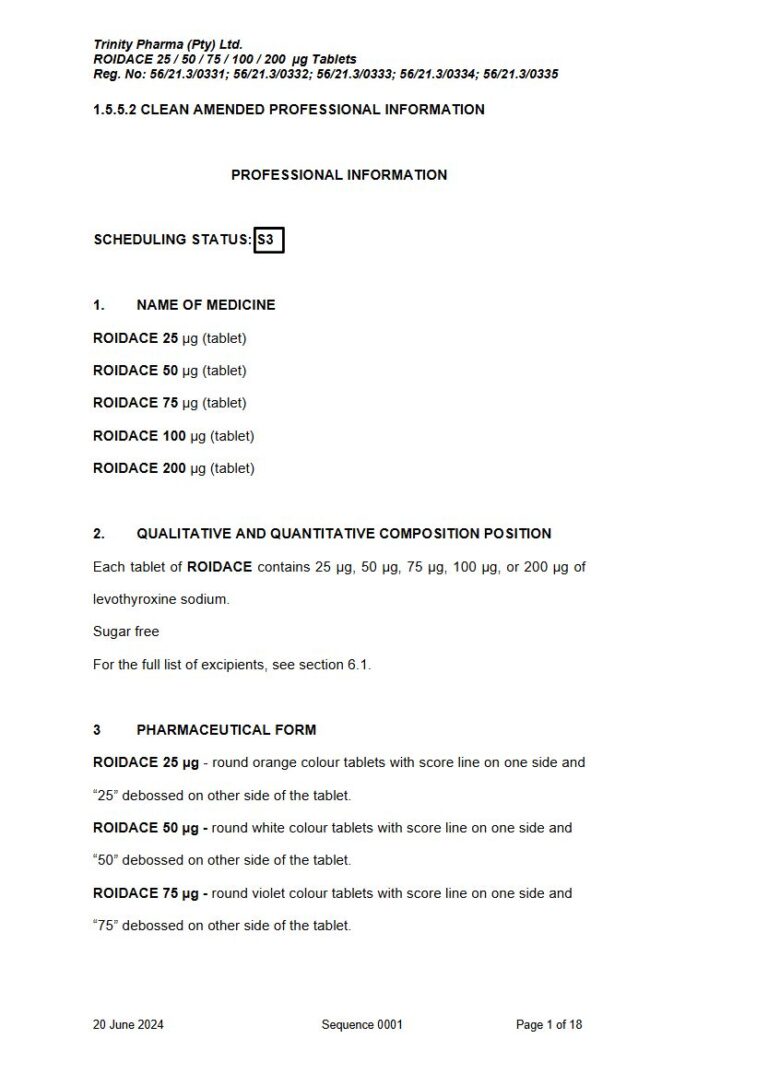
Roidace 25 / 50 / 75 / 100 / 200 μg Tablet.
PDF Leaflet Revision Date: 20 June 2024
Clinical Summary
Quick overview from the medicine insert
Indication
Untreated hypothyroidism.
Dosage (summary)
Adults: Initially 50-100 u03bcg daily, adjust by 50 u03bcg every 3-4 weeks.
Special Populations
- Elderly
- Renal impairment
- Hepatic impairment
Pregnancy & Breastfeeding
Thyroxine dosage may need adjustment during pregnancy; monitor TSH levels.
Key Drug Interactions
- Warfarin
- Phenytoin
- Carbamazepine
- Digoxin
- Cholestyramine
Contraindications
- Hypersensitivity
- Untreated hyperthyroidism
- Untreated adrenal insufficiency
Common side effects
- Hyperthyroidism
- Angina pectoris
- Palpitations
- Nausea
- Hair loss
Counselling Points
- Take before breakfast
- Do not double doses
- Monitor for side effects
Serious warnings
- Narrow therapeutic index
- Thyroid storm risk
- Monitor thyroid function regularly
Important Disclaimer
The Roidace 25 / 50 / 75 / 100 / 200 μg Tablet. professional information leaflet below is the property of Trinity Pharma and is provided on Medinsert exactly as issued, with no.. alterations or editorial changes. We make every effort to keep content current by updating documents as soon as new versions become available. Medinsert serves as a trusted access point for healthcare professionals, but does not replace official sources or clinical judgement. For more details, please read our full disclaimer. read more>>
 Healthcare Professionals Only
This content is for registered healthcare professionals
Sign in or create a free account to read the full package insert.
Free for HPCSA-registered professionals. Powered by Medinsert.
Clinical Particulars
Section 4 of the official insert — extracted exactly as issued, no alterations
4.1 Therapeutic indications
ROIDACE is indicated for untreated hypothyroidism.
4.2 Posology and method of administration
Posology
If the dose of ROIDACE is increased too rapidly, symptoms such as diarrhoea, nervousness, rapid pulse, insomnia, tremors and sometimes anginal pain where there is latent myocardial ischaemia may occur and the dosage must be reduced or withheld for a day or two, then restarted at a lower level.
Missed dosage: If a scheduled daily dose is missed, the dose should be taken as soon as the patient remembers, unless it is almost time for the patientu2019s next dose. Two doses should not be taken together.
The dose of ROIDACE for the treatment of any thyroid disorder should be individualised on the basis of clinical response and biochemical tests and should be monitored regularly.
Adults
Initially 50 u03bcg to 100 u03bcg daily, preferably taken before breakfast or the first meal of the day. Adjust at three to four week intervals by 50 u03bcg until normal metabolism is steadily maintained. The final daily dose may be up to 100 u03bcg to 300 u03bcg.
Special populations
Elderly
As for patients aged over 50 years. For patients over 50 years, initially, it is not advisable to exceed 50 u03bcg daily. In this condition, the daily dose may be increased by 50 u03bcg at intervals of every 3 to 4 weeks, until stable thyroxine levels are attained. The final daily dose may be up to 50 u03bcg to 200 u03bcg.
Patients over 50 years with cardiac disease
Where there is cardiac disease, 25 u03bcg daily or 50 u03bcg on alternate days is more suitable. In these conditions, the daily dose may be increased by 25 u03bcg at intervals of every 4 weeks, until stable thyroxine levels are attained. The final daily dose may be up to 50 u03bcg to 200 u03bcg. For patients aged over 50 years, with or without cardiac disease, clinical response is probably a more acceptable criteria of dosage rather than serum levels.
Paediatric population
The maintenance dose is generally 100 u03bcg to 150 u03bcg per mu00b2 body surface area. The dose for children depends on their age, weight and the condition being treated. Regular monitoring is required to make sure he/she gets the right dose. Infants should be given the total daily dose at least half an hour before the first meal of the day.
Congenital hypothyroidism in infants
For neonates and infants with congenital hypothyroidism, where rapid replacement is important, the initial recommended dosage is 10 u03bcg to 15 u03bcg per kg body weight per day for the first 3 months. Thereafter, the dose should be adjusted individually according to the clinical findings and thyroid hormone and TSH values.
Acquired hypothyroidism in children
For children with acquired hypothyroidism, the initial recommended dosage is 12,5 u03bcg to 50 u03bcg per day. The dose should be increased gradually every 2 to 4 weeks according to the clinical findings and thyroid hormone and TSH values until the full replacement dose is reached.
Juvenile myxoedema in children
The initial recommended dosage is 25 u03bcg daily. In such conditions, the daily dose may be increased by 25 u03bcg at intervals of every 2 to 4 weeks, until mild symptoms of hyperthyroidism are seen. The dose will then be reduced slightly.
Method of administration
For oral use. When applicable tablets are to be disintegrated in some water (10 ml to 15 ml) and the resultant suspension, which must be prepared freshly as required, is to be administered with some more liquid (5 ml to 10 ml).
4.3 Contraindications
Hypersensitivity to the active substance or to any of the excipients listed in section 6.1.
- Patients with untreated hyperthyroidism.
- Untreated adrenal insufficiency, untreated pituitary insufficiency.
- Treatment must not be initiated in acute myocardial infarction, acute myocarditis, and acute pancarditis.
4.4 Special warnings and precautions for use
At the onset of treatment, ordinary therapeutic doses may cause anginal pain, palpitations and cramps in the skeletal muscle.
Before initiating therapy with ROIDACE the following diseases should be excluded or treated: coronary insufficiency, angina pectoris, arteriosclerosis, hypertension, pituitary insufficiency, adrenal insufficiency, thyroid autonomy.
Even slight medicine-induced hyperthyroidism must be avoided in patients with coronary failure, cardiac insufficiency or tachycardiac dysrhythmias. Hence frequent checks of thyroid hormone parameters must be made in these cases.
In the case of secondary hypothyroidism the cause must be determined before replacement therapy is given and if necessary replacement treatment of a compensated adrenal insufficiency must be commenced.
Where thyroid autonomy is suspected, a TRH test should be carried out or a suppression scintigram obtained before treatment. In postmenopausal women with hypothyroidism and an increased risk of osteoporosis, supraphysiological serum levels of ROIDACE should be avoided, and, therefore, thyroid function should be checked regularly.
Thyroid storm (or thyrotoxic crisis) is a medical emergency and has been occasionally reported after massive or chronic intoxication. Convulsions, cardiac dysrhythmias, heart failure, coma and death have occurred. (See section 4.9)
ROIDACE has a narrow therapeutic index. Appropriate ROIDACE dosage is based upon clinical assessment and laboratory monitoring of thyroid function tests. During the initial titration period, careful dosage titration and monitoring is necessary to avoid the consequences of under- or over-treatment. The symptoms of excessive ROIDACE dosage are the same as many features of endogenous thyrotoxicosis.
Treatment with ROIDACE in patients with panhypopituitarism or other causes predisposing to adrenal insufficiency may cause reactions including dizziness, weakness, malaise, weight loss, hypotension and adrenal crisis. It is advisable to initiate corticosteroid therapy before giving ROIDACE in these cases.
Subclinical hyperthyroidism may be associated with bone loss. To minimise the risk of osteoporosis, dosage of ROIDACE should be titrated to the lowest possible effective level.
It is especially important that children with hypothyroidism have their dosage individualised and treatment monitored. Parents of children receiving ROIDACE should be advised that partial loss of hair may occur during the first few months of therapy, but this effect is usually transient and subsequent regrowth may occur.
Special care is needed in the elderly and in patients with symptoms of myocardial insufficiency or ECG evidence of myocardial infarction or ischaemia and also those with diabetes mellitus or insipidus. ROIDACE raises blood sugar levels and this may upset the stability of patients receiving antidiabetic medicines.
Orlistat may decrease ROIDACE absorption which may result in hypothyroidism. To avoid this orlistat and ROIDACE should be administered at least 4 hours apart. Regular monitoring for changes in thyroid function is required (see section 4.5).
Patients with myxoedema have an increased sensitivity for thyroid hormones; in these patients the starting dose should be low with slow dosing increments. ROIDACE absorption is decreased in patients with malabsorption syndromes. It is advised to treat the malabsorption condition to ensure effective ROIDACE treatment with regular ROIDACE dose.
4.5 Interactions with other medicines
Warfarin: ROIDACE increases the effect of warfarin and it may be necessary to reduce the dose of warfarin if excessive hypoprothrombinaemia and bleeding are to be avoided. The INR should be monitored.
Phenytoin and carbamazepine: Phenytoin levels may be increased by ROIDACE. Anticonvulsants such as carbamazepine and phenytoin enhance the metabolism of ROIDACE and may displace thyroxine from plasma proteins. Initiation or discontinuation of anticonvulsant therapy may alter thyroxine sodium dose requirements.
Digoxin: If co-administered with digoxin, adjustment of dosage may be necessary.
Sympathomimetic medicines: The effects of sympathomimetic medicines are also enhanced. ROIDACE increases receptor sensitivity to catecholamines thus accelerating the response to tricyclic antidepressants (e.g. amitriptyline, imipramine).
Cholestyramine: Cholestyramine given concurrently reduces the gastrointestinal absorption of ROIDACE.
Other medicines: A number of other medicines may decrease the absorption of ROIDACE, and therefore increase ROIDACE dosage requirements including antacids (e.g. aluminium hydroxide), proton pump inhibitors, cimetidine, bile acid sequestrants (e.g. colestipol), cation exchange resins (e.g. kayexalate), sucralfate, calcium carbonate and ferrous sulphate (administration should be separated by 4 to 5 hours).
Co-administration of oral contraceptives, as well as a number of other medicines, including oestrogen, tamoxifen, clofibrate, methadone, and 5-fluorouracil may increase serum concentration of thyroxine-binding globulin, and therefore increase ROIDACE dosage requirements.
A number of medicines may decrease serum concentration of thyroxine-binding globulin, and therefore decrease ROIDACE dosage requirements, including androgens and anabolic steroids.
Imatinib: Treatment with imatinib was associated with increased levothyroxine sodium as in ROIDACE dosage requirements in hypothyroid patients.
Amiodarone: Treatment with amiodarone has been associated with multiple effects on thyroid function including increased ROIDACE dosage requirements in hypothyroid patients.
Thyroid function tests: A number of medicines may affect thyroid function tests and this should be borne in mind when monitoring a patient on ROIDACE therapy.
Antibacterials: Enzyme induction by rifampicin enhances thyroid hormone metabolism resulting in reduced serum concentrations of thyroid hormones.
Oral ciprofloxacin can lead to the development of hypothyroidism in stable patients receiving ROIDACE.
Antidiabetics: As thyroid status influences metabolic activity and most body systems, correction of hypothyroidism may affect other disease states and dosage of any medicine treatment. In hypothyroid diabetics for instance, starting thyroid replacement therapy may increase their insulin or oral hypoglycaemic requirements.
Antidepressants: Some medicines such as lithium act directly on the thyroid gland and inhibit the release of thyroid hormones leading to clinical hypothyroidism. The effects of ROIDACE in hypothyroid patients may be decreased by use with sertraline, and the dose of ROIDACE may need to be increased.
Antivirals: An increased dose of ROIDACE is necessary with ritonavir whereas a decreased dose is needed with indinavir.
Beta-blockers: Plasma concentrations of propranolol are reduced in hyperthyroidism compared with the euthyroid state, probably due to increased clearance and hypothyroid patients receiving chronic propranolol therapy have a reduction in plasma-propranolol concentrations when given ROIDACE treatment.
General anaesthetics: Severe hypertension and tachycardia can occur when ketamine is used in patients taking ROIDACE.
Antimalarials: Increased thyroid-stimulating hormone concentration can occur after the use of chloroquine with proguanil for malaria prophylaxis.
NSAIDs: Falsely low concentrations of levothyroxine (T4) or tri-iodothyronine (T3) can occur during treatment with some anti-inflammatory medicines. Serum TSH measurements are less affected by NSAIDs and therefore TSH would be the optimal screening test in patients receiving an NSAID.
Soya-based infant formula: Soya-based infant formulas may impair absorption of ROIDACE, and frequent testing may be needed, particularly when there are changes in formula.
Simvastatin: Increased thyroid stimulating hormone concentrations, requiring increased doses of ROIDACE, can occur when simvastatin is used.
Furosemide: Furosemide in high doses (250 mg) can displace levothyroxine sodium as contained in ROIDACE from plasma proteins, resulting in an elevated free-thyroxine (T4) fraction.
4.6 Fertility, pregnancy and lactation
Pregnancy
ROIDACE has been taken by pregnant women and women of childbearing age without any form of definite disturbances in the reproductive process having been observed. Thyroid hypo- or hyperactivity in the mother may, however, unfavourably influence the foetal and postnatal development, therefore ROIDACE dosage may need to be adjusted during pregnancy (see section 4.4).
Breastfeeding
ROIDACE is excreted in breast milk and this may be sufficient to interfere with neonatal screening for hypothyroidism. It is very important to monitor thyroid function in the mother as well as in the infant regularly.
Fertility
There is no available data on the effect of ROIDACE on fertility.
4.7 Effects on ability to drive and use machines
Patients should not drive, use machinery or perform any tasks that require concentration until they are certain that ROIDACE does not adversely affect their ability to do so safely (See section 4.8).
4.8 Undesirable effects
a) Tabulated list of adverse reactions
The following effects are indicative of excessive dosage, and usually disappear on reduction of dosage or withdrawal of treatment for a few days.
System organ class Frequency unknown (cannot be estimated from the available data)
- Immune system disorders: Hypersensitivity reactions, rash, pruritus, anaphylactic reactions, eosinophilia, fever, liver dysfunction
- Endocrine disorders: Hyperthyroidism, hypothyroidism, thyrotoxic crisis
- Metabolism and nutrition disorders: Increased appetite, loss of weight
- Psychiatric disorders: Excitability, restlessness, insomnia, confusion, agitation, anxiety, affect emotional lability, nervousness
- Nervous system disorders: Headache, tremors, seizure, cephalalgia. cases of benign intracranial hypertension
- Cardiac disorders: Angina pectoris, cardiac dysrhythmias, palpitations, tachycardia, cardiac failure, myocardial infarction
- Vascular disorders: Increased blood pressure, flushing
- Respiratory, thoracic and mediastinal disorders: Dyspnoea
- Gastrointestinal disorders: Abdominal pain, nausea, vomiting, diarrhoea
- Skin and subcutaneous tissue disorders: Hyperhidrosis, hair loss, rash, pruritus, angioedema, urticaria
- Musculoskeletal and connective tissue disorders: Muscle spasms, muscular weakness, arthralgia
- Reproductive system and breast disorders: Irregular menstruation, infertility
- Congenital and familial and genetic disorders: Excessive dose may result in craniosynostosis in infants, and epiphyses premature fusion in children with compromised adult height
- General disorders and administrative site conditions: Fatigue, temperature intolerance, pyrexia, malaise, oedema
- Investigations: Decreased bone mineral density
b) Paediatric population
Heat intolerance, transient hair loss, benign intracranial hypertension, craniostenosis in infants and premature closure of epiphysis in children. Cases of benign intracranial hypertension have been reported, especially in children.
Reporting of suspected adverse reactions
Reporting suspected adverse reactions after authorisation of the medicinal product is important. It allows continued monitoring of the benefit/risk balance of the medicinal product. Healthcare professionals are asked to report any suspected adverse reactions to SAHPRA via the u201c6.04 Adverse Drug Reaction Reporting Formu201d, found online under SAHPRAu2019s publications: https://www.sahpra.org.za/Publications/Index/8
4.9 Overdose
In addition to exaggeration of side effects, the following symptoms may be seen: agitation, confusion, irritability, hyperactivity, headache, sweating, mydriasis, tachycardia, dysrhythmias, tachypnoea, pyrexia, increased bowel movements and convulsions. In addition to all known side effects, thyroid storm (or thyrotoxic crisis) a medical emergency, may occur and require urgent medical attention as soon as possible. Some of the signs of thyrotoxicosis that have been reported include fever, dysrhythmias, tachycardia, increased blood pressure, confusion, agitation, neurological complications and coma. The appearance of clinical hyperthyroidism may be delayed for up to five days. The goal of therapy is restoration of clinical and biochemical euthyroid state by omitting or reducing the thyroxine dosage and other measures as needed depending on clinical status. Treatment is symptomatic and tachycardia has been controlled in an adult by a suitable beta blocking medicine and other symptoms by a suitable benzodiazepine as appropriate.
