
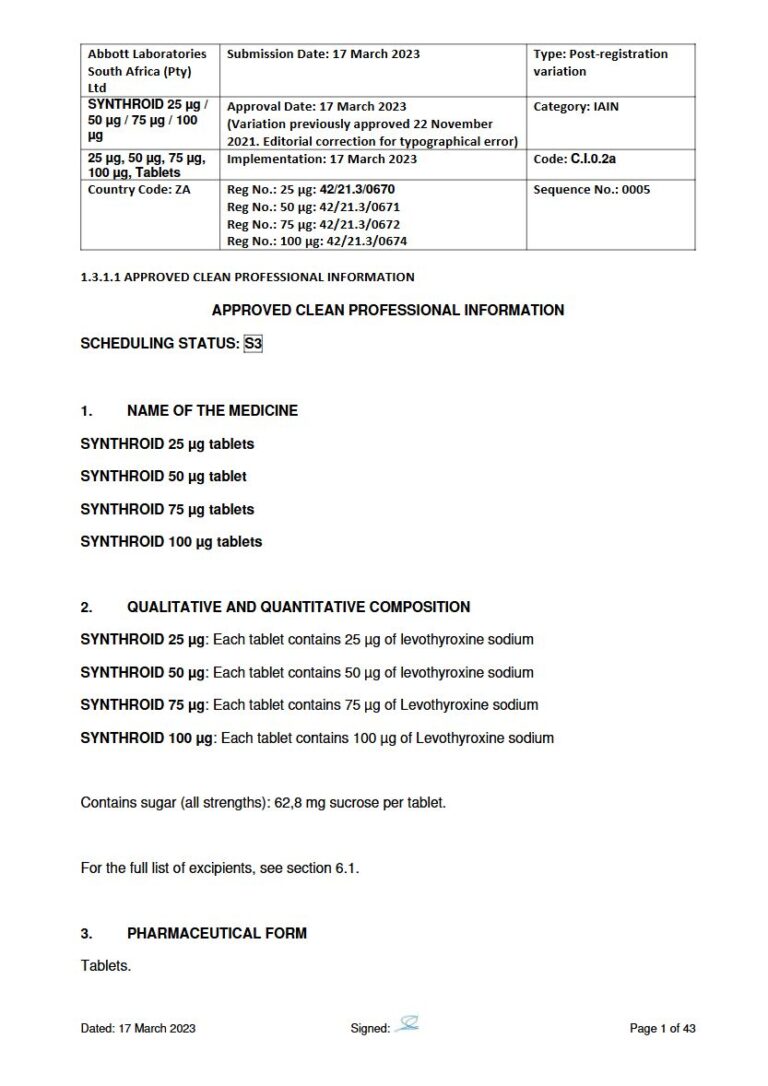
Synthroid 25 μg, 50 μg, 75 μg, 100 μg, Tablets
PDF Leaflet Revision Date: 17 March 2023
Clinical Summary
Quick overview from the medicine insert
Indication
Hypothyroidism and pituitary TSH suppression.
Dosage (summary)
Adults: 1.7 u03bcg/kg/day; elderly: start at 25-50 u03bcg/day.
Onset of Action / Duration
Onset: 4-6 weeks, Duration: variable.
Special Populations
- Elderly
- Cardiovascular disease
- Pregnant women
Pregnancy & Breastfeeding
Safe in pregnancy; monitor TSH; minimal excretion in breast milk.
Key Drug Interactions
- Antacids
- Calcium supplements
- Warfarin
Contraindications
- Untreated thyrotoxicosis
- Acute myocardial infarction
- Adrenal insufficiency
Common side effects
- Hyperthyroidism symptoms
- Palpitations
- Weight loss
Counselling Points
- Take on an empty stomach
- Avoid certain foods that affect absorption
- Regular monitoring of TSH levels
Serious warnings
- Not for weight loss
- Monitor for cardiac symptoms
- Narrow therapeutic index
Important Disclaimer
The Synthroid 25 μg, 50 μg, 75 μg, 100 μg, Tablets professional information leaflet below is the property of Abbott Laboratories South Africa and is provided on Medinsert exactly as issued, with no.. alterations or editorial changes. We make every effort to keep content current by updating documents as soon as new versions become available. Medinsert serves as a trusted access point for healthcare professionals, but does not replace official sources or clinical judgement. For more details, please read our full disclaimer. read more>>
 Healthcare Professionals Only
This content is for registered healthcare professionals
Sign in or create a free account to read the full package insert.
Free for HPCSA-registered professionals. Powered by Medinsert.
Clinical Particulars
Section 4 of the official insert — extracted exactly as issued, no alterations
4.1 Therapeutic indications
SYNTHROID is indicated for the following:
- Hypothyroidism
- As replacement or supplemental therapy in congenital or acquired hypothyroidism of any etiology, except transient hypothyroidism during the recovery phase of subacute thyroiditis.
- Pituitary TSH Suppression
- In the treatment or prevention of various types of euthyroid goiters (see section 4.4), including thyroid nodules (see section 4.4), subacute or chronic lymphocytic thyroiditis (Hashimotou2019s thyroiditis), multinodular goiter (see section 4.4) and, as an adjunct to surgery and radioiodine therapy in the management of thyrotropin-dependent well-differentiated thyroid cancer.
4.2 Posology and method of administration
General Principles
The goal of replacement therapy is to achieve and maintain a clinical and biochemical euthyroid state. The goal of suppressive therapy is to inhibit growth and/or function of abnormal thyroid tissue. The dose of SYNTHROID that is adequate to achieve these goals depends on a variety of factors including the patientu2019s age, body weight, cardiovascular status, concomitant medical conditions, including pregnancy, concomitant medications, and the specific nature of the condition being treated (see section 4.4). Hence, the following recommendations serve only as dosing guidelines. Dosing must be individualised and adjustments made based on periodic assessment of the patientu2019s clinical response and laboratory parameters (see section 4.4, Laboratory Tests).
Due to the long half-life of levothyroxine, the peak therapeutic effect at a given dose of SYNTHROID may not be attained for four to six weeks. Caution should be exercised when administering SYNTHROID to patients with underlying cardiovascular disease, to the elderly, and to those with concomitant adrenal insufficiency (see section 4.4).
Posology
Specific Patient Populations
- Hypothyroidism in Adults and in Children in Whom Growth and Puberty are Complete (see section 4.4, Laboratory Tests)
Therapy may begin at full replacement doses in otherwise healthy individuals less than 50 years old and in those older than 50 years who have been recently treated for hyperthyroidism or who have been hypothyroid for only a short time (such as a few months). The average full replacement dose of SYNTHROID is approximately 1,7 u03bcg /kg/day (e.g.,100 to 125 u03bcg /day for a 70 kg adult). Older patients may require less than 1 u03bcg /kg/day. SYNTHROID doses greater than 200 u03bcg /day are seldom required. An inadequate response to daily doses greater than or equal to 300 u03bcg /day is rare and may indicate poor compliance, malabsorption, and/or medicine interactions. For most patients older than 50 years or for patients under 50 years of age with underlying cardiac disease, an initial starting dose of 25 to 50 u03bcg /day of SYNTHROID is recommended, with gradual increments in dose at six to eight week intervals, as needed. The recommended starting dose of SYNTHROID in elderly patients with cardiac disease is 12,5 to 25 u03bcg /day, with gradual dose increments at four to six week intervals. The SYNTHROID dose is generally adjusted in 12,5 to 25 u03bcg increments until the patient with primary hypothyroidism is clinically euthyroid and the serum TSH has normalised. In patients with severe hypothyroidism, the recommended initial SYNTHROID dose is 12,5 to 25 u03bcg /day with increases of 25 u03bcg /day every two to four weeks, accompanied by clinical and laboratory assessment, until the TSH level is normalised. - Paediatric Dosage u2013 Congenital or Acquired Hypothyroidism (see section 4.4)
General Principles
In general, SYNTHROID therapy should be instituted at full replacement doses as soon as possible. Delays in diagnosis and institution of therapy may have deleterious effects on the childu2019s intellectual and physical growth and development. Undertreatment and overtreatment should be avoided (see section 4.4, Paediatric Use). To ensure maximum absorption, it is recommended that SYNTHROID be taken one-half to one-hour before breakfast. However, if the childu2019s diet/sleep/activity schedule is such that it cannot be taken this way, consistency becomes the key. If SYNTHROID is administered with food, take it every day with food, consistently. If administration changes from taking it on an empty stomach, then around six to eight weeks after you start taking it with food, another TSH test should be done to ensure the child is receiving the proper amount of SYNTHROID. - Newborns
The recommended starting dose of SYNTHROID in newborn infants is 10 to 15 u03bcg /kg/day. A lower starting dose (e.g., 25 u03bcg /day) should be considered in infants at risk for cardiac failure, and the dose should be increased in four to six weeks as needed based on clinical and laboratory response to treatment. In infants with very low (less than 5 u03bcg /dL) or undetectable serum levothyroxine (T 4 ) concentrations, the recommended initial starting dose is 50 u03bcg /day of SYNTHROID. - Infants and Children
SYNTHROID therapy is usually initiated at full replacement doses, with the recommended dose per body weight decreasing with age (see Table 3). However, in children with chronic or severe hypothyroidism, an initial dose of 25 u03bcg /day of SYNTHROID is recommended with increments of 25 u03bcg every two to four weeks until the desired effect is achieved. Hyperactivity in an older child can be minimised if the starting dose is one-fourth of the recommended full replacement dose, and the dose is then increased on a weekly basis by an amount equal to one-fourth the full-recommended replacement dose until the full recommended replacement dose is reached.
Table 3: SYNTHROID Dosing Guidelines for Paediatric Hypothyroidism
| Age | Daily Dose Per Kg Body Weight |
|---|---|
| 0 to 3 months | 10 to 15 u03bcg/kg/day |
| 3 to 6 months | 8 to 10 u03bcg/kg/day |
| 6 to 12 months | 6 to 8 u03bcg/kg/day |
| 1 to 5 years | 5 to 6 u03bcg/kg/day |
| 6 to 12 years | 4 to 5 u03bcg/kg/day |
| Greater than 12 years, but growth and puberty incomplete | 2 to 3 u03bcg/kg/day |
| Growth and puberty complete | 1,7 u03bcg/kg/day |
Pregnancy
Pregnancy may increase SYNTHROID requirements (see section 4.6).
TSH Suppression in Well-differentiated Thyroid Cancer and Thyroid Nodules
The target level for TSH suppression in these conditions has not been established with controlled studies. In addition, the efficacy of TSH suppression for benign nodular disease is controversial. Therefore, the dose of SYNTHROID used for TSH suppression should be individualised based on the specific disease and the patient being treated. In the treatment of well-differentiated (papillary and follicular) thyroid cancer, SYNTHROID is used as an adjunct to surgery and radioiodine therapy. Generally, TSH is suppressed to less than 0,1 mU/L, and this usually requires a SYNTHROID dose of greater than 2 u03bcg /kg/day. However, in patients with high-risk tumors, the target level for TSH suppression may be less than 0,01 mU/L. In the treatment of benign nodules and nontoxic multinodular goiter, TSH is generally suppressed to a higher target (e.g., 0,1 to either 0,5 or 1,0 mU/L) than that used for the treatment of thyroid cancer. SYNTHROID is contraindicated if the serum TSH is already suppressed due to the risk of precipitating overt thyrotoxicosis (see sections 4.3 and 4.4).
Myxedema Coma
Myxedema coma is a life-threatening emergency characterised by poor circulation and hypometabolism, and may result in unpredictable absorption of SYNTHROID from the gastrointestinal tract. Therefore, oral thyroid hormone medicine products, such as SYNTHROID, are not recommended to treat this condition. Thyroid hormone products formulated for intravenous administration should be administered.
Method of administration
SYNTHROID is administered as a single daily dose, preferably one-half to one-hour before breakfast. SYNTHROID should be taken at least four (4) hours apart from medicines that are known to interfere with its absorption (see section 4.5). SYNTHROID may be administered to infants and children who cannot swallow intact tablets by crushing the tablet and suspending the freshly crushed tablet in a small amount (5 to 10 mL or one to two teaspoons) of potable water, breast milk or non-soybean based formula. This suspension can be administered by spoon or by dropper. DO NOT STORE THE SUSPENSION. Foods or formula containing large amounts of soybean fibre or iron should not be used for administering SYNTHROID (see section 4.5, Medicine-Food Interactions). The crushed tablet may also be sprinkled over a small amount of food, such as cooked cereal or apple sauce.
4.3 Contraindications
- Untreated subclinical (suppressed serum TSH level with normal T 3 and levothyroxine (T 4 ) levels) or overt thyrotoxicosis of any aetiology and in patients with acute myocardial infarction.
- Uncorrected adrenal insufficiency since thyroid hormones may precipitate an acute adrenal crisis by increasing the metabolic clearance of glucocorticoids (see section 4.4).
- Hypersensitivity to levothyroxine sodium or to any of the excipients listed in section 6.1.
4.4 Special warnings and precautions for use
WARNING: THYROID HORMONES, INCLUDING SYNTHROID, EITHER ALONE OR WITH OTHER THERAPEUTIC MEDICINES, SHOULD NOT BE USED FOR THE TREATMENT OF OBESITY OR FOR WEIGHT LOSS. IN EUTHYROID PATIENTS, DOSES WITHIN THE RANGE OF DAILY HORMONAL REQUIREMENTS ARE INEFFECTIVE FOR WEIGHT REDUCTION. LARGER DOSES MAY PRODUCE SERIOUS OR EVEN LIFE THREATENING MANIFESTATIONS OF TOXICITY, PARTICULARLY WHEN GIVEN IN ASSOCIATION WITH SYMPATHOMIMETIC AMINES SUCH AS THOSE USED FOR THEIR ANORECTIC EFFECTS.
SYNTHROID should not be used in the treatment of male or female infertility unless this condition is associated with hypothyroidism. In patients with nontoxic diffuse goiter or nodular thyroid disease, particularly the elderly or those with underlying cardiovascular disease, SYNTHROID therapy is contraindicated if the serum TSH level is already suppressed due to the risk of precipitating overt thyrotoxicosis (see section 4.3). If the serum TSH level is not suppressed, SYNTHROID should be used with caution in conjunction with careful monitoring of thyroid function for evidence of hyperthyroidism and clinical monitoring for potential associated adverse cardiovascular signs and symptoms of hyperthyroidism.
General
SYNTHROID has a narrow therapeutic index. Regardless of the indication for use, careful dosage titration and response monitoring is necessary to avoid the consequences of over- or under-treatment. These consequences include, among others, effects on growth and development, cardiovascular function, bone metabolism, reproductive function, cognitive function, emotional state, gastrointestinal function, and on glucose and lipid metabolism. Many medicines interact with SYNTHROID necessitating adjustments in dosing to maintain therapeutic response (see section 4.5).
Effects on Bone Mineral Density
In women, long-term SYNTHROID therapy has been associated with increased bone resorption, thereby decreasing bone mineral density, especially in post-menopausal women on greater than replacement doses or in women who are receiving suppressive doses of SYNTHROID. The increased bone resorption may be associated with increased serum levels and urinary excretion of calcium and phosphorus, elevations in bone alkaline phosphatase and suppressed serum parathyroid hormone levels. Therefore, it is recommended that patients receiving SYNTHROID be given the minimum dose necessary to achieve the desired clinical and biochemical response.
Patients with underlying Cardiovascular Disease
Exercise caution when administering SYNTHROID to patients with cardiovascular disorders and to the elderly in whom there is an increased risk of occult cardiac disease. In these patients, SYNTHROID therapy should be initiated at lower doses than those recommended in younger individuals or in patients without cardiac disease (see sections 4.2 and Geriatric Use). If cardiac symptoms develop or worsen, the SYNTHROID dose should be reduced or withheld for one week and then cautiously restarted at a lower dose. Over-treatment with SYNTHROID may have adverse cardiovascular effects such as an increase in heart rate, cardiac wall thickness, and cardiac contractility and may precipitate angina or dysrhythmias, particularly in patients with cardiovascular disease and in elderly patients. Patients with coronary artery disease who are receiving SYNTHROID therapy should be monitored closely during surgical procedures, since the possibility of precipitating cardiac dysrhythmias may be greater in those treated with SYNTHROID. Concomitant administration of SYNTHROID and sympathomimetic medicines to patients with coronary artery disease may precipitate coronary insufficiency.
Patients with Nontoxic Diffuse Goiter or Nodular Thyroid Disease
Exercise caution when administering SYNTHROID to patients with nontoxic diffuse goiter or nodular thyroid disease in order to prevent precipitation of thyrotoxicosis (see section 4.4). If the serum TSH is already suppressed, SYNTHROID should not be administered (see section 4.3).
Associated Endocrine Disorders
Hypothalamic/pituitary Hormone Deficiencies - In patients with secondary or tertiary hypothyroidism, additional hypothalamic/pituitary hormone deficiencies should be considered, and, if diagnosed, treated (see Autoimmune Polyglandular Syndrome) for adrenal insufficiency. Autoimmune Polyglandular Syndrome u2013 Occasionally, chronic autoimmune thyroiditis may occur in association with other autoimmune disorders such as adrenal insufficiency, pernicious anaemia, and insulin-dependent diabetes mellitus. Patients with concomitant adrenal insufficiency should be treated with replacement glucocorticoids prior to initiation of treatment with SYNTHROID. Failure to do so may precipitate an acute adrenal crisis when thyroid hormone therapy is initiated, due to increased metabolic clearance of glucocorticoids by thyroid hormone. Patients with diabetes mellitus may require upward adjustments of their antidiabetic therapeutic regimens when treated with SYNTHROID (see section 4.5).
Other Associated Medical Conditions
Infants with congenital hypothyroidism appear to be at increased risk for other congenital anomalies, with cardiovascular anomalies (pulmonary stenosis, atrial septal defect, and ventricular septal defect) being the most common association.
4.5 Interactions with other medicines
Medicine Interactions
Many medicines affect thyroid hormone pharmacokinetics and metabolism (e.g., absorption, synthesis, secretion, catabolism, protein binding, and target tissue response) and may alter the therapeutic response to SYNTHROID. In addition, thyroid hormones and thyroid status have varied effects on the pharmacokinetics and actions of other medicines. A listing of medicine - thyroidal axis interactions is contained in Table 2.
The list of medicine-thyroidal axis interactions in Table 2 may not be comprehensive due to the introduction of new medicines that interact with the thyroidal axis or the discovery of previously unknown interactions. The prescriber should be aware of this fact and should consult appropriate reference sources (e.g., the professional information of newly approved medicines, medical literature) for additional information if a medicine-medicine interaction with SYNTHROID is suspected.
Table 2: Medicine Thyroidal Axis Interactions
| Medicine or Medicine Class | Effect |
|---|---|
| Dopamine/Dopamine Agonists | Use of these medicines may result in a transient reduction in TSH secretion when administered at the following doses: Dopamine (greater than or equal to 1 u03bcg /kg/min); Glucocorticoids (hydrocortisone greater than or equal to 100 mg/day or equivalent); Octreotide (greater than 100 u03bcg /day). |
| Aminoglutethimide | Medicines that may decrease thyroid hormone secretion, which may result in hypothyroidism |
| Amiodarone | Medicines that may decrease thyroid hormone secretion, which may result in hypothyroidism |
| Iodide (including iodine-containing radiographic contrast medicines) | Medicines that may decrease thyroid hormone secretion, which may result in hypothyroidism |
| Lithium | Medicines that may decrease thyroid hormone secretion, which may result in hypothyroidism |
| Thioamides | Medicines that may decrease thyroid hormone secretion, which may result in hypothyroidism |
| Long-term lithium therapy can result in goiter in up to 50 % of patients, and either subclinical or overt hypothyroidism, each in up to 20 % of patients. The foetus, neonate, elderly and euthyroid patients with underlying thyroid disease (e.g., Hashimotou2019s thyroiditis or with Graves' disease previously treated with radioiodine or surgery) are among those individuals who are particularly susceptible to iodine-induced hypothyroidism. Oral cholecystographic medicines and amiodarone are slowly excreted, producing more prolonged hypothyroidism than parenterally administered iodinated contrast medicines. Long-term aminoglutethimide therapy may minimally decrease levothyroxine (T 4 ) and T 3 levels and increase TSH, although all values remain within normal limits in most patients. |
4.6 Fertility, pregnancy and lactation
Pregnancy
Studies in women taking SYNTHROID during pregnancy have not shown an increased risk of congenital abnormalities. Therefore, the possibility of fetal harm appears remote. SYNTHROID should not be discontinued during pregnancy and hypothyroidism diagnosed during pregnancy should be promptly treated. Hypothyroidism during pregnancy is associated with a higher rate of complications, including spontaneous abortion, pre-eclampsia, stillbirth and premature delivery. Maternal hypothyroidism may have an adverse effect on fetal and childhood growth and development. During pregnancy, serum levothyroxine (T 4 ) levels may decrease and serum TSH levels increase to values outside the normal range. Since elevations in serum TSH may occur as early as four weeks gestation, pregnant women taking SYNTHROID should have their TSH measured during each trimester. An elevated serum TSH level should be corrected by an increase in the dose of SYNTHROID. Since postpartum TSH levels are similar to preconception values, the SYNTHROID dosage should return to the pre-pregnancy dose immediately after delivery. A serum TSH level should be obtained six to eight weeks postpartum. Thyroid hormones cross the placental barrier to some extent as evidenced by levels in cord blood of athyreotic foetuses being approximately one-third maternal levels. Transfer of thyroid hormone from the mother to the foetus, however, may not be adequate to prevent in utero hypothyroidism.
Lactation
Although thyroid hormones are excreted only minimally in human milk, caution should be exercised when SYNTHROID is administered to a nursing mother. However, adequate replacement doses of SYNTHROID are generally needed to maintain normal lactation.
4.7 Effects on ability to drive and use machines
SYNTHROID is unlikely to affect your ability to drive and use machinery (see section 4.8). Caution is advised before driving a vehicle or operating machinery until the effects of SYNTHROID are known.
4.8 Undesirable effects
Adverse reactions associated with SYNTHROID therapy are primarily those of hyperthyroidism due to therapeutic overdosage (see section 4.4 and section 4.9). They include the following:
Metabolism and nutrition disorders: Frequency not known: Increased appetite
Psychiatric disorders: Frequency not known: Nervousness, anxiety, irritability, emotional lability, insomnia
Nervous system disorders: Frequency not known: Headache; hyperactivity; tremors
Cardiac disorders: Frequency not known: Palpitations, tachycardia, dysrhythmias, increased pulse and blood pressure, heart failure, angina pectoris, myocardial infarction, cardiac arrest
Vascular disorders: Frequency not known: Flushing
Respiratory, thoracic and mediastinal disorders: Frequency not known: Dyspnoea
Gastrointestinal disorders: Frequency not known: Diarrhoea, vomiting, abdominal cramps
Hepatobiliary disorders: Frequency not known: Elevations in liver function tests
Skin and subcutaneous tissue disorders: Frequency not known: Excessive sweating; hair loss
Musculoskeletal and connective tissue disorders: Frequency not known: Muscle weakness
Reproductive system and breast disorders: Frequency not known: Menstrual irregularities; impaired fertility
General disorders and administration site conditions: Frequency not known: Fatigue; heat intolerance; fever
Investigations: Frequency not known: Decreased bone mineral density; weight loss
Pseudotumor cerebri and slipped capital femoral epiphysis have been reported in children receiving SYNTHROID therapy. Over-treatment may result in craniosynostosis in infants and premature closure of the epiphyses in children with resultant compromised adult height. Seizures have been reported rarely with the institution of SYNTHROID therapy.
Inadequate SYNTHROID dosage will produce or fail to ameliorate the signs and symptoms of hypothyroidism.
Hypersensitivity reactions to inactive ingredients have occurred in patients treated with thyroid hormone products. These include urticaria, pruritus, skin rash, flushing, angioedema, various gastrointestinal symptoms (abdominal pain, nausea, vomiting and diarrhoea), fever, arthralgia, serum sickness and wheezing. Hypersensitivity to SYNTHROID itself is not known to occur.
4.9 Overdose
The signs and symptoms of overdosage are those of hyperthyroidism (sections 4.4 and 4.8). In addition, confusion and disorientation may occur. Cerebral embolism, shock, coma, and death have been reported. Seizures have occurred in a child ingesting 18 mg of SYNTHROID. Symptoms may not necessarily be evident or may not appear until several days after ingestion of SYNTHROID.
Treatment of Overdosage
SYNTHROID should be reduced in dose or temporarily discontinued if signs or symptoms of overdosage occur. Acute Massive Overdosage may be a life-threatening emergency, therefore, symptomatic and supportive therapy should be instituted immediately. Activated charcoal or cholestyramine may also be used to decrease absorption. Central and peripheral increased sympathetic activity may be treated by administering beta-receptor antagonists, e.g. propranolol, provided there are no medical contraindications to their use. Provide respiratory support as needed; control congestive heart failure and arrhythmia; control fever, hypoglycaemia, and fluid loss as necessary. Large doses of antithyroid medicines (e.g. methimazole, carbimazole, or propylthiouracil) followed in one to two hours by large doses of iodine may be given to inhibit synthesis and release of thyroid hormones. Glucocorticoids may be given to inhibit the conversion of levothyroxine (T 4 ) to T 3. Plasmapheresis, charcoal hemoperfusion and exchange transfusion have been reserved for cases in which continued clinical deterioration occurs despite conventional therapy. Because levothyroxine (T 4 ) is highly protein bound, very little medicine will be removed by dialysis.
