
Ryaltris Nasal Spray
PDF Leaflet Revision Date: 25 September 2025
Clinical Summary
Quick overview from the medicine insert
Indication
Treatment of allergic rhinitis and rhinoconjunctivitis in patients 6 years and older.
Dosage (summary)
Adults: 2 sprays in each nostril twice daily; Children (6-11 years): 1 spray in each nostril twice daily.
Special Populations
- Paediatric patients under 6 years
- Elderly patients
- Hepatic impairment
- Renal impairment
Pregnancy & Breastfeeding
Contraindicated in pregnancy and lactation.
Key Drug Interactions
- Coadministration with ketoconazole may increase mometasone levels.
Contraindications
- Hypersensitivity to components
- Active or quiescent tuberculosis
- Untreated infections
- Live vaccines
Common side effects
- Dizziness
- Somnolence
- Nasal discomfort
- Epistaxis
Counselling Points
- Shake well before use
- Avoid contact with eyes
- Do not use after 30 days of opening
- Monitor for signs of infection
Serious warnings
- Hypersensitivity reactions
- Immunosuppression
- Potential for glaucoma and cataracts
- Growth suppression in children
Important Disclaimer
The Ryaltris Nasal Spray professional information leaflet below is the property of Glenmark Pharmaceuticals South Africa and is provided on Medinsert exactly as issued, with no.. alterations or editorial changes. We make every effort to keep content current by updating documents as soon as new versions become available. Medinsert serves as a trusted access point for healthcare professionals, but does not replace official sources or clinical judgement. For more details, please read our full disclaimer. read more>>
 Healthcare Professionals Only
This content is for registered healthcare professionals
Sign in or create a free account to read the full package insert.
Free for HPCSA-registered professionals. Powered by Medinsert.
Clinical Particulars
Section 4 of the official insert — extracted exactly as issued, no alterations
4.1 Therapeutic indications
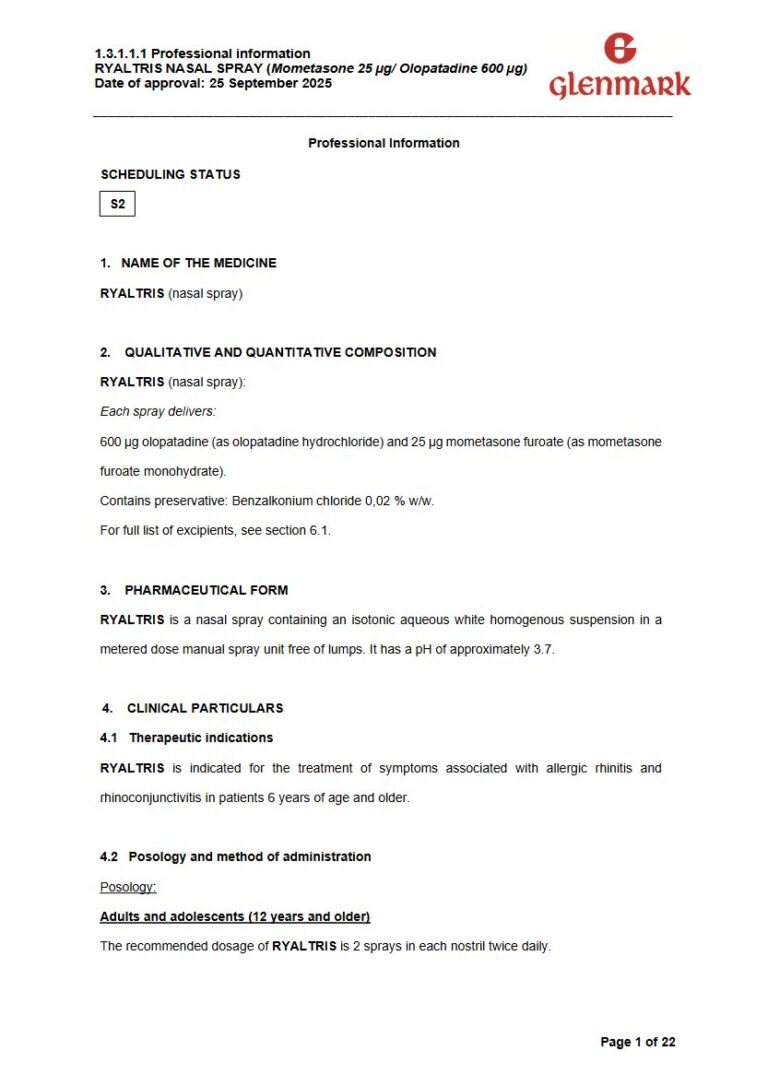
RYALTRIS is indicated for the treatment of symptoms associated with allergic rhinitis and rhinoconjunctivitis in patients 6 years of age and older.
4.2 Posology and method of administration
Posology:
Adults and adolescents (12 years and older)
The recommended dosage of RYALTRIS is 2 sprays in each nostril twice daily.
Children (6 to 11 Years of Age)
The recommended dosage of RYALTRIS is 1 spray in each nostril twice daily.
Method of administration:
Administer RYALTRIS by the intranasal route only. Shake the bottle well before each use. Priming: Prime RYALTRIS before initial use by releasing 6 sprays. When RYALTRIS has not been used for 14 days or more, re-prime by releasing 2 sprays or until a fine mist appears. Avoid spraying RYALTRIS into the eyes or mouth.
4.3 Contraindications
Hypersensitivity to olopatadine hydrochloride, mometasone furoate, or to any of the inactive ingredients of RYALTRIS (see Section 6.1). Pregnancy and lactation. Immunisation with live viral/bacterial vaccines. Patients with active or quiescent Mycobacterium tuberculosis infections. Patients with untreated local or systemic fungal or bacterial infections, systemic viral or parasitic infections irrespective of anatomical site (see Section 4.4).
4.4 Special warnings and precautions for use
Hypersensitivity reactions: Hypersensitivity reactions, including instances of wheezing, may occur after the intranasal administration of mometasone furoate monohydrate. Discontinue RYALTRIS if such reactions occur (see Section 4.3).
Immunosuppression: RYALTRIS may suppress the immune system making the patient more susceptible to infections than healthy individuals. If exposed to chickenpox, prophylaxis with Varicella zoster immune globulin (VZIG) may be indicated. If exposed to measles, prophylaxis with pooled intramuscular immunoglobulin (IG) may be indicated. (See the respective professional information for complete VZIG and IG prescribing information.) If chickenpox develops, treatment with antiviral medicines may be considered.
RYALTRIS should not be used in patients with active or quiescent tuberculous infections of the respiratory tract, untreated local or systemic fungal or bacterial infections, systemic viral or parasitic infections, or ocular herpes simplex because of the potential for worsening of these infections (see Section 4.3).
Caution is advised in treatment of patients with HIV infection.
Hypothalamic-pituitary-adrenal (HPA) axis effects: Intranasal steroid products are designed to deliver drug directly to the nasal mucosa in order to minimise overall systemic glucocorticoid exposure and side effects. When intranasal corticosteroids are used at higher-than-recommended dosages or in susceptible individuals at recommended dosages, systemic corticosteroid effects such as hypercorticism and adrenal suppression may appear. Medical practitioners should be alert for evidence of systemic effects, especially in chronically treated patients.
However, there is no evidence of hypothalamic-pituitary-adrenal (HPA) axis suppression following prolonged treatment with mometasone furoate nasal spray. Care must be taken while transferring patients from systemic steroid treatment to RYALTRIS if there is any reason to suppose that their adrenal function is impaired.
During transfer from systemic corticosteroids to intranasal corticosteroids some patients may experience symptoms of withdrawal from systemically active corticosteroids (e.g. joint and/or muscular pain, lassitude, and depression initially) despite relief from nasal symptoms. Such transfer may also unmask pre-existing allergic conditions such as allergic conjunctivitis and eczema, previously suppressed by systemic corticosteroid therapy.
Local nasal effects: Instances of nasal ulceration and nasal septal perforation have been reported (see Section 4.8). Instances of epistaxis have been reported (see Section 4.8). Because of the inhibitory effect of corticosteroids on wound healing, patients who have experienced recent nasal septal ulcers, nasal surgery, or nasal trauma should avoid the use of RYALTRIS until healing has occurred.
In clinical studies with mometasone furoate administered intranasally, localised infections of the nose and pharynx with Candida albicans have occurred. When such an infection develops, it may require treatment with appropriate local therapy and discontinuation of treatment with RYALTRIS.
Glaucoma and cataracts: The use of nasal corticosteroids may result in the development of glaucoma and/or cataracts. Therefore, close monitoring is warranted in patients with a change in vision or with a history of increased intraocular pressure, glaucoma, and/or cataracts.
Effect on growth: Intranasal corticosteroids as in RYALTRIS may cause a reduction in growth velocity when administered to patients less than 18 years of age and the growth of patients less than 18 years of age receiving RYALTRIS should be monitored (see Pharmacokinetic properties, Special populations, Paediatric use).
Somnolence: Somnolence has been reported following administration of RYALTRIS in clinical studies (see Section 4.8). Concurrent use of RYALTRIS with alcohol or other central nervous system (CNS) depressants should be avoided because additional reductions in alertness and additional impairment of CNS performance may occur.
Paediatric use: Safety in children 6 to 11 years of age has not been studied beyond 2 weeks of use or in perennial allergic rhinitis. The safety and effectiveness of RYALTRIS in patients below the age of 6 years has not been established. Retardation of growth rate in children may occur with intranasal corticosteroids, particularly at high doses prescribed for prolonged periods of time. Long term glucocorticoid exposure carries particular risks in the 6 to 11 year age group. Routinely monitor the growth of paediatric patients receiving intranasal corticosteroids.
Periodic clinical review, pursuit of lowest effective dosing, and consideration of adjunctive treatment modalities are recommended in paediatric patients aged 6 to 11 years.
4.5 Interaction with other medicines and other forms of interaction
No formal pharmacokinetic medicine interaction studies have been performed with RYALTRIS. Any medicine interactions from the combination of olopatadine and mometasone furoate are expected to reflect those of the components taken individually, as no pharmacokinetic interaction between olopatadine and mometasone furoate was observed when administered in combination.
Olopatadine as contained in RYALTRIS: Medicine interactions with inhibitors of liver enzymes are not anticipated because olopatadine is eliminated predominantly by renal excretion. Olopatadine did not inhibit the in vitro metabolism of specific substrates for CYP1A2, CYP2C9, CYP2C19, CYP2D6, CYP2E1, and CYP3A4. Based on these data, medicine interactions involving P450 inhibition are not expected. Due to the modest protein binding of olopatadine (55 %), medicine interactions through displacement from plasma proteins are also not expected.
Mometasone furoate as contained in RYALTRIS: Studies have shown that mometasone furoate, a component of RYALTRIS, is primarily and extensively metabolised to multiple metabolites in the liver. In vitro studies have confirmed the primary role of cytochrome P450 (CYP) 3A4 in the metabolism of mometasone furoate. Coadministration with ketoconazole, a potent CYP3A4 inhibitor, may increase the plasma concentrations of mometasone furoate.
4.6 Fertility, pregnancy and lactation
Pregnancy: RYALTRIS is contraindicated during pregnancy (see Section 4.3). Animal studies revealed evidence of embryo-foetal toxicity and malformations.
Breastfeeding: RYALTRIS is contraindicated in lactation. RYALTRIS is not for use by mothers who are breastfeeding their infants (see Section 4.3). Corticosteroids such as mometasone furoate are excreted in breast milk.
4.7 Effects on ability to drive and use machines
RYALTRIS may cause side effects such as somnolence and dizziness (see Section 4.8). Patients should be cautioned against engaging in hazardous activities requiring complete mental alertness and motor coordination, such as operating machinery or driving a motor vehicle, after administration of RYALTRIS.
4.8 Undesirable effects
The safety data described below reflects exposure to RYALTRIS in 3 062 patients with seasonal allergic rhinitis in 4 placebo- and active-controlled clinical studies of 2-week duration. The safety and efficacy of RYALTRIS in the treatment of paediatric patients with seasonal allergic rhinitis was investigated in one clinical trial. This was a double-blind, placebo-controlled study with a 2 week duration in 446 paediatric patients ranging from age 6 to 11 years.
The adverse reactions are listed below by system organ class and frequency. Frequencies are defined as: Very common (u22651/10); common (u22651/100 to <1/10); uncommon (u22651/1 000 to <1/100); rare (u22651/10 000 to <1/1 000); very rare (<1/10 000); not known (cannot be estimated from the available data).
Tabulated list of adverse reactions
System Organ Class Frequency Undesirable effect Infections and infestations Uncommon Pharyngitis, respiratory tract infection Nervous system disorders Common Dysgeusia (unpleasant taste) Uncommon Dizziness, lethargy, somnolence, anxiety, insomnia Respiratory, thoracic and mediastinal disorders Uncommon Cough, nasal dryness, nasal discomfort, throat irritation, wheezing Gastrointestinal disorders Uncommon Dry mouth, abdominal discomfort, vomiting Skin and subcutaneous tissue disorders Uncommon Rash, pruritus, contact dermatitis
Description of selected adverse reactions: Local corticosteroid use as in RYALTRIS may result in the following: u2022 Nasal ulcerations, nasal septal perforations, epistaxis, impaired wound healing, and Candida albicans infection (see Section 4.4). u2022 Glaucoma and cataracts (see Section 4.4). u2022 Immunosuppression (see Section 4.4). u2022 HPA axis effects, including growth reduction (see Section 4.4). u2022 Somnolence (see Section 4.4).
Reporting of suspected adverse reactions: Reporting suspected adverse reactions after authorisation of the medicine is important. It allows continued monitoring of the benefit/risk balance of the medicine. Health care providers are asked to report any suspected adverse reactions to SAHPRA via the Med Safety APP (Medsafety X SAHPRA) and eReporting platform (who-umc.org) found on SAHPRA website.
4.9 Overdose
The risks associated with overdosage for the individual components described below apply to RYALTRIS.
Olopatadine: Symptoms of antihistamine overdose may include drowsiness in adults and, initially, agitation and restlessness, followed by drowsiness in children. There is no known specific antidote to olopatadine hydrochloride. Should overdose occur, symptomatic or supportive treatment is recommended, taking into account any concomitantly ingested medications.
Mometasone furoate: Chronic overdosage with RYALTRIS may result in signs or symptoms of hypercorticism (see Section 4.4).
