
Rybelsus 3 Mg/7 Mg/14 Mg Tablets
PDF Leaflet Revision Date: 03 September 2024
Clinical Summary
Quick overview from the medicine insert
Indication
Treatment of adults with insufficiently controlled type 2 diabetes mellitus.
Dosage (summary)
Starting dose: 3 mg once daily for 1 month, then 7 mg once daily; may increase to 14 mg after 1 month.
Onset of Action / Duration
Onset: 1 week, Duration: 24 hours
Special Populations
- Elderly
- Renal impairment
- Hepatic impairment
Pregnancy & Breastfeeding
Not recommended during pregnancy or breastfeeding due to potential risks.
Key Drug Interactions
- Warfarin
- Levothyroxine
- SGLT2 inhibitors
- Sulfonylureas
Contraindications
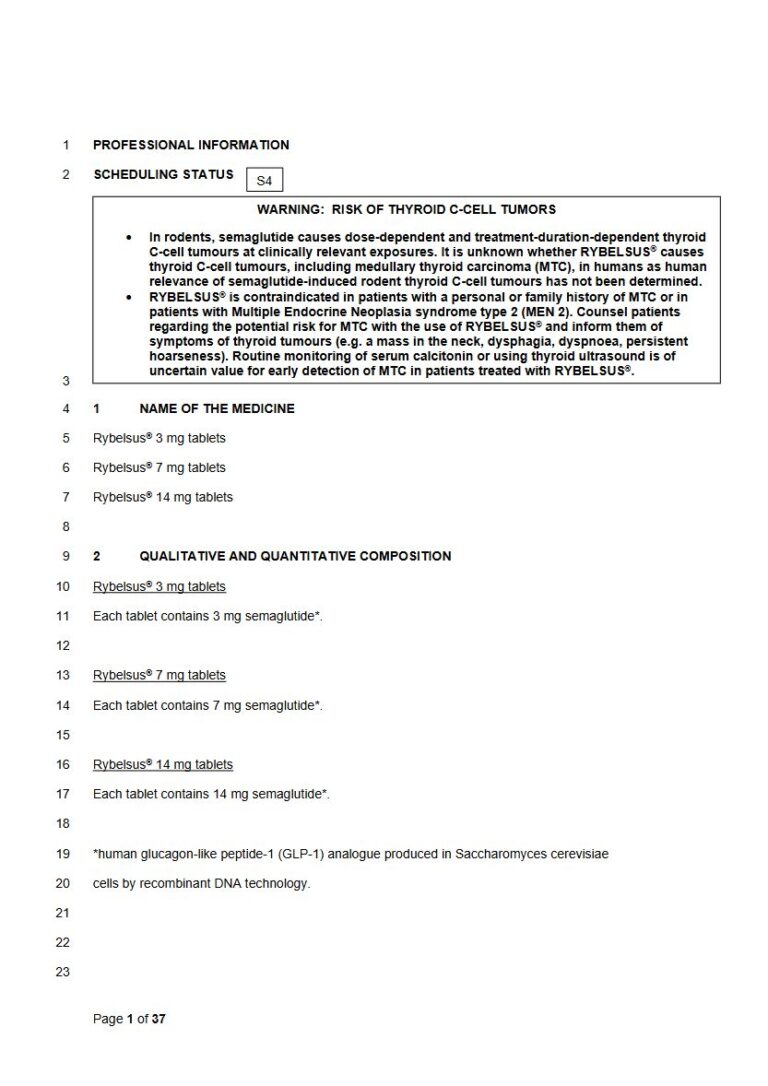
- Personal or family history of medullary thyroid carcinoma
- Multiple Endocrine Neoplasia syndrome type 2
- Hypersensitivity to semaglutide
Common side effects
- Nausea
- Diarrhoea
- Vomiting
- Hypoglycaemia
- Fatigue
Counselling Points
- Take on an empty stomach
- Wait 30 mins before eating or taking other medications
- Monitor for signs of pancreatitis
Serious warnings
- Risk of thyroid C-cell tumors
- Acute pancreatitis
- Gastrointestinal effects leading to dehydration
Important Disclaimer
The Rybelsus 3 Mg/7 Mg/14 Mg Tablets professional information leaflet below is the property of Novo Nordisk and is provided on Medinsert exactly as issued, with no.. alterations or editorial changes. We make every effort to keep content current by updating documents as soon as new versions become available. Medinsert serves as a trusted access point for healthcare professionals, but does not replace official sources or clinical judgement. For more details, please read our full disclaimer. read more>>
 Healthcare Professionals Only
This content is for registered healthcare professionals
Sign in or create a free account to read the full package insert.
Free for HPCSA-registered professionals. Powered by Medinsert.
Clinical Particulars
Section 4 of the official insert — extracted exactly as issued, no alterations
4.1 Therapeutic indications
Rybelsus u00ae is indicated for the treatment of adults with insufficiently controlled type 2 diabetes mellitus as an adjunct to diet and exercise.
u2022 as monotherapy when metformin is considered inappropriate due to intolerance or contraindications
u2022 in combination with other medicinal products for the treatment of diabetes. For study results with respect to combinations, effects on glycaemic control and cardiovascular events, and the populations studied, see sections 4.4, 4.5 and 5.1.
4.2 Posology and method of administration
The starting dose of Rybelsus u00ae is 3 mg once daily for one month. After one month, the dose should be increased to a maintenance dose of 7 mg once daily. After at least one month on with a dose of 7 mg once daily, the dose can be increased to a maintenance dose of 14 mg once daily to further improve glycaemic control.
The maximum recommended single daily dose of Rybelsus u00ae is 14 mg. Taking two 7 mg tablets to achieve the effect of a 14 mg dose has not been studied and is therefore not recommended.
Rybelsus u00ae can be used as monotherapy or in combination with one or more glucose-lowering medicinal products (see section 5.1).
When Rybelsus u00ae is used in combination with metformin and/or a sodium-glucose co-transporter-2 inhibitor (SGLT2i) or thiazolidinedione, the current dose of metformin and/or SGLT2i/thiazolidinedione can be continued.
When Rybelsus u00ae is used in combination with a sulfonylurea or insulin, a reduction in the dose of sulfonylurea or insulin should be considered to reduce the risk of hypoglycaemia (see section 4.4).
Self-monitoring of blood glucose is not needed in order to adjust the dose of semaglutide. Blood glucose self-monitoring is necessary to adjust the dose of sulfonylurea and insulin, particularly when semaglutide is started and insulin is reduced. A stepwise approach to insulin reduction is recommended.
Missed dose
If a dose is missed, the missed dose should be skipped, and the next dose should be taken the following day.
Special populations
Elderly
No dose adjustment is required based on age. Therapeutic experience in patients u226575 years of age is limited (see section 5.2).
Renal impairment
No dose adjustment is required for patients with mild, moderate or severe renal impairment. Experience with the use of semaglutide in patients with severe renal impairment is limited. Semaglutide is not recommended in patients with end-stage renal disease (see section 5.2).
Hepatic impairment
No dose adjustment is required for patients with hepatic impairment. Experience with the use of semaglutide in patients with severe hepatic impairment is limited. Caution should be exercised when treating these patients with semaglutide (see section 5.2).
Paediatric population
The safety and efficacy of Rybelsus u00ae in children and adolescents below 18 years have not been established. No data are available.
Method of administration
Rybelsus u00ae is a tablet for once-daily oral use.
- This medicinal product should be taken on an empty stomach at any time of the day.
- It should be swallowed whole with a sip of water (up to half a glass of water equivalent to 120 ml). Tablets should not be split, crushed or chewed, as it is not known whether this impacts absorption of semaglutide.
- Patients should wait at least 30 minutes before eating or drinking or taking other oral medicinal products. Waiting less than 30 minutes decreases the absorption of semaglutide (see sections 4.5 and 5.2).
4.3 Contraindications
Hypersensitivity to the active substance or to any of the excipients listed in section 6.1.
4.4 Special warnings and precautions for use
Traceability
In order to improve the traceability of biological medicinal products, the name and the batch number of the administered product should be clearly recorded.
General
Semaglutide should not be used in patients with type 1 diabetes mellitus or for the treatment of diabetic ketoacidosis. Diabetic ketoacidosis has been reported in insulin-dependent patients whom had rapid discontinuation or dose reduction of insulin when treatment with a GLP-1 receptor agonist is started (see section 4.2).
There is no therapeutic experience in patients with congestive heart failure New York Heart Association (NYHA) class IV and semaglutide is therefore not recommended in these patients.
There is no therapeutic experience with semaglutide in patients with bariatric surgery.
Gastrointestinal effects
Use of GLP-1 receptor agonists may be associated with gastrointestinal adverse reactions that can cause dehydration, which in rare cases can lead to a deterioration of renal function (see section 4.8). Patients treated with semaglutide should be advised of the potential risk of dehydration in relation to gastrointestinal side effects and take precautions to avoid fluid depletion.
Acute pancreatitis
Acute pancreatitis has been observed with the use of GLP-1 receptor agonists. Patients should be informed of the characteristic symptoms of acute pancreatitis. If pancreatitis is suspected, semaglutide should be discontinued; if confirmed, semaglutide should not be restarted. Caution should be exercised in patients with a history of pancreatitis.
Hypoglycaemia
Patients treated with semaglutide in combination with a sulfonylurea or insulin may have an increased risk of hypoglycaemia (see section 4.8). The risk of hypoglycaemia can be lowered by reducing the dose of sulfonylurea or insulin when initiating treatment with semaglutide (see section 4.2).
Diabetic retinopathy
Rapid improvement in glucose control has been associated with a temporary worsening of diabetic retinopathy, but other mechanism cannot be excluded. Long-term glycaemic control decreases the risk of diabetic retinopathy. Patients with a history of diabetic retinopathy should be monitored for worsening and treated according to clinical guidelines.
Treatment response
Compliance with the dosing regimen is recommended for optimal effect of semaglutide. If the treatment response with semaglutide is lower than expected, the treating physician should be aware that the absorption of semaglutide is highly variable and may be minimal (2 u2013 4 % of patients will not have any exposure), and that the absolute bioavailability of semaglutide is low.
Sodium content
This medicinal product contains 23 mg sodium per tablet, equivalent to 1 % of the WHO recommended maximum daily intake of 2 g sodium for an adult.
4.5 Interaction with other medicines and other forms of interaction
Semaglutide delays gastric emptying which may influence the absorption of other oral medicinal products.
Effects of semaglutide on other medicinal products
Thyroxine
Total exposure (AUC) of thyroxine (adjusted for endogenous levels) was increased by 33 % following administration of a single dose of levothyroxine. Maximum exposure (C max ) was unchanged. Monitoring of thyroid parameters should be considered when treating patients with semaglutide at the same time as levothyroxine.
Warfarin
Semaglutide did not change the AUC or C max of R- and S-warfarin following a single dose of warfarin, and the pharmacodynamic effects of warfarin as measured by the international normalised ratio (INR) were not affected in a clinically relevant manner. However, upon initiation of semaglutide treatment in patients on warfarin or other coumarin derivatives, frequent monitoring of INR is recommended.
Rosuvastatin
AUC of rosuvastatin was increased by 41 % [90 % CI: 24; 60] when co-administered with semaglutide. Based on the wide therapeutic index of rosuvastatin the magnitude of changes in the exposure in not considered clinically relevant.
Digoxin, oral contraceptives, metformin, furosemide
No clinically relevant change in AUC or C max of digoxin, oral contraceptives (containing ethinylestradiol and levonorgestrel), metformin or furosemide was observed when concurrently administered with semaglutide. Interactions with medicinal products with very low bioavailability (F: 1 %) have not been evaluated.
Effects of other medicinal products on semaglutide
Omeprazole
No clinically relevant change in AUC or C max of semaglutide was observed when taken with omeprazole.
In a trial investigating the pharmacokinetics of semaglutide co-administered with five other tablets, the AUC of semaglutide decreased by 34 % and C max by 32 %. This suggests that the presence of multiple tablets in the stomach influences the absorption of semaglutide if co-administered at the same time. After administering semaglutide, the patients should wait 30 minutes before taking other oral medicinal products (see section 4.2).
4.6 Fertility, pregnancy and lactation
Women of childbearing potential
Women of childbearing potential are recommended to use contraception when treated with semaglutide.
Pregnancy
Studies in animals have shown reproductive toxicity (see section 5.3). There are limited data from the use of semaglutide in pregnant women. Therefore, semaglutide should not be used during pregnancy. If a patient wishes to become pregnant, or pregnancy occurs, semaglutide should be discontinued. Semaglutide should be discontinued at least 2 months before a planned pregnancy due to the long half-life (see section 5.2).
Breastfeeding
In lactating rats, semaglutide, salcaprozate sodium and/or its metabolites were excreted in milk. As a risk to a breast-fed child cannot be excluded, Rybelsus u00ae should not be used during breast-feeding.
Fertility
The effect of semaglutide on fertility in humans is unknown. Semaglutide did not affect male fertility in rats. In female rats, an increase in oestrous length and a small reduction in number of ovulations were observed at doses associated with maternal body weight loss (see section 5.3).
4.7 Effects on ability to drive and use machines
Semaglutide has no or negligible influence on the ability to drive or use machines. When it is used in combination with a sulfonylurea or insulin, patients should be advised to take precautions to avoid hypoglycaemia while driving and using machines (see section 4.4).
4.8 Undesirable effects
Summary of the safety profile
In 10 phase 3a trials, 5 707 patients were exposed to semaglutide alone or in combination with other glucose-lowering medicinal products. The duration of the treatment ranged from 26 weeks to 78 weeks. The most frequently reported adverse reactions in clinical trials were gastrointestinal disorders, including nausea (very common), diarrhoea (very common) and vomiting (common).
Tabulated list of adverse reactions
Table 1 lists adverse reactions identified in all phase 3a trials in patients with type 2 diabetes mellitus (further described in section 5.1). The frequencies of the adverse reactions are based on a pool of the phase 3a trials excluding the cardiovascular outcomes trial.
The reactions are listed below by system organ class and absolute frequency. Frequencies are defined as: very common: (u22651/10); common: (u22651/100 to <1/10); uncommon: (u22651/1,000 to <1/100); rare: (u22651/10,000 to <1/1,000) and very rare: (<1/10,000). Within each frequency grouping, adverse reactions are presented in order of decreasing seriousness.
4.9 Overdose
Effects of overdose with semaglutide in clinical studies may be associated with gastrointestinal disorders. In the event of overdose, appropriate supportive treatment should be initiated according to the patientu2019s clinical signs and symptoms. A prolonged period of observation and treatment of the symptoms may be necessary, taking into account the long half-life of semaglutide of approximately 1 week (see section 5.2). There is no specific antidote for overdose with semaglutide.
