
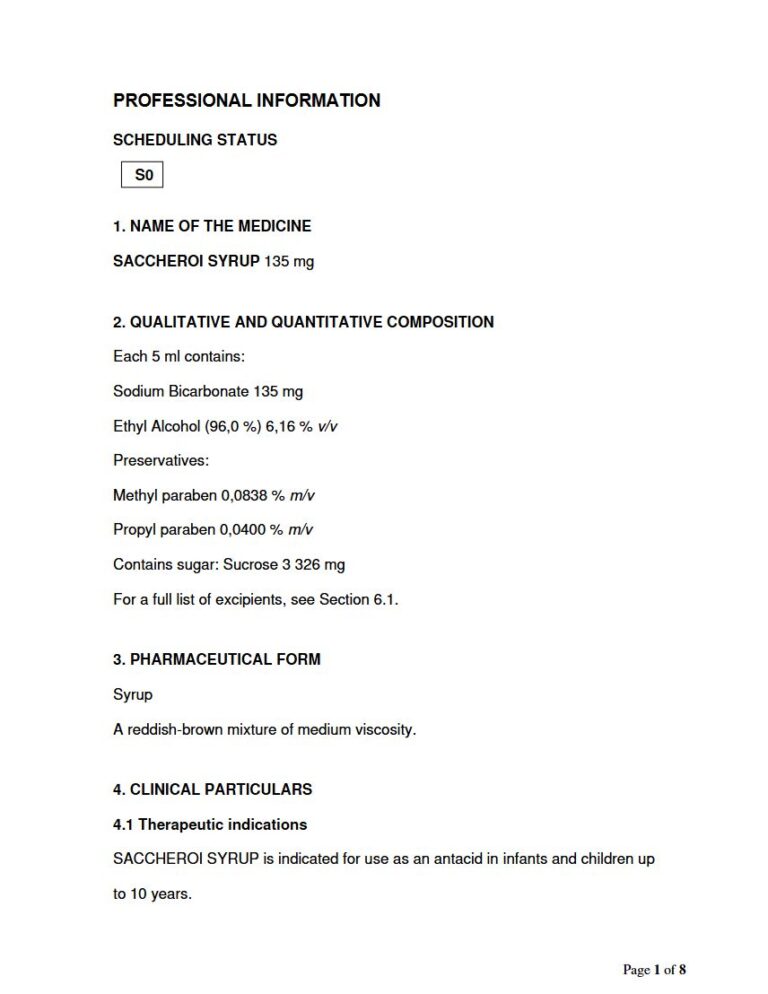
Saccheroi Syrup 135 mg Syrup
PDF Leaflet Revision Date: 21 February 2024
Clinical Summary
Quick overview from the medicine insert
Indication
Antacid for infants and children up to 10 years.
Dosage (summary)
Children: 0-6 months: 7.5 ml; 6 months-1 year: 10 ml; 1-2 years: 15 ml; 3-5 years: 20 ml; 6-10 years: 30-35 ml, 3-4 times daily.
Onset of Action / Duration
Onset: 30 mins, Duration: 2-3 hours
Special Populations
- Renal impairment
- Congestive heart failure
- Cirrhosis
- Hypertension
Pregnancy & Breastfeeding
Not intended for use during pregnancy or breastfeeding.
Key Drug Interactions
- Increased renal clearance of acidic medicines
- Effects on sympathomimetics and tricyclic antidepressants
Contraindications
- Metabolic or respiratory alkalosis
- Hypocalcaemia
- Hypochlorhydria
- Body mass < 2.5 kg
- Hypersensitivity to sodium bicarbonate
Common side effects
- Stomach cramps
- Flatulence
- Belching
Counselling Points
- Shake before use
- Do not double doses
- Report any adverse reactions
Serious warnings
- Maximum dosage not for more than two weeks without supervision
- Caution in patients with renal impairment
Important Disclaimer
The Saccheroi Syrup 135 mg Syrup professional information leaflet below is the property of Avid Brands SA and is provided on Medinsert exactly as issued, with no.. alterations or editorial changes. We make every effort to keep content current by updating documents as soon as new versions become available. Medinsert serves as a trusted access point for healthcare professionals, but does not replace official sources or clinical judgement. For more details, please read our full disclaimer. read more>>
 Healthcare Professionals Only
This content is for registered healthcare professionals
Sign in or create a free account to read the full package insert.
Free for HPCSA-registered professionals. Powered by Medinsert.
Clinical Particulars
Section 4 of the official insert — extracted exactly as issued, no alterations
4.1 Therapeutic indications
SACCHEROI SYRUP is indicated for use as an antacid in infants and children up to 10 years.
4.2 Posology and method of administration
Posology
SHAKE THE BOTTLE BEFORE USE.
Take three to four times a day with water.
Children:
0 u2013 6 months: 7,5 ml (1u00bd medicine measuresful)
6 months u2013 1 year: 10 ml (2 medicine measuresful)
1 u2013 2 years: 15 ml (3 medicine measuresful)
3 u2013 5 years: 20 ml (4 medicine measuresful)
6 u2013 10 years: 30 u2013 35 ml (6 u2013 7 medicine measuresful)
Do not give more than three to four times per 24 hour period.
Do not give this medicine to babies with a body mass less than 2,5 kg (see section 4.3).
IF YOU MISS GIVING A DOSE, SKIP THE MISSED DOSE. DO NOT DOUBLE THE DOSES.
Do not use the maximum dosage of this product for more than two weeks, except under the advice and supervision of a doctor (see section 4.4).
Method of administration
For oral use only.
4.3 Contraindications
SACCHEROI SYRUP is contraindicated in:
u2022 patients with metabolic or respiratory alkalosis, hypocalcaemia or hypochlorhydria;
u2022 babies with a body mass less than 2,5 kg;
u2022 patients who are hypersensitive to sodium bicarbonate or to any of the excipients listed in section 6.1.
4.4 Special warnings and precautions for use
Do not use the maximum dosage of this product for more than two weeks, except under the advice and supervision of a doctor.
SACCHEROI SYRUP should be administered extremely cautiously to patients with congestive heart failure, oedema, renal impairment, cirrhosis of the liver or hypertension, aldosteronism, and to patients receiving corticosteroids.
Methyl paraben and propyl paraben may cause allergic reactions (possibly delayed).
This medicine contains 0,30824 ml of alcohol (ethanol 96 %) in each 5 ml. The small amount of alcohol in this medicine will not have any noticeable effects.
Contains sucrose. Patients with rare hereditary conditions such as fructose intolerance, glucose-galactose mal-absorption or sucrase-isomaltase insufficiency should not take SACCHEROI SYRUP.
4.5 Interaction with other medicinal products and other forms of interaction
Sodium bicarbonate may increase or decrease the effects of a number of medicines due to raising gastric pH and the alkalinisation of the urine.
Alkalinisation of the urine by sodium bicarbonate leads to increased renal clearance of acidic medicines such as salicylates, tetracyclines, barbiturates.
Alkalisation of the urine may also affect the elimination of sympathomimetics, anticholinergics, tricyclic antidepressants, H2-blockers, captopril and quinidine.
Lithium excretion is enhanced.
Most interactions can be avoided by taking antacids 2 hours before or after ingestion of other medicines.
4.6 Fertility, pregnancy and lactation
Pregnancy
There is no data available on the effects of SACCHEROI SYRUP on pregnancy as this product is not intended for use during pregnancy.
Breastfeeding
There is no data available on the effects of SACCHEROI SYRUP on breastfeeding as this product is not intended for use during breastfeeding.
Fertility
There is no data available on the effects of SACCHEROI SYRUP on fertility.
4.8 Undesirable effects
Gastrointestinal disorders
Frequency unknown: Stomach cramps, flatulence and belching.
Reporting of suspected adverse reactions
Reporting of suspected adverse reactions after authorisation of the medicinal product is important. It allows continued monitoring of the benefit/risk balance of the medicinal product. Healthcare providers are asked to report any suspected adverse reactions to SAHPRA via the u201c6.04 Adverse Drug Reactions Reporting Formu201d, found online under SAHPRAu2019s publications: https://www.sahpra.org.za/Publications/Index/8
4.9 Overdose
Excessive administration may lead to metabolic alkalosis, especially in patients with impaired renal function. Symptoms may include shortness of breath, muscle weakness, restlessness, convulsions and coma. Hyperkalaemia may occur in patients with renal failure. Muscle hypertonicity, twitching, and tetany may develop especially in hypocalcaemic patients. Treatment of metabolic alkalosis and hypernatraemia associated with sodium bicarbonate overdose consists mainly of appropriate correction of fluid and electrolyte balance. Replacement of calcium, chloride and potassium ions may be of particular importance. Excessive doses of sodium salts may also lead to sodium overloading and hyperosmolality.
