
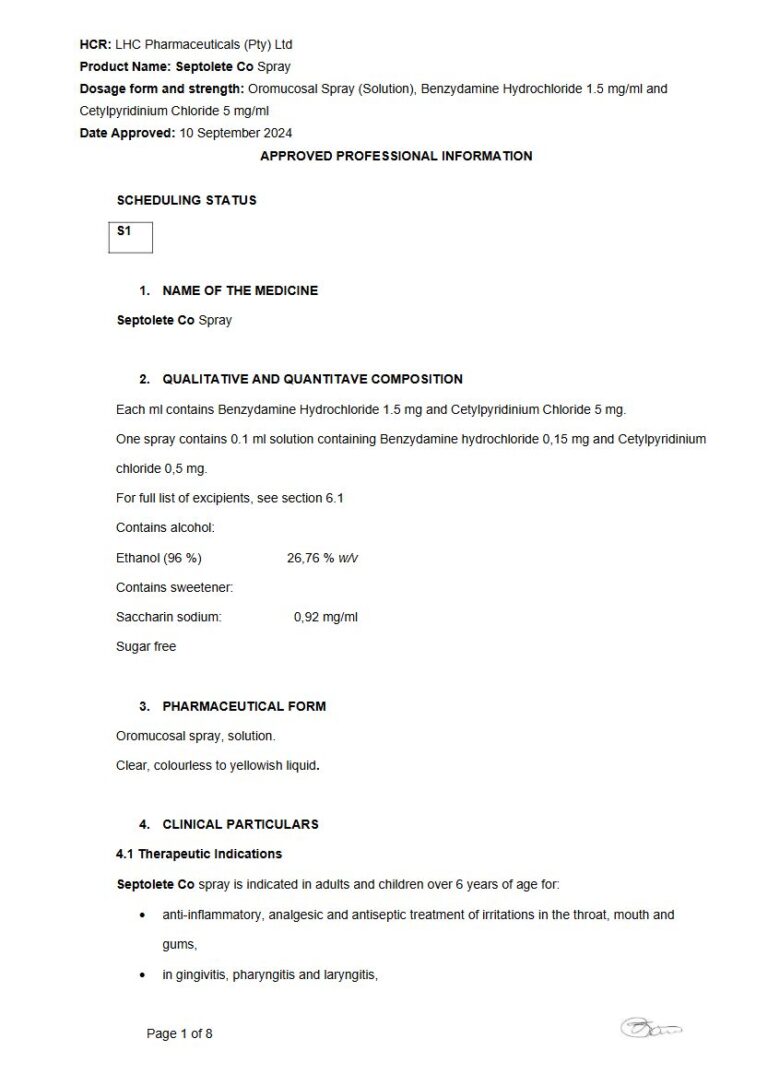
Septolete Co 1.5mg/5mg/ml Oromucosal Spray
PDF Leaflet Revision Date: 10 September 2024
Clinical Summary
Quick overview from the medicine insert
Indication
Anti-inflammatory, analgesic, and antiseptic treatment for throat, mouth, and gum irritations.
Dosage (summary)
Adults: 1-2 sprays every 2 hours, up to 5 times daily. Children 6-12: 1 spray every 2 hours, up to 5 times daily.
Special Populations
- Elderly
- Children over 6 years
Pregnancy & Breastfeeding
Not recommended during pregnancy; use in breastfeeding only if essential.
Key Drug Interactions
- Do not use with other antiseptics
- Avoid with anionic compounds in toothpastes
Contraindications
- Hypersensitivity to ingredients
- Children under 6 years
Common side effects
- Hypersensitivity reactions
- Burning mucosa
- Oral mucosal irritation
Counselling Points
- Avoid contact with eyes
- Do not inhale
- Use with caution in sensitive individuals
Serious warnings
- Do not use for more than 7 days
- Consult doctor if no improvement in 3 days
Important Disclaimer
The Septolete Co 1.5mg/5mg/ml Oromucosal Spray professional information leaflet below is the property of Lhc Pharmaceuticals and is provided on Medinsert exactly as issued, with no.. alterations or editorial changes. We make every effort to keep content current by updating documents as soon as new versions become available. Medinsert serves as a trusted access point for healthcare professionals, but does not replace official sources or clinical judgement. For more details, please read our full disclaimer. read more>>
 Healthcare Professionals Only
This content is for registered healthcare professionals
Sign in or create a free account to read the full package insert.
Free for HPCSA-registered professionals. Powered by Medinsert.
Clinical Particulars
Section 4 of the official insert — extracted exactly as issued, no alterations
4.1 Therapeutic Indications
Septolete Co spray is indicated in adults and children over 6 years of age for:
- anti-inflammatory, analgesic and antiseptic treatment of irritations in the throat, mouth and gums,
- in gingivitis, pharyngitis and laryngitis,
- before and after tooth extractions.
4.2 Posology and method of administration
Posology
Adults: For a single dose, the spray head should be pressed once to twice. This may be repeated every 2 hours, 3-5 times a day. For optimal effect, it is not recommended to use the product immediately before or after cleaning teeth. The stated dose should not be exceeded. Septolete Co Spray can be used for up to 7 days.
Elderly patients: The recommended dose is the same as for adults.
Paediatric population: Children over 12 years of age: For a single dose, the spray head should be pressed once to twice. This may be repeated every 2 hours, 3-5 times a day. Children from 6 to 12 years of age: For a single dose, the spray head should be pressed once. This may be repeated every 2 hours, 3-5 times a day. Septolete Co is contraindicated in children under 6 years of age.
Method of administration
Before the first use of Septolete Co Spray, press the spray several times in order to obtain even delivery. If the spray has not been used for a long period of time (like at least for one week), press the spray head one time in order to obtain even delivery. Remove the plastic cap before use.
Open your mouth wide, point the spray nozzle towards your throat and press the spray head 1-2 times. Hold your breath while spraying. After each use, place the plastic cap on the spray head. When the spray head is pressed once, 0.1 ml of oromucosal spray, solution, which contains 0.15 mg benzydamine hydrochloride and 0.5 mg cetylpyridinium chloride is released.
4.3 Contraindications
Hypersensitivity to benzydamine hydrochloride, cetylpyridinium chloride or to any of the excipients of Septolete Co Spray listed in section 6.1. Children aged under 6 years since the pharmaceutical form is not appropriate for this age group.
4.4 Special warnings and precautions for use
- Septolete Co Spray should not be used for more than 7 days. If there are no noticeable results after 3 days, a doctor should be consulted.
- The use of topical preparations, especially over a long period of time, may lead to sensitisation, in which case treatment must be suspended and a suitable therapy instated.
- Septolete Co Spray must not be used in combination with anionic compounds, such as those present in toothpastes, therefore it is not recommended to use the product immediately before or after cleaning teeth (see section 4.5).
- Direct contact of Septolete Co with eyes should be avoided.
- Septolete Co Spray must not be inhaled.
- Septolete Co Spray contains small amounts of ethanol (alcohol), less than 100 mg per dose.
4.5 Interaction with other medicines and other forms of interaction
Septolete Co Spray should not be used at the same time as other antiseptics. Septolete Co Spray must not be used in combination with anionic compounds, such as those present in toothpastes, therefore it is not recommended to use the product immediately before or after cleaning teeth (see section 4.4).
4.6 Fertility, pregnancy and lactation
Pregnancy
There are no or limited amount of data from the use of benzydamine hydrochloride and cetylpyridinium chloride in pregnant women. Septolete Co is not recommended during pregnancy.
Breastfeeding
Septolete Co Spray should not be used in during lactation unless considered essential by the medical doctor. It is unknown whether benzydamine hydrochloride/metabolites are excreted in human milk. A risk to the newborns/infants cannot be excluded. A decision must be made whether to discontinue breast-feeding or to discontinue/abstain from Septolete Co Spray therapy taking into account the benefit of breast feeding for the child and the benefit of therapy for the woman.
4.7 Effects on ability to drive and use machines
Septolete Co Spray does not influence the ability to drive or use machines.
4.8 Undesirable effects
Tabulated list of adverse reactions
Adverse reactions are tabulated below by System Organ Class (SOC) and frequency. The following convention has been utilized for the classification of undesirable effects:
FREQUENT implies very common (u22651/10) or common (u2265 1/100, <1/10)
LESS FREQUENT implies uncommon (u22651/1000, <1/100), rare (u22651/10 000, <1/1000), very rare (<1/10 000), single or isolated reports.
FREQUENCY UNKNOWN implies it cannot be estimated from available data.
| System organ Class | Frequency |
|---|---|
| Immune system disorders | Hypersensitivity reactions |
| Nervous system disorders | Burning mucosa, Anaesthesia of oral mucosa |
| Respiratory, thoracic and mediastinal disorders | Bronchospasm |
| Gastrointestinal disorders | Oral mucosal irritation, Burning oral sensation, Numbness furry tongue and paraesthesia in the mouth |
| Skin and subcutaneous tissue disorders | Urticaria, Photosensitivity |
| General disorders and administration site conditions | Medicine intolerance, that occurs as burning or irritation at the application site |
Reporting of suspected adverse reactions
Reporting suspected adverse reactions after authorisation of the medicinal product is important. It allows continued monitoring of the benefit/risk balance of the medicine. Health care providers are asked to report any suspected adverse reactions to SAHPRA via the u201c6.04 Adverse Drug Reaction Reporting Formu201d, found online under SAHPRAu2019s publications: https://www.sahpra.org.za/Publications/Index/8.
4.9 Overdose
Symptoms
Toxic manifestations of benzydamine overdose consist of excitement, convulsions, sweating, ataxia, shivering and vomiting. Since there is no specific antidote, the treatment of acute benzydamine intoxication is purely symptomatic. Signs and symptoms of intoxication as a result of the ingestion of significant quantities of cetylpyridinium chloride include nausea, vomiting, dyspnoea, cyanosis, asphyxia, following paralysis of the respiratory muscles, depression of the CNS, hypotension and coma. The lethal dose in humans is approximately 1- 3 grams.
Management
Since there is no specific antidote, the treatment of acute overdose is purely symptomatic.
