
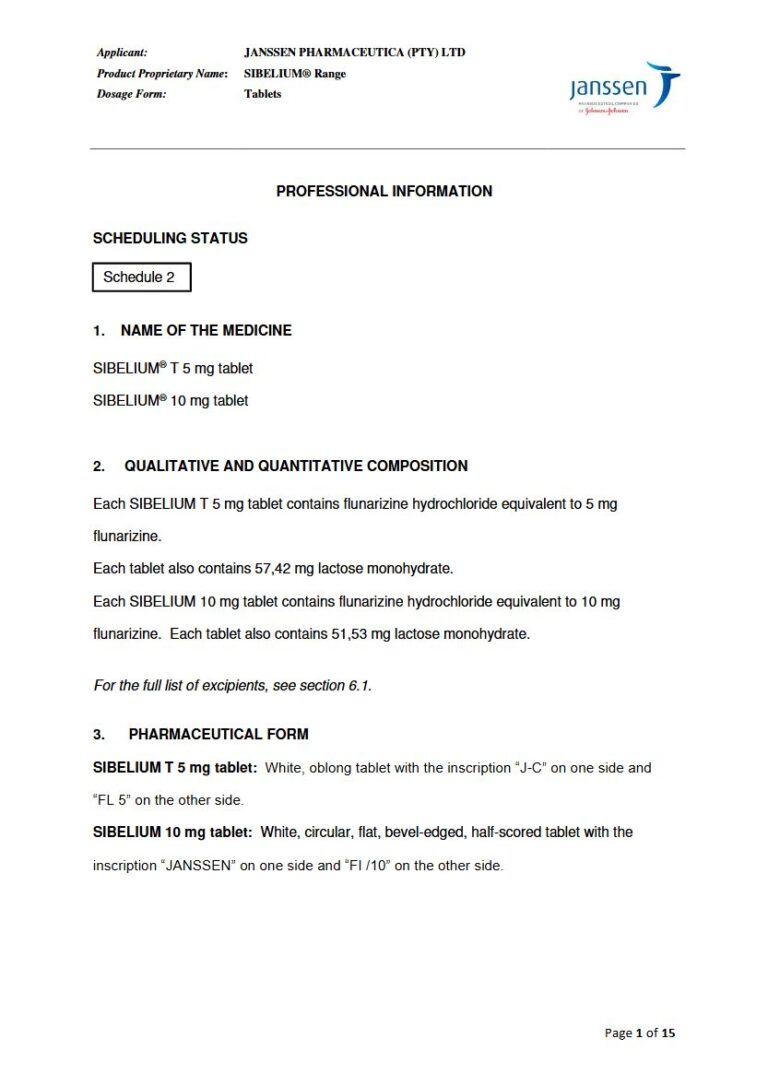
Sibeliuma Range 5mg/10mg Tablet
PDF Leaflet Revision Date: 12 May 2022
Clinical Summary
Quick overview from the medicine insert
Indication
Prophylaxis of migraine and symptomatic treatment of vestibular vertigo.
Dosage (summary)
Adults: 10 mg at night; Elderly: 5 mg daily.
Special Populations
- Elderly
- Paediatrics (6-17 years)
Pregnancy & Breastfeeding
Safety in pregnancy not established; contraindicated in breastfeeding.
Key Drug Interactions
- Alcohol
- Phenothiazines
- Hepatic enzyme inducers
Contraindications
- Hypersensitivity to flunarizine
- History of depressive illness
- Parkinson's disease
Common side effects
- Somnolence
- Depression
- Increased weight
- Increased appetite
Counselling Points
- Take at night
- Do not exceed recommended dose
- Report any depressive symptoms
Serious warnings
- May cause extrapyramidal symptoms
- Monitor for depressive symptoms
Important Disclaimer
The Sibeliuma Range 5mg/10mg Tablet professional information leaflet below is the property of Janssen Pharmaceutica and is provided on Medinsert exactly as issued, with no.. alterations or editorial changes. We make every effort to keep content current by updating documents as soon as new versions become available. Medinsert serves as a trusted access point for healthcare professionals, but does not replace official sources or clinical judgement. For more details, please read our full disclaimer. read more>>
 Healthcare Professionals Only
This content is for registered healthcare professionals
Sign in or create a free account to read the full package insert.
Free for HPCSA-registered professionals. Powered by Medinsert.
Clinical Particulars
Section 4 of the official insert — extracted exactly as issued, no alterations
4.1 Therapeutic indications:
SIBELIUM is indicated in:
- Prophylaxis of classic (with aura) or common (without aura) migraine.
- Symptomatic treatment of vestibular vertigo (due to a diagnosed functional disorder of the vestibular system).
4.2 Posology and method of administration
Adults and elderly (18 years of age and older)
u2022 Migraine prophylaxis
Starting dose: Treatment is started at two 5 mg tablets (10 mg) SIBELIUM at night in adult patients aged 18 to 64 years and at 5 mg daily for elderly patients aged 65 years and older. If, during this treatment, depressive, extrapyramidal or other unacceptable adverse experiences occur, administration should be discontinued. If, after 2 months of this initial treatment, no significant improvement is observed, the patient should be considered a non-responder and administration should be discontinued.
Maintenance treatment: If a patient is responding satisfactorily and if a maintenance treatment is needed, the dosage schedule should be changed so that each week the patient receives 5 days of treatment at the same daily dose and 2 successive medicine free days. Even if the prophylactic maintenance treatment is successful and well tolerated, it should be interrupted after 6 months and it should be re-initiated only if the patient relapses.
u2022 Vertigo
The same daily doses should be used as for migraine, but the starting treatment should not be given longer than needed for symptom control, which generally takes less than two months. If, however, no significant improvement is observed, after 1 month of treatment for chronic vertigo or after 2 months treatment for paroxysmal vertigo, the patient should be considered a non-responder and administration should be discontinued. The dose will be as described below:
u2022 Take the same number of tablets you are used to taking (1 or half a tablet(s) every day before going to bed for 5 days in a row; and do not take any tablets for 2 days in a row. Repeat this pattern (5 days with medicine followed by 2 days with no medicine) for the rest of the treatment.
Special populations
Paediatrics (6 to 17 years of age) u2013 migraine prophylaxis
u2022 The recommended dose is 5 mg daily (at night).
u2022 The dose may be increased to 10 mg daily in patients weighing over 40 kg, if required.
If, during this treatment, depressive symptoms or other unacceptable adverse experiences occur, administration should be discontinued (see sections 4.4 and 4.8). If, after 3 months of this initial treatment, no significant improvement is observed, the patient should be considered a non-responder and administration should be discontinued. The maximum recommended treatment duration is 6 months.
Paediatrics (5 years of age and younger) u2013 migraine prophylaxis
The safety and efficacy of SIBELIUM for prophylaxis of migraine in paediatric patients aged 5 years and younger have not been established.
Paediatrics (17 years of age and younger) u2013 vertigo
The safety and efficacy of SIBELIUM for treatment of vertigo in paediatric patients have not been established.
4.3 Contraindications:
Hypersensitivity to flunarizine or any other ingredient in the formulation. SIBELIUM is contraindicated in patients with a history of depressive illness, or with pre-existing symptoms of Parkinson's disease or other extrapyramidal disorders (See sections 4.4 and 4.8).
4.4 Special warnings and precautions for use
SIBELIUM is not suited for aborting a migraine attack. The possible occurrence of an attack is therefore no reason to increase the dose of SIBELIUM.
This treatment may give rise to extrapyramidal and depressive symptoms and reveal Parkinsonism, especially in predisposed patients such as the elderly. SIBELIUM should therefore be used with caution in such patients.
SIBELIUM should be used with care in patients with depression or those being prescribed other agents, such as phenothiazines, concurrently, which may cause extrapyramidal side effects.
Fatigue may increase progressively during SIBELIUM therapy; in this event therapy should be discontinued.
The recommended dose should not be exceeded. Patients should be seen at regular intervals, especially during maintenance treatment, so that extrapyramidal or depressive symptoms may be detected early and if so, treatment discontinued. If during maintenance treatment the therapeutic effects wane, treatment should also be discontinued (see section 4.2).
Patients who are intolerant to lactose should not take SIBELIUM, as the tablets contain lactose. Patients with rare hereditary problems of galactose intolerance, the Lapp lactase deficiency or glucose-galactose malabsorption should not take SIBELIUM.
4.5 Interaction with other medicines and other forms of interaction:
Excessive sedation can occur when alcohol, hypnotics or tranquillisers are taken simultaneously with SIBELIUM.
Galactorrhoea has been reported in some women on oral contraceptives within the first two months of SIBELIUM treatment.
Hepatic enzyme inducers such as carbamazepine and phenytoin may interact with flunarizine by increasing its metabolism. An increase in dosage of SIBELIUM may be required.
The pharmacokinetics of flunarizine were unaffected by topiramate. During co-administration of SIBELIUM with topiramate 50 mg every 12 hours, a 16 % increase in the systemic exposure to flunarizine in migraine patients was observed comparable to a 14 % increase in patients treated with flunarizine only. The steady-state pharmacokinetics of topiramate were unaffected by flunarizine.
Chronic administration of flunarizine did not affect the disposition of phenytoin, carbamazepine, valproate or phenobarbital. Plasma concentrations of flunarizine were generally lower in patients with epilepsy taking these anti-epileptic drugs (AEDs) compared to healthy subjects given similar doses. The plasma protein binding of carbamazepine, valproate, and phenytoin is not affected by co-administration with flunarizine.
4.6 Fertility, pregnancy and lactation
Safety in pregnancy has not been established.
Breastfeeding women should not take SIBELIUM.
4.7 Effects on ability to drive or operate machinery
Since somnolence may occur, especially at the start of the treatment, caution should be exercised during activities such as driving or operating dangerous machinery.
4.8 Undesirable effects
Clinical trial data
The safety of SIBELIUM (5 to 10 mg/day) was evaluated in 247 flunarizine-treated subjects who participated in two placebo-controlled clinical trials in the treatment of vertigo and migraine, and in 476 flunarizine-treated subjects who participated in two comparator-controlled clinical trials in the treatment of vertigo and/or migraine. Based on pooled safety data from these clinical trials, the most commonly reported (u2265 4 % incidence) adverse reactions were: Increased weight (11 %), somnolence (9 %), depression (5 %), increased appetite (4 %); and rhinitis (4%).
Including the above-mentioned adverse reactions, the following table displays adverse reactions that have been reported with the use of SIBELIUM from clinical trials. The displayed frequency categories use the following convention: Very common (u22651/10); common (u22651/100 to 1/10) and uncommon (u22651/1 000 to <1/100).
System Organ Class Adverse reactions Frequency categories Very common (u22651/10) Common (u22651/100 to 1/10) Uncommon (u22651/1 000 to < 1/100)
Infections and infestations Rhinitis Metabolism and nutrition disorders Increased appetite Psychiatric disorders Depression Depressive symptom Sleep disorder Apathy Nervous system disorders Somnolence Abnormal coordination Disorientation Lethargy Paraesthesia Restlessness Sluggishness Tinnitus Torticollis Cardiac disorders Palpitations Gastrointestinal disorders Constipation Upper abdominal pain Intestinal obstruction Dry mouth Gastrointestinal disorder
4.9 Overdose:
Symptoms
Sedation and asthenia may be expected to occur. Acute overdosage has been reported and the observed symptoms were sedation, agitation and tachycardia.
Treatment
Treatment of acute overdosage consists of charcoal administration, and supportive measures. No specific antidote is known.
