
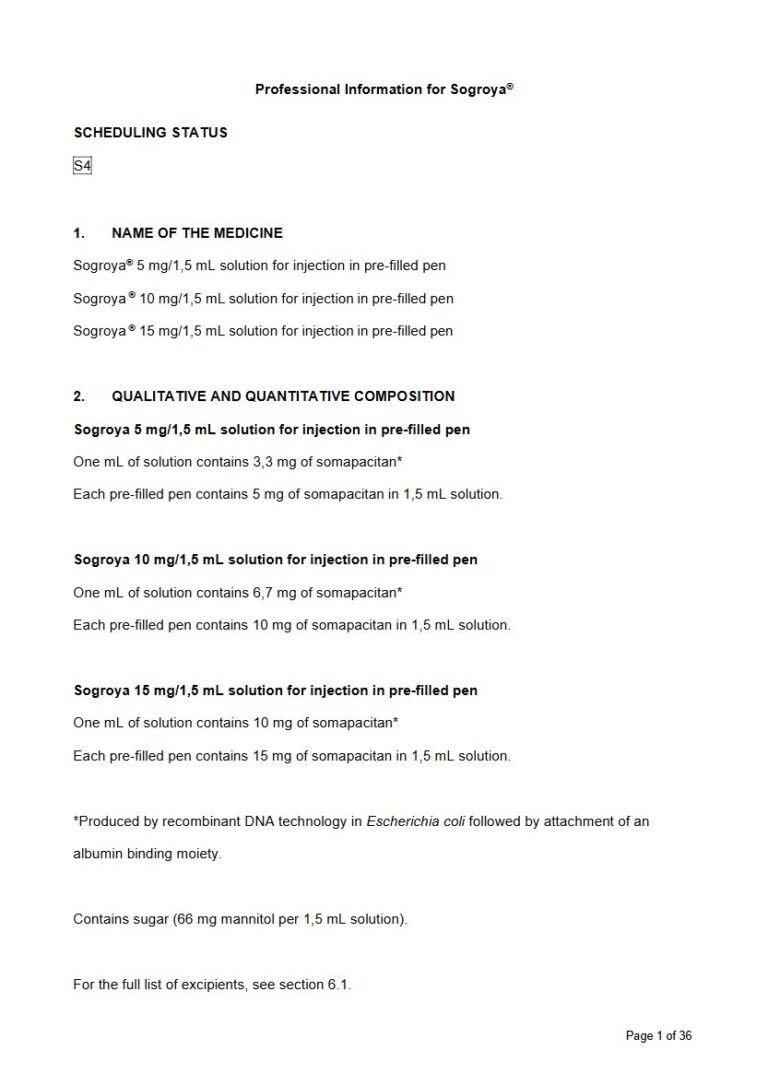
Sogroya 5 Mg/1,5 Ml/10 Mg/15 Mg Solution
PDF Leaflet Revision Date: 08 October 2024
Clinical Summary
Quick overview from the medicine insert
Indication
Replacement of endogenous growth hormone in GHD patients.
Dosage (summary)
Paediatric: 0.16 mg/kg/week; Adults: 1.5 mg/week (nau00efve), 2 mg/week (women on oestrogen). Elderly: 1 mg/week.
Special Populations
- Elderly
- Renal impairment
- Hepatic impairment
Pregnancy & Breastfeeding
Not recommended during pregnancy; unknown if excreted in breast milk.
Key Drug Interactions
- Cytochrome P450 metabolised medicines
- Glucocorticoids
- Antihyperglycaemic medicines
Contraindications
- Hypersensitivity to somapacitan
- Active tumor growth
- Closed epiphyses in children
- Acute critical illness
Common side effects
- Headache
- Hypothyroidism
- Injection site reactions
- Peripheral oedema
- Fatigue
Counselling Points
- Rotate injection sites
- Monitor glucose levels
- Report severe headaches or visual changes
- Adhere to dosing schedule
Serious warnings
- Adrenocortical insufficiency
- Thyroid function monitoring
- Glucose metabolism impairment
- Neoplasms risk
Important Disclaimer
The Sogroya 5 Mg/1,5 Ml/10 Mg/15 Mg Solution professional information leaflet below is the property of Novo Nordisk and is provided on Medinsert exactly as issued, with no.. alterations or editorial changes. We make every effort to keep content current by updating documents as soon as new versions become available. Medinsert serves as a trusted access point for healthcare professionals, but does not replace official sources or clinical judgement. For more details, please read our full disclaimer. read more>>
 Healthcare Professionals Only
This content is for registered healthcare professionals
Sign in or create a free account to read the full package insert.
Free for HPCSA-registered professionals. Powered by Medinsert.
Clinical Particulars
Section 4 of the official insert — extracted exactly as issued, no alterations
4.1 Therapeutic indications
Sogroya is indicated for the replacement of endogenous growth hormone (GH) in paediatric patients with growth failure due to growth hormone deficiency (GHD).
Sogroya is indicated for the replacement of endogenous growth hormone in adults with growth hormone deficiency (AGHD).
4.2 Posology and method of administration
Somapacitan treatment should be initiated and monitored by health care professionals who are appropriately qualified and experienced in the diagnosis and management of patients with the condition for which Sogroya is indicated (e.g. endocrinologists).
Posology
Table 1: Dose recommendation
- Paediatric GHD
- Recommended dose
- Treatment-nau00efve patients and patients switching from other growth hormone products: 0,16 mg/kg/week
- Adult GHD
- Recommended starting dose
- Nau00efve patients
- Adults (18 to less than 60 years): 1,5 mg/week
- Women on oral oestrogen therapy (irrespective of age): 2 mg/week
- Elderly (60 years or older): 1 mg/week
- Patients switching from daily GH medicines
- Adults (18 to less than 60 years): 2 mg/week
- Women on oral oestrogen therapy (irrespective of age): 4 mg/week
- Elderly (60 years or older): 1,5 mg/week
Paediatric GHD: Individualise and adjust the dosage based on response. When GHD persists after growth completion, growth hormone treatment should be continued to achieve full somatic adult development including lean body mass and bone mineral accrual (for guidance on dosing see recommended dose for adults (Table 1).
Adult GHD: Dose titration
The somapacitan dose must be individually adjusted for each patient. It is recommended to increase the dose gradually with 2 u2013 4 weeks intervals in steps from 0,5 mg to 1,5 mg based on the patientsu2019 clinical response and experience of adverse reactions up to a dose of 8 mg somapacitan per week. Serum insulin like growth factor-I (IGF-I) levels (drawn 3-4 days after dosing) can be used as guidance for the dose titration. Dose titration should be individualised and the IGF-I standard deviation score (SDS) target should aim for the upper half of the normal range not exceeding 2 SDS. See Treatment evaluation below and section 5.1.
Treatment evaluation
Using IGF-I SDS as a biomarker for dose titration, the aim is to reach IGF-I SDS levels within the age-adjusted upper reference range (IGF-I SDS upper reference range: 0 and +2) within 12 months of titration. During somapacitan maintenance treatment, evaluation of efficacy and safety should be considered at approximately 6- to 12-month intervals and may be assessed by evaluating biochemistry (IGF-I-, glucose-, and lipid levels), body composition, and body mass index.
Maintenance dose
Maintenance dose varies from person to person and between male and female patients. The average somapacitan maintenance dose observed in the phase 3 clinical trials was 2,4 mg/week.
Switching from other growth hormone products
Switching a patient from another type or brand of growth hormone should be done by health care professional who has experience in diagnosis and management in growth hormone deficiency. Patients switching from a weekly human growth hormone to once-weekly somapacitan are recommended to continue their once weekly dosing schedule. Patients switching from daily human growth hormone to once-weekly somapacitan should choose the preferred day for the weekly dose and take the final dose of daily treatment the day before (or at least 8 hours before) taking the first dose of once-weekly somapacitan. Patients should follow the instructions for the dose presented in Table 1.
Flexibility in dosing time
The day of weekly injection can be changed as long as the time between two doses is at least 4 days (96 hours). After selecting a new dosing day, the once weekly dosing should be continued.
On occasions when administration at the scheduled dosing day is not possible, once-weekly Sogroya can be taken up to 2 days before or 3 days after the scheduled weekly dosing day as long as the time between two doses is at least 4 days (96 hours). Once-weekly dosing for the next dose could be resumed at the regularly scheduled dosing day.
Special populations
Elderly (60 years of age or older): Generally, lower doses of Sogroya may be necessary in older patients. For further information, see section 5.2.
Gender: Adults: Women may require higher doses than men, with men showing an increasing IGF-1 sensitivity over time. This means that there is a risk that women, especially those on oral oestrogen replacement are undertreated while men are overtreated. In women using oral oestrogen replacement, it should be considered to change the route of oestrogen administration (e.g. transdermal, vaginal). See sections 4.4 and 5.2.
Race and ethnicity: No dose adjustment is required based on race. Ethnicity (Hispanic or Latino 4,5 % (15 subjects received somapacitan)) was not investigated due to small sample size in the development programme.
Patients with renal impairment: Adults: No adjustment of the starting dose is required for patients with renal impairment. Patients with renal impairment may need lower doses of somapacitan but since the dose of somapacitan is individually adjusted according to the need of each patient, no further dose adjustment is required (see section 5.2). Sogroya is not recommended in patients with severe hepatic impairment. Sogroya has not been studied in paediatric patients with renal impairment.
Patients with hepatic impairment: Adults: No adjustment of the starting dose is required for patients with hepatic impairment. Patients with moderate hepatic impairment may need higher doses of somapacitan but since the dose of somapacitan is individually adjusted according to the need of each patient, no further dose adjustment is required (see section 5.2). Sogroya is not recommended in patients with severe hepatic impairment. Sogroya has not been studied in paediatric patients with hepatic impairment.
Method of administration
Subcutaneous injection. Sogroya is to be administered once weekly at any time of the day. Sogroya is to be injected subcutaneously in the abdomen, thighs, buttocks or upper arms. The injection site should be rotated every week. For further information on administration, see section 6.6.
The Sogroya 5 mg/1,5 mL (3,3 mg/mL) pen delivers doses from 0,025 mg to 2 mg in increments of 0,025 mg (0,0075 mL). The Sogroya 10 mg/1,5 mL (6,67 mg/mL) pen delivers doses from 0,05 mg to 4 mg in increments of 0,05 mg (0,0075 mL). The Sogroya 15 mg/1,5 mL (10 mg/mL) pen delivers doses from 0,10 mg to 8 mg in increments of 0,1 mg (0,01 mL).
Missed dose
Patients who miss a dose are advised to inject once-weekly Sogroya upon discovery as soon as possible, within 3 days after the missed dose, and then resume their usual once-weekly dosing schedule. If more than 3 days have passed, the dose should be skipped and the next dose should be administered on the regularly scheduled day. If two or more doses have been missed, the dose should be resumed on the regularly scheduled day.
4.3 Contraindications
Known hypersensitivity to somapacitan or to any of the excipients listed in section 6.1.
Sogroya must not be used when there is any evidence of activity of a tumour. Intracranial tumours must be inactive and antitumour therapy must be completed prior to starting somapacitan therapy. Treatment should be discontinued if there is evidence of tumour growth.
Sogroya should not be used for longitudinal growth promotion in children with closed epiphyses.
(Adults) Patients with acute critical illness suffering from complications following open heart surgery, abdominal surgery, multiple accidental trauma, acute respiratory failure or similar conditions should not be treated with Sogroya.
Active proliferative or severe non-proliferative diabetic retinopathy.
4.4 Special warnings and precautions for use
Traceability
In order to improve the traceability of biological medicines, the name and the batch number of the administered product should be clearly recorded.
Adrenocortical insufficiency
Patients receiving growth hormone therapy who have or are at risk for pituitary hormone deficiency(s) may experience reduced serum cortisol levels and/or unmasking of central (secondary) hypoadrenalism. In addition, patients treated with glucocorticoid replacement for previously diagnosed hypoadrenalism may require an increase in their maintenance or stress doses following initiation of growth hormone treatment. Monitor patients for reduced serum cortisol levels and/or need for glucocorticoid dose increases in those with known hypoadrenalism.
Thyroid function
Growth hormone increases the extrathyroidal conversion of T4 to T3 and may as such unmask incipient hypothyroidism. As hypothyroidism interferes with the response to growth hormone therapy, patients should have their thyroid function tested regularly, and should receive replacement therapy with thyroid hormone when indicated.
Glucose metabolism impairment
Treatment with growth hormone may decrease insulin sensitivity, particularly at higher doses in susceptible patients, and consequently hyperglycaemia may occur in subjects with inadequate insulin secretory capacity. As a result, previously undiagnosed impaired glucose tolerance and overt diabetes mellitus may be unmasked during growth hormone treatment. Therefore, glucose levels should be monitored periodically in all patients treated with growth hormone, especially in those with risk factors for diabetes mellitus, such as obesity, or a family history of diabetes mellitus. Patients with pre-existing type 1 or type 2 diabetes mellitus or impaired glucose tolerance should be monitored closely during growth hormone therapy (see section 4.5). The doses of antihyperglycaemic medicines (i.e. insulin or oral agents) may require adjustment when growth hormone therapy is instituted in these patients.
Neoplasms
There is no evidence for increased risk of new primary cancers in adults, treated with growth hormone. In patients in complete remission from malignant disease or pituitary tumour, growth hormone therapy has not been associated with an increased relapse rate. Patients who have achieved complete remission of malignant disease or pituitary tumour should be followed closely for relapse after commencement of growth hormone therapy. Growth hormone treatment should be interrupted in case of any development or reoccurrence of malignant disease. An overall slight increase in second neoplasms has been observed in childhood cancer survivors treated with growth hormone, with the most frequent being intracranial tumours. The dominant risk factor for second neoplasms seems to be prior exposure to radiation.
Benign intracranial hypertension
In the event of severe or recurrent headache, visual symptoms, nausea, and/or vomiting, a fundoscopy for papilloedema is recommended. If papilloedema is confirmed, a diagnosis of benign intracranial hypertension should be considered and if appropriate the growth hormone treatment should be discontinued. At present there is insufficient evidence to guide clinical decision making in patients with resolved intracranial hypertension. If growth hormone treatment is restarted, careful monitoring for symptoms of intracranial hypertension is necessary.
Lipohypertrophy
When Sogroya is administered at the same site over a long period of time, lipohypertrophy may occur. The injection site should be rotated to reduce the risk, see sections 4.2 and 4.8.
Adults
Oral oestrogen replacement
Oral oestrogen influences the IGF-I response to growth hormone including somapacitan. Women taking any form of oral oestrogen replacement should consider changing the route of oestrogen administration (e.g. transdermal-, vaginal hormone products). If a woman on oral oestrogen replacement is starting Sogroya therapy, higher starting doses and a longer titration period may be required (see section 4.2). If a woman using Sogroya begins oral oestrogen replacement, the dose of somapacitan may need to be increased to maintain the serum IGF-I levels within the normal age-appropriate range. Conversely, if a woman on Sogroya discontinues oral oestrogen replacement, the dose of somapacitan may need to be reduced to avoid excess of somapacitan and/or undesirable effects, see sections 4.2 and 4.5.
Long term treatment
Growth hormone deficiency is a lifelong disease and needs to be treated accordingly.
Laboratory Tests
Serum levels of inorganic phosphorus and alkaline phosphatase may increase after Sogroya therapy. Serum levels of parathyroid hormone may increase with somatropin treatment.
Sodium
This medicine contains less than 1 mmol sodium (23 mg) per dose, i.e. it is essentially sodium-free.
4.5 Interaction with other medicines and other forms of interaction
Cytochrome P450 metabolised medicines
Data from an interaction study performed in growth hormone deficient adults suggests that growth hormone administration may increase the clearance of medicines known to be metabolised by cytochrome P450 isoenzymes. The clearance of medicines metabolised by cytochrome P450 (e.g. sex steroids, corticosteroids, anticonvulsants and ciclosporin) may be especially increased resulting in lower plasma levels of these medicines. The clinical significance of this is unknown.
Glucocorticoids
Growth hormone decreases the conversion of cortisone to cortisol and may unmask previously undiscovered central hypoadrenalism or render low glucocorticoid replacement doses ineffective, see section 4.4.
Antihyperglycaemic medicines
Antihyperglycaemic treatment including insulin may require dose adjustment in case of Sogroya co-administration since somapacitan may decrease insulin sensitivity, see sections 4.4 and 4.8.
Other
The metabolic effects of somapacitan can also be influenced by concomitant therapy with other hormones, e.g. testosterone and thyroid hormones, see section 4.4.
Adults
Oral oestrogen replacement
In women on oral oestrogen replacement, a higher dose of Sogroya may be required to achieve the treatment goal.
4.6 Fertility, pregnancy and lactation
Pregnancy
There are no data from the use of somapacitan in pregnant women. Studies in animal have shown reproductive toxicity, see section 5.3. Sogroya is not recommended during pregnancy and in women of childbearing potential not using contraception.
Breastfeeding
It is unknown whether somapacitan/metabolites are excreted in human milk. Available pharmacodynamic/toxicological data in animals have shown excretion of somapacitan in milk, see section 5.3. A risk to the breastfed newborns/infants cannot be excluded. A decision must be made whether to discontinue breastfeeding or to discontinue/abstain from Sogroya therapy taking into account the benefit of breastfeeding for the child and the benefit of therapy for the woman.
Fertility
There is no clinical experience with somapacitan use and its potential effect on fertility. No adverse effects were observed on male and female fertility in rats, see section 5.3.
4.7 Effects on ability to drive and use machines
Sogroya has no or negligible influence on the ability to drive and use machines.
4.8 Undesirable effects
Paediatric GHD
Summary of safety profile
In paediatric patients, the adverse drug reactions (ADRs) are (in decreasing order) headache (12 %), hypothyroidism (5%), injection site reactions (5 %), peripheral oedema (3 %), arthralgia (2 %), hyperglycaemia (2 %), fatigue (2 %), and adrenocortical insufficiency (1,5 %). In general, the ADRs are non-serious, of mild severity and generally transient.
Tabulated list of adverse reactions
The ADRs listed below are based on the safety data from one ongoing pivotal phase 3 trial (52 weeks) in paediatric patients with GHD and adverse reactions from somapacitan treatment. The frequencies of the ADRs have been calculated based on the frequencies in the pivotal phase 3 trial.
The ADRs are listed by MedDRA system organ class and frequency category defined as: Very common (u2265 1/10); common (u2265 1/100 to < 1/10); uncommon (u2265 1/1 000 to < 1/100); rare (u2265 1/10 000 to < 1/1 000); very rare (< 1/10 000).
Table 2: Adverse reactions from phase 3 clinical trial (GHD)
MedDRA system organ class
- Very common
- Endocrine disorders
- Hypothyroidism
- Common
- Adrenocortical insufficiency
- Metabolism and nutrition disorders
- Hyperglycaemia
- Nervous system disorders
- Headache
- Musculoskeletal and connective tissue disorders
- Arthralgia
- General disorders and administration site conditions
- Peripheral oedema
- Injection site reactions
- Fatigue
Description of selected adverse reactions
- Headache was very commonly observed (12 %). Almost all of the cases were of mild severity, and the majority of the cases recovered.
- Peripheral oedema was commonly observed (3 %). All cases were of mild severity, and all cases recovered.
- Hypothyroidism was commonly observed (5 %). Almost all of the cases were of mild severity, and the hypothyroidism did not recover spontaneously. Refer to section 4.4.
- Injection site reactions were commonly observed (5 %). All cases were of mild severity, and the majority of cases recovered after short durations. The injection site reactions were injection site bruising (1,5 %), injection site pain (1,5 %), injection site haematoma (1,5 %) and injection site swelling (0,8 %).
Adult GHD
Summary of safety profile
The commonly reported and serious adverse reactions after treatment with somapacitan are headache (12 %), peripheral oedema (4 %) and adrenocortical insufficiency (3 %).
Tabulated list of adverse reactions
The adverse reactions listed below are based on the compiled safety data from three completed phase 3 trials in patients with AGHD. The frequencies of the ADRs have been calculated based on a pool of the phase 3a trials. The adverse reactions are listed by MedDRA system organ class and frequency category defined as: Very common (u2265 1/10); common (u2265 1/100 to < 1/10); uncommon (u2265 1/1 000 to < 1/100); rare (u2265 1/10 000 to < 1/1 000); very rare (< 1/10 000).
Table 3: Adverse reactions
MedDRA system organ class
- Very common
- Endocrine disorders
- Adrenocortical insufficiency
- Hypothyroidism
- Common
- Metabolism and nutrition disorders
- Hyperglycaemia*
- Nervous system disorders
- Headache
- Paraesthesia
- Carpal tunnel syndrome
- Skin and subcutaneous tissue disorders
- Rash*
- Urticaria*
- Lipohypertrophy*
- Pruritus*
- Musculoskeletal and connective tissue disorders
- Arthralgia
- Myalgia
- Muscle stiffness*
- Joint stiffness
- General disorders and administration site conditions
- Peripheral oedema
- Fatigue
- Asthenia
- Injection site reactions*
*In general, these adverse reactions were non-serious, mild or moderate severity and transient.
Description of selected adverse reactions
- Headache was very commonly observed (12 %). Almost half of the cases were of mild severity and almost all the cases were transient and recovered.
- Fatigue and asthenia (weakness) was commonly observed (6% and 3 %, respectively). The majority of cases were of mild severity and the majority of cases recovered.
- Peripheral oedema was commonly observed (4 %). All cases were of mild, or moderate severity and the majority of cases recovered. Growth hormone deficient patients are characterised by extracellular volume deficit. When treatment with growth hormone products is initiated, this deficit is corrected and with peripheral oedema and a slight weight increase may occur. This is usually dose-dependent and transient.
- Adrenocortical insufficiency was commonly observed (3 %). All cases were of mild, or moderate severity and the majority of the cases recovered. Refer to section 4.4.
- Hyperglycaemia was commonly observed (1 %). All cases were of mild severity and all the cases were transient and recovered., refer to section 4.4.
- Lipohypertrophy at the injection site was uncommonly observed (0,4 %). In the single case observed, the adverse event was of mild severity, non-serious, transient and recovered after change of the injection site.
Other special populations
Renal impairment: Sogroya was well tolerated in subjects with renal impairment.
Hepatic impairment: Sogroya was well tolerated in subjects with hepatic impairment.
Elderly: Sogroya was well tolerated in the elderly (60 years of age or older).
Reporting of suspected adverse reactions
Reporting suspected adverse reactions after authorisation of Sogroya is important. It allows continued monitoring of the benefit/risk balance of Sogroya. Health care providers are asked to report any suspected adverse reactions via the u201c6.04 Adverse Drug Reaction Reporting Formu201d, found online under SAHPRAu2019s publications: https://www.sahpra.org.za/Publications/Index/8
4.9 Overdose
There is limited clinical experience with overdose of Sogroya.
