
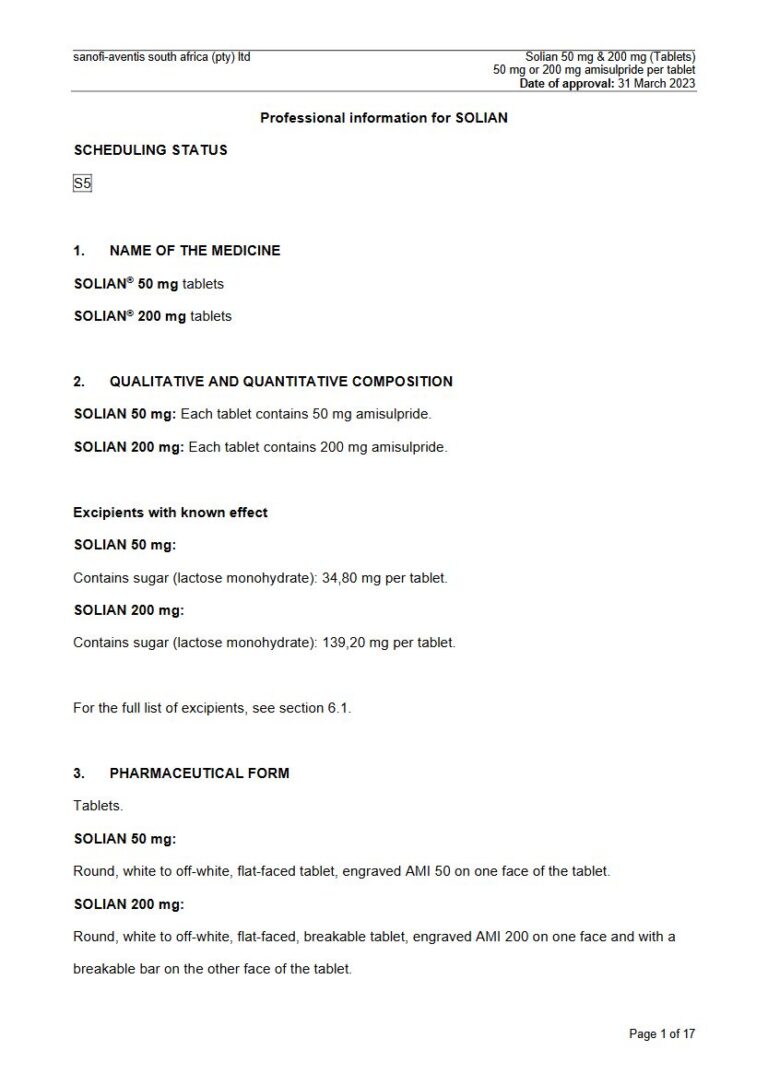
Solian 50mg. 200mg Tablet
PDF Leaflet Revision Date: 31 March 2023
Clinical Summary
Quick overview from the medicine insert
Indication
Treatment of acute and chronic schizophrenia.
Dosage (summary)
Adults: 400-800 mg/day for acute schizophrenia; 50-100 mg/day for predominant negative symptoms.
Special Populations
- Elderly
- Renal impairment
- Hepatic impairment
Pregnancy & Breastfeeding
Not recommended during pregnancy; contraindicated in breastfeeding.
Key Drug Interactions
- Class Ia and III antidysrhythmic medicines
- Levodopa
- CNS depressants
Contraindications
- Hypersensitivity to amisulpride
- Congenital QT-interval prolongation
- Severe renal impairment
- Children under 15 years
Common side effects
- Extrapyramidal symptoms
- Somnolence
- Constipation
- Nausea
Counselling Points
- Monitor for hyperglycaemia symptoms
- Avoid abrupt discontinuation
- Caution with driving or operating machinery
Serious warnings
- Risk of hyperglycaemia
- QT-interval prolongation
- Neuroleptic malignant syndrome
Important Disclaimer
The Solian 50mg. 200mg Tablet professional information leaflet below is the property of Sanofi-Aventis South Africa and is provided on Medinsert exactly as issued, with no.. alterations or editorial changes. We make every effort to keep content current by updating documents as soon as new versions become available. Medinsert serves as a trusted access point for healthcare professionals, but does not replace official sources or clinical judgement. For more details, please read our full disclaimer. read more>>
 Healthcare Professionals Only
This content is for registered healthcare professionals
Sign in or create a free account to read the full package insert.
Free for HPCSA-registered professionals. Powered by Medinsert.
Clinical Particulars
Section 4 of the official insert — extracted exactly as issued, no alterations
4.1 Therapeutic indications
SOLIAN is indicated for the treatment of patients with acute and chronic schizophrenia, including patients characterised by predominant negative symptoms.
4.2 Posology and method of administration
Posology
No specific titration is required when initiating the treatment with SOLIAN and doses should be adjusted according to the individual response. SOLIAN can be administered once daily at oral doses up to 400 mg, higher doses should be administered twice daily. The minimum effective dose should be used.
Adults
For acute schizophrenia: Oral doses between 400 u2013 800 mg/day are recommended. In individual cases, the dose may be increased up to 1 200 mg/day. Doses above 1 200 mg/day have not been evaluated for safety and therefore should not be used.
For patients with mixed positive and negative symptoms: Doses should be adjusted to obtain optimal control of positive symptoms. Maintenance treatment should be established individually with the minimum effective dose.
For patients characterised by predominant negative symptoms: Doses between 50 u2013 100 mg/day are recommended. Doses should be adjusted individually.
Special populations
Paediatric population
The efficacy and safety of SOLIAN from puberty to the age of 18 years have not been established: there are limited data available on the use of SOLIAN in adolescents in schizophrenia. Therefore, the use of SOLIAN from puberty to age of 18 years is not recommended; in children up to puberty SOLIAN is contraindicated (see section 4.3).
Elderly
The safety of SOLIAN has been examined in a limited number of elderly patients. Particular caution should be exercised due to a possible risk of hypotension or sedation. Reduction in dosage may also be required in the presence of renal insufficiency.
Hepatic insufficiency
Since amisulpride, as contained in SOLIAN, is weakly metabolised, a dosage reduction should not be necessary.
Renal impairment
Amisulpride, as contained in SOLIAN, is eliminated by the renal route. In renal insufficiency, the dose should be reduced to half in patients with creatinine clearance (CR CL ) between 30 u2013 60 mL/min and to a third in patients with CR CL between 10 u2013 30 mL/min. As there is no experience in patients with severe renal impairment (CR CL < 10 mL/min), these patients should not use SOLIAN (see section 4.4).
4.3 Contraindications
- Hypersensitivity to amisulpride or to any of the constituents of the formulation (see section 6.1).
- Concomitant use of other medicines that could induce or enhance the risk of torsades de pointes and/or prolong the QT-interval (see sections 4.4 and 4.5).
- Congenital QT-interval prolongation.
- Concomitant prolactin-dependent tumours e.g. pituitary gland prolactinomas and breast cancer (see sections 4.4 and 4.8).
- Phaeochromocytoma.
- Children before the onset of puberty (under 15 years of age).
- Pregnancy and lactation (see section 4.6).
- Women of childbearing potential unless using adequate contraception (see section 4.6).
- Severe renal function impairment (see section 4.2).
- Combination with the following medications which could induce torsades de pointes:
- Class Ia antidysrhythmic medicines, such as quinidine, disopyramide.
- Class III antidysrhythmic medicines, such as amiodarone, sotalol.
- Other medications, such as bepridil, cisapride, sultopride, thioridazine, methadone, IV erythromycin, IV vincamine, halofantrine, pentamidine, sparfloxacin (see section 4.5).
- Combination with levodopa (see section 4.5).
4.4 Special warnings and precautions for use
Hyperglycaemia, in some cases extreme and associated with ketoacidosis or hyperosmolar coma or death, has been reported with some atypical antipsychotic medicines, including SOLIAN. Patients with an established diagnosis of diabetes mellitus, who are started on SOLIAN, should be monitored regularly for worsening of glucose control. Patients with risk factors for diabetes mellitus (e.g. obesity, family history of diabetes) who are starting treatment with SOLIAN should be monitored for symptoms of hyperglycaemia including polydipsia, polyuria, polyphagia and weakness. Patients who develop symptoms of hyperglycaemia during treatment with SOLIAN should undergo fasting blood glucose testing. In some cases, hyperglycaemia may resolve when SOLIAN is discontinued. However, some patients could require continuation of anti-diabetic treatment despite discontinuation of the suspect medicine.
SOLIAN contains lactose, which may have an effect on the glycaemic control of patients with diabetes mellitus. Patients with rare hereditary problems of galactose intolerance, total lactase deficiency or glucose-galactose malabsorption should not take SOLIAN.
Neuroleptic malignant syndrome: a potentially fatal complication, characterised by hyperthermia, muscle rigidity, autonomic instability, altered consciousness, rhabdomyolysis and elevated creatinine phosphokinase (CPK) may occur. In the event of hyperthermia, particularly with high daily doses, all antipsychotic medicines, including SOLIAN, should be discontinued.
Rhabdomyolysis has also been observed in patients without neuroleptic malignant syndrome.
SOLIAN is eliminated by the renal route. In cases of renal insufficiency, the dose should be decreased, or intermittent treatment could be considered (see section 4.2).
SOLIAN may lower the seizure threshold. Therefore, patients with a history of epilepsy should be closely monitored during SOLIAN therapy.
Caution should be exercised when prescribing SOLIAN in patients with Parkinsonu2019s disease since it may cause worsening of the disease. SOLIAN should be used only if neuroleptic treatment cannot be avoided.
Prolongation of the QT-interval SOLIAN induces a dose-dependent prolongation of the QT-interval (see sections 4.4 and 4.8). This effect is known to potentiate the risk of serious ventricular dysrhythmias such as torsade de pointes. Before any administration, and if possible, according to the patientu2019s clinical status, it is recommended to monitor factors which could favour the occurrence of this rhythm disorder, such as for example:
- bradycardia less than 55 bpm,
- patients with known cardiovascular disease or family history of sudden death or QT prolongation,
- electrolyte imbalance, in particular hypokalaemia,
- congenital prolongation of the QT-interval,
- on-going treatment with a medication likely to produce pronounced bradycardia (< 55 bpm), hypokalaemia, decreased intracardiac conduction, or prolongation of the QT-interval.
Stroke
In randomized clinical trials versus placebo performed in a population of elderly patients with dementia and treated with certain atypical antipsychotic medicines, a 3-fold increase of the risk of cerebrovascular events has been observed. The mechanism of such risk increase is not known. An increase in the risk with other antipsychotic medicines, or other populations of patients cannot be excluded. SOLIAN should be used with caution in patients with stroke risk factors.
Elderly patients with dementia
Elderly patients with dementia-related psychosis treated with antipsychotic medicines are at an increased risk of death. Although the cause of death in clinical trials with atypical antipsychotics were varied, most of the deaths appeared to be either cardiovascular (e.g. heart failure, sudden death) or infectious (e.g. pneumonia) in nature. Observational studies suggest that, similar to atypical antipsychotic medicines, treatment with conventional antipsychotic medicines, such as SOLIAN, may increase mortality. The extent to which the findings of increased mortality in observational studies may be attributed to the antipsychotic medicine as opposed to some characteristic(s) of the patients is not clear. In elderly patients, SOLIAN should be used with particular caution because of a possible risk of hypotension or sedation.
Venous thromboembolism (VTE)
Cases of VTE, sometimes fatal, have been reported with antipsychotic medicines. Therefore, SOLIAN should be used with caution in patients with risk factors for thromboembolism. All possible risk factors for VTE should be identified before and during treatment with SOLIAN and preventive measures undertaken (see section 4.8).
Breast cancer
SOLIAN may increase prolactin levels. Therefore, caution should be exercised and patients with a history or a family history of breast cancer should be closely monitored during SOLIAN therapy (see section 4.3).
Benign pituitary tumour
SOLIAN may increase prolactin levels. Cases of benign pituitary tumours such as prolactinoma have been observed during SOLIAN therapy (see section 4.8). In case of very high levels of prolactin or clinical signs of pituitary tumour (such as visual field defect and headache), pituitary imaging should be performed. If the diagnosis of pituitary tumour is confirmed, the treatment with SOLIAN must be stopped (see section 4.3).
Acute withdrawal symptoms including nausea, vomiting and insomnia have been described after abrupt cessation of high doses of antipsychotic medicines. Recurrence of psychotic symptoms may also occur, and the emergence of involuntary movement disorders (such as akathisia, dystonia and dyskinesia) have been reported. Therefore, gradual withdrawal of SOLIAN is advisable.
Leucopenia, neutropenia and agranulocytosis have been reported with antipsychotics, including SOLIAN. Unexplained infections or fever may be evidence of blood dyscrasia and requires immediate haematological investigation (see section 4.8).
4.5 Interaction with other medicines and other forms of interaction
Combinations, which are contraindicated (see section 4.3)
Medications which could induce torsade de pointes:
u2022 Class Ia antidysrhythmic medicines, such as quinidine, disopyramide.
u2022 Class III antidysrhythmic medicines, such as amiodarone, sotalol.
u2022 Other medications, such as bepridil, cisapride, sultopride, thioridazine, methadone, IV erythromycin, IV vincamine, halofantrine, pentamidine, sparfloxacin.
Levodopa: reciprocal antagonism of effects between levodopa and neuroleptics.
Combinations not recommended
u2022 SOLIAN may enhance the central effects of alcohol.
u2022 Medications which enhance the risk of torsade de pointes or could prolong the QT-interval: Bradycardia-inducing medications such as beta-blockers, bradycardia-inducing calcium channel blockers, such as diltiazem and verapamil, clonidine, guanfacine, digoxin.
u2022 Medications, which induce hypokalaemia: hypokalaemic diuretics, stimulant laxatives, IV amphotericin B, glucocorticoids, tetracosactide. Hypokalaemia should be corrected.
u2022 Neuroleptics, such as pimozide, haloperidol, imipramine antidepressants, lithium.
Combinations to be taken into account
u2022 Central nervous system (CNS) depressants including narcotics, anaesthetics, analgesics, sedative H1 antihistamines, barbiturates, benzodiazepines and other anxiolytic medicines, clonidine and derivatives.
u2022 Antihypertensive medicines and other hypotensive medications.
u2022 Co-administration of amisulpride and clozapine may lead to an increase in plasma levels of amisulpride.
4.6 Fertility, pregnancy and lactation
Pregnancy
Amisulpride crosses the placenta. The use of SOLIAN is not recommended during pregnancy and in women of childbearing potential not using effective contraception (see section 4.3). Neonates exposed to antipsychotics, including SOLIAN, during the third trimester of pregnancy are at risk of adverse reactions including extrapyramidal and/or withdrawal symptoms that may vary in severity and duration following delivery (see section 4.8). There have been reports of agitation, hypertonia, hypotonia, tremor, somnolence, respiratory distress, or feeding disorder. Consequently, newborns should be monitored carefully.
Breastfeeding
Amisulpride is excreted in treated women. Breastfeeding is contraindicated (see section 4.3).
Fertility
A decrease in fertility linked to the pharmacological effects of the medicine (prolactin-mediated effect) was observed in treated animals.
4.7 Effects on ability to drive and use machines
Even when used as recommended, SOLIAN may cause somnolence and blurred vision; therefore, the ability to drive vehicles or operate machines may be impaired (see section 4.8).
4.8 Undesirable effects
Side effects have been ranked under headings of frequency using the following convention: Very common: (u2265 1/10); Common: (u2265 1/100; < 1/10); Uncommon (u2265 1/1 000; < 1/100); Rare: (u2265 1/10 000; < 1/1 000); Very Rare: (< 1/10 000); frequency not known (cannot be estimated from the available data).
Blood and lymphatic system disorders
Uncommon: leucopenia, neutropenia (see section 4.4).
Rare: agranulocytosis (see section 4.4).
Immune system disorders
Uncommon: allergic reactions.
Endocrine disorders
Common: increase in plasma prolactin levels, which is reversible after SOLIAN discontinuation. This may result in galactorrhoea, amenorrhoea, gynaecomastia, breast pain or enlargement and erectile dysfunction.
Rare: benign pituitary tumour such as prolactinoma (see section 4.3 and section 4.4).
Metabolism and nutrition disorders
Uncommon: hyperglycaemia (see section 4.4), hypertriglyceridaemia and hypercholesterolaemia.
Rare: hyponatraemia, syndrome of inappropriate antidiuretic hormone secretion (SIADH).
Psychiatric disorders
Common: insomnia, anxiety, agitation, orgasmic dysfunction.
Uncommon: confusion.
Nervous system disorders
Very common: extrapyramidal symptoms (tremor, rigidity, hypersalivation, akathisia, hypokinesia, dyskinesia) may occur. These symptoms are generally mild at optimal dosages and partially reversible without discontinuation of SOLIAN upon administration of antiparkinsonian medicine. The incidence of extrapyramidal symptoms is dose related.
Common: somnolence, acute dystonia (spasm torticollis, oculogyric crisis, trismus). This is reversible without discontinuation of SOLIAN upon treatment with an antiparkinsonian medicine.
Uncommon: tardive dyskinesia, characterised by rhythmic, involuntary movements primarily of the tongue and/or face has been reported. Antiparkinsonian medication may induce aggravation of these symptoms. Seizures.
Rare: neuroleptic malignant syndrome, which is a potentially fatal complication (see section 4.4).
Frequency not known: restless legs syndrome with or without a context of akathisia.
Eye disorders
Common: blurred vision (see section 4.7).
Cardiac disorders
Uncommon: bradycardia.
Rare: QT interval prolongation, ventricular dysrhythmias, such as torsade de pointes, ventricular tachycardia, ventricular fibrillation, cardiac arrest, sudden death (see section 4.4).
Vascular disorders
Common: hypotension.
Uncommon: increase in blood pressure.
Rare: venous thromboembolism, including pulmonary embolism, sometimes fatal, and deep vein thrombosis (see section 4.4).
Respiratory, thoracic and mediastinal disorders
Uncommon: nasal congestion, pneumonia aspiration (mainly in association with other antipsychotics and CNS depressants).
Gastrointestinal disorders
Common: constipation, nausea, vomiting, dry mouth.
Hepatobiliary disorders
Uncommon: hepatocellular injury.
Skin and subcutaneous tissue disorders
Rare: angioedema; urticaria.
Frequency not known: photosensitivity reaction.
Musculoskeletal and connective tissue disorders
Uncommon: osteopenia, osteoporosis.
Frequency not known: rhabdomyolysis (see section 4.4).
Renal and urinary disorders
Uncommon: urinary retention
Pregnancy, puerperium and perinatal conditions
Frequency not known: neonatal medicine withdrawal syndrome (see section 4.6)
Investigations
Common: weight gain
Uncommon: elevations of hepatic enzymes, mainly transaminases
Frequency not known: blood creatine phosphokinase increased (see section 4.4).
Injury, poisoning and procedural complications
Frequency not known: fall as a consequence of adverse reactions compromising body balance.
Reporting of suspected adverse reactions
Reporting suspected adverse reactions after authorisation of SOLIAN is important. It allows continued monitoring of the benefit/risk balance of SOLIAN. Health care providers are asked to report any suspected adverse reactions to:
u2022 The Pharmacovigilance Unit at Sanofi: [email protected] (email) or 011 256-3700 (tel.), or
u2022 SAHPRA via the 6.04 Adverse Drug Reaction Reporting Form, found online under SAHPRAu2019s publications: https://www.sahpra.org.za/Publications/Index/8.
4.9 Overdose
Experience with SOLIAN in overdosage is limited. Exaggeration of the known pharmacological effects of SOLIAN has been reported, including drowsiness and sedation, coma, hypotension and extrapyramidal symptoms. Fatal outcomes have been reported mainly in combination with other psychotropics. In case of acute overdosage, the possibility of multiple medicine intake should be considered. Since SOLIAN is weakly dialysed, haemodialysis should not be used to eliminate the medicine. There is no specific antidote. Appropriate supportive measures should therefore be instituted: close supervision of vital functions and continuous cardiac monitoring (risk of prolongation of QT-interval) until the patient recovers. If severe extrapyramidal symptoms occur, anticholinergic medicines should be administered.
