
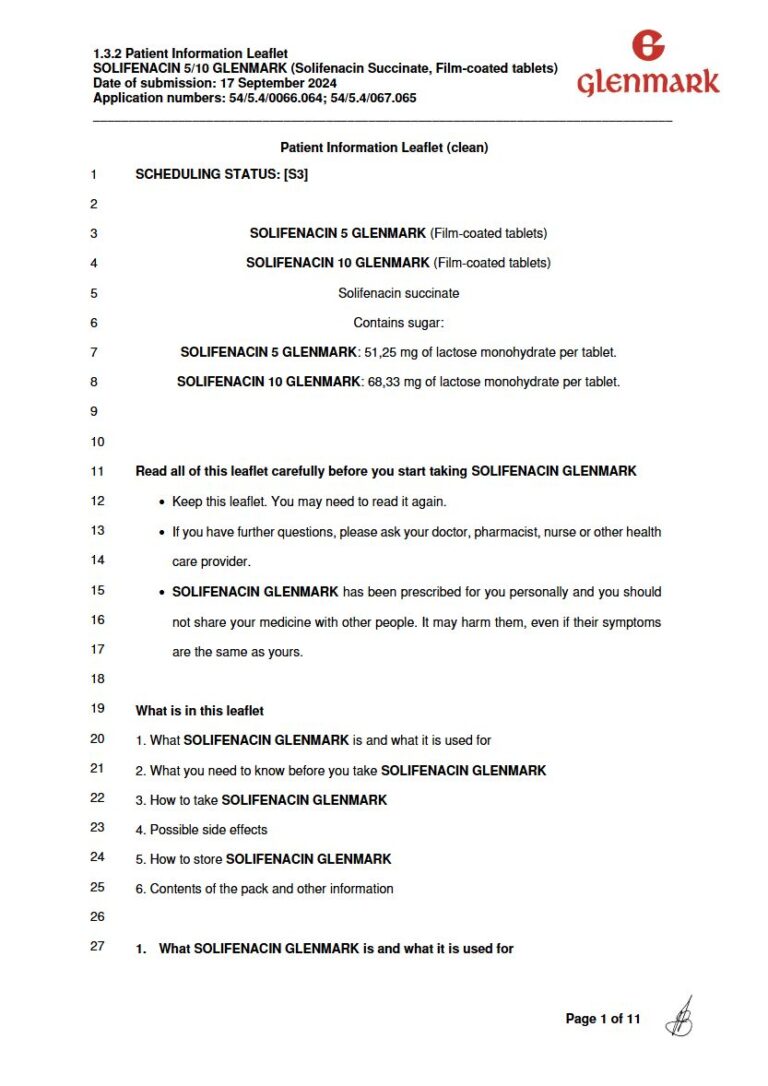
Solifenacin 5 & 10 Glenmark 5 mg, 10 mg Fim-coated tablets
PDF Leaflet Revision Date: 17 September 2024
Clinical Summary
Quick overview from the medicine insert
Indication
Treatment of overactive bladder syndrome.
Dosage (summary)
5 mg daily, may increase to 10 mg.
Special Populations
- Elderly
- Renal impairment
- Hepatic impairment
Pregnancy & Breastfeeding
Contraindicated in pregnancy and breastfeeding.
Key Drug Interactions
- Anticholinergic medicines
- Cholinergic receptor agonists
- Ketoconazole
Contraindications
- Hypersensitivity to solifenacin
- Inability to pass water
- Uncontrolled narrow angle glaucoma
- Myasthenia gravis
- Toxic megacolon
- Severe kidney disease
- Severe liver disease
- Fast, irregular heartbeats
Common side effects
- Blurred vision
- Dry mouth
- Constipation
- Nausea
- Dyspepsia
Counselling Points
- Take with or without food.
- Do not crush or chew tablets.
- Avoid driving if affected.
Serious warnings
- Risk of confusion in elderly
- Angioedema
- Potentially life-threatening allergic reactions
Important Disclaimer
The Solifenacin 5 & 10 Glenmark 5 mg, 10 mg Fim-coated tablets professional information leaflet below is the property of Glenmark Pharmaceuticals South Africa and is provided on Medinsert exactly as issued, with no.. alterations or editorial changes. We make every effort to keep content current by updating documents as soon as new versions become available. Medinsert serves as a trusted access point for healthcare professionals, but does not replace official sources or clinical judgement. For more details, please read our full disclaimer. read more>>
 Healthcare Professionals Only
This content is for registered healthcare professionals
Sign in or create a free account to read the full package insert.
Free for HPCSA-registered professionals. Powered by Medinsert.
Clinical Particulars
Section 4 of the official insert — extracted exactly as issued, no alterations
4.1 Therapeutic indications
SOLIFENACIN GLENMARK belongs to a group of medicines known as anticholinergics. It is used to treat the symptoms of a condition called overactive bladder syndrome, including the following:
- A frequent need to urinate (usually defined as needing to go more than 8 times in 24 hours)
- Sudden frequent urges to urinate (urinary urgency) and/or
- Leaking accidents (urinary incontinence or urge incontinence).
4.2 Posology and method of administration
The usual dose is 5 mg daily taken with or without food. Your doctor may increase your dose to 10 mg daily. You should swallow the tablet whole with some liquid. Do not crush or chew the tablets.
4.3 Contraindications
Do not take SOLIFENACIN GLENMARK:
- If you are hypersensitive (allergic) to solifenacin succinate or any of the other ingredients of SOLIFENACIN GLENMARK (see section 6)
- If you have an inability to pass water or to empty your bladder completely
- If you have uncontrolled increased pressure inside of your eyes (uncontrolled narrow angle glaucoma)
- If you suffer from myasthenia gravis, a muscle disease which can cause extreme weakness of certain muscles, difficulty swallowing, eye weakness and facial expression weakness
- If you have a severe bowel condition causing your intestines to expand or dilate known as toxic megacolon (a complication associated with ulcerative colitis)
- If you are undergoing kidney dialysis (a process used to clean your blood when your kidneys are not functioning normally)
- If you have a severe liver disease
- If you suffer from a severe kidney disease or a moderate liver disease and you are being treated with medicines that may decrease the removal of SOLIFENACIN GLENMARK from your body (such as ketoconazole, used to treat fungal infections)
- If you have fast, irregular heartbeats
- If you are pregnant or breastfeeding your baby
4.4 Special warnings and precautions for use
Special care should be taken with SOLIFENACIN GLENMARK:
- If you have trouble emptying your bladder (bladder obstruction) or have difficulty in passing urine (weak urine flow)
- If you have some obstruction of your digestive system (such as constipation)
- If you are at risk of your digestive system slowing down (decreased stomach and bowel movements)
- If you have a condition causing inflammation or ulcers on the lining of your intestines, known as ulcerative colitis (diarrhoea, pain or cramping in your stomach area, loss of body mass or uncomfortable or painful bowel movements)
- If you suffer from a severe kidney disease
- If you have a moderate liver disease
- If you are taking ketoconazole (see Taking other medicines with SOLIFENACIN GLENMARK)
- If you are male and you have an enlarged prostate which is causing difficulty to urinate
- If you have a fever or increased body temperature
- If you have any other heart condition, or you have to have a heart procedure done, that causes your heart to beat faster than normal
- If you have had a heart attack
- If you have high blood pressure
- If you have Downu2019s syndrome or albinism (absence of pigment in your skin)
- If you are an elderly person. SOLIFENACIN GLENMARK may cause confusion.
- If you have angioedema (a skin allergy that results in swelling that occurs in the tissue just below the surface of your skin) with difficulty in breathing. Stop SOLIFENACIN GLENMARK immediately and contact a doctor
- If you have a nervous disorder that is causing bladder problems
4.5 Interactions with other medicines
Always tell your healthcare provider if you are taking any other medicine. Always tell your healthcare provider if you are using, have recently used or might use any other medicines. (This includes all complementary or traditional medicines.) If you are taking any of the following medicines, check with your doctor or pharmacist first before taking SOLIFENACIN GLENMARK:
- Medicines belonging to the same class as SOLIFENACIN GLENMARK (anticholinergic medicines) as the effect and side effects of both medicines may be enhanced. An interval of approximately one week should be allowed after stopping treatment with SOLIFENACIN GLENMARK before starting other anticholinergic medicines.
- Medicines belonging to a different class which has the opposite effect of SOLIFENACIN GLENMARK (cholinergic receptor agonists), as they can reduce the effect of SOLIFENACIN GLENMARK.
- SOLIFENACIN GLENMARK can reduce the effect of medicines that stimulate the movement of the digestive tract e.g. metoclopramide (used to treat nausea and vomiting) or cisapride (used to increase the movement of food in your gastrointestinal tract).
- Medicines that decrease the removal of SOLIFENACIN GLENMARK from the body e.g. ketoconazole (used to treat fungal infections).
4.6 Fertility, pregnancy and lactation
Pregnancy: Do not use SOLIFENACIN GLENMARK if you are pregnant, think that you may be pregnant or want to become pregnant, as it may harm your unborn baby. If you are pregnant or planning a pregnancy it is very important that you discuss this with your doctor before you receive any treatment. If you get pregnant during your treatment, you must immediately inform your doctor.
Breastfeeding: You must not breastfeed your baby while you are treated with SOLIFENACIN GLENMARK because it passes into breast milk and could affect the baby. If you are pregnant or breastfeeding your baby, please consult your doctor, pharmacist or other healthcare professional for advice before you take SOLIFENACIN GLENMARK.
4.7 Effects on ability to drive and use machines
SOLIFENACIN GLENMARK may cause side effects, such as blurred vision and dizziness and may impair your ability to drive and use machines or perform other skilled tasks. Take special care before performing tasks requiring your attention, until you know how SOLIFENACIN GLENMARK will affect you. It is not always possible to predict to what extent SOLIFENACIN GLENMARK may interfere with your daily activities. You should ensure that you do not engage in the above activities until you are aware of the measure to which SOLIFENACIN GLENMARK affects you.
4.8 Undesirable effects
SOLIFENACIN GLENMARK can have side effects. Not all side effects reported for SOLIFENACIN GLENMARK are included in this leaflet. Should your general health worsen or if you experience any untoward effects while taking SOLIFENACIN GLENMARK, please consult your healthcare provider for advice. If any of the following happens, stop taking SOLIFENACIN GLENMARK and tell your doctor immediately or go to the casualty department at your nearest hospital:
- A severe, potentially life-threatening allergic reaction (anaphylaxis) which can present as swelling of the face and throat area, skin rash, nausea, vomiting, difficulty breathing and shock. These are all very serious side effects. If you have them, you may have had a serious reaction to SOLIFENACIN GLENMARK. You may need urgent medical attention or hospitalisation.
Tell your doctor immediately or go to the casualty department at your nearest hospital if you notice the following:
- Erythema Multiforme (a skin reaction that can be triggered by an infection or some medicines). These are all serious side effects. You may need urgent medical attention.
Tell your doctor if you notice any of the following:
Frequent side effects:
- Blurred vision (loss of sharpness of eyesight)
- Dry mouth
- Constipation (Passing less than three bowel movements a week or has difficult bowel movements)
- Nausea (a queasy sensation including an urge to vomit)
- Dyspepsia (upper abdominal discomfort such as a burning sensation, bloating or gassiness, nausea or feeling full too quickly after starting to eat)
- Abdominal pain (stomach pain)
Less frequent side effects:
- Urinary tract infection (an infection in any part of the urinary system, the kidneys, bladder or urethra)
- Cystitis (inflammation of the bladder)
- Hallucinations (seeing or hearing things that are not real)
- Confusional state (serious disturbance in mental abilities that results in confused thinking and reduced awareness of surroundings)
- Somnolence (sleepiness, drowsiness)
- Dysgeusia (altered perception of taste)
- Dizziness (altered sense of balance and place, possibly described as lightheaded, feeling faint or as if head is spinning)
- Headache (a painful sensation in any part of the head, ranging from sharp to dull)
- Nasal dryness
- Gastro-oesophageal reflux diseases
- Dry throat
- Obstruction of your colon
- Faecal impaction (hardened stool that's stuck in the rectum or lower colon due to chronic constipation)
- Dry skin
- Pruritus (an uncomfortable, irritating sensation that creates an urge to scratch that can involve any part of the body)
- Rash (widespread eruptions or skin lesions)
- Urticaria (a raised, itchy rash that appears on the skin)
Side effects with unknown frequency:
- Decreased appetite
- Hyperkalaemia (high level potassium in the blood)
- Delirium (serious disturbance in mental abilities that results in confused thinking and reduced awareness of surroundings)
- Glaucoma (a group of eye disorders causing blindness)
- Torsade de Pointes (disturbance of the heartu2019s rhythm)
- Electrocardiogram QT prolonged
- Dysphonia (disorders of the voice)
- Ileus (a temporary lack of the normal muscle contractions of the intestines)
- Abdominal discomfort
- Liver disorder, liver function test abnormal
- Exfoliative dermatitis (a severe skin condition that causes extreme shedding of the top layers of your skin)
- Muscle weakness
- Renal impairment (kidney failure or damage)
If you notice any side effects not mentioned in this leaflet, please inform your doctor or pharmacist.
4.9 Overdose
In the event of an overdosage you may experience any of the side effects listed below:
- Headache
- Dry mouth
- Dizziness
- Drowsiness
- Blurred vision
In the event of overdosage, consult your doctor or pharmacist. If neither is available, consult the nearest hospital or poison centre.
