
Soliqua 100 units Solution
PDF Leaflet Revision Date: 19 September 2024
Clinical Summary
Quick overview from the medicine insert
Indication
For treatment of adults with type 2 diabetes mellitus to improve glycaemic control.
Dosage (summary)
Administer subcutaneously once daily, titrate based on clinical response; max 60 units.
Special Populations
- Elderly patients
- Hepatic impairment
- Renal impairment
Pregnancy & Breastfeeding
Contraindicated in pregnancy and lactation.
Key Drug Interactions
- Oral antidiabetics
- Corticosteroids
- Sulphonylureas
Contraindications
- Hypersensitivity to components
- Hypoglycaemia
- Acute pancreatitis
- Severe renal impairment
- Pregnancy
- Lactation
Common side effects
- Hypoglycaemia
- Nausea
- Diarrhoea
- Vomiting
Counselling Points
- Rotate injection sites
- Monitor blood glucose regularly
- Recognize symptoms of hypoglycaemia
Serious warnings
- Risk of pancreatitis
- Hypoglycaemia risk
- Injection site reactions
Important Disclaimer
The Soliqua 100 units Solution professional information leaflet below is the property of Sanofi-Aventis South Africa and is provided on Medinsert exactly as issued, with no.. alterations or editorial changes. We make every effort to keep content current by updating documents as soon as new versions become available. Medinsert serves as a trusted access point for healthcare professionals, but does not replace official sources or clinical judgement. For more details, please read our full disclaimer. read more>>
 Healthcare Professionals Only
This content is for registered healthcare professionals
Sign in or create a free account to read the full package insert.
Free for HPCSA-registered professionals. Powered by Medinsert.
Clinical Particulars
Section 4 of the official insert — extracted exactly as issued, no alterations
4.1 Therapeutic indications
SOLIQUA is indicated for the treatment of adults with type 2 diabetes mellitus to improve glycaemic control when oral glucose-lowering medicines alone or combined with basal insulin, or basal insulin alone, do not provide adequate glycaemic control.
4.2 Posology and method of administration
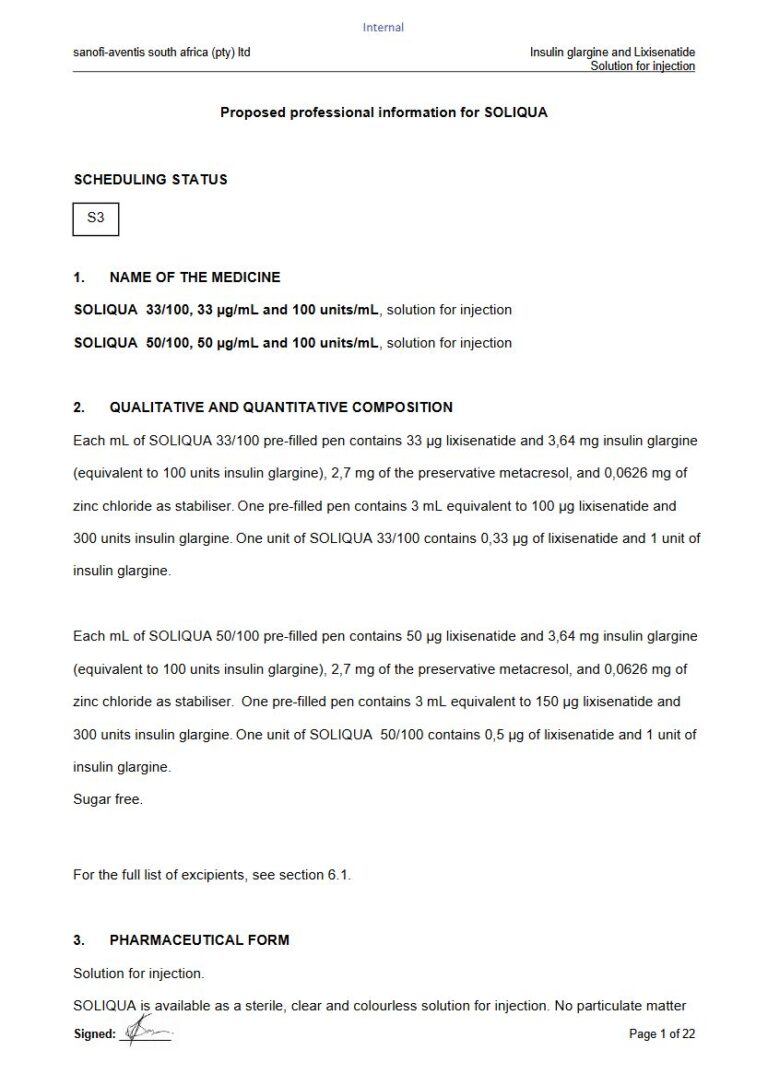
SOLIQUA is titratable and available in two pens, providing different dosing options. The differentiation between the pen strengths is based on the dose range of the pen:
- SOLIQUA 50/100 (10 u2013 40 pen):
- 1 unit of SOLIQUA contains 0,5 u03bcg lixisenatide and 1 unit of insulin glargine
- Allows daily doses between 10 and 40 units of SOLIQUA (10 to 40 units of insulin glargine in combination with 5 to 20 u03bcg lixisenatide)
- SOLIQUA 33/100 (30 u2013 60 pen):
- 1 unit of SOLIQUA contains 0,33 u03bcg lixisenatide and 1 unit of insulin glargine
- Allows daily doses between 30 and 60 units of SOLIQUA (30 to 60 units insulin glargine in combination with 10 to 20 u03bcg lixisenatide).
To avoid medicine errors, make sure the correct SOLIQUA pen, (10 u2013 40) pen or (30 u2013 60) pen, is stated in the prescription. The maximum daily dose of SOLIQUA is 60 units of SOLIQUA (60 units insulin glargine and 20 u03bcg lixisenatide). SOLIQUA should be administered subcutaneously once a day within 1 hour prior to any meal.
Posology
The dose of SOLIQUA must be individualised based on clinical response and is titrated based on the patientu2019s need for insulin. The lixisenatide dose is increased or decreased along with insulin glargine dose and also depends on which pen is used. Patients adjusting the amount or timing of dosing with SOLIQUA should only do so under medical guidance with appropriate glucose monitoring.
Initiation of SOLIQUA
Starting dose of SOLIQUA Treatment with basal insulin or glucagon-like peptide-1 (GLP-1) receptor agonist or oral glucose-lowering medicine should be discontinued prior to initiation of SOLIQUA. The starting dose of SOLIQUA is selected based on previous anti-diabetic treatment and in order not to exceed the recommended lixisenatide starting dose of 10 u03bcg:
Table 1. Starting dose of SOLIQUA
Previous treatment
Insulin nau00efve patients (Oral anti-diabetic treatment or GLP-1 receptor agonist)
Insulin glargine (100 units/mL)**
- <20 units
- u2265 20 to < 30 units
- u2265 30 to u2264 60 units
Starting dose and Pen
SOLIQUA 50/100 (10 u2013 40) pen
- 10 units (10 units/5 u03bcg)*
- 20 units (20 units /10 u03bcg)*
SOLIQUA 33/100 (30 u2013 60) pen
- 30 units (30 units /10 u03bcg)*
* units insulin glargine (100 units/mL)/lixisenatide (u03bcg)
** If a different basal insulin was taken:
- For twice daily basal insulin or insulin glargine (300 units/mL), the total daily dose previously used should be reduced by 20,0 % to choose the SOLIQUA starting dose.
- For any other basal insulin, the same rule as for insulin glargine (100 units/mL) should be applied.
Dosage titration of SOLIQUA
SOLIQUA is to be dosed in accordance with the individual patientu2019s needs for insulin. It is recommended to optimise glycaemic control via dose adjustment based on fasting self-monitored plasma glucose. Close glucose monitoring is recommended during the initiation and in the following weeks.
- If the patient starts with the SOLIQUA (10 u2013 40) pen, the dose may be titrated up to 40 units with this pen.
- For total daily doses > 40 units/day switch to the SOLIQUA (30 u2013 60) pen.
- If the patient starts with the SOLIQUA (30 u2013 60) pen, the dose may be titrated up to 60 units with this pen.
- For total daily doses > 60 units/day, do not use SOLIQUA.
Special populations
Children
The safety and effectiveness of SOLIQUA in paediatric patients below the age of 18 years have not been established.
Elderly patients (u2265 65 years old)
SOLIQUA can be used in elderly patients. Dose should be adjusted on an individual basis, based on glucose monitoring. The therapeutic experience in patients u2265 75 years of age is limited.
Hepatic impairment
The effect of hepatic impairment on the pharmacokinetics of SOLIQUA has not been studied. In patients with hepatic impairment, insulin requirements may be diminished due to reduced capacity of gluconeogenesis and reduced insulin metabolism. Frequent glucose monitoring and dose adjustment of SOLIQUA may be necessary in patients with hepatic impairment.
Renal impairment
There is no therapeutic experience with use of lixisenatide in patients with severe renal impairment (creatinine clearance less than 30 mL/min) or end-stage renal disease and, therefore, it is not recommended to use lixisenatide in these populations. In patients with renal impairment, insulin requirements may be diminished due to reduced insulin metabolism. Frequent glucose monitoring and dose adjustment of SOLIQUA may be necessary in patients with renal impairment.
Method of administration
Administration is a subcutaneous injection in either the abdomen, deltoid or thigh. The injection site should be rotated within the same region (abdomen, deltoid or thigh) from one injection to the next to reduce the risk of lipodystrophy and cutaneous amyloidosis (see section 4.4 and 4.8). Do not inject into areas of lipodystrophy and cutaneous amyloidosis.
4.3 Contraindications
SOLIQUA is contraindicated in:
- patients with known hypersensitivity to lixisenatide, insulin glargine or to any of the other ingredients listed in section 6.1
- during episodes of hypoglycaemia
- acute pancreatitis
- severe renal impairment (creatinine clearance < 30 mL/min) or end-stage renal disease
- pregnancy and/or lactation (see section 4.6).
4.4 Special warnings and precautions for use
Use of SOLIQUA
SOLIQUA should not be used in patients with type 1 diabetes mellitus or for the treatment of diabetic ketoacidosis.
Risk of pancreatitis
Use of glucagon-like peptide-1 (GLP-1) receptor agonists, as in SOLIQUA, have been associated with a risk of developing acute pancreatitis. Patients should be informed of the characteristic symptoms of acute pancreatitis: persistent, severe abdominal pain. If pancreatitis is suspected, SOLIQUA should be discontinued; if acute pancreatitis is confirmed, SOLIQUA should not be restarted (see section 4.3). Use with caution in patients with a history of pancreatitis.
Lipodystrophy and cutaneous amyloidosis
Patients must be instructed to perform continuous rotation of the injection site to reduce the risk of developing lipodystrophy and cutaneous amyloidosis. There is a potential risk of delayed insulin absorption and worsened glycaemic control following insulin injections at sites with these reactions. A sudden change in the injection site to an unaffected area has been reported to result in hypoglycaemia. Blood glucose monitoring is recommended after the change in the injection site, and dose adjustment of antidiabetic medications may be considered.
Hypoglycaemia
Hypoglycaemia was the most frequently reported observed undesirable adverse reaction during treatment with SOLIQUA. Hypoglycaemia may occur if the dose of SOLIQUA is higher than required. Factors increasing the susceptibility to hypoglycaemia require particularly close monitoring and may necessitate dose adjustment. These factors include:
- change in the injection area
- improved insulin sensitivity (e.g. by removal of stress factors)
- uncustomed, increased or prolonged physical activity
- undercurrent illness (e.g. vomiting, diarrhoea)
- inadequate food intake
- missed meals
- alcohol consumption
- certain uncompensated endocrine disorders, (e.g. in hypothyroidism and in anterior pituitary or adrenocortical insufficiency)
- concomitant treatment with certain other medicines (see section 4.5)
- lixisenatide and/or insulin in combination with a sulfonylurea may result in an increased risk of hypoglycaemia. Therefore SOLIQUA should not be given in combination with a sulfonylurea.
The dose of SOLIQUA must be individualised based on clinical response and titrated based on the patientu2019s need for insulin (see section 4.2).
Acute gallbladder disease
The use of glucagon-like peptide-1 (GLP-1) receptor agonists has been associated with acute gallbladder disease. Acute gallbladder events such as cholelithiasis or cholecystitis have been reported in patients treated with lixisenatide although a causal relationship has not been established. Patients should be informed of the characteristic symptoms of acute gallbladder disease such as upper abdominal pain, fever, nausea, vomiting, and jaundice. If cholelithiasis is suspected, gallbladder exams and follow up are indicated.
Use in patients with severe gastroparesis
The use of GLP-1 receptor agonists is associated with gastrointestinal adverse reactions. SOLIQUA has not been studied in patients with severe gastrointestinal diseases, including severe gastroparesis, and therefore, the use of SOLIQUA is not recommended in these patients.
Renal impairment
There is no therapeutic experience in patients with severe renal impairment (creatinine clearance < 30 mL/min) or end-stage renal disease. The use of SOLIQUA is not recommended in patients with severe renal impairment or end-stage renal disease (see sections 4.2 and 4.3).
Concomitant use with other medicines
The delay of gastric emptying with lixisenatide may reduce the rate of absorption of orally administered medicines. SOLIQUA should be used with caution in patients receiving oral medicines that require rapid gastrointestinal absorption, careful clinical monitoring or have a narrow therapeutic ratio.
Dehydration
Patients treated with SOLIQUA should be advised of the potential risk of dehydration in relation to gastrointestinal adverse reactions and take precautions to avoid fluid depletion.
Antibody formation
Administration of SOLIQUA may cause formation of antibodies against insulin glargine and/or lixisenatide. The presence of such antibodies may necessitate adjustment of the SOLIQUA dose in order to correct a tendency for hyper- or hypoglycaemia.
Excipients with known effect
SOLIQUA contains less than 1 mmol (23 mg) sodium per dose, that is to say essentially sodium free. SOLIQUA contains metacresol, which may cause allergic reactions.
4.5 Interaction with other medicines and other forms of interaction
A number of substances affect glucose metabolism and may require dose adjustment of SOLIQUA.
Insulin glargine
Substances that may increase the blood glucose lowering effect and susceptibility to hypoglycaemia: oral antidiabetics; ACE inhibitors; salicylates; disopyramide; fibrates; fluoxetine; MAO inhibitors; pentoxifylline; propoxyphene; sulphonamide antibiotics.
Substances that may reduce the blood glucose-lowering effect: corticosteroids, danazol, diazoxide, diuretics, sympathomimetic agents (e.g. adrenaline [epinephrine], salbutamol, terbutaline), glucagon, isoniazid, phenothiazine derivatives, somatropin, thyroid hormones, oestrogens and progestogens (e.g. in oral contraceptives), protease inhibitors and atypical antipsychotic medicines (e.g. olanzapine and clozapine).
Beta-blockers, clonidine, lithium salts and alcohol may either potentiate or weaken the blood glucose-lowering effect of SOLIQUA. Pentamidine may cause hypoglycaemia, which may sometimes be followed by hyperglycaemia. In addition, under the influence of sympatholytic medicines such as beta-blockers, clonidine and reserpine, the signs of adrenergic counter-regulation may be reduced or absent.
Lixisenatide
Lixisenatide is a peptide and is not metabolised by cytochrome P450. In vitro studies, lixisenatide did not affect the activity of cytochrome P450 isozymes or human transporters tested.
Effect of gastric emptying on oral medicines
Lixisenatide delays gastric emptying which may reduce the rate of absorption of orally administered medicines. Use caution when co-administering oral medicines with a narrow therapeutic ratio or that require careful clinical monitoring. If such medicines are to be administered with food, patients should be advised to take them with a meal or snack when lixisenatide is not administered. Oral medicines that are particularly dependent on threshold concentrations for efficacy, such as antibiotics, should be administered at least 1 hour before or 11 hours after SOLIQUA injection.
Paracetamol
Paracetamol was used as a model medicine to evaluate the effect of lixisenatide gastric emptying. Lixisenatide 10 u03bcg did not change the overall exposure (AUC) of paracetamol following administration of a single dose of paracetamol 1 000 mg, whether before or after lixisenatide. No effects on paracetamol C max and t max were observed when paracetamol was administered 1 hour before lixisenatide. When administered 1 or 4 hours after 10 u03bcg lixisenatide, C max of paracetamol was decreased by 29 % and 31 %, respectively, and median t max was delayed by 2 and 1,75 hours, respectively. Based on these results, no dose adjustment for paracetamol is required.
Oral contraceptives
Following administration of a single dose of an oral contraceptive medicine (ethinylestradiol 0,03 mg/levonorgestrel 0,15 mg) 1 hour before or 11 hours after 10 u03bcg lixisenatide, the C max, AUC, tu00bd and t max of ethinylestradiol and levonorgestrel were unchanged. Administration of the oral contraceptives 1 hour or 4 hours after lixisenatide did not affect AUC and tu00bd of ethinylestradiol and levonorgestrel, whereas C max of ethinylestradiol was decreased by 52 % and 39 %, respectively, and C max of levonorgestrel was decreased by 46 % and 20 %, respectively and median t max was delayed by 1 to 3 hours. Based on these results, no dose adjustment for oral contraceptives is required. It is recommended that oral contraceptives be administered at least 1 hour before or at least 11 hours after SOLIQUA administration.
Atorvastatin
When lixisenatide 20 u03bcg and atorvastatin 40 mg were co-administered in the morning for 6 days, the exposure of atorvastatin was not affected, while C max was decreased by 31 % and t max was delayed by 3,25 hours. No such increase for t max was observed when atorvastatin was administered in the evening and lixisenatide in the morning but the AUC and C max of atorvastatin were increased by 27 % and 66 %, respectively. These changes are not clinically relevant and therefore, no dose adjustment for atorvastatin is required when co-administered with SOLIQUA. However, because of the delay in t max, patients taking atorvastatin should be advised to take atorvastatin at least 1 hour before or 11 hours after SOLIQUA administration.
Warfarin and other coumarin derivatives
After concomitant administration of warfarin 25 mg with repeated dosing of lixisenatide 20 u03bcg, there were no effects on AUC and INR (international normalised ratio) while C max was reduced by 19 % and t max was delayed by 7 hours. Based on these results, no dose adjustment is required for warfarin when co-administered with SOLIQUA.
Digoxin
After concomitant administration of lixisenatide 20 u03bcg and digoxin 0,25 mg at steady state, the AUC of digoxin was not affected. The t max of digoxin was delayed by 1,5 hours and the C max was reduced by 26 %. Based on these results, no dose adjustment for digoxin is required when co-administered with SOLIQUA.
Ramipril
After concomitant administration of lixisenatide 20 u03bcg and ramipril 5 mg for 6 days, the AUC of ramipril was increased by 21 % while the C max was decreased by 63 %. The AUC and C max of the active metabolite (ramiprilat) were not affected. The t max of ramipril and ramiprilat were delayed by approximately 2,5 hours. Based on these results, no dose adjustment for ramipril is required when co-administered with SOLIQUA.
4.6 Fertility, pregnancy and lactation
Pregnancy
SOLIQUA is contraindicated during pregnancy (see section 4.3). If a patient wishes to become pregnant, or pregnancy occurs, treatment with SOLIQUA should be discontinued.
Lactation
SOLIQUA is contraindicated during breastfeeding (see section 4.3).
4.7 Effects on ability to drive and use machines
SOLIQUA has no or negligible influence on the ability to drive a vehicle or use machines. The patientu2019s ability to concentrate and react may be impaired as a result of hypoglycaemia or hyperglycaemia or, for example, as a result of visual impairment. This may constitute a risk in situations where these abilities are of special importance (e.g. driving a car or operating machines). Patients should be advised to take precautions to avoid hypoglycaemia whilst driving a vehicle or operating machines. This is particularly important in those who have reduced or absent awareness of the warning symptoms of hypoglycaemia or have frequent episodes of hypoglycaemia. The advisability of driving should be considered in these circumstances.
4.8 Undesirable effects
The SOLIQUA phase 3 clinical studies included 834 patients treated with SOLIQUA. The most frequently reported undesirable side effects during treatment with SOLIQUA were hypoglycaemia and gastrointestinal side effects. The following CIOMS frequency rating is used, when applicable: Very common u2265 10 %; Common u2265 1 % and < 10 %; Uncommon u2265 0,1 % and < 1 %; Rare u2265 0,01 % and < 0,1 %; Very rare < 0,01 %; Unknown (cannot be estimated from available data).
Infections and infestations:
- Uncommon: nasopharyngitis, upper respiratory tract infection
Immune system disorders:
- Uncommon: urticaria
Metabolism and nutrition disorders:
- Very common: hypoglycaemia
Nervous system disorders:
- Common: dizziness
- Uncommon: headache
Gastrointestinal disorders:
- Common: nausea, diarrhoea, vomiting
- Uncommon: dyspepsia, abdominal pain
- Rare: delayed gastric emptying
- Not known: intestinal obstruction
Skin and subcutaneous tissue disorders:
- Not known: cutaneous amyloidosis, lipodystrophy
General disorders and administration site conditions:
- Uncommon: fatigue, injection site reactions.
Hypoglycaemia: Severe hypoglycaemia attacks, especially if recurrent, may lead to neurological damage. Prolonged or severe hypoglycaemic episodes may be life-threatening. In many patients, the signs and symptoms of neuroglycopenia are preceded by signs of adrenergic counter-regulation. Generally, the greater and more rapid the decline in blood glucose, the more marked is the phenomenon of counter-regulation and its symptoms.
Gastrointestinal disorders: Gastrointestinal side effects (nausea, vomiting and diarrhoea) were frequently reported side effects during the treatment period. In patients treated with SOLIQUA, the incidence of related nausea, diarrhoea and vomiting was 8,4 %, 2,2 % and 2,2 %, respectively. Gastrointestinal side effects were mostly mild and transient in nature. In patients treated with lixisenatide, the incidence of related nausea, diarrhoea and vomiting was 22,3 %, 3,0 % and 3,9 %, respectively.
Skin and subcutaneous tissue disorders: Subcutaneous administration of injectable products containing insulin could result in lipoatrophy (depression in the skin) or lipohypertrophy (enlargement or thickening of tissue) and cutaneous amyloidosis at the injection site. The injection sites should be rotated within the same region (abdomen, thigh, or deltoid) from one injection to the next to reduce the risk of lipodystrophy and cutaneous amyloidosis (see section 4.4).
Immune system disorders: Allergic reactions (urticarial) possibly related to SOLIQUA has been reported in 0,3 % of patients. Cases of generalised allergic reaction including anaphylactic reaction and angioedema have been reported during marketed use of insulin glargine and lixisenatide. Immunogenicity: Administration of SOLIQUA may cause formation of antibodies against insulin glargine and/or lixisenatide. The incidence of formation of anti-insulin glargine antibodies was 21 % and 26,2 %. In approximately 93 % of the patients, anti-insulin glargine antibodies showed cross-reactivity to human insulin. The incidence of formation of anti-lixisenatide antibodies was approximately 43 %. Neither status for anti-insulin glargine antibodies nor for anti-lixisenatide antibodies had a clinically relevant impact on safety or efficacy. Injection site reactions: Some patients taking insulin-containing therapy, including SOLIQUA, have experienced erythema, local oedema, and pruritus at the site of injection.
Reporting of suspected adverse reactions
Reporting suspected adverse reactions after authorisation of SOLIQUA is important. It allows continued monitoring of the benefit/risk balance of the medicine. Health care providers are asked to report any suspected adverse reactions to the South African Health Products Regulatory Authority (SAHPRA) via the Med Safety APP (Medsafety X SAHPRA) and eReporting platform (who-umc.org) found on SAHPRA website. Side effects can be reported directly to Sanofiu2019s Pharmacovigilance Unit at [email protected] (email) or 011 256 3700 (tel).
4.9 Overdose
Symptoms: Hypoglycaemia and gastrointestinal side effects may develop if a patient is dosed with more SOLIQUA than required. Insulin glargine: An excess of insulin, relative to food intake, energy expenditure or both, may lead to severe and sometimes prolonged and life-threatening hypoglycaemia. Lixisenatide: During clinical studies an increased incidence of gastrointestinal disorders was observed.
Management: Insulin glargine: Mild episodes of hypoglycaemia can usually be treated with oral carbohydrates. Adjustments in dosage, meal patterns, or exercise may be needed. More severe episodes culminating in coma, seizure, or neurological impairment may be treated with intramuscular/subcutaneous glucagon or concentrated intravenous glucose. Sustained carbohydrate intake and observation may be necessary because hypoglycaemia may recur after apparent clinical recovery. Appropriate supportive treatment should be initiated according to the patientu2019s clinical signs and symptoms and the SOLIQUA dose should be reduced to the prescribed dose.
