
Spravato 28 mg Nasal Spray
PDF Leaflet Revision Date: 24 July 2024
Clinical Summary
Quick overview from the medicine insert
Indication
Treatment-resistant depression in adults.
Dosage (summary)
Induction: 56 mg twice weekly for 4 weeks; Maintenance: 56 mg or 84 mg weekly or biweekly.
Onset of Action / Duration
Onset: 30 mins, Duration: 1-2 hours
Special Populations
- Elderly
- Hepatic impairment
- Renal impairment
Pregnancy & Breastfeeding
Not recommended in pregnancy; breastfeeding not advised due to potential neurotoxicity.
Key Drug Interactions
- CNS depressants
- Psychostimulants
- MAOIs
Contraindications
- Hypersensitivity to esketamine
- Increased blood pressure risk
- Aneurysmal vascular disease
- Intracerebral hemorrhage
Common side effects
- Dizziness
- Nausea
- Dissociation
- Headache
- Somnolence
Counselling Points
- Avoid hazardous activities post-treatment
- Monitor for suicidal thoughts
- Do not eat/drink before administration
Serious warnings
- Risk of suicidal thoughts
- Transient blood pressure increases
- Potential for dissociation
Important Disclaimer
The Spravato 28 mg Nasal Spray professional information leaflet below is the property of Janssen Pharmaceutica and is provided on Medinsert exactly as issued, with no.. alterations or editorial changes. We make every effort to keep content current by updating documents as soon as new versions become available. Medinsert serves as a trusted access point for healthcare professionals, but does not replace official sources or clinical judgement. For more details, please read our full disclaimer. read more>>
 Healthcare Professionals Only
This content is for registered healthcare professionals
Sign in or create a free account to read the full package insert.
Free for HPCSA-registered professionals. Powered by Medinsert.
Clinical Particulars
Section 4 of the official insert — extracted exactly as issued, no alterations
4.1 Therapeutic indications
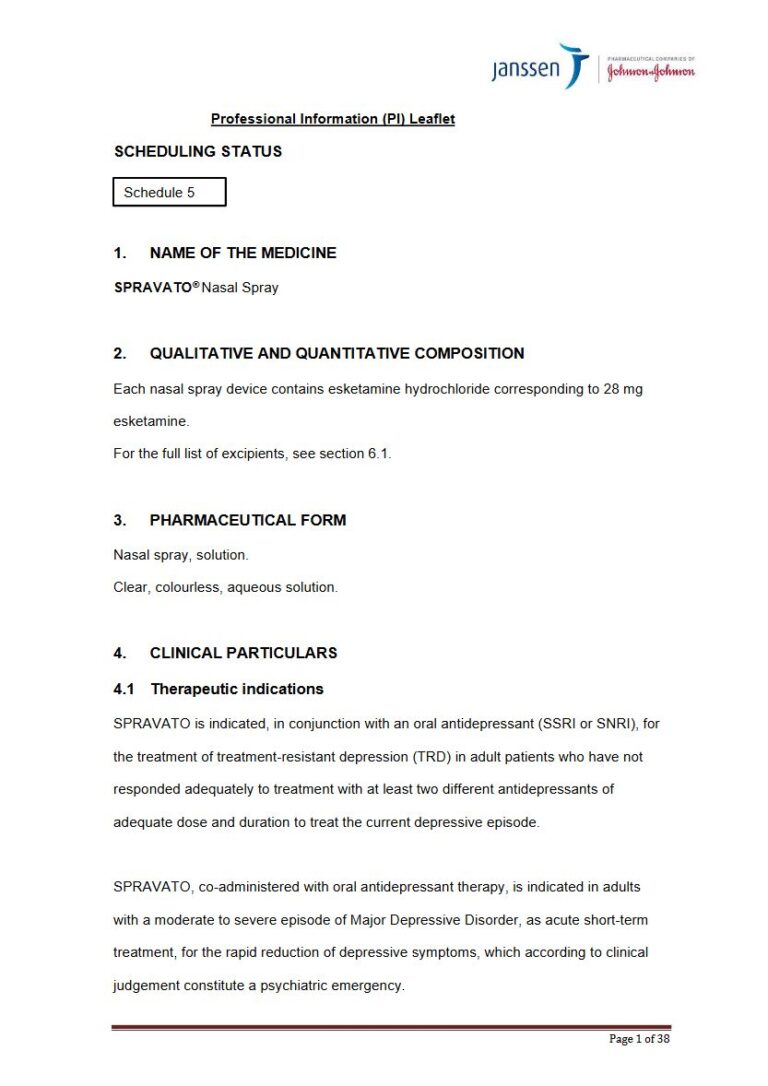
SPRAVATO is indicated, in conjunction with an oral antidepressant (SSRI or SNRI), for the treatment of treatment-resistant depression (TRD) in adult patients who have not responded adequately to treatment with at least two different antidepressants of adequate dose and duration to treat the current depressive episode. SPRAVATO, co-administered with oral antidepressant therapy, is indicated in adults with a moderate to severe episode of Major Depressive Disorder, as acute short-term treatment, for the rapid reduction of depressive symptoms, which according to clinical judgement constitute a psychiatric emergency.
4.2 Posology and method of administration
SPRAVATO should be administered in conjunction with oral antidepressant (AD) therapy. A treatment session consists of nasal administration of SPRAVATO and post-administration observation under the supervision of a healthcare professional. SPRAVATO is for nasal use only. The nasal spray device is a single-use device that delivers a total of 28 mg of esketamine in two sprays (one spray per nostril). Total volume of medicine product per device to be delivered is 0,2 mL containing a total of 32,3 mg of esketamine hydrochloride (equivalent to 28 mg of esketamine). To prevent loss of medication, the device should not be primed before use. It is intended for administration by the patient under the supervision of a healthcare professional, using 1 device (for a 28 mg dose), 2 devices (for a 56 mg dose) or 3 devices (for an 84 mg dose), with a 5-minute rest between use of each device. Blood pressure assessment before and after treatment Assess blood pressure prior to dosing with SPRAVATO (See section 4.4). If baseline blood pressure is elevated (e.g., > 140 mmHg systolic, > 90 mmHg diastolic), consider the risks of short-term increases in blood pressure and benefit of SPRAVATO treatment (See section 4.4). Do not administer SPRAVATO if an increase in blood pressure or intracranial pressure poses a serious risk (See section 4.3). After dosing with SPRAVATO, blood pressure must be reassessed approximately 40 minutes after dosing and subsequently as clinically warranted.
If blood pressure has normalised and the patient appears clinically stable, both physically and mentally for at least two hours, the patient may be discharged at the end of the post-dose monitoring period; if not, continue to monitor (See section 4.4) Since some patients may experience nausea and vomiting after administration of SPRAVATO, patients should be advised not to eat for at least 2 hours before administration and not to drink liquids at least 30 minutes prior to administration (See section 4.8 Nausea and vomiting). Patients who require nasal corticosteroid or nasal decongestant on a dosing day should be advised not to administer these medications within 1 hour before administration of SPRAVATO.
Dosage u2013 Adults Administer SPRAVATO in conjunction with an oral antidepressant (AD) The dosage recommendations for SPRAVATO are shown in Table 1. Dose adjustments should be made based on efficacy and tolerability to the previous dose. Recommended Dosing for SPRAVATO for TRD Table 1: Induction Phase Maintenance Phase Weeks 1-4 (two treatment sessions/week): Starting Day 1 dose*: 56 mg Subsequent doses: 56 mg or 84 mg Weeks 5-8: 56 mg or 84 mg once weekly From Week 9: 56 mg or 84 mg every 2 weeks or once weekly ** Evidence of therapeutic benefit should be evaluated at the end of induction phase to determine need for continued treatment. Periodically re-examine the need for continued treatment * For patients u2265 65 years Day 1 starting dose is 28 mg ** Dosing frequency should be individualised to the lowest frequency to maintain remission/response After depressive symptoms improve, treatment is recommended for at least 6 months. Acute short-term treatment of psychiatric emergency due to Major Depressive Disorder The recommended dosage of Spravato for adult patients (<65 years) is 84 mg twice per week for 4 weeks. Dosage reduction to 56 mg should be made based on tolerability. After 4 weeks of treatment with Spravato, the oral antidepressant (AD) therapy should be continued, per clinical judgement. In these patients, treatment with Spravato should be part of the comprehensive clinical care plan.
Post-administration observation During and after SPRAVATO administration at each treatment session, a healthcare professional should observe the patient until the patient is stable based on clinical judgment. Before SPRAVATO administration, instruct patients not to engage in potentially hazardous activities, such as driving a motor vehicle or operating machinery until the next day after a restful sleep (See section 4.4 - Effect on Blood pressure, Potential for Cognitive and Motor Impairment and Effect on ability to Drive and use Machines). Missed treatment session(s) Patients who have missed treatment session(s) during the first 4 weeks of treatment, should continue their current dosing schedule. For patients with treatment-resistant Depression who miss treatment session(s) during maintenance phase and have worsening of depression symptoms, per clinical judgement, consider returning to the previous dosing schedule (see Table 1). Special populations Paediatrics (17 years of age and younger) The safety and efficacy of SPRAVATO have not been established in patients aged 17 years and younger. Elderly (65 years of age and older) In elderly patients the initial SPRAVATO dose is 28 mg (Day 1, Starting Dose, See Table 1). Subsequent doses should be increased in increments of 28 mg up to 56 mg or 84 mg, based on efficacy and tolerability. Hepatic impairment No dosage adjustment is necessary in patients with mild (Child-Pugh class A) or moderate (Child-Pugh class B) hepatic impairment. SPRAVATO has not been studied in patients with severe hepatic impairment (Child-Pugh class C). Use in this population is not recommended (See section 5.2 u2013 Special populations, Hepatic impairment). Japanese and Chinese patients with treatment-resistant depression Efficacy of SPRAVATO in Japanese and Chinese patients has not been established.
4.3 Contraindications
SPRAVATO is contraindicated:
- In patients with known hypersensitivity to esketamine, ketamine, or to any of the excipients
- In patients for whom an increase in blood pressure or intracranial pressure poses a serious risk (See section 4.4 - Effect on blood pressure)
- Patients with known aneurysmal vascular disease (including intracranial, thoracic, or abdominal aorta, or peripheral arterial blood vessels)
- History of intracerebral haemorrhage
- Arteriovenous malformation
4.4 Special warnings and precautions for use
Suicide/suicidal thoughts or clinical worsening The effectiveness of SPRAVATO in preventing suicide or in reducing suicidal ideation or behavior has not been demonstrated. Use of SPRAVATO for the rapid reduction of depressive symptoms in adult patients with Major Depressive Disorder who have active suicidal ideation with intent does not preclude the need for hospitalization, if clinically warranted. Closely monitor all antidepressant treated patients including patients treated with SPRAVATO for clinical worsening or emergence of suicidal thoughts and behaviors, especially during the initial few months of drug therapy and at times of dosage changes. Patients (and caregivers of patients) should be alerted to the need to monitor for any clinical worsening, suicidal behavior or thoughts and unusual changes in behavior and to seek medical advice immediately if these symptoms present. Depression is associated with an increased risk of suicidal thoughts, self-harm and suicide (suicide related events). This risk persists until significant remission occurs; therefore, patients should be closely monitored. It is general clinical experience that the risk of suicide may increase in the early stages of recovery. Patients with a history of suicide related events or those exhibiting a significant degree of suicidal ideation prior to commencement of treatment are known to be at greater risk of suicidal thoughts or suicide attempts and should receive careful monitoring during treatment.
Respiratory depression Respiratory depression may occur at high doses following rapid intravenous injection of esketamine or ketamine when used for anaesthesia. Rare cases of deep sedation have been reported. Concomitant use of Spravato with CNS depressants may increase the risk of sedation (see section 4.5). Close monitoring is required for sedation and respiratory depression.
Effect on blood pressure SPRAVATO can cause transient increases in systolic and/or diastolic blood pressure which peak at approximately 40 minutes after medicine administration and last approximately 1-2 hours (See section 4.8). Patients with cardiovascular and cerebrovascular conditions should be carefully assessed before prescribing SPRAVATO and treatment initiated only if the benefit outweighs the risk (See section 4.3). Examples of conditions which should be carefully considered include:
- Unstable or poorly controlled hypertension
- History (within 6 weeks) of cardiovascular event including myocardial infarction (MI). Patients with a history of an MI should be clinically stable and cardiac symptom free prior to dosage administration.
- History (within 6 months) of ischaemic stroke or transient ischaemic attack.
- Haemodynamically significant valvular heart disease such as mitral valve regurgitation, mitral valve stenosis, aortic valve stenosis, or aortic valve regurgitation.
- New York Heart Association (NYHA) Class III-IV heart failure of any aetiology.
Blood pressure should be assessed prior to dosing with SPRAVATO. In patients whose blood pressures prior to dose administration and are judged to be elevated (as a general guide: > 140/90 mmHg for patients 150/90 mmHg for patients u2265 65 years of age), it is appropriate to consider lifestyle and/or pharmacologic therapies to reduce blood pressure before starting treatment with SPRAVATO. The decision whether or not to delay SPRAVATO therapy should take into account the balance of benefit and risk in individual patients. Blood pressure should be monitored after dose administration until blood pressure returns to acceptable levels. If blood pressure remains too high, assistance should promptly be sought from practitioners experienced in blood pressure management. Patients who experience symptoms of a hypertensive crisis should be referred immediately for emergency care. Closely monitor blood pressure with concomitant use of SPRAVATO with psychostimulants or monoamine oxidase inhibitors (MAOIs) (See section 4.5).
Dissociation The most common psychological effects of SPRAVATO were dissociative or perceptual changes (including distortion of time, space and illusions), derealization and depersonalization (61 % to 84 % of SPRAVATO-treated patients developed dissociative or perceptual changes based on the Clinician Administered Dissociative Symptoms Scale) (See section 4.8). Given its potential to induce dissociative effects, carefully assess patients with psychosis before administering SPRAVATO; treatment should be initiated only if the benefit outweighs the risk. Because of the risks of dissociation, patients must be monitored by a healthcare provider for at least 2 hours at each treatment session, followed by an assessment to determine when the patient is considered clinically stable and ready to leave the healthcare setting.
Sedation In clinical trials, 48 % to 61 % of SPRAVATO-treated patients developed sedation based on the Modified Observeru2019s Alertness/Sedation scale (MOAA/s) (See section 4.8), and 0,3 % to 0,4 % of SPRAVATO-treated patients experienced loss of consciousness (MOAA/s score of 0). Because of the possibility of delayed or prolonged sedation, patients must be monitored by a healthcare provider for at least 2 hours at each treatment session, followed by an assessment to determine when the patient is considered clinically stable and ready to leave the healthcare setting (See section 4.2). Closely monitor for sedation with concomitant use of SPRAVATO with CNS depressants (See section 4.5).
Potential for Cognitive and Motor Impairment SPRAVATO has been reported to cause somnolence, sedation, dissociative symptoms, perception, disturbances, dizziness, vertigo and anxiety during clinical trials (See section 4.8). The effects may impair attention, judgment, thinking, reaction speed and motor skills. Tolerance to above effects may develop after a few treatment sessions. At each treatment session, patients should be monitored by a healthcare professional to assess when the patient is considered clinically stable (See section 4.2).
Cognitive Impairment Short-Term Cognitive Impairment In a study in healthy volunteers, a single dose of SPRAVATO caused cognitive performance decline 40 minutes post-dose. Compared to placebo-treated subjects, SPRAVATO-treated subjects required a greater effort to complete cognitive tests at 40 minutes post-dose. Cognitive performance and mental effort were comparable between SPRAVATO and placebo at 2 hours post-dose. Sleepiness was comparable after 4 hours post-dose.
Long-Term Cognitive Impairment Long-term cognitive and memory impairment have been reported with long-term ketamine use or drug abuse. These effects did not increase over time and were reversible after discontinuing ketamine. In clinical trials, the effect of esketamine nasal spray on cognitive functioning was evaluated over time and performance remained stable. However, the long-term cognitive effects of SPRAVATO have not been evaluated beyond one year.
Urinary tract symptoms Cases of interstitial cystitis have been reported in subjects using ketamine for recreational use or for treatment of chronic pain at high doses with long term use. In clinical studies with esketamine nasal spray, subjects were assessed for symptoms of cystitis, bladder pain and interstitial cystitis. No cases of esketamine u2013 related interstitial cystitis was observed in any of the studies, which involved treatment for up to a year.
Drug abuse and dependence Abuse Individuals with a history of drug abuse or dependence may be at greater risk for abuse and misuse of SPRAVATO. Careful consideration is advised prior to treatment of individuals with a history of substance use disorder, including alcohol. Monitoring for signs of abuse or dependence is recommended. The potential for abuse, misuse and diversion of SPRAVATO is minimised due to the productu2019s design and the administration taking place under the supervision of a healthcare professional. Ketamine, the racemic mixture of arketamine and esketamine, has been reported as a drug of abuse. In a study of abuse potential conducted in recreational polydrug users (n=41), single doses of esketamine nasal spray (84 mg and 112 mg) and the positive control drug intravenous ketamine (0,5 mg/kg infused over 40 minutes) produced significantly greater scores than placebo on subjective ratings of u201cdrug likingu201d and other measures of subjective drug effects.
Dependence Dependence and tolerance have been reported with prolonged use of ketamine. Individuals who were dependent on ketamine reported withdrawal symptoms of cravings, anxiety, shaking, sweating and palpitations. Monitoring for signs of dependence is recommended.
Other Populations at risk SPRAVATO should be used with caution in patients with the following conditions. These patients should be carefully assessed before prescribing SPRAVATO and treatment initiated only if the benefit outweighs the risk:
- Presence or history of psychosis
- Presence of history of mania or bipolar disorder
- Hyperthyroidism that has not been sufficiently treated
- Significant pulmonary insufficiency
- Patients with known uncontrolled brady or tachydysrhythmias that lead to haemodynamic instability
- History of brain injury, hypertensive encephalopathy, intrathecal therapy with ventricular shunts, or any other condition associated with increased intracranial pressure.
4.5 Interaction with other medicinal products and other forms of interaction
Pharmacodynamic interactions Concomitant use with CNS depressants (e.g., benzodiazepines, opioids, alcohol) may increase sedation. Closely monitor for sedation with concomitant use of SPRAVATO with CNS depressants. Concomitant use with psychostimulants (e.g., amphetamines, methylphenidate, modafinil, armodafinil) may increase blood pressure. Closely monitor blood pressure with concomitant use of SPRAVATO with psychostimulants. Concomitant use with monoamine oxidase inhibitors (MAOIs) (e.g., tranylcypromine, selegiline, phenelzine) may increase blood pressure. Closely monitor blood pressure with concomitant use of SPRAVATO with MAOIs.
Pharmacokinetic interactions Esketamine is extensively metabolised in the liver. The primary metabolic pathway of esketamine in human liver microsomes is N-demethylation to form noresketamine. The main cytochrome P450 (CYP) enzymes responsible for esketamine N-demethylation are CYP2B6 and CYP3A4 (See section 5.2). Effect of other medicines on esketamine Hepatic enzyme inhibitors Pretreatment of healthy subjects with oral ticlopidine, an inhibitor of hepatic CYP2B6 activity, (250 mg twice daily for 9 days prior to and on the day of esketamine administration) had no effect on the maximum plasma concentration (C max) of esketamine administered as a nasal spray. The area under the plasma concentration-time curve AUC (0-inf) of esketamine was increased by approximately 29 %. The terminal half-life of esketamine was not affected by ticlopidine pretreatment. Pretreatment with oral clarithromycin, an inhibitor of hepatic CYP3A4 activity, (500 mg twice daily for 3 days prior to and on the day of esketamine administration) increase the mean C max and AUC (0-inf) of nasally administered esketamine by approximately 11 % and 4 %, respectively. The terminal half-life of esketamine was not affected by clarithromycin pretreatment. Hepatic enzyme inducers Pre-treatment with oral rifampicin, a potent inducer of the activity of multiple hepatic CYP enzymes such as CYP3A4 and CYP2B6, (600 mg daily for 5 days prior to esketamine administration) decreased the mean C max and AUC (0-inf) values of esketamine administered as a nasal spray by approximately 17 % and 28 %, respectively.
Other Nasal Spray Products Concomitant use of SPRAVATO with other nasally administered medicinal products has been evaluated in the following pharmacokinetic interaction studies. Pretreatment of subjects with history of allergic rhinitis and pre-exposed to grass pollen with oxymetazoline administered as a nasal spray (2 sprays of 0,05 % solution administered at 1 hour prior to nasal administration of esketamine) had minor effects on the pharmacokinetics of esketamine. Pretreatment of healthy subjects with nasal administration of mometasone furoate (200 mcg per day for 2 weeks with the last mometasone furoate dose administered at 1 hour prior to nasal administration of esketamine) had minor effects on the pharmacokinetics of esketamine.
Effect of esketamine on other medicines Nasal administration of 84 mg esketamine twice a week for 2 weeks reduced the mean plasma AUC (0-inf) of oral midazolam (single 6 mg dose), a substrate of hepatic CYP3A4, by approximately 16 %. Nasal administration of 84 mg esketamine twice a week for 2 weeks did not affect the mean plasma AUC (0-inf) of oral bupropion (single 150 mg dose), a substrate of hepatic CYP2B6.
4.6 Fertility, pregnancy and lactation
Women of childbearing potential To avoid exposing the foetus to esketamine, women of reproductive potential should be advised to use highly effective contraception during and up to 6 weeks after the last treatment with SPRAVATO.
Pregnancy SPRAVATO is not recommended during pregnancy. The risks of SPRAVATO during pregnancy have not been studied. Human data in pregnant women during clinical trials with esketamine exposure are too limited to be conclusive. Animal studies with ketamine, the racemic mixture of arketamine and esketamine, show evidence of developmental neurotoxicity. The potential for esketamine to have neurotoxic effects on foetuses cannot be excluded. If a woman becomes pregnant while being treated with SPRAVATO, treatment with esketamine should be discontinued and the patient should be counselled about the potential risk to the foetus and clinical/therapeutic options as soon as possible.
Breastfeeding Esketamine is present in human milk. There are no data on the effects of SPRAVATO on the breastfed infant or on milk production. Published studies with ketamine in juvenile animals report neurotoxicity. Because of the potential for neurotoxicity, advise patients that breastfeeding is not recommended during treatment with SPRAVATO.
Fertility In a fertility and early embryonic development (Segment I) study in rats, oestrous cycle irregularities were observed at an intranasal esketamine dose of 45 mg/kg/day and a delay in mating was observed u2265 15 mg/kg/day. Due to the lack of overall changes to mating and fertility indices, the NOAEL in this study was considered 45 mg/kg/day which produce AUC exposure that was 0,6 times the AUC exposure at the maximum recommended human dose (MRHD).
4.7 Effects on ability to drive and use machines
SPRAVATO has a major influence on the ability to drive and use machines. In clinical studies, SPRAVATO has been reported to cause somnolence, sedation, dissociative symptoms, perception disturbances, dizziness, vertigo and anxiety (See section 4.8). Before SPRAVATO administration, instruct patients not to engage in potentially hazardous activities requiring complete mental alertness and motor coordination, such as driving a motor vehicle or operating machinery, until the next day following a restful sleep (See section 4.4.- Potential for Cognitive and Motor Impairment).
4.8 Undesirable effects
Summary of the safety profile The most commonly observed adverse reactions in patients treated with SPRAVATO were dizziness (31 %), nausea (27 %), dissociation (27 %), headache (23 %), somnolence (18 %), vertigo (16 %), dysgeusia (18 %), hypoaesthesia (11 %), and vomiting (11 %) and blood pressure increased (10%).
Tabulated list of adverse reactions Adverse reactions reported with esketamine are listed in the table below. Within the designated system organ classes, adverse reactions are listed under headings of frequency, using the following convention: very common (u2265 1/10); common (u2265 1/100 to < 1/10); uncommon (u2265 1/1,000 to < 1/100); rare (u2265 1/10,000 to < 1/1,000); very rare (< 1/10,000); not known (cannot be estimated from the available data).
Table 2: Tabulated list of adverse reactions System Organ Class Adverse Drug Reaction Frequency Very common Common Uncommon Psychiatric disorders Dissociation euphoric mood, agitation, anxiety, illusion, irritability, panic attack, time perception altered, hallucination including visual hallucination, derealisation, confusional state psychomotor retardation, emotional distress, dysphoria Nervous system disorders dizziness, headache, dysgeusia, somnolence, hypoaesthesia mental impairment, tremor, lethargy, dysarthria, paraesthesia, sedation, disturbance in attention nystagmus, psychomotor hyperactivity Eye disorders blurred vision Ear and labyrinth disorders Vertigo hyperacusis, tinnitus Cardiac disorders Tachycardia Vascular disorders Hypertension Respiratory, thoracic and mediastinal disorders nasal discomfort, nasal dryness including nasal crusting, nasal pruritus, throat irritation, oropharyngeal pain Gastrointestinal disorders nausea, vomiting dry mouth, oral hypoaesthesia salivary hypersecretion Skin and subcutaneous tissue disorders hyperhidrosis cold sweat Renal and urinary disorders pollakiuria, dysuria, micturition urgency General disorders and administration site conditions feeling abnormal, feeling drunk, feeling of body temperature change, asthenia, crying gait disturbance Investigations blood pressure increased
Dissociation/perceptual changes Dissociation (27 %) was one of the most common psychological effects of esketamine. Other related terms included derealisation (2,2 %), depersonalisation (2,2 %), illusions (1,3 %), and distortion of time (1,2 %). These adverse reactions were reported as transient and self-limited and occurred on the day of dosing. Dissociation was reported as severe in intensity at the incidence of less than 4 % across studies. Dissociation symptoms typically resolved by 1,5 hours post-dose and the severity tended to reduce over time with repeated treatments.
Sedation/Somnolence Adverse reactions of sedation (9.3 %) and somnolence (18,2 %) were primarily mild or moderate in severity, occurred on the day of dosing and resolved spontaneously the same day. Sedative effects typically resolved by 1,5 hours post-dose. Rates of somnolence were relatively stable over time during long-term treatment. In the cases of sedation, no symptoms of respiratory distress were observed, and haemodynamic parameters (including vital signs and oxygen saturation) remained within normal ranges.
During post-marketing use, respiratory depression has been observed in isolated cases with the use of SPRAVATO in combination with other CNS depressants and in patients with comorbidities such as obesity, anxiety, cardiovascular and respiratory conditions, though causality has not been established. These events were transient in nature and resolved after verbal/tactile stimulation or supplemental oxygen.
Cognitive and memory impairment Cognitive and memory impairment have been reported with long-term ketamine use or drug abuse. These effects did not increase over time and were reversible after discontinuing ketamine. In long-term clinical trials, the effect of esketamine nasal spray on cognitive functioning was evaluated over time and performance remained stable.
Changes in Blood Pressure In clinical trials, for treatment-resistant Major Depressive Disorder, increases in systolic and diastolic blood pressure (SBP and DBP) over time were about 7 to 9 mmHg in SBP and 4 to 6 mmHg in DBP at 40 minutes post-dose and 2 to 5 mmHg in SBP and 1 to 3 mmHg in DBP at 1,5 hours post-dose in patients receiving SPRAVATO plus oral antidepressants (See section 4.4). The frequency of markedly abnormal blood pressure elevations of SBP (u2265 40 mmHg increase) ranged from 8 % (< 65 years) to 17 % (u2265 65 years) and DBP (u2265 25 mmHg increase) ranged from 13 % (< 65 years) to 14 % (u2265 65 years) in patients receiving esketamine plus oral antidepressant. The incidence of increased SBP (u2265 180 mmHg) was 3 % and DBP (u2265 110 mmHg) was 4 %.
Urinary tract symptoms Cases of interstitial cystitis have been reported with daily and long-term ketamine use at high doses. In clinical studies with esketamine, there were no cases of interstitial cystitis, however a higher rate of lower urinary tract symptoms was observed (pollakiuria, dysuria, micturition urgency, nocturia, and cystitis) in esketamine-treated patients compared with placebo-treated patients.
Reporting of suspected adverse reactions Reporting suspected adverse reactions after authorisation of the medicine is important. It allows continued monitoring of the benefit/risk balance of the medicine. Health care providers are asked to report any suspected adverse reactions to SAHPRA via the : 6.04 Adverse Drug Reactions Reporting Formu201d, found online under SAHPRAu2019s publications: https://www.sahpra.org.za/Publications/Index/8.
4.9 Overdose
No cases of overdose were reported in clinical studies with SPRAVATO. The potential for overdose of SPRAVATO by the patient is minimised due to the product's design and the administration taking place under the supervision of a healthcare professional (See section 4.2).
Symptoms There is limited clinical trial experience with esketamine nasal spray doses higher than the maximum recommended dose of 84 mg. The maximum single esketamine nasal spray dose tested in healthy volunteers was 112 mg which showed no evidence of toxicity and/or adverse clinical outcomes. However, compared to the recommended dose range, the 112 mg esketamine nasal spray dose was associated with higher rates of adverse reactions including dizziness, hyperhidrosis, somnolence, hypothesis, feeling abnormal, nausea and vomiting.
Management There is no specific antidote for esketamine overdose. In the case of overdose, the possibility of multiple medicine involvement should be considered. It is advisable to contact a poison control centre to obtain the latest recommendations for the management of an overdose. Management of SPRAVATO overdose should consist of treating clinical symptoms and relevant monitoring. Close supervision and monitoring should continue until the patient recovers.
