
Suprane 240 ml Clear, colourless, volatile liquid.
PDF Leaflet Revision Date: 20 March 2020
Clinical Summary
Quick overview from the medicine insert
Indication
Inhalation agent for induction and maintenance of anaesthesia.
Dosage (summary)
Adults: Starting at 3% concentration, adjust as needed. Children: Not for induction; maintenance 5.2-10%.
Onset of Action / Duration
Onset: 2-4 mins, Duration: variable.
Special Populations
- Renal impairment
- Hepatic impairment
Pregnancy & Breastfeeding
Not established for safety; avoid in obstetric procedures.
Key Drug Interactions
- Opioids
- Benzodiazepines
- Muscle relaxants
Contraindications
- Known sensitivity to halogenated agents
- Malignant hyperthermia susceptibility
- Severe hepatic dysfunction
- Paediatric inhalation induction
Common side effects
- Nausea
- Vomiting
- Apnoea
- Laryngospasm
- Hypoxia
Counselling Points
- Avoid driving for 24 hours post-anaesthesia
- Do not breastfeed until fully recovered
Serious warnings
- Malignant hyperthermia risk
- Hyperkalaemia
- QT prolongation
Important Disclaimer
The Suprane 240 ml Clear, colourless, volatile liquid. professional information leaflet below is the property of Baxter Healthcare South Africa and is provided on Medinsert exactly as issued, with no.. alterations or editorial changes. We make every effort to keep content current by updating documents as soon as new versions become available. Medinsert serves as a trusted access point for healthcare professionals, but does not replace official sources or clinical judgement. For more details, please read our full disclaimer. read more>>
 Healthcare Professionals Only
This content is for registered healthcare professionals
Sign in or create a free account to read the full package insert.
Free for HPCSA-registered professionals. Powered by Medinsert.
Clinical Particulars
Section 4 of the official insert — extracted exactly as issued, no alterations
4.1 Therapeutic indications
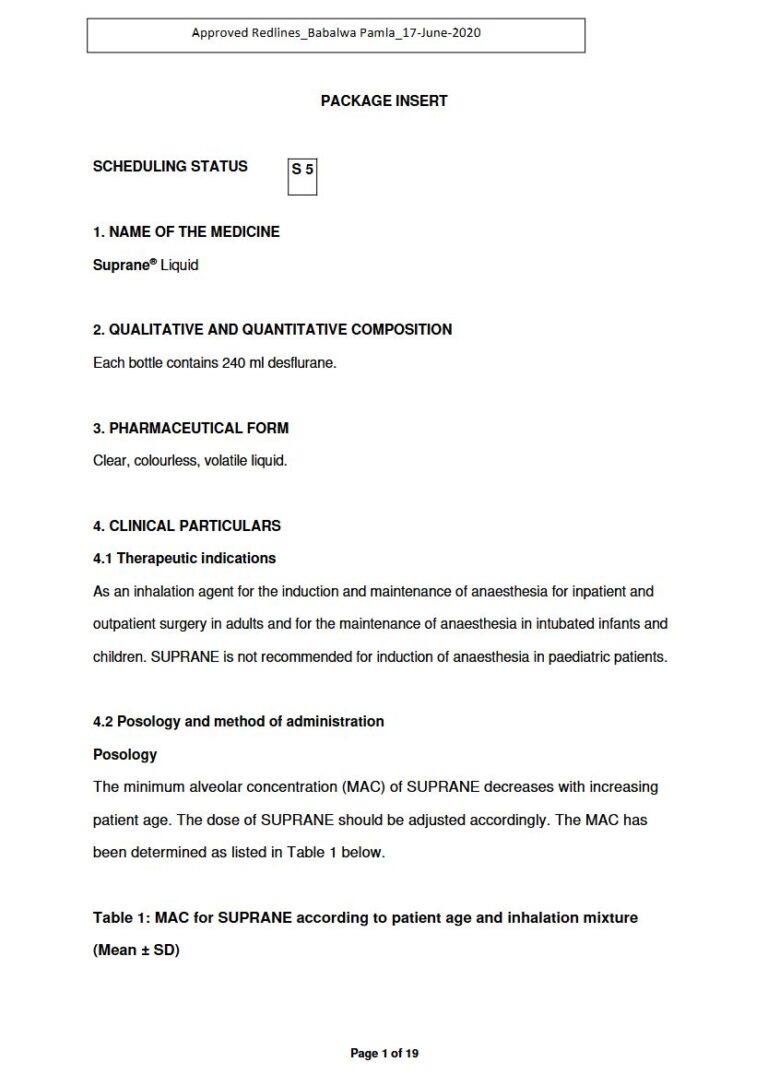
As an inhalation agent for the induction and maintenance of anaesthesia for inpatient and outpatient surgery in adults and for the maintenance of anaesthesia in intubated infants and children. SUPRANE is not recommended for induction of anaesthesia in paediatric patients.
4.2 Posology and method of administration
Posology
The minimum alveolar concentration (MAC) of SUPRANE decreases with increasing patient age. The dose of SUPRANE should be adjusted accordingly. The MAC has been determined as listed in Table 1 below.
Table 1: MAC for SUPRANE according to patient age and inhalation mixture (Mean u00b1 SD)
Age N* 100 % Oxygen N* 60 % Nitrous Oxide / 40 % Oxygen
2 weeks 6 9,2 u00b1 0,0 - -
10 weeks 5 9,4 u00b1 0,4 - -
9 months 4 10,0 u00b1 0,7 5 7,5 u00b1 0,8
2 years 3 9,1 u00b1 0,6 - -
3 years - - 5 6,4 u00b1 0,4
4 years 4 8,6 u00b1 0,6 - -
7 years 5 8,1 u00b1 0,6 - -
25 years 4 7,3 u00b1 0,0 4 4,0 u00b1 0,3
45 years 4 6,0 u00b1 0,3 6 2,8 u00b1 0,6
70 years 6 5,17 u00b1 0,6 6 1,67 u00b1 0,4
* N = number of crossover pairs (using up-and-down method of quantal response).
In patients with coronary artery disease, maintenance of normal haemodynamics is important to avoid myocardial ischaemia. SUPRANE should not be used as the sole agent for anaesthetic induction in patients at risk of coronary artery disease or in patients where increases in heart rate or blood pressure are undesirable. It should be used with other medications, preferably intravenous opioids and hypnotics.
Effects on Concomitant Therapy:
Opioids or benzodiazepines decrease the amounts of SUPRANE required to produce anaesthesia. SUPRANE decreases the doses of neuromuscular blocking agents (see section 4.5). If added relaxation is required, supplemental doses of muscle relaxants may be used.
Premedication:
Issues such as whether or not to premedicate and the choice of premedicant(s) must be individualised. In clinical trials, patients scheduled to be anaesthetised with SUPRANE frequently received IV pre-anaesthetic medicine, such as opioids and/or benzodiazepines.
Induction of Anaesthesia in Adults:
In adults a starting concentration of 3 % is recommended, increasing in 0,5 - 1,0 % increments every 2 to 3 breaths. Inspired concentrations of 4 - 11 % SUPRANE produce surgical anaesthesia in 2 - 4 minutes. Higher concentrations up to 15 % may be used. Such concentrations of SUPRANE will proportionately dilute the concentration of oxygen and commencing administration of oxygen should be 30 % or above. During induction in adults, the overall incidence of oxyhaemoglobin desaturation (SpO2 < 90 %) occurred in 6 % (see section 4.8). High concentrations of SUPRANE may induce upper airway adverse events.
After induction in adults with an intravenous medicine such as thiopental or propofol, SUPRANE can be started at approximately 0,5 - 1 MAC, whether the carrier gas is oxygen or nitrous oxide/oxygen. In patients with intracranial conditions SUPRANE should be administered at 0,8 MAC or less, and in conjunction with a barbiturate induction and hyperventilation (hypocapnia) until cerebral decompression in patients with known or suspected increases in CSFP. Appropriate attention must be paid to maintain cerebral perfusion pressure. (see section 4.4).
Maintenance of Anaesthesia in Adults:
Surgical levels of anaesthesia may be sustained with a 2 - 6 % concentration of SUPRANE when nitrous oxide is used concomitantly. SUPRANE at 2,5 - 8,5 % may be required when administered using oxygen or oxygen enriched air.
Paediatric population
Induction of Anaesthesia in Children:
SUPRANE is not indicated for use as an inhalation induction agent in children and infants because of the high incidence of laryngospasm, increase in secretions, breath holding, apnoea and coughing.
Maintenance of Anaesthesia in Children:
SUPRANE is indicated for maintenance anaesthesia in intubated infants and children. In children, surgical levels of anaesthesia may be maintained with concentrations of 5,2 - 10 % SUPRANE with or without the concomitant use of nitrous oxide. Although end-tidal concentrations of up to 18 % SUPRANE have been administered for short periods of time, if high concentrations of SUPRANE are used with nitrous oxide, it is important to ensure that the inspired mixture contains a minimum of 30 % oxygen.
Blood Pressure and Heart Rate During Maintenance:
Blood pressure and heart rate should be monitored carefully during maintenance as part of the evaluation of depth of anaesthesia.
Special populations
Dosage in Renal and Hepatic impairment:
Concentrations of 1 - 4 % SUPRANE in nitrous oxide/oxygen have been used in patients with chronic renal or hepatic impairment and during renal transplantation surgery. Because of minimal metabolism, a need for dose adjustment in patients with renal and hepatic impairment is not to be expected.
Method of Administration
SUPRANE should only be administered by persons trained in the administration of general anaesthesia using a vaporizer specifically designed and designated for use with SUPRANE.
Vaporiser:
SUPRANE is administered by inhalation. It should be delivered from a vaporiser specifically designed and designated for use with SUPRANE.
Individualisation:
The administration of general anaesthesia must be individualised based on the patient's response.
4.3 Contraindications
SUPRANE is contraindicated in patients:
- in whom general anaesthesia is contraindicated
- with a known sensitivity to halogenated agents
- with a known or suspected genetic susceptibility to malignant hyperthermia
- with a history of confirmed hepatitis due to a halogenated inhalational anaesthetic or with a history of unexplained moderate to severe hepatic dysfunction (e.g., jaundice associated with fever and/or eosinophilia) after anaesthesia with a halogenated inhalation anaesthetic
- SUPRANE is contraindicated for use as an inhalation induction agent in paediatric patients because of the frequent occurrence of cough, breath holding, apnoea, laryngospasm and increased secretions
4.4 Special warnings and precaution for use
Warnings
Malignant Hyperthermia (MH):
In susceptible individuals, SUPRANE may trigger a skeletal muscle hypermetabolic state leading to high oxygen demand and the clinical syndrome known as malignant hyperthermia. The clinical syndrome is signalled by hypercapnia and may include muscle rigidity, tachycardia, tachypnea, cyanosis, dysrrhythmias, and/or unstable blood pressure. Some of these non-specific signs may also appear during light anaesthesia, acute hypoxia, hypercapnia and hypovolemia. Treatment of malignant hyperthermia includes discontinuation of SUPRANE, administration of intravenous dantrolene sodium and application of supportive therapy. Renal failure may appear later and urine flow should be monitored and sustained if possible. SUPRANE should not be used in subjects known to be susceptible to MH. Fatal outcome of malignant hyperthermia has been reported with SUPRANE.
Perioperative Hyperkalaemia:
Use of SUPRANE, has been associated with increases in serum potassium levels that have resulted in cardiac dysrrhythmias, some fatal, in patients during the postoperative period. Patients with latent as well as overt muscular dystrophies, particularly Duchenne muscular dystrophy, appear to be more vulnerable. Concomitant use of succinylcholine has been associated with most, but not all, of these cases. These patients also experienced significant elevations in serum creatinine kinase levels and, in some cases, changes in urine consistent with myoglobinuria. Despite the similarity in presentation to malignant hyperthermia, none of these patients exhibited signs or symptoms of muscle rigidity or hypermetabolic state. Early and aggressive intervention to treat the hyperkalaemia and resistant dysrrhythmias is recommended, as is subsequent evaluation for latent neuromuscular disease.
Paediatric Inhalation Induction:
SUPRANE is not recommended for use as an inhalation induction agent in paediatric patients because of the frequent occurrence of cough, breath holding, apnoea, laryngospasm and increased secretions in children under 12 years.
Use in Children with Bronchial Hyperreactivity:
SUPRANE should be used with caution in children with asthma or a history of recent upper airway infection due to the potential for airway narrowing and increases in airway resistance.
Maintenance of Anaesthesia in Children:
Due to the limited data available in non-intubated paediatric patients, SUPRANE is not approved for maintenance of anaesthesia in non-intubated children. Caution should be exercised, should SUPRANE be used for maintenance anaesthesia with laryngeal mask airway (LMA) in children, in particular for children 6 years old or younger, because of the increased potential for adverse respiratory reactions, e.g. coughing and laryngospasm, especially with removal of the LMA under deep anaesthesia.
Obstetrics:
The safety of SUPRANE has not been established for use in obstetric procedures. SUPRANE is not recommended in obstetric operations. Desflurane is a uterine- relaxant and reduces the uterine-placental blood-flow (see section 4.6).
QT Prolongation:
QT prolongation, very rarely associated with torsade de pointes, has been reported (see Section 4.8). Caution should be exercised when administering SUPRANE to susceptible patients (e.g. patients with congenital Long QT Syndrome or patients taking medicines that can prolong the QT interval.
Precautions
SUPRANE can react with desiccated carbon dioxide (CO2) absorbents to produce carbon monoxide which may result in elevated levels of carboxyhaemoglobin in some patients. Case reports suggest that barium hydroxide lime and soda lime become desiccated when fresh gases are passed through the CO2 absorber canister at high flow rates over many hours or days. When a clinician suspects that CO2 absorbent may be desiccated, it should be replaced before administration of SUPRANE.
In patients with coronary artery disease, maintenance of normal haemodynamics is important to avoid myocardial ischaemia. Marked increases in pulse rate, mean arterial pressure and levels of epinephrine (adrenaline) and norepinephrine (noradrenaline) are associated with a rapid increase in SUPRANE concentrations. SUPRANE should not be used as the sole agent for anaesthetic induction in patients at risk of coronary artery disease or in patients where increases in heart rate or blood pressure are undesirable. It should be used with other medications, preferably intravenous opioids and hypnotics.
SUPRANE may produce a dose dependent increase in cerebrospinal fluid pressure (CSFP) when administered to patients with intra-cranial space occupying lesions. In such patients, SUPRANE should be administered at 0,8 MAC (minimum alveolar concentration) or less, and in conjunction with a barbiturate or propofol induction and hyperventilation (hypocapnia) until cerebral decompression in patients with known or suspected increase in CSFP. Appropriate attention must be paid to maintain cerebral perfusion pressure.
In hypovolaemic, hypotensive and debilitated patients a lower concentration is recommended.
With the use of halogenated anaesthetics such as SUPRANE, disruption of the liver function, jaundice and fatal liver necrosis have been reported. Such reactions appear to indicate hypersensitivity reactions to anaesthetics. SUPRANE may cause immune mediated hepatitis in patients who have been sensitised by previous exposure to halogenated anaesthetics. Cirrhosis, viral hepatitis or other pre-existing liver disease can be a reason to select an anaesthetic other than a halogenated anaesthetic such as SUPRANE.
During maintenance of anaesthesia, increases in heart rate and blood pressure occurring after rapid incremental increases in end-tidal concentration of SUPRANE may not reflect inadequate anaesthesia. The changes due to sympathetic activation resolve in approximately 4 minutes. Increases in heart rate and blood pressure occurring before or in the absence of a rapid increase in SUPRANE concentration may be interpreted as light anaesthesia. Hypotension and respiratory depression increase as anaesthesia is deepened.
Rapid emergence with SUPRANE should be taken into account in cases where post- anaesthesia pain is anticipated. Care should be taken that appropriate analgesia has been administered to the patient at the end of the procedure or early in the post- anaesthesia care unit stay. Emergence from anaesthesia in children may evoke a brief state of agitation that may hinder cooperation.
Repeated anaesthesia within a short period of time should be approached with caution.
Facilities for maintenance of a patent airway, artificial ventilation, oxygen enrichment and circulatory resuscitation must be immediately available.
4.5 Interaction with other medicines and other forms of interaction
Commonly used muscle relaxants are potentiated by SUPRANE. Lower doses of SUPRANE are required in patients receiving opioids, benzodiazepines or other sedatives. These interactions are illustrated below.
Concentration of other gases
The MAC for SUPRANE is reduced by concomitant nitrous oxide administration, as illustrated in Table 1 above under section 4.2.
Muscle relaxants:
Muscle relaxants are potentiated by SUPRANE: Anaesthetic concentrations of SUPRANE at equilibrium reduce the ED95 of succinylcholine by approximately 30 % and that of atracurium and pancuronium by approximately 50 % compared to N2O/opioid anaesthesia. The doses of pancuronium, atracurium, suxamethonium and vecuronium needed to produce 95 % (ED95) depression in neuromuscular transmission at different concentrations of SUPRANE are given in Table 2. The ED95 of vecuronium is 14 % lower with SUPRANE than isoflurane. Additionally, recovery from neuromuscular blockade is longer with SUPRANE than with isoflurane.
Table 2: Dosage (mg/kg) of muscle relaxant causing 95 % depression in neuromuscular transmission
SUPRANE Concentration Pancuronium Atracurium Suxamethonium Vecuronium
0,65 MAC/60 % N2O/O2 0,026 0,133 *NA *NA
1,25 MAC/60 % N2O/O2 0,018 0,119 *NA *NA
1,25 MAC/O2 0,022 0,120 0,360 0,019
*NA = not available
Pre-anaesthetic Medicines:
All commonly used pre-anaesthetic medicines will potentiate the pharmacodynamics effect of SUPRANE.
Sedatives:
Patients anaesthetised with different concentrations of SUPRANE who received increasing doses of fentanyl showed a marked reduction in the anaesthetic requirements or MAC. The administration of increasing doses of intravenous midazolam showed a small reduction in MAC. Results are reported in Table 3. It is anticipated that there will be a similar influence on MAC with other opioid and sedative medicines.
Table 3: Effect of Fentanyl or Midazolam on SUPRANE MAC
Medication *MAC (%) % MAC reduction
No Fentanyl 6,33 - 6,35 ----
Fentanyl (3 microg/kg) 3,12 - 3,46 46 - 51
Fentanyl (6 microg/kg) 2,25 - 2,97 53 - 64
No Midazolam 5,85 - 6,86 ----
Midazolam (25 microg/kg) 4,93 15,7
Midazolam (50 microg/kg) 4,88 16,6
* Includes values for ages 18-65 years
Beta Blockers:
Concomitant use of beta blockers may exaggerate the cardiovascular effects of inhalational anaesthetics, including hypotension and negative inotropic effects.
Monoamine Oxidase Inhibitors (MAO):
Concomitant use of MAO inhibitors and inhalational anaesthetics may increase the risk of hemodynamic instability during surgery or medical procedures.
4.6 Fertility, pregnancy and lactation
The safety in pregnancy and lactation has not been established. SUPRANE is a uterine-relaxant and reduces the uterine-placental blood-flow and is not recommended for obstetric operations. (See section 4.4). There are no adequate data from the use of SUPRANE in pregnant or lactating women. Patients should not breastfeed their babies until fully recovered from their anaesthesia.
4.7 Effects on ability to drive and use machines
Patients should be advised that the ability to perform tasks such as driving or operation of machinery may be impaired after general anaesthesia, and it is advisable to avoid such tasks for a period of 24 hours. The patients are advised not to drink alcohol and not to make any legally binding decisions for until 24 hours after the anaesthetics.
4.8 Undesirable effects
Side Effects from Clinical Trials:
Side effects reported in controlled clinical trials are shown in Tables 4 and 5. This is an all-patient pooled analysis. The studies were conducted using a variety of premedications, other anaesthetics and surgical procedures of varying length. The side effect frequency is based upon the following scale: Very Common (u22651/10); Common (u22651/100 - <1/10), Uncommon (u22651/1,000 - <1/100), Rare (u22651/10,000 - <1/1,000), Very Rare (<1/10,000).
Table 4: Clinical Trial Side Effects
Clinical Trial Side Effects System Organ Class (SOC) Preferred MedDRA Term Frequency
Induction PSYCHIATRIC DISORDERS Breath holding Common
RESPIRATORY, THORACIC, AND MEDIASTINAL DISORDERS Apnoea Laryngospasm Hypoxia Cough Common Common Uncommon Very Common
GASTROINTESTINAL DISORDERS Nausea Vomiting Salivary hypersecretion Very Common Very Common Common
Table 5: Clinical Trial Side Effects
Clinical Trial Side Effects System Organ Class (SOC) Preferred MedDRA Term Frequency
Maintenance or Recovery INFECTIONS AND INFESTATIONS Pharyngitis Common
PSYCHIATRIC DISORDERS Agitation Breath holding Uncommon Common
NERVOUS SYSTEM DISORDERS Headache Dizziness Common Uncommon
EYE DISORDERS Conjunctivitis Common
CARDIAC DISORDERS Nodal dysrhythmia Bradycardia Tachycardia Hypertension Myocardial infarction Myocardial ischaemia Dysrrhythmia Common Common Common Common Uncommon Uncommon Uncommon
VASCULAR DISORDERS Vasodilation Uncommon
RESPIRATORY, THORACIC, AND MEDIASTINAL DISORDERS Apnoea Cough Hypoxia Common Common Uncommon
GASTROINTESTINAL DISORDERS Vomiting Nausea Salivary hypersecretion Very Common Very Common Common
MUSCULOSKELETAL, CONNECTIVE TISSUE AND BONE DISORDERS Myalgia Uncommon
INVESTIGATIONS Increased creatinine phosphokinase ECG abnormal Common Common
Post-Marketing Side Effects:
In addition to the side effects noted in clinical trials, the following side effects have been reported in the post-marketing experience.
BLOOD AND LYMPHATIC SYSTEM DISORDERS: Coagulopathy.
METABOLISM AND NUTRITION DISORDERS: Hyperkalaemia, hypokalaemia, metabolic acidosis.
NERVOUS SYSTEM DISORDERS: Convulsion.
EYE DISORDERS: Ocular icterus.
CARDIAC DISORDERS: Cardiac arrest, torsade de pointes, ventricular failure, ventricular hypokinesia, atrial fibrillation.
VASCULAR DISORDERS: Malignant hypertension, haemorrhage, hypotension, shock.
RESPIRATORY, THORACIC AND MEDIASTINAL DISORDERS: Respiratory arrest, respiratory failure, respiratory distress, bronchospasm, haemoptysis.
GASTROINTESTINAL DISORDERS: Pancreatitis acute, abdominal pain.
HEPATOBILIARY DISORDERS: Hepatic failure, hepatic necrosis, hepatitis, cytolytic hepatitis, cholestasis, jaundice, hepatic function abnormal, liver disorder.
SKIN AND SUBCUTANEOUS TISSUE DISORDER: Urticaria, erythema.
MUSCULOSKELETAL, CONNECTIVE TISSUE, AND BONE DISORDERS: Rhabdomyolysis.
GENERAL DISORDERS AND ADMINISTRATION SITE CONDITIONS:
Hyperthermia malignant, asthenia, malaise.
INVESTIGATIONS: Electrocardiogram ST-T change, electrocardiogram T wave inversion, transaminases increased, alanine aminotransferase increased, aspartate aminotransferase increased, blood bilirubin increased, coagulation test abnormal, ammonia increased.
INJURY, POISONING, AND PROCEDURAL COMPLICATIONS: Agitation postoperative, dizziness*, migraine*, tachydysrrhythmia*, palpitations*, eye burns*, blindness transient*, encephalopathy*, ulcerative keratitis*, ocular hyperaemia*, visual acuity reduced*, eye irritation*, eye pain*, fatigue*, accidental exposure*, skin burning sensation*, medicine administration error*.
* Reaction was due to accidental exposures to non-patients.
Other (Class) Reactions: Other adverse reactions reported with similar products include: CARDIAC DISORDERS: Electrocardiogram QT prolonged.
4.9 Overdose
The symptoms of overdosage of SUPRANE can present as a deepening of anaesthesia, cardiac and/or respiratory depression in spontaneously breathing patients and cardiac depression in ventilated patients in whom hypercapnia and hypoxia may occur only at a late stage.
In the event of overdosage or what may appear to be overdosage, the following actions should be taken: stop SUPRANE, establish a clear airway and initiate assisted or controlled ventilation with pure oxygen. Support and maintain adequate haemodynamics.
