
Uromitexan 400 Mg Injection
PDF Leaflet Revision Date: 28 October 2022
Clinical Summary
Quick overview from the medicine insert
Indication
Reduces urinary toxicity from oxazaphosphorines.
Dosage (summary)
IV injection of 20% of oxazaphosphorine dose at 0, 4, and 8 hours.
Special Populations
- Elderly patients
- Paediatric patients (<16 years)
Pregnancy & Breastfeeding
Not established; avoid in pregnancy and lactation.
Key Drug Interactions
- Incompatible with cisplatin, carboplatin, nitrogen mustard
- Inactivates epirubicin
Contraindications
- Hypersensitivity to UROMITEXAN or thiol compounds
Common side effects
- Headache
- Infusion site reactions
- Abdominal pain
- Light-headedness
- Nausea
Counselling Points
- Monitor for hypersensitivity reactions
- Maintain adequate hydration
- Inspect for particulate matter before use
Serious warnings
- Potential for severe hypersensitivity reactions
- Does not prevent all adverse effects of oxazaphosphorines
Important Disclaimer
The Uromitexan 400 Mg Injection professional information leaflet below is the property of Baxter Healthcare South Africa and is provided on Medinsert exactly as issued, with no.. alterations or editorial changes. We make every effort to keep content current by updating documents as soon as new versions become available. Medinsert serves as a trusted access point for healthcare professionals, but does not replace official sources or clinical judgement. For more details, please read our full disclaimer. read more>>
 Healthcare Professionals Only
This content is for registered healthcare professionals
Sign in or create a free account to read the full package insert.
Free for HPCSA-registered professionals. Powered by Medinsert.
Clinical Particulars
Section 4 of the official insert — extracted exactly as issued, no alterations
4.1 Therapeutic indications
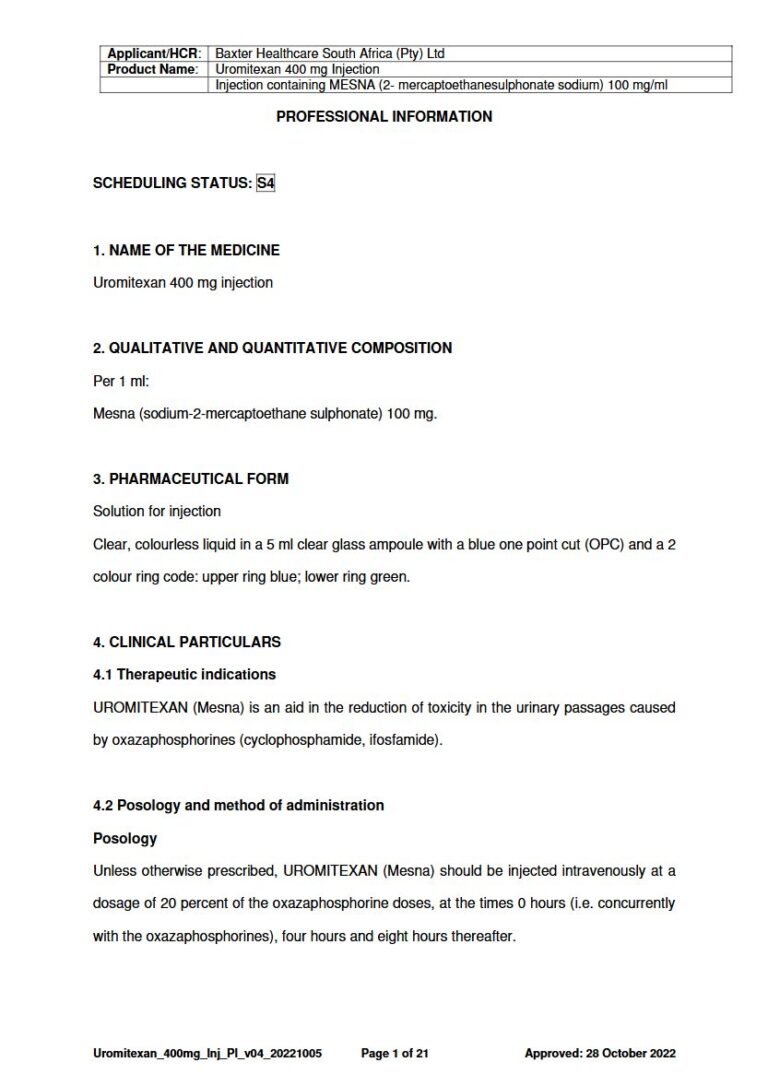
UROMITEXAN (Mesna) is an aid in the reduction of toxicity in the urinary passages caused by oxazaphosphorines (cyclophosphamide, ifosfamide).
4.2 Posology and method of administration
Posology
Unless otherwise prescribed, UROMITEXAN (Mesna) should be injected intravenously at a dosage of 20 percent of the oxazaphosphorine doses, at the times 0 hours (i.e. concurrently with the oxazaphosphorines), four hours and eight hours thereafter.
UROMITEXAN dosing is dependent on the dose of concomitant oxazaphosphorine medicine that a patient receives. The UROMITEXAN dosing schedule should be repeated each day that the oxazaphosphorine medicine is received. If the oxazaphosphorine dose is adjusted, the UROMITEXAN dose should also be modified to maintain the mesna-to-oxazaphosphorine ratio.
Paediatric use: Safety and effectiveness of UROMITEXAN in paediatric patients (<16 years of age) have not been established (see section 4.4).
Geriatric use: In general, dose selection for an elderly patient should be cautious, reflecting the greater frequency of decreased hepatic, renal, or cardiac function, and concomitant disease or other medicine therapy. However, the ratio of UROMITEXAN to oxazaphosphorines should remain unchanged (see section 4.4).
Method of administration
UROMITEXAN is administered by means of intravenous injection. Parenteral medicinal products should be inspected visually for particulate matter and discoloration prior to administration. Any solutions which are discoloured, hazy, or contain visible particulate matter should not be used.
4.3 Contraindications
Known hypersensitivity to UROMITEXAN, other thiol containing compounds or any of the inactive ingredients. Pregnancy and Lactation (see section 4.6).
4.4 Special warnings and precaution for use
Warnings
The protective effect of UROMITEXAN is restricted to the urinary passages. All other prophylactic measures and concomitant therapy recommended for oxazaphosphorine treatment are not affected and should be continued as before.
Hypersensitivity
Hypersensitivity reactions (hyperergic reactions) following UROMITEXAN therapy may occur. Therefore, it should be ensured that adequate emergency medication is available when UROMITEXAN is used. Hypersensitivity reactions to UROMITEXAN may have been reported following administration of UROMITEXAN as an uroprotectant. These include various skin and subcutaneous tissue symptoms (see section 4.8). In addition, cases of severe bullous and ulcerative skin and mucosal reactions were reported. Some reactions were considered to be consistent with Stevens-Johnson Syndrome, toxic epidermal necrolysis, or erythema exudativum multiforme. In some cases, skin reactions were accompanied by one or more other symptoms, such as:
- fever,
- cardiovascular symptoms (hypotension, in some cases reported as fluid refractory, tachycardia, ECG signs consistent with perimyocarditis, hypertension) (see section 4.8),
- signs consistent with acute renal impairment,
- pulmonary symptoms (hypoxia, respiratory distress, bronchospasm, tachypnea, cough, bloody sputum (see section 4.8),
- haematological abnormalities (laboratory signs of disseminated intravascular coagulation, leukopaenia, eosinophilia, lymphopaenia, thrombocytopaenia, pancytopaenia (see section 4.8),
- increased liver enzymes,
- nausea, vomiting,
- pain in the extremities, arthralgia, myalgia, malaise,
- stomatitis, and
- conjunctivitis.
Some reactions have presented as anaphylaxis. Fever accompanied by, e.g., hypotension, but no skin manifestations has also been reported. Severe as well as minor reactions were reported with the use of UROMITEXAN in regimens to treat both severe systemic autoimmune disorders and malignancy. In most cases, reactions occurred during or after a first treatment occasion or after several weeks of UROMITEXAN exposure. In other cases, the initial reaction was observed only after several months of exposure. Patients with autoimmune disease who were treated with cyclophosphamide and UROMITEXAN appeared to have a higher incidence of hypersensitivity reactions.
In many cases, symptoms appeared on the day of exposure, with a tendency to shorter intervals following subsequent exposures. In some patients, the occurrence and/or severity of reaction appeared to vary with the dose administered. Recurrence of reactions, in some cases with increasing severity, has been reported with re-exposure. However, in some cases, a reaction did not recur with re-exposure. Some patients with a history of a reaction have shown positive delayed-type skin test results. However, a negative delayed reaction does not exclude hypersensitivity to mesna. Positive immediate-type skin test reactions have occurred in patients regardless of previous mesna exposure or history of hypersensitivity reactions, and may be related to the concentration of the UROMITEXAN solution used for testing.
Prescribers should - be aware of the potential for such reactions and that reactions may worsen with re-exposure and may in some cases be life-threatening, - be aware that hypersensitivity reactions to UROMITEXAN were interpreted to resemble the clinical picture of sepsis and, in patients with autoimmune disorders, resemble an exacerbation of the underlying disease.
UROMITEXAN will not prevent or alleviate any of the other adverse reactions or toxicities associated with oxazaphosphorine therapy. A morning specimen of urine should always be examined for the presence of haematuria (microscopic evidence of red blood cells) each day prior to oxazaphosphorine therapy. If haematuria develops when UROMITEXAN is given with oxazaphosphorines according to the recommended dosage schedule, depending on the severity of the haematuria, dosage reduction or discontinuation of oxazaphosphorine therapy may be initiated.
Thiol Compounds
UROMITEXAN is a thiol compound, i.e., a sulfhydryl (SH) group-containing organic compound. Thiol compounds show some similarities in their adverse reaction profiles, including a potential to elicit severe skin reactions. Examples of medicines that are thiol compounds include amifostine, penicillamine and captopril. It is not clear whether patients who experienced an adverse reaction to such a medicine are at increased risk for any reactions, or similar reactions, to another thiol compound. However, when considering subsequent use of another thiol compound in such patients, the possibility of an increased risk should be taken into account.
Precautions
UROMITEXAN does not prevent haemorrhagic cystitis in all patients. Patients should be monitored accordingly. Sufficient urinary output should be maintained, as required for oxazaphosphorine treatment.
Laboratory test interferences
UROMITEXAN treatment may cause false positive reactions in nitroprusside sodium-based urine tests (including dipstick tests) for ketone bodies and false positive or false negative reactions in the dipstick tests for erythrocytes in the urine. The addition of glacial acetic acid can be used to differentiate between a false positive result (cherry-red colour that fades) and a true positive result (red-violet colour that intensifies).
UROMITEXAN treatment may cause false positive reactions in Tillmanu2019s reagent -based urine screening tests for ascorbic acid. In pharmacokinetic studies in healthy volunteers, serum creatine phosphokinase (CPK) values were lower in samples taken 24 hours after mesna dosing than in pre-dosing samples. While available data are insufficient to determine the cause of this phenomenon, it might be considered to represent a significant interference with thiol (e.g., N-acetylcysteine) dependent enzymatic CPK tests.
4.5 Interaction with other medicines and other forms of interaction
The systemic effects of oxazaphosphorines are not affected by UROMITEXAN. UROMITEXAN is incompatible in vitro with cisplatin, carboplatin and nitrogen mustard. In vivo compatibility has not been demonstrated. Mixing UROMITEXAN with epirubicin leads to inactivation of epirubicin and should be avoided. UROMITEXAN neither affects the antineoplastic efficacy of cytostatics such as doxorubicin, carmustine (BCNU), methotrexate, vincristine, nor the therapeutic effect of other medicines such as digitalis glycosides.
4.6 Fertility, pregnancy and lactation
The safety of UROMITEXAN in pregnant and lactating women has not been established. UROMITEXAN should not be used during pregnancy and lactation (see section 4.3).
4.7 Effects on ability to drive and use machines
Patients undergoing treatment with UROMITEXAN may experience undesirable effects (including, syncope, light-headedness, lethargy/drowsiness, dizziness and blurred vision), which could affect the ability to drive or use machines. The decision to drive or operate machinery should be made on an individual basis.
4.8 Undesirable effects
The most frequently occurring adverse reactions (> 10 %) associated with use of UROMITEXAN, per subject are: headache (36,05 %), infusion site reactions (25,32 %), abdominal pain/colic (22,09 %), light-headedness (16,28 %), lethargy/drowsiness (12,79 %), pyrexia (12,79 %), rash (12,79 %), diarrhoea (11,63 %), nausea (11,63 %), flushing (10,47 %), and influenza-like illness (10,47 %).
The most frequently occurring adverse reactions (> 1 %) associated with use of UROMITEXAN, per administration are: infusion site reactions (15,35 %), headache (5,24 %), abdominal pain/colic (4,39 %), nausea (1,72 %), diarrhoea (1,53 %), rash (1,72 %), flushing (1,33 %), light-headedness (1,33 %), lethargy/drowsiness (1,33 %), and pyrexia (1,149 %).
The most severe adverse reactions associated with use of UROMITEXAN are: toxic epidermal necrolysis, Stevens-Johnson syndrome, anaphylaxis, and medicinal rash with eosinophilia and systemic symptoms (DRESS). Because UROMITEXAN is used in combination with oxazaphosphorines or oxazaphosphorine-containing combination chemotherapy, it is difficult to distinguish the adverse reactions, which may be due to UROMITEXAN from those caused by concomitantly administered cytotoxic agents.
4.9 Overdose
A specific antidote for UROMITEXAN is not known. Due to the possibility of anaphylactoid reactions in patients with autoimmune disorders, it should be ensured that adequate emergency medication is available. Reports of inadvertent overdose and observations from a high-dose tolerability study in healthy volunteers showed that, in adults, single doses in the range of approximately 4 g to 7 g of UROMITEXAN can cause symptoms such as nausea, vomiting, abdominal pain/colic, diarrhoea, headache, fatigue, limb and joint pains, paraesthesia, fever, bronchospasm, rash, flushing, hypotension, bradycardia and tachycardia. A markedly increased rate of nausea, vomiting and diarrhoea has also been found in oxazaphosphorine-treated patients receiving u2265 80 mg UROMITEXAN per kg per day intravenously compared with patients receiving lower doses or hydration treatment only. Treatment is symptomatic and supportive.
