
Tambocor 100mg / 10mg/ml Tablets / Injection
PDF Leaflet Revision Date: 20 April 2012
Clinical Summary
Quick overview from the medicine insert
Indication
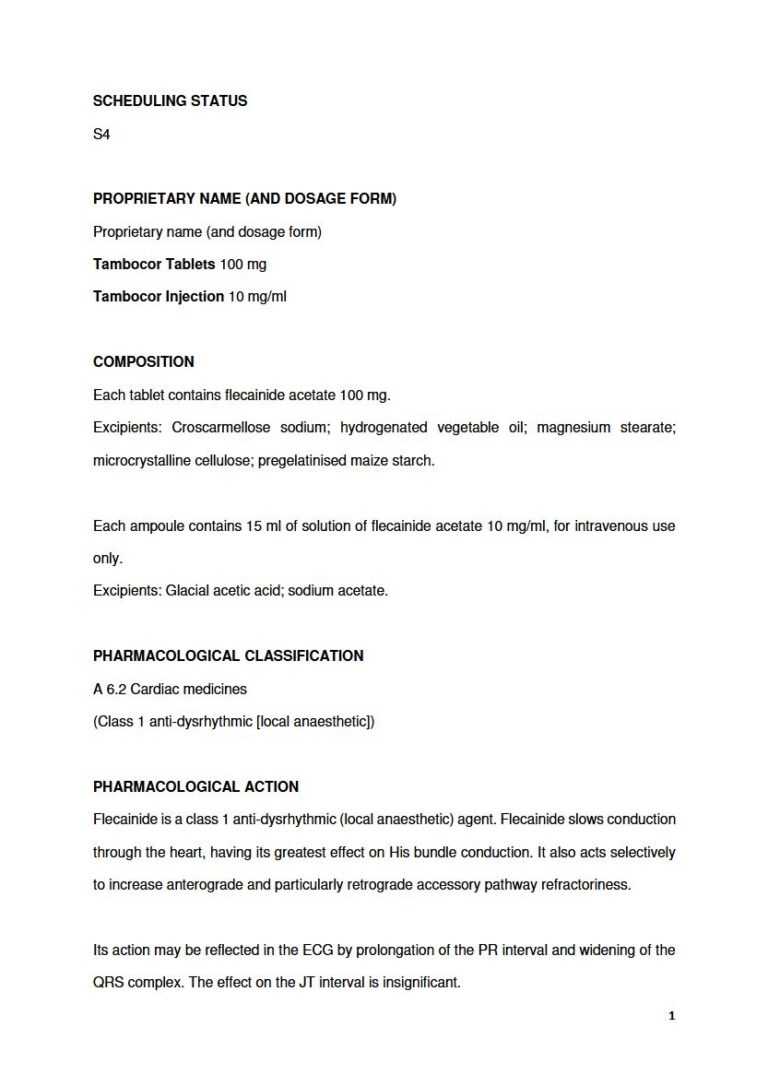
Control of sustained ventricular dysrhythmias and paroxysmal atrial fibrillation.
Dosage (summary)
Starting dose: 50 mg twice daily for supra-ventricular; 100 mg twice daily for ventricular. Max: 300 mg or 400 mg daily.
Onset of Action / Duration
Onset: 2-3 hours, Duration: 12-14 hours
Special Populations
- Elderly
- Renal impairment
- Hepatic impairment
Pregnancy & Breastfeeding
Not established; avoid in pregnancy, especially first trimester.
Key Drug Interactions
- Increased digoxin levels
- Additive effects with beta-blockers
- Avoid with other class 1 anti-dysrhythmics
Contraindications
- Cardiac failure
- Recent myocardial infarction
- Atrial fibrillation
- Sinus node dysfunction
Common side effects
- Dizziness
- Visual disturbances
- Pro-dysrhythmic effects
Counselling Points
- Monitor for dizziness
- Report visual changes
- Avoid in pregnancy
Serious warnings
- Electrolyte disturbances
- Caution in hepatic impairment
- Increased mortality in post-MI patients
Important Disclaimer
The Tambocor 100mg / 10mg/ml Tablets / Injection professional information leaflet below is the property of Inova Pharmaceuticals and is provided on Medinsert exactly as issued, with no.. alterations or editorial changes. We make every effort to keep content current by updating documents as soon as new versions become available. Medinsert serves as a trusted access point for healthcare professionals, but does not replace official sources or clinical judgement. For more details, please read our full disclaimer. read more>>
 Healthcare Professionals Only
This content is for registered healthcare professionals
Sign in or create a free account to read the full package insert.
Free for HPCSA-registered professionals. Powered by Medinsert.
Clinical Particulars
Section 4 of the official insert — extracted exactly as issued, no alterations
4.1 Therapeutic indications
Treatment with Tambocor should be initiated in a hospital for control of the following dysrhythmias:
- Sustained ventricular dysrhythmias.
- AV nodal reciprocating tachycardia; Wolff-Parkinson-White Syndrome and similar conditions with accessory pathway and anterograde or retrograde conduction.
- Paroxysmal atrial fibrillation in patients with disabling symptoms. Dysrhythmias of recent onset are more likely to respond.
- In addition, Tambocor tablets are indicated in premature ventricular contractions and/or non-sustained ventricular tachycardia if these are causing disabling symptoms.
- Tambocor tablets can be used for the maintenance of normal rhythm following conversion by other means.
4.2 Posology and method of administration
a. Tablets: Supra-ventricular dysrhythmias: The recommended starting dosage is 50 mg twice daily and most patients will be controlled at this dose. If required, the dose may be increased to a maximum of 300 mg daily.
Ventricular dysrhythmias: The recommended starting dosage is 100 mg twice daily. The maximum daily dose is 400 mg daily and this is normally reserved for patients of large build or where rapid control of the dysrhythmia is required. After 3 u2013 5 days it is recommended that the dosage be progressively adjusted to the lowest level which maintains control of the dysrhythmia. It may be possible to reduce the dosage during long-term treatment.
b. Bolus injection: Tambocor can be given in an emergency or for rapid effect by a slow intravenous injection of 2 mg/kg over not less than ten minutes, or in divided doses. If preferred, the dose may be diluted with 5% dextrose and given as a mini-infusion. Continuous ECG monitoring is recommended in all patients receiving the bolus dose. The injection should be stopped when there is control of the dysrhythmia. It is recommended that Tambocor should be administered more slowly to patients in sustained ventricular tachycardia, with careful monitoring of the electrocardiogram. Similar caution should apply to patients with a history of cardiac failure, who may become decompensated during the administration. For such patients it is recommended that the initial dose is given over 30 minutes. The maximum recommended bolus dose is 150 mg.
c. Intravenous infusion: When prolonged parenteral administration is required, it is recommended that therapy is initiated by slow injection of 2 mg/kg over 30 minutes and continued by intravenous infusion at the following rates: First hour: 1.5 mg/kg per hour. Second and later hours: 0.1 u2013 0.25 mg/kg per hour. It is recommended that the infusion duration should not exceed 24 hour. However, where this is considered necessary, or for patients receiving the upper end of the dose range, plasma level monitoring is strongly recommended. The maximum cumulative dose given in the first 24 hours should not exceed 600 mg. Plasma levels: Based on PVC suppression, it appears that plasma levels of 200 u2013 1000 ng/ml may be needed to obtain the maximum therapeutic effect. Plasma levels above 700 u2013 1000 ng/ml are associated with increased likelihood of adverse experiences.
Children: Tambocor is not recommended in children under 18 years of age, as there is insufficient evidence of its use in this age group.
Renal impairment: In patients with significant renal impairment (creatinine clearance of 35 ml/min/1.73 sq.m or less) the maximum initial dosage should be 100 mg daily (or 50 mg twice daily). When used in such patients, frequent plasma level monitoring is strongly recommended.
Elderly patients: The rate of flecainide elimination from plasma may be reduced in elderly people and doses may need to be adjusted accordingly.
4.3 Contraindications
Tambocor is contra-indicated in cardiac failure, and in patients with a recent myocardial infarction or a history of myocardial infarction who have either asymptomatic ventricular ectopics or asymptomatic non-sustained ventricular tachycardia. Pregnancy and lactation (see Pregnancy and lactation). It is also contra-indicated in patients with long standing atrial fibrillation and in patients with haemodynamically significant valvular heart disease. Unless pacing rescue is available, Tambocor should not be given to patients with sinus node dysfunction, atrial conduction defects, second degree or greater atrio-ventricular block, bundle branch block or distal block. Tambocor is also contra-indicated in the presence of cardiogenic shock or known sensitivity to the agent.
4.4 Special warnings and precautions for use
Electrolyte disturbances: Pre-existing hypokalaemia and hyperkalaemia should be corrected before using Tambocor. Since flecainide elimination from the plasma can be markedly slower in patients with hepatic impairment, flecainide should not be used in such patients unless the potential benefits clearly outweigh the risks. Plasma monitoring is strongly recommended in these circumstances.
Tambocor is known to increase endocardial pacing thresholds i.e. to decrease endocardial pacing sensitivity. This effect is reversible and is more marked on the acute pacing threshold than on the chronic. Tambocor should thus be used with caution in all patients with permanent pacemakers or temporary pacing electrodes, and not be administered to patients with existing poor thresholds or non-programmable pacemakers unless suitable pacing rescue is available. Generally, a doubling of either pulse width or current is sufficient to regain capture, but it may be difficult to obtain ventricular thresholds less than 1 volt at initial implantation in the presence of Tambocor. The negative inotropic effect of flecainide may be important in patients predisposed to cardiac failure. Difficulty has been experienced in defibrillating some patients. Most of the cases reported had pre-existing heart disease with cardiac enlargement, a history of myocardial infarction, arterio-sclerotic heart disease and cardiac failure. Tambocor should be used with caution in patients with acute onset of atrial fibrillation following cardiac surgery. In post-myocardial infarction patients with asymptomatic ventricular dysrhythmia, oral flecainide was associated with a 2.2 fold incidence of mortality or non-fatal cardiac arrest as compared to placebo. An even higher incidence of mortality was observed in flecainide-treated patients with more than one myocardial infarction. There is no evidence that the use of Tambocor favourably affects survival or the incidence of sudden death.
4.5 Interactions with other medicines
Use of flecainide with other class 1 anti-dysrhythmics or calcium channel blockers with anti-dysrhythmic activity is not recommended. Treatment with Tambocor is compatible with use of oral anti-coagulants.
Flecainide can cause the plasma digoxin level to rise by about 15%. It is recommended that the digoxin plasma level in digitalised patients should be measured not less than six hours after any digoxin dose, before or after administration of flecainide. The possibility of additive negative effects of beta-blockers and other cardiac depressants with flecainide should be recognised. Limited data in patients receiving known enzyme inducers (phenytoin, phenobarbital, carbamazepine) indicate a 30% increase in the rate of flecainide elimination. In healthy subjects receiving cimetidine (1g daily) for one week, plasma flecainide levels increased by about 30% and the half-life increased by about 10%. When amiodarone is added to flecainide therapy, plasma flecainide levels may increase twofold or more. Therefore the usual flecainide dosage should be reduced by at least 50% and the patients monitored closely for adverse effects. Plasma level monitoring is strongly recommended in these circumstances.
4.6 Fertility, pregnancy and lactation
Safety in pregnancy and lactation has not been established. It should not be administrated in the case of suspected pregnancy or during the first three months of pregnancy.
4.7 Effects on ability to drive and use machines
Not provided in the text.
4.8 Undesirable effects
The following side effects have been observed during treatment with Tambocor: Very common ( u2265 1/10); common (u2265 1/100, < 1/10); uncommon (u2265 1/1 000, < 1/10 0); rare (u2265 1/10 000, u2264 1/1000 ); very rare (u2265 1/10 000).
Nervous system disorders: Very common: Giddiness, dizziness, and light-headedness which are usually transient have been reported. During long term oral therapy peripheral neuropathy, paraesthesia and ataxia have been reported.
Eye disorders: Very common: Visual disturbances, such as double vision and blurring of vision may occur. Uncommon: Corneal deposits have also been reported.
Cardiac disorders: Common: Pro-dysrhythmic effects may occur in any patient but very common in patients with structural heart disease and/or significant left ventricular impairment. In patients with atrial flutter the use of Tambocor has been associated with 1:1 AV conduction following initial arterial slowing with resultant ventricular acceleration. This has been seen most commonly following the use of the injection for acute conversion. This effect is usually short lived and abates quickly following cessation of therapy.
Respiratory, thoracic and mediastinal disorders: Very rare: pulmonary fibrosis, interstitial lung disease or pneumonitis.
Gastrointestinal disorders: Rare: Nausea and vomiting.
Hepato-biliary disorders: Insufficient efficacy and safety data are available to recommend the use of Tambocor in patients with liver function impairment. Rare: Elevated liver enzymes and jaundice have been reported in association with Tambocor treatment.
Skin and subcutaneous tissue disorders: Rare: Photosensitivity has been reported.
Elderly patients: The rate of flecainide elimination from plasma may be reduced in elderly people and doses may need to be adjusted accordingly. The occurrence of cardiac arrest and symptomatic conduction disturbances is higher in the elderly.
Children: Tambocor is not recommended in children under 18 years of age, as there is insufficient evidence of its use in this age group.
4.9 Overdose
No specific antidote is known. There is no known way of rapidly removing flecainide from the system, but forced acid diuresis may theoretically be helpful. Neither dialysis nor haemoperfusion is helpful and injections of anticholinergics are not recommended. Treatment may include therapy with an inotropic agent, intravenous calcium, giving circulatory assistance (e.g. balloon pumping), mechanically assisting respiration, or temporarily inserting a transvenous pacemaker if there are severe conduction disturbances or the patients left ventricular function is otherwise compromised.
