
Teejel 1 g Gel.
PDF Leaflet Revision Date: 7 August 2025
Clinical Summary
Quick overview from the medicine insert
Indication
Pain and inflammation associated with oral and nasal lesions.
Dosage (summary)
Adults: 1 cm gel 3-4 times daily; Children >2 years: 1 cm; Infants: 0.5 cm.
Onset of Action / Duration
Onset: 2-3 mins, Duration: 2-3 hours
Special Populations
- Children under 2 years
- Pregnant women (3rd trimester)
Pregnancy & Breastfeeding
Not for use in the third trimester; minimal amounts in breast milk.
Key Drug Interactions
- Increased effects of anticoagulants
Contraindications
- Hypersensitivity to choline salicylate
- Active peptic ulceration
Common side effects
- Burning sensation on mucous membrane
Counselling Points
- Apply with clean fingers
- Do not exceed recommended dose
- Avoid use in alcohol abuse history
Serious warnings
- Risk of Reyeu2019s Syndrome in children
- Limit daily dose to 250 mg
Important Disclaimer
The Teejel 1 g Gel. professional information leaflet below is the property of Inova Pharmaceuticals and is provided on Medinsert exactly as issued, with no.. alterations or editorial changes. We make every effort to keep content current by updating documents as soon as new versions become available. Medinsert serves as a trusted access point for healthcare professionals, but does not replace official sources or clinical judgement. For more details, please read our full disclaimer. read more>>
 Healthcare Professionals Only
This content is for registered healthcare professionals
Sign in or create a free account to read the full package insert.
Free for HPCSA-registered professionals. Powered by Medinsert.
Clinical Particulars
Section 4 of the official insert — extracted exactly as issued, no alterations
4.1 Therapeutic Indications
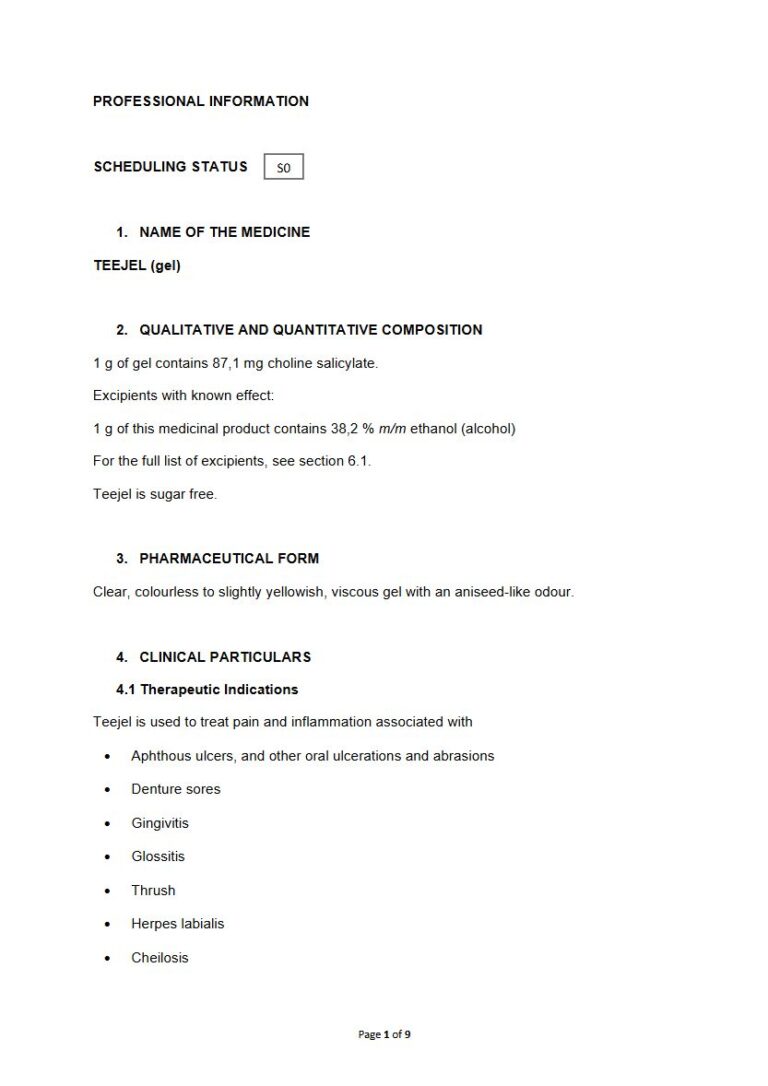
Teejel is used to treat pain and inflammation associated with
- Aphthous ulcers, and other oral ulcerations and abrasions
- Denture sores
- Gingivitis
- Glossitis
- Thrush
- Herpes labialis
- Cheilosis
- Lesions of the nasal mucosa (including the nasal and oral lesions of erythema multiforme and lichen planus)
- Infant teething.
4.2 Posology and method of administration
Posology
Adults and children older than 2 years
Apply approximately 1 cm of the gel on to the sore area three to four times daily before meals and at bedtime.
Infants and children up to 2 years
Apply approximately 0,5 cm of the gel on to the sore area three to four times daily before meals and at bedtime.
Mode of administration
For local use. By topical application to the oral or nasal mucosa.
Instructions to open tube
- Remove the cap and invert.
- Place the cap over neck of tube.
- Press firmly until seal is broken.
The gel should be applied on the painful or affected area with a well washed, clean finger or fingerstall and gently rubbed in.
4.3 Contraindications
Hypersensitivity to the choline salicylate, other non-acetylated salicylates or to any of the excipients listed in section 6.1. Active peptic ulceration. For safety reasons, Teejel must not be used in the last trimester of pregnancy.
4.4 Special warnings and precautions for use
A maximum total daily dose of 250 mg choline salicylate (approximately u00ba of a tube) must not be exceeded. This corresponds to a maximum daily dose of approximately 1170 mg ethanol. Maximum application frequency of Teejel must not exceed 8 - 10 times per day. The quantity of gel per single application must not be greater than the size of a pea. The systemically available quantity of salicylate after application of Teejel to the oral mucosa is so minimal that the use of Teejel as recommended is also possible for children under 12 years of age with teething discomfort without prescription by a doctor. There is a possible association between salicylates and Reyeu2019s Syndrome when given to children. Reyeu2019s Syndrome is a very rare disease, which affects the brain and liver and can be fatal. While the cause of Reyeu2019s Syndrome is unknown, some studies suggest a possible association between the development of Reyeu2019s Syndrome and the use of medicines containing acetylated salicylates or aspirin. Choline salicylate is a non-acetylated salicylate and the evidence for a causal association between choline salicylate and Reyeu2019s Syndrome is very limited. Teejel contains alcohol (ethanol) and should not be used by persons with a history of alcohol abuse.
4.5 Interaction with other medicinal products and other forms of interaction
Salicylates, including choline salicylate, as contained in Teejel, may increase the effects of anticoagulants.
4.6 Fertility, pregnancy and lactation
Salicylates cross the placental barrier and pass into breast milk in minimal amounts. For reasons of safety, Teejel must not be used during the third trimester of pregnancy. During the first two trimesters of pregnancy and during lactation the dosage indicated should not be exceeded.
4.7 Effect on ability to drive or use machines
Teejel has no or only negligible influence on the ability to drive and use machines.
4.8 Undesirable effects
Classification of undesirable effects has been based on the following frequencies:
Very common (u2265 1/10)
Common (u2265 1/100, < 1/10)
Uncommon (u2265 1/1 000, < 1/100)
Rare (u2265 1/10 000, < 1/1 000)
Very rare (< 1/10 000)
Not known (cannot be estimated from the available data)
Within each frequency grouping, undesirable effects are presented in order of decreasing seriousness.
b. Tabulated list of adverse reactions
System Organ Class Adverse Event Frequency
Blood and lymphatic system disorders When used at very high doses, systemic effects of salicylate, especially on coagulation, cannot be ruled out. Very rare
Gastrointestinal disorders When used at very high doses, systemic effects of salicylate, especially on the gastrointestinal tract, cannot be ruled out. Very rare
Skin and subcutaneous tissue disorders Burning sensation on mucous membrane. Not known
Nervous system disorder Reyeu2019s syndrome Very rare (see section 4.4)
4.9 OVERDOSE
After topical application no toxic side effects are to be expected. Salicylate intoxication, known as salicylism, may occur with large systemic doses or prolonged treatment duration. (see recommendations for maximum dosage in section 4.4).
Symptoms of overdose
Symptoms of salicylate overdose include headache, dizziness, tinnitus, hearing disturbance, confusion, somnolence, sweating, nausea and vomiting, diarrhea, fever and hyperventilation. Severe intoxication may be associated with central nervous system disturbances, delirium, tremor, disturbances of electrolyte balance, respiratory alkalosis, respiratory and metabolic acidosis, hyperthermia, dehydration, toxic circulatory and renal failure, cerebral and pulmonary oedema as well as coma.
Treatment of overdose: Patients should be given supportive therapy or treatment for salicylate poisoning as necessary. Primary elimination (activated charcoal), monitoring of electrolyte balance, electrolyte compensation, glucose correction, IC support (ventilation, fluid supply), acceleration of elimination (alkalised, forced diuresis, hemodialysis), administration of diazepam in the event of cramping.
