
Thymoglobuline 25 mg Powder for solution for infusion.
PDF Leaflet Revision Date: 15 April 2022
Clinical Summary
Quick overview from the medicine insert
Indication
Immunosuppression in transplantation and severe aplastic anaemia.
Dosage (summary)
1-1.5 mg/kg/day for 2-9 days post-transplant; 2.5-3.5 mg/kg/day for 5 days in aplastic anaemia.
Special Populations
- Elderly
- Renal impairment
- Hepatic impairment
Pregnancy & Breastfeeding
Not recommended during pregnancy; discontinue breastfeeding during therapy.
Key Drug Interactions
- Ciclosporin
- Tacrolimus
- Mycophenolate mofetil
- Live attenuated vaccines
Contraindications
- Hypersensitivity to rabbit proteins
- Active infections
Common side effects
- Infection
- Lymphopenia
- Thrombocytopenia
- Hypotension
- Fever
Counselling Points
- Monitor for infusion reactions
- Avoid live vaccines
- Use under medical supervision
Serious warnings
- Anaphylaxis
- Cytokine release syndrome
- Infection risk
Important Disclaimer
The Thymoglobuline 25 mg Powder for solution for infusion. professional information leaflet below is the property of Sanofi-Aventis South Africa and is provided on Medinsert exactly as issued, with no.. alterations or editorial changes. We make every effort to keep content current by updating documents as soon as new versions become available. Medinsert serves as a trusted access point for healthcare professionals, but does not replace official sources or clinical judgement. For more details, please read our full disclaimer. read more>>
 Healthcare Professionals Only
This content is for registered healthcare professionals
Sign in or create a free account to read the full package insert.
Free for HPCSA-registered professionals. Powered by Medinsert.
Clinical Particulars
Section 4 of the official insert — extracted exactly as issued, no alterations
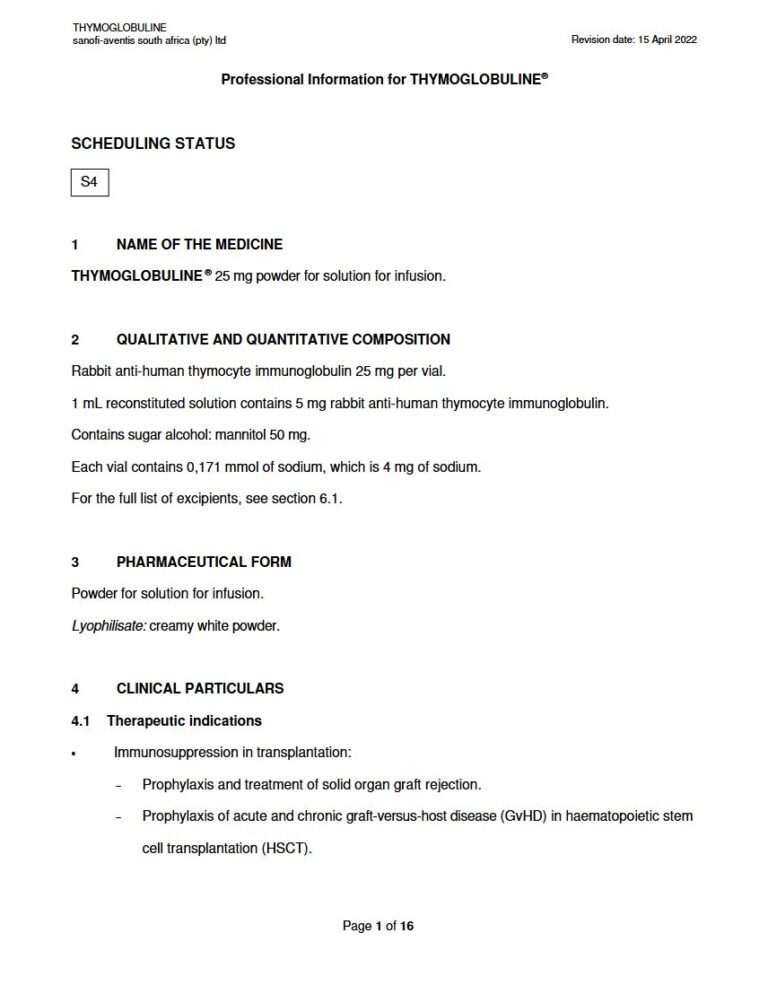
4.1 Therapeutic indications
u2022 Immunosuppression in transplantation:
u2212 Prophylaxis and treatment of solid organ graft rejection.
u2212 Prophylaxis of acute and chronic graft-versus-host disease (GvHD) in haematopoietic stem cell transplantation (HSCT).
u2022 Treatment of severe aplastic anaemia when an immune mechanism is suspected, when an HLA identical sibling is not available, or the patient is older than 45 years.
u2022 Treatment of graft-versus-host disease (GvHD).
u2022 THYMOGLOBULINE may be used as a substitute for equine anti-lymphocyte immunoglobulin in the event of intolerance or contraindication to the latter.
4.2 Posology and method of administration
Posology
The posology depends on the indication, the administration regimen and combination with other immunosuppressive medicines. The following dosage recommendations may be used as a reference. Treatment can be discontinued without gradual tapering of the dose.
Immunosuppression in transplantation:
u2022 Prophylaxis of acute graft rejection: 1 to 1,5 mg/kg/day for 2 to 9 days after transplantation of a kidney, pancreas or liver and for 2 to 5 days after heart transplantation, corresponding to a cumulative dose of 2 to 7,5 mg/kg in heart transplantation and 2 to 13,5 mg/kg for other organs.
u2022 Treatment of acute graft rejection: 1,5 mg/kg/day for 3 to 14 days, corresponding to a cumulative dose of 4,5 to 21 mg/kg.
Severe aplastic anaemia: 2,5 to 3,5 mg/kg/day for 5 consecutive days, corresponding to a cumulative dose of 12,5 to 17,5 mg/kg.
Prophylaxis of acute and chronic graft-versus-host disease: In transplantation of grafts (bone marrow or haematopoietic stem cells from peripheral blood) from mismatched related or matched unrelated donors, it is recommended in adult patients that THYMOGLOBULINE be administered, as a preliminary therapy, at a dose of 2,5 mg/kg/day from day -4 to day -2 or -1, corresponding to a cumulative dose of 7,5 to 10 mg/kg.
Treatment of graft-versus-host disease: The dosage must be determined on an individual basis. It is usually between 2 and 5 mg/kg/day for 5 days.
Method of administration:
Route of administration: Intravenous infusion (after reconstitution and further dilution). Rabbit anti-human thymocyte immunoglobulin is usually administered in the context of a therapeutic regimen combining several immunosuppressive medicines. Administer the daily doses of intravenous corticosteroids and antihistamines required prior to infusion of rabbit anti-human thymocyte immunoglobulin. Anti-pyretic medicines (such as paracetamol) may also increase the tolerability of the initial infusion. Before use each vial of THYMOGLOBULINE is reconstituted with 5 mL of sterile water for injection to form a limpid or slightly opalescent, colourless or pale yellow solution (see section 6.6 Reconstitution and dilution). The reconstituted solution is further diluted in an isotonic solution of 0,9 % sodium chloride or of 5 % dextrose before infusion (see section 6.6). To avoid inadvertent administration of particulate matter from reconstitution, it is recommended that THYMOGLOBULINE is administered through a 0,22 u03bcm in-line filter. Infuse slowly into a large vein. Adjust the infusion rate so that the total duration of infusion is at least 4 hours. ANY VIAL OPENED MUST BE USED IMMEDIATELY.
4.3 Contraindications
Known hypersensitivity to rabbit proteins or one of the components of THYMOGLOBULINE (see section 6.1).
Active acute or chronic infections which would contraindicate any additional immunosuppression.
4.4 Special warnings and precautions for use
Immune-mediated reactions
In rare instances, serious immune-mediated reactions have been reported with the use of THYMOGLOBULINE; these reactions consist of anaphylaxis or severe cytokine release syndrome (CRS). Fatal anaphylaxis has been reported (see section 4.8). Administration must immediately be discontinued and permanently withdrawn if an anaphylactic reaction occurs. Appropriate emergency treatment should be initiated promptly. Equipment for emergency therapy for anaphylactic shock must be readily available. Any anaphylactoid reaction during administration is a contraindication for further treatment.
Severe, acute infusion-associated reactions (IARs) are consistent with CRS attributed to the release of cytokines by activated monocytes and lymphocytes. In rare instances, these reported reactions are associated with serious cardiorespiratory events and/or death (see General below and section 4.8).
Infection
THYMOGLOBULINE is routinely used in combination with other immunosuppressive medicines. Infections (bacterial, fungal, viral and protozoal), reactivation of infection (particularly cytomegalovirus [CMV]), and sepsis have been reported after THYMOGLOBULINE administration in combination with multiple immunosuppressive medicines. In rare cases, these infections have been fatal. Careful patient monitoring and appropriate anti-infective prophylaxis are recommended.
General
Appropriate dosing for THYMOGLOBULINE is different from dosing for other anti-thymocyte globulin (ATG) products, as protein composition and concentrations vary depending on the source of ATG used. Healthcare practitioners should therefore exercise care to ensure that the dose prescribed is appropriate for the ATG product being administered. THYMOGLOBULINE should be used under strict medical supervision in a hospital setting and patients should be carefully monitored during the infusions, and for a period of time following the end of the infusion until the patient is stable. Infusion-associated reactions (IARs) may occur following the administration of THYMOGLOBULINE and may occur as soon as the first or second infusion during a single course of THYMOGLOBULINE treatment. Close compliance with the recommended dosage and infusion time may reduce the incidence and severity of IARs. Additionally, reducing the infusion rate may minimise many of these IARs or the infusion can be discontinued until the symptoms have resolved. Premedication with antipyretics, corticosteroids, and/or antihistamines may decrease both the incidence and severity of these adverse reactions. Rapid infusion rates have been associated with case reports consistent with cytokine release syndrome (CRS). In rare instances, severe CRS can be fatal.
Haematological effects
Thrombocytopenia and/or leucopenia (including lymphopenia and neutropenia) have been identified and are reversible following dose adjustments. When thrombocytopenia and/or leucopenia are not part of the underlying disease or associated with the condition for which THYMOGLOBULINE is being administered, the following dose reductions are suggested:
u2022 A reduction in dosage must be considered if the platelet count is between 50 000 and 75 000 cells/mm 3 or if the white blood cell count is between 2 000 and 3 000 cells/mm 3.
u2022 Discontinuation of THYMOGLOBULINE treatment should be considered if persistent and severe thrombocytopenia (< 50 000 cells/mm 3) occurs or leucopenia (< 2 000 cells/mm 3) develops. White blood cell and platelet counts should be monitored during and after THYMOGLOBULINE therapy.
Malignancy
Use of immunosuppressive medicines, including THYMOGLOBULINE, may increase the incidence of malignancies, including lymphoproliferative disorders or lymphoma (which may be virally mediated). These events have sometimes been associated with fatal outcomes (see section 4.8). It is important to note that concomitant or previous immunosuppressive treatments may contribute to the over-immunosuppression observed.
Special considerations for THYMOGLOBULINE infusion
Reactions at the infusion site can occur and may include pain, swelling and erythema. The recommended route of administration for THYMOGLOBULINE is intravenous infusion using a high flow vein, however, it may be administered through a peripheral vein. When THYMOGLOBULINE is administered through a peripheral vein, concomitant use of heparin and hydrocortisone in an infusion solution of 0,9 % sodium chloride solution for injection may minimise the potential for superficial thrombophlebitis and deep vein thrombosis. The combination of THYMOGLOBULINE, heparin and hydrocortisone in a dextrose infusion solution has been noted to precipitate and is not recommended (see section 4.2 and section 6.2 (Incompatibilities)).
Immunisations
Immunisation with attenuated live vaccines is not recommended for patients who have recently received THYMOGLOBULINE because the safety of immunisation with attenuated live vaccines following THYMOGLOBULINE therapy has not been studied (see section 4.5).
Risk of transmission of infectious medicines
Human blood components (formaldehyde-treated red blood cells and thymus cells) are used in the manufacturing process for THYMOGLOBULINE. Standard measures to prevent infections resulting from the use of medicines prepared from human blood components include specific markers of infection and the inclusion of effective manufacturing steps for inactivation/removal of viruses. Despite these measures, when medicines prepared from human blood components are administered, the possibility of transmitting infective agents cannot be totally excluded. This risk also applies to unknown or emerging viruses and other pathogens.
Traceability
In order to improve the traceability of biological medicinal products, the name and the batch number of the administered product should be clearly recorded.
4.5 Interaction with other medicines and other forms of interaction
u2022 While THYMOGLOBULINE is injected, it is advisable not to give blood or blood derivatives simultaneously and to avoid simultaneous infusions of any other solution, particularly lipids.
u2022 Ciclosporin, tacrolimus, mycophenolate mofetil: risk of excessive immunosuppression with subsequent lymphoproliferation.
u2022 Live attenuated vaccines: risk of systemic infection due to the vaccine which may potentially be fatal (see section 4.4). This risk is increased in subjects who are already immunocompromised due to the underlying disease (aplastic anaemia).
u2022 Rabbit anti-human thymocyte immunoglobulin may induce the formation of antibodies which react with other rabbit immunoglobulins.
u2022 Rabbit anti-human thymocyte immunoglobulin may interfere with ELISA tests using rabbit antibodies for a period of two months.
u2022 THYMOGLOBULINE has not been shown to interfere with any routine clinical laboratory tests which use immunoglobulins. However, THYMOGLOBULINE can induce production of human anti-rabbit antibodies which may interfere with rabbit antibody-based immunoassays and with cross-match or panel-reactive antibody cytotoxicity assays.
4.6 Fertility, pregnancy and lactation
The safety of rabbit anti-human thymocyte immunoglobulins during pregnancy and lactation has not been established. In consequence, rabbit anti-human thymocyte immunoglobulin must not be prescribed during pregnancy unless absolutely required. Breastfeeding should be discontinued during THYMOGLOBULINE therapy.
4.7 Effects on ability to drive and use machines
Given the possible adverse events which can occur during the period of THYMOGLOBULINE infusion, in particular cytokine release syndrome (CRS) (see section 4.8), it is recommended that patients should not drive or operate machinery.
4.8 Undesirable effects
Infections and infestations
Frequent : Infection (including reactivation of infection), sepsis, (see section 4.4), cytomegalovirus infection, urinary tract infection.
Less frequent : Herpes simplex infection, oral moniliasis.
Neoplasms benign and malignant (including cysts and polyps)
Frequent: Malignancy, lymphomas (which may be virally mediated), malignant neoplasms (solid tumours) (see section 4.4).
Less frequent: Lymphoproliferative disorder (see section 4.4).
Blood and the lymphatic system disorders
Frequent : Lymphopenia, leucopenia, thrombocytopenia, neutropenia (see section 4.4)
Less frequent: Coagulopathy.
Frequency unknown: Febrile neutropenia, disseminated intravascular coagulopathy.
Immune system disorders
Less frequent : Anaphylactic reaction (see section 4.4), allergic reactions, cytokine release syndrome*, serum sickness*.
* Side effects are described below
Cardiac disorders
Frequent: Tachycardia.
Vascular disorders
Frequent : Hypotension.
Frequency unknown: Peripheral thrombophlebitis.
Respiratory, thoracic and mediastinal disorders
Frequent : Dyspnoea.
Gastrointestinal disorders
Frequent: Vomiting, nausea, diarrhoea.
Hepatobiliary disorders
Frequent: Increased transaminases * .
Less frequent: Hepatocellular injury, hepatotoxicity, hepatic failure * .
*Side effects are described below
Skin and subcutaneous tissue disorders
Frequent: Pruritus, rash.
Musculoskeletal and connective tissue disorders
Frequent: Arthralgia, myalgia.
General disorders and administration site conditions
Frequent : Fever, chills, pain at the infusion site.
Less frequent: Infusion-associated reactions (IARs)*.
*Side effects are described below
Description of selected adverse reactions
Infusion-associated reactions (IARs) and immune system disorders
IARs may occur following the administration of THYMOGLOBULINE and may occur as soon as the first or second infusion during a single course of THYMOGLOBULINE treatment. Clinical manifestations of IARs have included some of the following signs and symptoms: fever, chills/rigors, dyspnoea, nausea/vomiting, diarrhoea, hypotension or hypertension, malaise, rash, urticaria, decreased oxygen saturation and/or headache (see section 4.4).
Hepatobiliary disorders
Transient reversible elevations in transaminases without any clinical signs or symptoms have also been reported during THYMOGLOBULINE administration.
Cases of hepatic failure have been reported secondary to allergic hepatitis and reactivation of hepatitis in patients with haematological disease and/or stem cell transplant as confounding factors.
Cytokine release syndrome (CRS)
Severe CRS have been associated with cardiorespiratory dysfunction (including hypotension, acute respiratory distress syndrome, pulmonary oedema, myocardial infarction, tachycardia and/or death) (See section 4.4).
Serum sickness
Serum sickness (including reactions such as fever, skin rash, arthralgia and/or myalgia, indicating possible serum sickness) have been reported. Serum sickness tends to occur 5 to 15 days after onset of THYMOGLOBULINE therapy. Symptoms are usually self-limited or resolve rapidly with corticosteroid treatment.
Reporting of suspected adverse reactions
Reporting suspected adverse reactions after authorisation of THYMOGLOBULINE is important. It allows continued monitoring of the benefit/risk balance of THYMOGLOBULINE. Health care professionals are asked to report any suspected adverse reactions to: The Pharmacovigilance Unit at Sanofi: [email protected] (email) or 011 256 3700 (tel), or SAHPRA via the u201c6.04 Adverse Drug Reactions Reporting Formu201d found online under SAHPRAu2019s publications: https://www.sahpra.org.za/Publications/Index/8.
4.9 Overdose
Accidental overdosage can lead to leucopenia (including lymphopenia and neutropenia) and thrombocytopenia. Prolonged use longer than 3 weeks of rabbit anti-human thymocyte immunoglobulin may induce severe infections and increase the risk of lymphoma. Treatment is symptomatic and supportive.
