
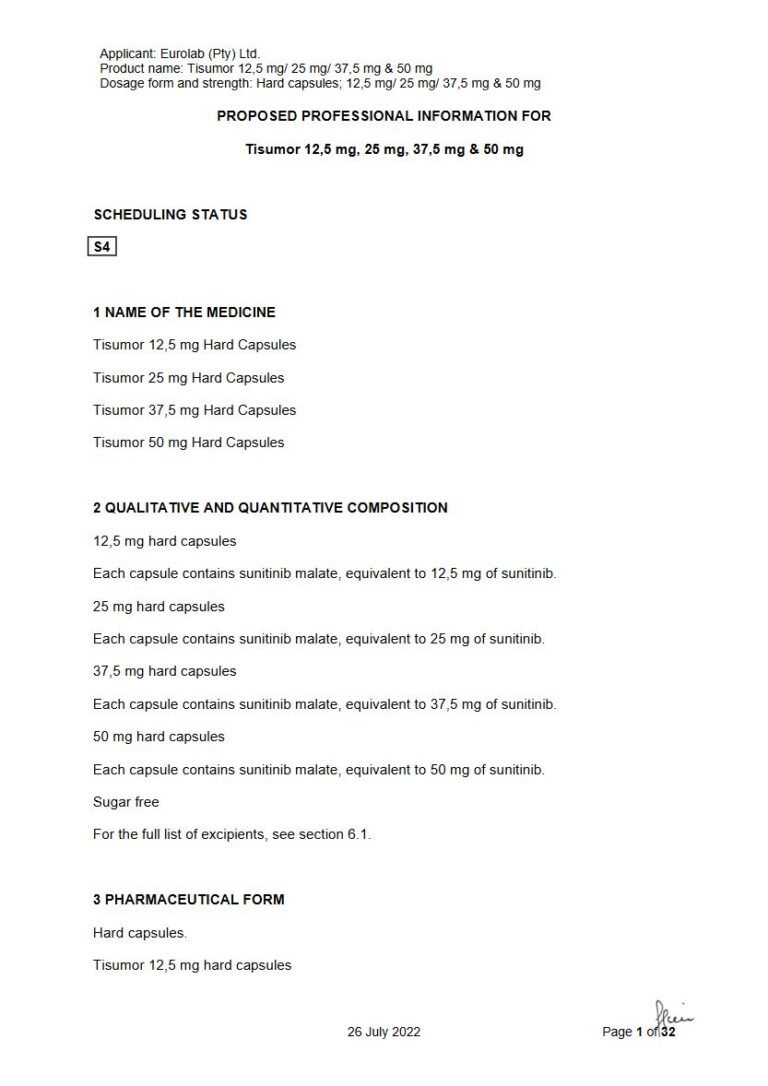
Tisumor 12,5 Mg/25 Mg/37,5 Mg/50 Mg Capsules
PDF Leaflet Revision Date: 26 July 2022
Clinical Summary
Quick overview from the medicine insert
Indication
Treatment of GIST after imatinib failure and advanced/metastatic renal cell carcinoma.
Dosage (summary)
50 mg orally once daily for 4 weeks, followed by a 2-week rest.
Special Populations
- Elderly
- Hepatic impairment
- Renal impairment
- Paediatric population
Pregnancy & Breastfeeding
Contraindicated in pregnancy; avoid breastfeeding.
Key Drug Interactions
- CYP3A4 inhibitors
- CYP3A4 inducers
Contraindications
- Hypersensitivity to sunitinib or excipients
Common side effects
- Hypertension
- Fatigue
- Gastrointestinal disorders
- Skin discolouration
Counselling Points
- Monitor for hypertension
- Avoid pregnancy
- Report signs of severe skin reactions
- Regular blood tests for liver function
Serious warnings
- Severe cutaneous reactions
- Cardiovascular events
- Haemorrhagic events
- Thrombotic microangiopathy
Important Disclaimer
The Tisumor 12,5 Mg/25 Mg/37,5 Mg/50 Mg Capsules professional information leaflet below is the property of Eurolab and is provided on Medinsert exactly as issued, with no.. alterations or editorial changes. We make every effort to keep content current by updating documents as soon as new versions become available. Medinsert serves as a trusted access point for healthcare professionals, but does not replace official sources or clinical judgement. For more details, please read our full disclaimer. read more>>
 Healthcare Professionals Only
This content is for registered healthcare professionals
Sign in or create a free account to read the full package insert.
Free for HPCSA-registered professionals. Powered by Medinsert.
Clinical Particulars
Section 4 of the official insert — extracted exactly as issued, no alterations
4.1 Therapeutic indications
- Tisumor is indicated for the treatment of gastrointestinal stromal tumour (GIST) after failure of imatinib mesylate treatment due to resistance or intolerance.
- Tisumor is indicated for the treatment of treatment-nau00efve advanced and/or metastatic renal cell carcinoma.
- Tisumor is also indicated for the treatment of metastatic renal cell carcinoma (MRCC) after failure of cytokine-based therapy (interferon u03b1, interleukin -2).
- Efficacy is based on time to tumour progression and an increase in survival in GIST and on objective response rates for MRCC.
- Efficacy and safety have not been demonstrated for more than 12 months.
4.2 Posology and method of administration
Therapy with Tisumor should be initiated by a medical practitioner experienced in the administration of anticancer medicines.
Posology
The recommended dose of Tisumor is 50 mg taken orally once daily, for 4 consecutive weeks, followed by a 2-week rest period (Schedule 4/2) to comprise a complete cycle of 6 weeks.
Dose adjustments
Safety and tolerability
Dose modifications in 12,5 mg steps may be applied based on individual safety and tolerability. Daily dose should not exceed 75 mg nor be decreased below 25 mg.
CYP3A4 inhibitors/inducers
In patients receiving Tisumor with a potent CYP3A4 inducer such as rifampin, the dosage of Tisumor may need to be increased in 12.5 mg increments (up to 75 mg per day). Clinical response and tolerability should be carefully monitored.
In patients receiving Tisumor with a CYP3A4 inhibitor such as ketoconazole, the doses of Tisumor may need to be reduced, based on tolerability and/or clinical response. Selection of an alternate concomitant medication with no, or minimal potential to induce or inhibit CYP34 should be considered.
Dose modifications in 12.5 mg increments may be applied based on individual safety and tolerability. Daily doses should not exceed 75 mg nor be decreased below 25 mg.
Special populations
Elderly
No significant differences in safety or efficacy were observed between younger and older patients.
Hepatic impairment
No dose adjustment is recommended when administering Tisumor to patients with mild or moderate (Child-Pugh class A and B) hepatic impairment. Sunitinib has not been studied in subjects with severe (Child-Pugh class C) hepatic impairment.
Renal impairment
No clinical studies have been performed in patients with impaired renal function. Studies excluded patients with serum creatinine > 2.0 x ULN. Population pharmacokinetic analyses have shown that Tisumor pharmacokinetics were unaltered in the range of renal function evaluated, as measured by creatinine clearance (42-347 mL/min).
Paediatric population
The safety and efficacy of Tisumor in patients below 18 years of age have not been established.
Method of administration
Tisumor is for oral administration. It may be taken with or without food. If a dose is missed, the patient should not be given an additional dose. The patient should take the usual prescribed dose on the following day.
4.3 Contraindications
Tisumor is contraindicated in patients with a hypersensitivity to sunitinib malate or to any of the excipients listed in section 6.1.
4.4 Special warnings and precautions for use
Class effects of Tyrosine Kinase Inhibitors (TKIs) such as contained in Tisumor
Cases of cerebrovascular accident, transient ischaemic attack, and ischaemic stroke including fatalities have been reported with the use of Imbruvica, with or without concomitant atrial fibrillation and/or hypertension, although causality with ibrutinib has not been established (see section 4.8, Post marketing Adverse Reactions). Regular monitoring and appropriate treatment of conditions that can contribute to the occurrence of these events, are recommended (see Section 4.4, Cardiac dysrhythmia and hypertension)
Sunitinib neither induces nor inhibits major CYP enzymes, including CYP3A4. The dose of Tisumor may need to be reduced based on tolerability when co-administered with CYP3A4 inhibitors. Co-administration with potent CYP3A4 inhibitors should be avoided because it may increase the plasma concentration of sunitinib (see sections 4.2 and 4.5). The dose of Tisumor may need to be increased when it is co-administered with potent CYP3A4 inducers. Co-administration with potent CYP3A4 inducers should be avoided because it may decrease sunitinib plasma concentration (see sections 4.2 and 4.5).
Skin and tissues disorders
Skin discolouration due to medicine colour(yellow) is a common treatment-related adverse event occurring in approximately 30 % of patients. Patients should be advised that depigmentation of the hair or skin may occur during treatment with Tisumor. Other possible dermatological effects may include dryness, thickness or cracking of the skin, blisters, or rash on the palms of the hands and soles of the feet. Mouth pain/irritation and Dysgeusia (taste disturbance) may also occur. The above reactions were not cumulative, were typically reversible, and generally, did not result in treatment discontinuation. Pyoderma gangrenosum are generally reversible after discontinuation of Tisumor.
Severe cutaneous reactions
Cases of erythema multiforme (EM), cases suggestive of Stevens-Johnson syndrome (SJS) and toxic epidermal necrolysis (TEN), some of which were fatal. If signs or symptoms of SJS, TEN, or EM (e.g., progressive skin rash often with blisters or mucosal lesions) are present, Tisumor treatment should be discontinued. If the diagnosis of SJS or TEN is confirmed, treatment must not be restarted. In some cases of suspected EM, patients tolerated the reintroduction of sunitinib therapy at a lower dose after resolution of the reaction; some of these patients also received concomitant treatment with corticosteroids or antihistamines (see section 4.8).
Haemorrhage and tumour bleeding
Haemorrhagic events, that may be fatal, may occur with sunitinib and may include gastrointestinal, respiratory, urinary tract and brain haemorrhages (see section 4.8). Treatment-related tumour haemorrhage occurred in approximately 2 % of patients with GIST. Tumour haemorrhage has not been observed in patients with MRCC or other solid tumours. Routine assessment of bleeding events should include complete blood counts and physical examination. Epistaxis was the most common haemorrhagic adverse reaction. Some of the epistaxis events were severe, but very rarely fatal. Events of tumour haemorrhage, sometimes associated with tumour necrosis, have been reported; some of these haemorrhagic events were fatal. Tumour haemorrhage may occur suddenly, and in the case of pulmonary tumours, may present as severe and life-threatening haemoptysis or pulmonary haemorrhage. Cases of pulmonary haemorrhage, some with a fatal outcome, may occur in patients treated with Tisumor for MRCC, GIST, and lung cancer. Tisumor is not approved for use in patients with lung cancer. Patients receiving concomitant treatment with anticoagulants (e.g. warfarin, acenocoumarole) may be periodically monitored by complete blood counts (platelets), coagulation factors (PT/INR), and physical examination. In patients receiving Tisumor for treatment-nau00efve MRCC, patients had bleeding events. Of patients receiving Tisumor for cytokine-refractory.
Gastrointestinal disorders
Diarrhoea, nausea/vomiting, abdominal pain, dyspepsia, and stomatitis/oral pain are common gastrointestinal adverse reactions; oesophagitis events are not common (see section 4.8). Supportive care for gastrointestinal adverse reactions requiring treatment may include medicines with antiemetic, anti-diarrhoeal, or antacid properties. Serious, sometimes fatal gastrointestinal complications including gastrointestinal perforation, is known to be in patients with intra-abdominal malignancies treated with sunitinib.
Hypertension
Treatment-related hypertension may be common in 16 % of patients with solid tumours. Hypertension in association with sunitinib, includes severe hypertension (> 200 mmHg systolic or 110 mmHg diastolic). Patients should be screened for hypertension and controlled as appropriate. Treatment-related hypertension may occur in patients receiving Tisumor for treatment-nau00efve MRCC. Temporary suspension is recommended in patients with severe hypertension that is not controlled with medical management. Treatment may be resumed once hypertension is appropriately controlled (see section 4.8).
Haematological disorders
Decreased absolute neutrophil counts and decreased platelet counts may occur in association with the use of sunitinib (see section 4.8).
Sunitinib has the potential to inhibit the cardiac action potential repolarization process (e.g. prolongation of QT interval). Increases in the QTc interval to over 500 msec may occur and changes from baseline in excess of 60 msec. May occur in solid tumour patients; both these parameters are recognised as potentially significant changes.
Cardiovascular events, including heart failure, cardiomyopathy, left ventricular ejection fraction decline to below the lower limit of normal, myocarditis, myocardial ischaemia and myocardial infarction, some of which may be fatal, may occur in patients treated with sunitinib. Sunitinib increases the risk of cardiomyopathy. Use sunitinib with caution in patients who are at risk for, or who have a history of, these events (see section 4.8). Patients who presented with cardiac events within 12 months prior to sunitinib administration, such as myocardial infarction (including severe/unstable angina), coronary/peripheral artery bypass graft, symptomatic congestive heart failure (CHF), cerebrovascular accident or transient ischaemic attack, or pulmonary embolism were excluded from sunitinib. It is unknown whether patients with these concomitant conditions may be at a higher risk of developing sunitinib-related left ventricular dysfunction. Medical practitioners are advised to weigh this risk against the potential benefits of sunitinib. Patients should be carefully monitored for signs and symptoms of CHF while receiving sunitinib especially patients with cardiac risk factors and/or history of coronary artery disease. Baseline and periodic evaluations of LVEF should also be considered while the patient is receiving sunitinib. In patients without cardiac risk factors, a baseline evaluation of ejection fraction should be considered. In the presence of clinical manifestations of CHF, discontinuation of sunitinib is recommended. The administration of sunitinib should be interrupted and/or the dose reduced in patients without clinical evidence of CHF but with an ejection fraction 20 % below baseline.
Pulmonary Embolism
Treatment-related pulmonary embolism may occur in patients with solid tumours who have received Tisumor. There were no further occurrences of pulmonary embolism in patients after treatment was resumed.
QT interval prolongation
Approximately twice, the therapeutic concentrations, Tisumor is known to show prolongation to QTcF (Fredericiau2019s correction) interval. Prolongation of QT interval and Torsade de pointes may be observed in <0,1 % of sunitinib-exposed patients. QT interval prolongation may lead to an increased risk of ventricular dysrhythmias including Torsade de pointes. Sunitinib should be used with caution in patients with a known history of QT interval prolongation, patients who are taking antidysrhythmics or medicines that can prolong QT interval, or patients with relevant pre-existing cardiac disease, bradycardia, or electrolyte disturbances. Concomitant administration of sunitinib with potent CYP3A4 inhibitors should be limited because of the possible increase in sunitinib plasma concentrations (see sections 4.2, 4.5 and 4.8).
Venous thromboembolic events
Treatment-related venous thromboembolic events may occur in patients who received sunitinib including deep venous thrombosis and pulmonary embolism (see section 4.8). Cases of pulmonary embolism with fatal outcome may occur.
Arterial thromboembolic events
Arterial thromboembolic events (ATE), sometimes fatal, may occur in patients treated with sunitinib. The most frequent events include cerebrovascular accident, transient ischaemic attack, and cerebral infarction. Risk factors associated with ATE, in addition to the underlying malignant disease and age u2265 65 years, include hypertension, diabetes mellitus, and prior thromboembolic disease.
Aneurysms and artery dissections
The use of vascular endothelial growth factor (VEGF) pathway inhibitors in patients with or without hypertension may promote the formation of aneurysms and/or artery dissections. Before initiating sunitinib, this risk should be carefully considered in patients with risk factors such as hypertension or history of aneurysm.
Thrombotic microangiopathy (TMA)
The diagnosis of TMA, including thrombotic thrombocytopaenic purpura (TTP) and haemolytic uraemic syndrome (HUS), sometimes leading to renal failure or a fatal outcome, should be considered in the occurrence of haemolytic anaemia, thrombocytopenia, fatigue, fluctuating neurological manifestation, renal impairment, and fever. Sunitinib therapy should be discontinued in patients who develop TMA and prompt treatment is required. Reversal of the effects of TMA has been observed after treatment discontinuation (see section 4.8).
Thyroid dysfunction
Treatment-emergent acquired hypothyroidism may occur in patients with GIST. Baseline laboratory measurement of thyroid function is recommended in all patients. Patients with pre-existing hypothyroidism or hyperthyroidism should be treated as per standard medical practice prior to the start of sunitinib treatment. During sunitinib treatment, routine monitoring of thyroid function should be performed every 3 months. In addition, patients should be observed closely for signs and symptoms of thyroid dysfunction during treatment, and patients who develop any signs and/or symptoms suggestive of thyroid dysfunction should have laboratory testing of thyroid function performed as clinically indicated. Patients who develop thyroid dysfunction should be treated as per the standard medical practice. Hypothyroidism may occur early as well as late during treatment with sunitinib (see section 4.8).
Pancreatitis
Increases in serum lipase and amylase activities may occur in patients with various solid tumours who received sunitinib. Increases in lipase activities were transient and were generally not accompanied by signs or symptoms of pancreatitis in subjects with various solid tumours (see section 4.8). Pancreatitis may occur in patients with solid tumours. Hepatic failure may occur in solid tumour patients treated with Tisumor. Cases of serious pancreatic events, some with fatal outcome, may occur. If symptoms of pancreatitis are present, patients should discontinue sunitinib and be provided with appropriate supportive care.
Hepatotoxicity
Hepatotoxicity may occur in patients treated with sunitinib. Cases of hepatic failure, some with a fatal outcome, may occur in solid tumour patients treated with sunitinib. Monitor liver function tests (alanine transaminase [ALT], aspartate transaminase [AST], bilirubin levels) before initiation of treatment, during each cycle of treatment, and as clinically indicated. If signs or symptoms of hepatic failure are present, sunitinib should be discontinued and appropriate supportive care should be provided (see section 4.8).
Renal function
Cases of renal impairment, renal failure and/or acute renal failure, in some cases with fatal outcome, may occur (see section 4.8). Risk factors associated with renal impairment/failure in patients receiving sunitinib included, in addition to underlying RCC, older age, diabetes mellitus, underlying renal impairment, cardiac failure, hypertension, sepsis, dehydration/hypovolaemia, and rhabdomyolysis. Cases of proteinuria and rare cases of nephrotic syndrome may occur. Baseline urinalysis is recommended, and patients should be monitored for the development or worsening of proteinuria. Discontinue sunitinib in patients with nephrotic syndrome.
Fistula
If fistula formation occurs, sunitinib treatment should be interrupted.
Impaired wound healing
Cases of impaired wound healing have been reported during sunitinib therapy. Temporary interruption of sunitinib therapy is recommended for precautionary reasons in patients undergoing major surgical procedures.
Osteonecrosis of the jaw (ONJ)
Cases of ONJ may occur in patients treated with Tisumor. Caution should therefore be exercised when Tisumor and intravenous bisphosphonates are used either simultaneously or sequentially. Invasive dental procedures are also an identified risk factor. Prior to treatment with Tisumor, a dental examination and appropriate preventive dentistry should be considered. In patients who have previously received or are receiving intravenous bisphosphonates, invasive dental procedures should be avoided if possible (see section 4.8).
Hypersensitivity/angioedema
If angioedema due to hypersensitivity occurs, sunitinib treatment should be interrupted and standard medical care provided (see section 4.8).
Seizures
Seizures may occur with Sunitinib. Patients with seizures and signs/symptoms consistent with posterior reversible leukoencephalopathy syndrome (RPLS), such as hypertension, headache, decreased alertness, altered mental functioning and visual loss, including cortical blindness, should be controlled with medical management including control of hypertension. Temporary suspension of sunitinib is recommended; following resolution, treatment may be resumed at the discretion of the treating medical practitioner (see section 4.8).
Tumour lysis syndrome (TLS)
Cases of TLS, some fatal, may occur in patients treated with sunitinib. Risk factors for TLS include high tumour burden, pre-existing chronic renal insufficiency, oliguria, dehydration, hypotension, and acidic urine. These patients should be monitored closely and treated as indicated, and prophylactic hydration should be considered.
Infections
Serious infections, with or without neutropenia, including some with a fatal outcome, may occur. Uncommon cases of necrotising fasciitis, including of the perineum, sometimes fatal, may occur (see section 4.8). Sunitinib therapy should be discontinued in patients who develop necrotising fasciitis, and appropriate treatment should be promptly initiated.
Hypoglycaemia
Decreases in blood glucose, which may be symptomatic and requiring hospitalisation due to loss of consciousness, may occur during sunitinib treatment. In case of symptomatic hypoglycaemia, sunitinib should be temporarily interrupted. Blood glucose levels in diabetic patients should be checked regularly in order to assess if antidiabetic medicinal product's dosage needs to be adjusted to minimise the risk of hypoglycaemia (see section 4.8).
4.5 Interaction with other medicines and other forms of interaction
When Tisumor is co-administered with other medications, there is a potential for medicine interaction.
Medicine that may increase sunitinib plasma concentrations
Effect of CYP3A4 inhibitors
Concomitant administration of a single dose of sunitinib with the potent CYP3A4 inhibitor ketoconazole results in an increase of the combined [sunitinib + primary metabolite] maximum concentration (Cmax) and area under the curve (AUC0- u221e) values of 49 % and 51 %, respectively. Administration of sunitinib with potent CYP3A4 inhibitors (e.g., ritonavir, itraconazole, erythromycin, clarithromycin, grapefruit juice) may increase sunitinib concentrations. Combination with CYP3A4 inhibitors should therefore be avoided, or the selection of an alternate concomitant medicinal product with no or minimal potential to inhibit CYP3A4 should be considered. If this is not possible, the dose of Tisumor may need to be reduced to a minimum of 37,5 mg daily for GIST and MRCC based on careful monitoring of tolerability (see section 4.2).
Effect of Breast Cancer Resistance Protein (BCRP) inhibitors
An interaction between sunitinib and other BCRP inhibitors cannot be excluded (see section 5.2).
Medicine that may decrease sunitinib plasma concentrations
Effect of CYP3A4 inducers
Concomitant administration of a single dose of sunitinib with the CYP3A4 inducer rifampicin results in a reduction of the combined [sunitinib + primary metabolite] Cmax and AUC0- u221e values of 23 % and 46 %, respectively. Administration of sunitinib with potent CYP3A4 inducers (e.g., dexamethasone, phenytoin, carbamazepine, rifampicin, phenobarbitone or herbal preparations containing St. John's Wort (Hypericum perforatum) may decrease sunitinib concentrations. Combination with CYP3A4 inducers should therefore be avoided, or selection of an alternate concomitant medicinal product, with no or minimal potential to induce CYP3A4 should be considered. If this is not possible, the dose of Tisumor may need to be increased in 12,5 mg increments (up to 75 mg per day for GIST and per MRCC), based on careful monitoring of tolerability (see section 4.2).
The calculated in vitro Ki values for all CYP isoforms tested (CYP1A2, CYP2A6, CYP2B6, CYP2C8, CYP2C9, CYP2C19, CYP2D6, CYP2E1, CYP3A4/5 AND CYP4A9/11) indicated that Tisumor and its primary active metabolite are unlikely to have any relevant interactions with medicine that may be metabolised by these enzymes.
4.6 Fertility, pregnancy and lactation
Women of childbearing potential / Contraception in males and females
Women of childbearing potential should be advised to use effective contraception and avoid becoming pregnant while receiving treatment with Tisumor.
Pregnancy
There are no studies in pregnant women using Tisumor. Studies in animals have shown reproductive toxicity including foetal malformations. Tisumor should not be used during pregnancy. If the patient becomes pregnant while on treatment with Tisumor, the patient should be apprised of the potential hazard to the foetus.
Breastfeeding
Sunitinib and/or its metabolites are excreted in rat milk. It is not known whether sunitinib or its primary active metabolite is excreted in human milk. Active substances are commonly excreted in human milk and because of the potential for serious adverse reactions in breastfeeding infants, women should not breastfeed while taking Tisumor.
Fertility
Based on nonclinical findings, male and female fertility may be compromised by treatment with Tisumor.
4.7 Effects on ability to drive and use machines
No studies on the effects on the ability to drive or operate machinery have been performed. Patients should be advised that they may experience dizziness during treatment with sunitinib (see section 4.8).
4.8 Undesirable effects
Summary of the safety profile
The most serious adverse reactions associated with sunitinib, some fatal, are renal failure, heart failure, pulmonary embolism, thrombocytopenia, gastrointestinal perforation, and haemorrhages (e.g., respiratory tract, gastrointestinal, tumour, urinary tract, and brain haemorrhages), febrile neutropenia, and hypertension. The most common adverse reactions of any grade (experienced by patients in MRCC and GIST) include a decreased appetite, taste disturbance, hypertension, fatigue, gastrointestinal disorders (i.e. diarrhoea, nausea, stomatitis, dyspepsia, and vomiting), skin discolouration, dysgeusia, anorexia and palmar-plantar erythrodysaesthesia syndrome. These symptoms may diminish as treatment continues. Fatigue, hypertension and neutropenia are the most common treatment-related adverse events.
Increased lipase was the most frequently occurring treatment-related adverse event with maximum severity in patients with solid tumours. Hypothyroidism may develop during treatment. Haematological disorders (e.g., neutropenia, thrombocytopenia, and anaemia) are amongst the most common adverse drug reactions. Fatal events other than those listed in section 4.4 above or in section 4.8 below that were considered possibly related to sunitinib included multi-system organ failure, disseminated intravascular coagulation, peritoneal haemorrhage, adrenal insufficiency, pneumothorax, shock, and sudden death.
Tabulated list of adverse reactions
Frequencies are defined as: Frequent, less Frequent, frequency not known
Table 1. Adverse reactions reported
System organ class
Frequent
Less Frequent
Frequency not known
Infections and infestations
Viral infections a
Respiratory infections b.*
Abscess c.*
Fungal infections d
Urinary tract infections
Skin infections e
Sepsis f.*
Necrotising fasciitis*
Bacterial infections g.*
Blood and lymphatic system disorders
Neutropenia
Thrombocytopenia
Anaemia
Leukopenia
Lymphopenia
Pancytopenia
Thrombotic microangiopathyh.*
Immune system disorders
Hypersensitivity
Angioedema
Endocrine disorders
Hypothyroidism
Hyperthyroidism
Thyroiditis
Metabolism and nutrition disorders
Decreased appetite i
Dehydration
Hypoglycaemia
Tumour lysis syndrome*
Psychiatric disorders
Insomnia
Depression
Nervous system disorders
Dizziness
Headache
Taste disturbance j
Neuropathy peripheral
Paraesthesia
Hypoaesthesia
Hyperaesthesia
Cerebral haemorrhage*
Cerebrovascular accident*
Transient ischaemic attack
Posterior reversible encephalopathy syndrome *
Ischaemic stroke
Eye disorders
Periorbital oedema
Eyelid oedema
Lacrimation increased
Cardiac disorders
Myocardial ischemia k.*
Ejection fraction decreased
Cardiac failure congestive
Myocardial infarction m.*
Cardiac failure*
Cardiomyopathy*
Pericardial effusion
Electrocardiogram QT prolonged
Left ventricular failure*
Torsade de pointes
Vascular disorders
Hypertension
Deep vein thrombosis
Hot flush
Flushing
Tumour haemorrhage*
Aneurysms and artery dissections*
Respiratory, thoracic and mediastinal disorders
Dyspnoea
Epistaxis
Cough
Pulmonary embolism*
Pleural effusion*
Haemoptysis
Dyspnoea exertional
Oropharyngeal pain n
Nasal congestion
Nasal dryness
Pulmonary haemorrhage*
Respiratory failure*
Gastrointestinal disorders
Stomatitis o
Abdominal pain p
Vomiting
Diarrhoea
Dyspepsia
Nausea
Constipation
Gastro-oesophageal reflux disease
Dysphagia
Gastrointestinal haemorrhage*
Oesophagitis*
Gastrointestinal perforation q.*
Pancreatitis
Anal fistula
Colitis r
Abdominal distension
Abdominal discomfort
Rectal haemorrhage
Gingival bleeding
Mouth ulceration
Proctalgia
Cheilitis
Haemorrhoids
Glossodynia
Oral pain
Dry mouth
Flatulence
Oral discomfort
Eructation
Hepatobiliary disorders
Hepatic failure*
Cholecystitis s,*
Hepatic function abnormal
Hepatitis
Skin and subcutaneous tissue disorders
Skin discolouration t
Palmar-plantar erythrodysaesthesia syndrome
Rash u
Hair colour changes
Dry skin
Skin exfoliation
Erythema multiforme*
Stevens-Johnson syndrome*
Pyoderma gangrenosum
Toxic epidermal necrolysis*
Skin reaction v
Eczema
Blister
Erythema
Alopecia
Acne
Pruritus
Skin hyperpigmentation
Skin lesion
Hyperkeratosis
Dermatitis
Nail disorder w
Musculoskeletal and connective tissue disorders
Pain in extremity
Arthralgia
Back pain
Musculoskeletal pain
Muscle spasms
Myalgia
Muscle weakness
Osteonecrosis of the jaw
Fistula*
Rhabdomyolysis*
Myopathy
Renal and urinary disorders
Renal failure*
Renal failure acute*
Chromaturia
Proteinuria
Haemorrhage urinary tract
Nephrotic syndrome
General disorders
Mucosal inflammation
Fatigue x
Oedema y
Impaired healing
Pyrexia
Chest pain
Pain
Influenza like illness
Chills
Investigations
Weight decreased
White blood cell count decreased
Lipase increased
Platelet count decreased
Haemoglobin decreased
Amylase increased z
Aspartate aminotransferase increased
Alanine aminotransferase increased
Blood creatinine increased
Blood pressure increased
Blood uric acid increased
Blood creatinine phosphokinase increased
Blood thyroid stimulating hormone increased
* Including fatal events.
4.9 Overdose
There is no experience of acute overdosage with Tisumor. There is no specific antidote for overdose with Tisumor and treatment of overdose should consist of general supportive measures. If indicated, elimination of unabsorbed active substance may be achieved by emesis. Cases of overdose may occur, some cases which were associated with adverse reactions consistent with the known safety profile of sunitinib. (See section 4.8)
