
Tobi 300 Mg/5 Ml Solution
PDF Leaflet Revision Date: 14 November 2023
Clinical Summary
Quick overview from the medicine insert
Indication
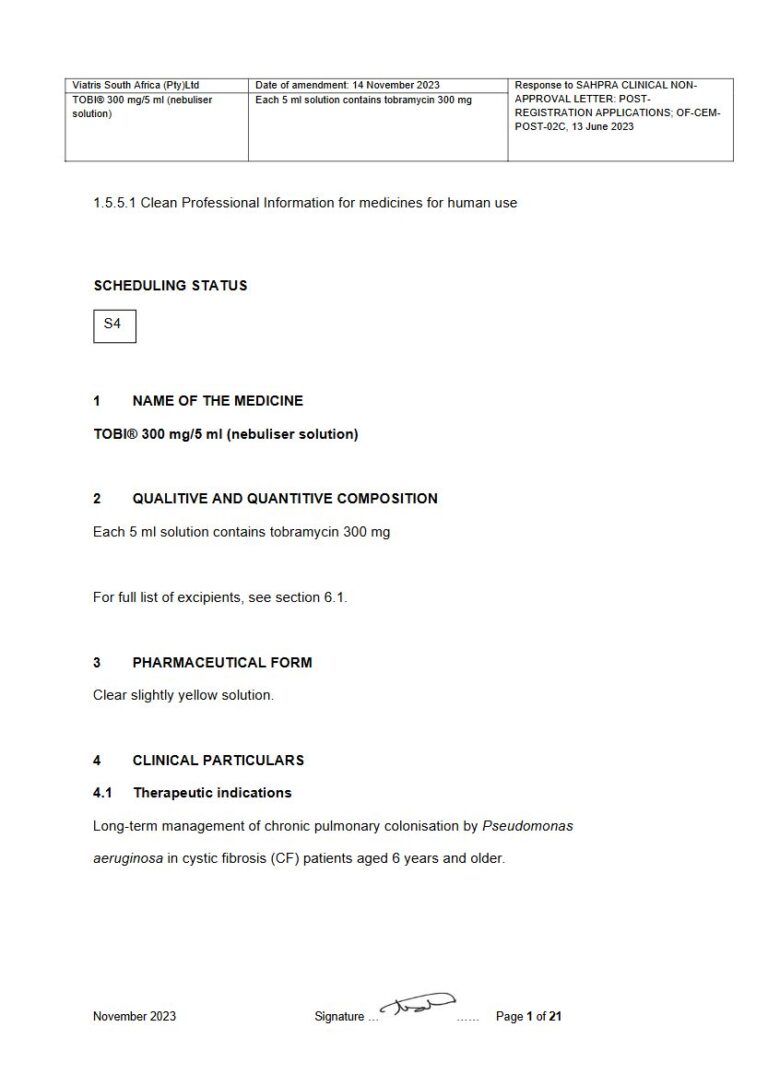
Long-term management of chronic pulmonary colonisation by Pseudomonas aeruginosa in cystic fibrosis patients aged 6 years and older.
Dosage (summary)
One ampoule (300 mg) twice daily for 28 days, followed by a 28-day rest period.
Special Populations
- Renal impairment
- Auditory dysfunction
- Neuromuscular disorders
Pregnancy & Breastfeeding
Not recommended during pregnancy or lactation due to potential harm to the fetus and infants.
Key Drug Interactions
- Nephrotoxic drugs
- Ototoxic drugs
- Diuretics
Contraindications
- Hypersensitivity to aminoglycosides
- Pregnancy
- Lactation
Common side effects
- Cough
- Pharyngitis
- Dyspnoea
- Tinnitus
- Dysphonia
Counselling Points
- Inhale using a nebuliser
- Monitor for signs of bronchospasm
- Avoid mixing with other medications in nebuliser
Serious warnings
- Risk of nephrotoxicity
- Risk of ototoxicity
- Bronchospasm
Important Disclaimer
The Tobi 300 Mg/5 Ml Solution professional information leaflet below is the property of Viatris South Africa (Pty)Ltd and is provided on Medinsert exactly as issued, with no.. alterations or editorial changes. We make every effort to keep content current by updating documents as soon as new versions become available. Medinsert serves as a trusted access point for healthcare professionals, but does not replace official sources or clinical judgement. For more details, please read our full disclaimer. read more>>
 Healthcare Professionals Only
This content is for registered healthcare professionals
Sign in or create a free account to read the full package insert.
Free for HPCSA-registered professionals. Powered by Medinsert.
Clinical Particulars
Section 4 of the official insert — extracted exactly as issued, no alterations
4.1 Therapeutic indications
Long-term management of chronic pulmonary colonisation by Pseudomonas aeruginosa in cystic fibrosis (CF) patients aged 6 years and older.
4.2 Posology and method of administration
TOBI is supplied for use via inhalation and is not for parenteral use.
Posology
- The recommended dose for adults and children is one ampoule twice daily for 28 days.
- The dose interval should be as close as possible to 12 hours and not less than 6 hours.
- After 28 days of therapy, patients should stop TOBI therapy for the next 28 days.
- A cycle of 28 days of active therapy and 28 days of rest from treatment should be maintained.
- Dosage is not adjusted for weight.
- All patients should receive one ampoule of TOBI (300 mg of tobramycin) twice daily.
Controlled clinical studies, conducted for a period of 6 months using the following TOBI regimen, have shown that improvement in lung function was maintained above baseline during the 28-day rest periods.
TOBI Dosing Regimen in Controlled Clinical Studies
- Cycle 1: 28 Days TOBI 300 mg twice daily plus standard care
- Cycle 2: 28 Days Standard care
- Cycle 3: 28 Days TOBI 300 mg twice daily plus standard care
Safety and efficacy have been assessed in controlled and open label studies for up to 96 weeks (12 cycles) but have not been studied in patients under the age of 6 years, patients with forced expiratory volume in 1 second (FEV1) 75 % predicted, or patients colonised with Burkholderia cepacia. Therapy should be initiated by a doctor experienced in the management of cystic fibrosis. Treatment with TOBI should be continued on a cyclical basis for as long as the doctor considers the patient is gaining clinical benefit from the inclusion of TOBI in their treatment regimen. If clinical deterioration of pulmonary status is evident, additional anti-pseudomonal therapy should be considered. Clinical studies have shown that a microbiological report indicating in vitro drug resistance does not necessarily preclude a clinical benefit for the patient. The maximum tolerated daily dose of TOBI has not been established.
Method of administration
- The contents of one ampoule should be emptied in the nebuliser and administered by inhalation over approximately a 15-minute period using a hand-held PARI LC PLUS reusable nebuliser with a suitable compressor.
- Suitable compressors are those which, when attached to a PARI LC Plus nebuliser, deliver a flow rate of 4-6 L/min and/or a back pressure of 110-217 kPa. The manufacturersu2019 instructions for the care and use of the nebuliser and compressor should be followed.
- TOBI is inhaled whilst the patient is sitting or standing upright and breathing normally through the mouthpiece of the nebuliser.
- Nose clips may help the patient breathe through the mouth.
- The patient should continue their standard regimen of chest physiotherapy.
- The use of appropriate bronchodilators should continue as thought clinically necessary.
- Where patients are receiving several different respiratory therapies, it is recommended that they are taken in the following order, bronchodilator, chest physiotherapy, other inhaled medicines and finally TOBI.
4.3 Contraindications
- Administration of TOBI is contraindicated in any patient with known hypersensitivity to any aminoglycoside or to any of the excipients.
- Pregnancy and lactation.
4.4 Special warnings and precautions for use
TOBI should be used with caution in patients with known or suspected renal, auditory, vestibular or neuromuscular dysfunction, or with severe, active haemoptysis.
Monitoring of serum tobramycin concentrations
The serum concentration of tobramycin should only be monitored through venipuncture and not finger prick blood sampling, which is a non-validated dosing method. It has been observed that contamination of the skin of the fingers from the preparation and nebulisation of TOBI may lead to falsely increased serum levels of the medicine. This contamination cannot be completely avoided by hand washing before testing.
Bronchospasm
Bronchospasm may occur with inhalation of medicines and has been reported with nebulised tobramycin. The first dose of TOBI should be given under supervision, using a pre-nebulisation bronchodilator if this is part of the current regimen for the patient. FEV1 should be measured before and after nebulisation. If there is evidence of therapy-induced bronchospasm in a patient not receiving a bronchodilator the test should be repeated, on a separate occasion, using a bronchodilator. Evidence of bronchospasm in the presence of bronchodilator therapy may indicate an allergic response. If an allergic response is suspected TOBI should be discontinued. Bronchospasm should be treated as medically appropriate.
Neuromuscular disorders
TOBI should be used with great caution in patients with neuromuscular disorders such as parkinsonism or other conditions characterised by myasthenia, including myasthenia gravis, as aminoglycosides may aggravate muscle weakness due to a potential curare-like effect on neuromuscular function.
Nephrotoxicity
Although nephrotoxicity has been associated with parenteral tobramycin therapy, there was no evidence of nephrotoxicity during clinical trials with TOBI. The product should be used with caution in patients with known or suspected renal dysfunction and serum concentrations of tobramycin should be monitored. Patients with severe renal impairment, i.e., serum creatinine > 2 mg/dL (176.8 u03bcmol/L), were not included in clinical studies. Current clinical practice suggests baseline renal function should be assessed. Serum urea and creatinine levels should be reassessed after every 6 complete cycles of TOBI therapy (180 days of nebulised aminoglycoside therapy). If there is evidence of nephrotoxicity, TOBI therapy should be discontinued until trough serum concentrations fall below 2 u03bcg/mL. Patients receiving concomitant parenteral aminoglycoside therapy should be monitored as clinically appropriate taking into account the risk of cumulative toxicity.
Ototoxicity
Ototoxicity, manifested as both auditory and vestibular toxicity, has been reported with tobramycin. Vestibular toxicity may be manifested by vertigo, ataxia or dizziness. Auditory toxicity, as measured by complaints of hearing loss or by audiometric evaluations, did not occur with TOBI therapy during controlled clinical studies. In open label studies and post-marketing experience, some patients with a history of prolonged previous or concomitant use of intravenous aminoglycosides have experienced hearing loss. Doctors should consider the potential for aminoglycosides to cause vestibular and cochlear toxicity and carry out appropriate assessments of auditory function during TOBI therapy. In patients with a predisposing risk due to previous prolonged, systemic aminoglycoside therapy it may be necessary to consider audiological assessment before initiating TOBI therapy. The onset of tinnitus warrants caution as it is a sentinel symptom of ototoxicity. If a patient reports tinnitus of hearing loss during aminoglycoside therapy the doctor should consider referring them for audiological assessment. Patients receiving concomitant parenteral aminoglycoside therapy should be monitored as clinically appropriate taking into account the risk of cumulative toxicity.
Risk of Ototoxicity Due to Mitochondrial DNA Variants
Cases of ototoxicity with aminoglycosides have been observed in patients with certain variants in the mitochondrially encoded 12S rRNA gene (MT-RNR1), particularly the m.1555A>G variant. Ototoxicity occurred in some patients even when their aminoglycoside serum levels were within the recommended range. In case of known maternal history of ototoxicity due to aminoglycoside use or a known mitochondrial DNA variant in the patient, consider alternative treatments other than aminoglycosides.
Microbial Resistance
In clinical studies, some patients on TOBI therapy showed an increase in tobramycin Minimum Inhibitory Concentrations for P. aeruginosa isolates tested. There is a theoretical risk that patients being treated with nebulised tobramycin may develop P. aeruginosa isolates resistant to intravenous tobramycin.
4.5 Interaction with other medicines and other forms of Interaction
In clinical studies patients taking TOBI concomitantly with dornase alfa, u03b2 - agonists, inhaled corticosteroids, and other oral or parenteral anti-pseudomonal antibiotics, demonstrated adverse experience profiles which were similar to those of the control group. Concurrent and/or sequential use of TOBI with other medicines with nephrotoxic or ototoxic potential should be avoided.
Some diuretics can enhance aminoglycoside toxicity by altering antibiotic concentrations in serum and tissue. TOBI should not be administered concomitantly with furosemide, urea or mannitol. Other medicines that have been reported to increase the potential toxicity of parenterally administered aminoglycosides include: Amphotericin B, cefalotin, ciclosporin, tacrolimus, polymyxins (risk of increased nephrotoxicity). Platinum compounds (risk of increased nephrotoxicity and ototoxicity). Anticholinesterases, botulinum toxin (neuromuscular effects).
4.6 Fertility, pregnancy and lactation
Pregnancy
TOBI should not be used during pregnancy or lactation (see section 4.3). There are no adequate data from the use of tobramycin administered by inhalation in pregnant women. Animal studies do not indicate a teratogenic effect of tobramycin. However, aminoglycosides can cause foetal harm (e.g., congenital deafness) when high systemic concentrations are achieved in a pregnant woman. If the patient becomes pregnant while taking TOBI, she should be informed of the potential hazard to the foetus.
Breastfeeding
Systemic tobramycin is excreted in breast milk. It is not known if administration of TOBI will result in serum concentrations high enough for tobramycin to be detected in breast milk. Because of the potential for ototoxicity and nephrotoxicity with tobramycin in infants TOBI should not be used in breastfeeding.
4.7 Effects on ability to drive and use machines
TOBI can cause a ringing or buzzing noise in one or both ears that may be constant or come and go, often associated with hearing loss or can cause dizziness and may affect mental and/or physical abilities to perform or execute tasks or activities requiring mental alertness, judgment and/or sound coordination and vision.
4.8 Undesirable effects
Summary of the safety profile
Two parallel, 24 u2010 week, randomised, double u2010 blind, placebo u2010 controlled clinical studies were conducted with TOBI in 520 cystic fibrosis patients ranging in age from 6 to 63 years. The most commonly (u2265 10 %) reported adverse events in the placebo u2010 controlled studies with TOBI were cough, pharyngitis, productive cough, asthenia, rhinitis, dyspnoea, pyrexia, lung disorder, headache, chest pain, sputum discoloured, haemoptysis, anorexia, pulmonary function test decreased, asthma, vomiting, abdominal pain, dysphonia, nausea, and weight loss. Most events were reported at similar or higher frequencies in patients receiving placebo. Dysphonia and tinnitus were the only undesirable effects reported in significantly more patients treated with TOBI; (12.8 % TOBI vs. 6.5 % placebo) and (3.1 % TOBI vs. 0 % placebo) respectively. These episodes of tinnitus were transient and resolved without discontinuation of TOBI therapy and were not associated with permanent loss of hearing on audiogram testing. The risk of tinnitus did not increase with repeated cycles of exposure to TOBI (see section 4.4 Ototoxicity).
Tabulated list of adverse reactions
In the 24 u2010 week placebo u2010 controlled studies and their open u2010 label extensions on active treatment, a total of 313, 264 and 120 patients completed treatment with TOBI for 48, 72 and 96 weeks respectively. Table 1 provides the incidence of treatment u2010 emergent adverse drug reactions, according to the following criteria: reported with an incidence of u2265 2 % for patients receiving TOBI, occurring at a higher rate in the TOBI arm, and assessed as drug u2010 related in u2265 1 % of patients.
4.9 Overdose
In overdose, side effects can be precipitated and/or be of increased severity (see section 4.8). Administration by inhalation results in low systemic bioavailability of tobramycin. Symptoms of aerosol overdose may include severe hoarseness.
In the event of accidental ingestion of TOBI, toxicity is unlikely as tobramycin is poorly absorbed from an intact gastrointestinal tract. In the event of inadvertent administration of TOBI by the intravenous route, signs and symptoms of parenteral tobramycin overdose may occur that include dizziness, tinnitus, vertigo, loss of hearing acuity, respiratory distress and/or neuromuscular blockade and renal impairment. Acute toxicity should be treated with immediate withdrawal of TOBI, and baseline tests of renal function should be undertaken. Tobramycin serum concentrations may be helpful in monitoring overdose. In the case of any overdosage, the possibility of drug interactions with alterations in the elimination of TOBI or other medicines should be considered. Treatment should be symptomatic and supportive.
