
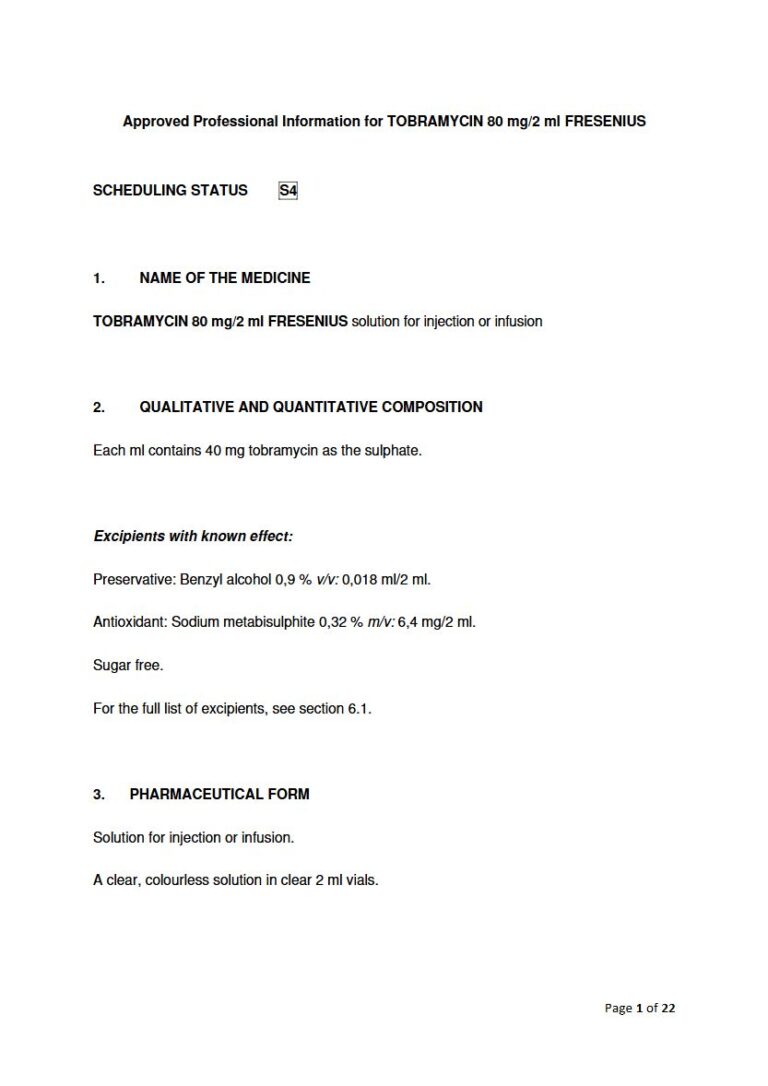
Tobramycin 80 Mg/2 Ml Solution
PDF Leaflet Revision Date: 09 September 2022
Clinical Summary
Quick overview from the medicine insert
Indication
Treatment of potentially life-threatening infections.
Dosage (summary)
Adults: 3-5 mg/kg/day; max 5 mg/kg/day for life-threatening infections.
Special Populations
- Elderly
- Renal impairment
- Paediatric population
Pregnancy & Breastfeeding
Contraindicated in pregnancy; excreted in breast milk.
Key Drug Interactions
- Neuromuscular blocking agents
- Other aminoglycosides
- Potent diuretics
Contraindications
- Allergy to tobramycin
- Pregnancy
- Myasthenia gravis
Common side effects
- Ototoxicity
- Neurotoxicity
- Renal impairment
Counselling Points
- Avoid concurrent use with nephrotoxic drugs
- Monitor for dizziness
- Report any hearing changes
Serious warnings
- Risk of ototoxicity and nephrotoxicity
- Monitor renal function
Important Disclaimer
The Tobramycin 80 Mg/2 Ml Solution professional information leaflet below is the property of Fresenius Kabi Manufacturing Sa and is provided on Medinsert exactly as issued, with no.. alterations or editorial changes. We make every effort to keep content current by updating documents as soon as new versions become available. Medinsert serves as a trusted access point for healthcare professionals, but does not replace official sources or clinical judgement. For more details, please read our full disclaimer. read more>>
 Healthcare Professionals Only
This content is for registered healthcare professionals
Sign in or create a free account to read the full package insert.
Free for HPCSA-registered professionals. Powered by Medinsert.
Clinical Particulars
Section 4 of the official insert — extracted exactly as issued, no alterations
4.1 Therapeutic indications
TOBRAMYCIN 80 mg/2 ml FRESENIUS is indicated for treatment of potentially life-threatening infections usually in combination with another antibiotic with Gram-negative activity, in the following infections, caused by susceptible organisms:
- complicated or recurrent urinary tract infections
- respiratory tract infections
- various nosocomial infections.
Sensitivity testing of the various organisms should always be undertaken whenever possible.
4.2 Posology and method of administration
Posology
Adults with serious infections: 3 mg/kg/day, administered once daily or in three equally divided doses every 8 hours (see Table 1).
Adults with life-threatening infections: Up to 5 mg/kg/day may be administered once daily or in three or four equally divided doses. The dosage should be reduced to 3 mg/kg/day as soon as clinically indicated. To prevent increased toxicity due to excessive blood levels dosage should not exceed 5 mg/kg/day unless serum levels are monitored. Treatment should generally continue for not longer than 7 to 10 days.
Table 1: Dosage schedule guide for adults with normal renal function
Patient mass
- Usual dose for serious infections: 1 mg/kg 8 hourly (total: 3 mg/kg/day)
- Maximum dose for life-threatening infections (reduce as soon as possible): 1,66 mg/kg 8 hourly (total: 5 mg/kg/day)
Special populations
Paediatric population
Children: 6 mg/kg/day to 7,5 mg/kg/day in three or four equally divided doses (2,0 mg/kg to 2,5 mg/kg every 8 hours or 1,5 mg/kg to 1,9 mg/kg every 6 hours).
Premature or full-term neonates 1 week of age or less: Up to 4 mg/kg/day may be administered in two equally divided doses every 12 hours.
TOBRAMYCIN 80 mg/2 ml FRESENIUS should not be physically premixed with other medicines, but should be administered separately. Note: The dosing interval of TOBRAMYCIN 80 mg/2 ml FRESENIUS in paediatric patients may vary from every four hours to every twenty-four hours, depending on the medical condition of the patient (cystic fibrosis, burns, renal dysfunction); serum levels must be monitored.
Method of administration
TOBRAMYCIN 80 mg/2 ml FRESENIUS may be given intramuscularly or intravenously over 20 to 60 minutes in 50 to 100 ml of sterile sodium chloride or glucose solutions. Proportionately less fluid should be given to children. It is recommended that a needle not larger than 21 gauge is used to reduce fragmentation of the rubber stopper.
4.3 Contraindications
- A history of allergy to tobramycin, other aminoglycosides or to any of the excipients listed in section 6.1.
- Pregnancy and lactation.
- Myasthenia gravis, parkinsonism and other conditions characterised by muscular weakness.
4.4 Special warnings and precautions for use
TOBRAMYCIN 80 mg/2 ml FRESENIUS contains sodium metabisulphite which may cause allergic-type reactions, including anaphylactic symptoms and life-threatening or less severe asthmatic episodes, in certain susceptible people. The overall prevalence of sulphite sensitivity in the general population is unknown and probably low, but it occurs more frequently in asthmatic patients.
Concurrent and sequential use of other aminoglycosides and other potentially neurotoxic and/or nephrotoxic antibiotics, particularly streptomycin, neomycin, kanamycin, gentamicin, cefaloridine, paromomycin, viomycin, polymyxin B, colistin, vancomycin and amikacin should be avoided (see section 4.5).
Patients with mitochondrial DNA mutations, particularly the nucleotide 1555 A to G substitution in the 12S rRNA gene may be at higher risk for ototoxicity, even if the patientu2019s aminoglycoside serum levels were within the recommended range. In case of family history of aminoglycoside-induced deafness or known mitochondrial DNA mutations in the 12S rRNA gene, alternative treatments other than aminoglycosides may need to be considered.
Both vestibular and auditory ototoxicity can occur. The auditory changes are irreversible, are usually bilateral, and may be partial or total. Eighth cranial nerve impairment may develop in patients with pre-existing renal damage and if TOBRAMYCIN 80 mg/2 ml FRESENIUS is administered for longer periods or in higher doses than those recommended. Other manifestations of neurotoxicity may include numbness, skin tingling, muscle twitching and convulsions. The risk of aminoglycoside-induced hearing loss increases with the degree of exposure to either high peak or high trough serum concentrations. Patients who develop cochlear damage may not have symptoms during therapy to warn them of 8th nerve toxicity, and partial or total irreversible bilateral deafness may continue to develop after TOBRAMYCIN 80 mg/2 ml FRESENIUS has been discontinued. Rarely, nephrotoxicity may not become manifest until the first few days after cessation of therapy. Aminoglycoside-induced nephrotoxicity is usually reversible. Therefore, renal and 8th cranial nerve function should be closely monitored in patients with known or suspected renal impairment and in those whose renal function is initially normal but who develop signs of renal dysfunction during therapy. Evidence of impairment in renal, vestibular and/or auditory function requires discontinuation of TOBRAMYCIN 80 mg/2 ml FRESENIUS or dosage adjustment.
Monitoring of renal function is particularly important in elderly patients who may have reduced renal function that may not be evident in the results of routine screening tests, such as blood urea or serum creatinine. A creatinine clearance determination may be more useful. A serum sample should be drawn about 30 minutes following intravenous infusion or at one hour after intramuscular injection in order to measure the peak level. Trough levels are measured by obtaining serum samples at 8 hours or just prior to the next TOBRAMYCIN 80 mg/2 ml FRESENIUS dose. Urine should be examined for increased excretion of protein, cells and casts. Serum creatinine or creatinine clearance (preferred over blood urea) should be measured periodically. When feasible, it is recommended that serial audiograms be obtained in patients old enough to be tested, particularly high-risk patients.
The risk of toxic reactions is low in patients with normal renal function who do not receive TOBRAMYCIN 80 mg/2 ml FRESENIUS in higher doses or for longer periods of time than those recommended. Because TOBRAMYCIN 80 mg/2 ml FRESENIUS has the inherent potential for causing oto- and nephrotoxicity, patients under treatment, especially at high dosage levels and with long duration of treatment, in infants and the elderly, should be monitored. Obese patients and those with cystic fibrosis should also be monitored. Impaired hepatic function or auditory function, bacteraemia, fever and exposure to loud noises have been reported to increase the risk of ototoxicity, while volume depletion or hypotension, liver disease, or female sex have been reported as additional risk factors for nephrotoxicity.
4.5 Interactions with other medicines
Concomitant use of TOBRAMYCIN 80 mg/2 ml FRESENIUS with:
- Pyridostigmine: TOBRAMYCIN 80 mg/2 ml FRESENIUS may antagonise the effect of pyridostigmine on skeletal muscles in patients with myasthenia gravis.
- Neostigmine: TOBRAMYCIN 80 mg/2 ml FRESENIUS may antagonise the effect of neostigmine.
- Neuromuscular blocking agents: The effect of neuromuscular blocking agents (e.g. anaesthetics) resulting in skeletal muscle weakness and possible respiratory depression or paralysis may be enhanced by TOBRAMYCIN 80 mg/2 ml FRESENIUS.
- Other neurotoxic/nephrotoxic medicines: Concurrent and sequential use of other aminoglycosides and other potentially neurotoxic and/or nephrotoxic antibiotics, particularly streptomycin, neomycin, kanamycin, gentamicin, cefaloridine, paromomycin, viomycin, polymyxin B, colistin, vancomycin and amikacin should be avoided (see section 4.4).
- Potent diuretics: TOBRAMYCIN 80 mg/2 ml FRESENIUS should not be given concurrently with potent diuretics. Some diuretics themselves cause ototoxicity, and intravenously administered diuretics enhance aminoglycoside toxicity by altering antibiotic concentrations in serum and tissue.
- Antibacterials: When TOBRAMYCIN 80 mg/2 ml FRESENIUS is used in conjunction with other antibacterials, such as cephalosporins notably cephalothin, there is an increased risk of nephrotoxicity.
- Cytotoxics and ciclosporins: There is increased risk of nephrotoxicity and possibly ototoxicity with cisplatin as well as increased risk of nephrotoxicity with ciclosporins.
- Tobramycin, as in TOBRAMYCIN 80 mg/2 ml FRESENIUS, has been known to potentiate warfarin and phenindione.
4.6 Fertility, pregnancy and lactation
Safety and efficacy in pregnancy and lactation have not been established. Use of TOBRAMYCIN 80 mg/2 ml FRESENIUS during pregnancy may damage the 8th cranial nerve of the fetus (see section 4.4).
Pregnancy
TOBRAMYCIN 80 mg/2 ml FRESENIUS is contraindicated during pregnancy. Aminoglycosides can cause fetal harm when administered to a pregnant woman. Aminoglycoside antibiotics cross the placenta, and there have been several reports of total irreversible bilateral congenital deafness in children whose mothers received streptomycin during pregnancy. Serious side effects to mother, fetus, or newborn have not been reported in the treatment of pregnant women with other aminoglycosides.
Breastfeeding
TOBRAMYCIN 80 mg/2 ml FRESENIUS is excreted in human breast milk and should be avoided in nursing women.
4.7 Effects on ability to drive and use machines
TOBRAMYCIN 80 mg/2 ml FRESENIUS may cause dizziness and vertigo (see section 4.8). Patients should therefore be warned to be cautious when driving a vehicle or operating machinery.
4.8 Undesirable effects
Blood and lymphatic system disorders
Frequency unknown: anaemia, granulocytopenia, purpura, increased or decreased reticulocyte count, thrombocytopenia, leucopenia, leucocytosis, eosinophilia
Immune system disorders
Less frequent: hypersensitivity reactions
Frequency unknown: fever
Psychiatric disorders
Frequency unknown: encephalopathy, mental confusion, lethargy, hallucinations, mental depression, disorientation
Nervous system disorders
Frequent: neurotoxicity (muscle twitching, paraesthesia, convulsions)
Less frequent: neuromuscular blockade (respiratory depression, muscular paralysis)
Frequency unknown: meningeal irritation, arachnoiditis, polyradiculitis, ventriculitis following the intrathecal, intracisternal or intraventricular administration of aminoglycosides, headache, dizziness
Eye disorders
Frequency unknown: visual disturbances
Ear and labyrinth disorders
Frequent: ototoxicity, irreversible (previous exposure to other ototoxic medicines such as kanamycin, gentamicin, paromomycin, amikacin and others may be a contributing factor), vertigo, tinnitus, roaring in the ears, hearing loss (usually irreversible and is manifested initially by diminution of high tone acuity)
Gastrointestinal disorders
Frequency unknown: pseudomembranous colitis, nausea, vomiting, diarrhoea
Hepato-biliary disorders
Frequency unknown: increased serum aminotransferase (AST and ALT) and serum bilirubin levels
Skin and subcutaneous tissue disorders
Frequency unknown: rash, exfoliative dermatitis, itching, urticaria
Renal and urinary disorders
Frequency unknown: acute renal failure (often in association with concurrent administration of other nephrotoxic medicines), renal impairment is usually mild, although acute tubular necrosis and interstitial nephritis have occurred, renal function changes, as shown by rising blood urea and serum creatinine and by oliguria, cylindruria and increased proteinuria, may occur, especially in patients with a history of renal impairment who are treated for longer periods or with higher doses than those recommended (these changes can occur in patients with initially normal renal function), decreased glomerular filtration rate is usually seen only after several days, and may even occur after therapy has been discontinued
General disorders and administration site conditions
Frequency unknown: hypomagnesaemia, hypocalcaemia, hyponatraemia, hypokalaemia.
Reporting of suspected adverse reactions
Reporting suspected adverse reactions after authorisation of TOBRAMYCIN 80 mg/2 ml FRESENIUS is important. It allows continued monitoring of the benefit/risk balance of TOBRAMYCIN 80 mg/2 ml FRESENIUS. Health care providers are asked to report any suspected adverse reactions via the u201c6.04 Adverse Drug Reaction Reporting Formu201d, found online under SAHPRAu2019s publications: https://www.sahpra.org.za/Publications/Index/8. Health care providers are asked to report any suspected Adverse Drug Reactions to the Holder of the Certificate of Registration at the following email address: [email protected], and to the relevant medicineu2019s regulatory authority in the country where the product is marketed.
4.9 Overdose
Signs and symptoms: Severity of the manifestations of TOBRAMYCIN 80 mg/2 ml FRESENIUS overdose depends on the dose, the patient's renal function, state of hydration, age and whether concurrent medicine with similar toxicities is being given. Toxicity may occur in patients treated for more than 10 days, given more than 5 mg/kg/day, children given more than 7,5 mg/kg/day, or patients with reduced renal function whose dose has not been appropriately adjusted. Nephrotoxicity following the parenteral administration of an aminoglycoside is most closely related to the AUC of serum concentration versus time. Nephrotoxicity is more likely if trough levels fail to fall below 2 mg/l and is also proportional to the average blood concentration. Patients who are elderly, have renal impairment, are receiving other nephrotoxic or ototoxic medicines, or are volume depleted, are at greater risk for developing acute tubular necrosis. Auditory and vestibular toxicities have been associated with aminoglycoside overdose. These toxicities occur in patients treated longer than 10 days, in patients with abnormal renal function, in dehydrated patients, or in patients on other ototoxic medicines. These patients may not have signs or symptoms, or may experience dizziness, tinnitus, vertigo and a loss of high-tone acuity. Signs and symptoms may not occur until long after TOBRAMYCIN 80 mg/2 ml FRESENIUS has been discontinued.
Neuromuscular blockade or respiratory failure may occur following rapid intravenous administration of many aminoglycosides. These reactions and prolonged respiratory paralysis may occur more commonly in patients with myasthenia gravis or Parkinson's disease, or those receiving decamethonium, tubocurarine or succinylcholine. Neuromuscular blockade may be reversed by the administration of calcium salts, but mechanical assistance may be necessary.
Toxicity from ingested tobramycin, as in TOBRAMYCIN 80 mg/2 ml FRESENIUS, is unlikely because aminoglycosides are poorly absorbed from an intact gastrointestinal tract.
Treatment: Resuscitative measures should be initiated promptly if respiratory paralysis occurs. Neuromuscular blockade may be reversed by giving calcium salts. Fluid balance, creatinine clearance and tobramycin plasma levels should be carefully monitored until the tobramycin level falls below 2 mg/l. Haemodialysis or peritoneal dialysis will help remove tobramycin from the blood. Between 25 % and 70 % of the administered dose may be removed, depending on the duration and type of dialysis employed; haemodialysis is the more effective method.
