
Tranmenxio Iv 500mg Solution for injection/infusion
PDF Leaflet Revision Date: 29 March 2022
Clinical Summary
Quick overview from the medicine insert
Indication
Short term use in hyphaema and hereditary angioedema.
Dosage (summary)
1.0 to 1.5 g IV every 8 hours for traumatic hyphaema; 1.0 - 1.5 g IV 2-3 times daily for hereditary angioedema.
Special Populations
- Renal impairment
Pregnancy & Breastfeeding
Safety not established in pregnancy; caution in breastfeeding.
Key Drug Interactions
- Increased thrombus formation with oestrogens
- Antagonism with thrombolytics
Contraindications
- Hypersensitivity
- Acute thrombosis
- Fibrinolytic conditions
- History of convulsions
Common side effects
- Dizziness
- Visual disturbances
- Nausea
- Vomiting
Counselling Points
- Administer slowly IV
- Monitor for visual disturbances
- Avoid in patients with thromboembolic history
Serious warnings
- Risk of convulsions
- Thromboembolic events
- Care in renal failure
Important Disclaimer
The Tranmenxio Iv 500mg Solution for injection/infusion professional information leaflet below is the property of Biotech Laboratories and is provided on Medinsert exactly as issued, with no.. alterations or editorial changes. We make every effort to keep content current by updating documents as soon as new versions become available. Medinsert serves as a trusted access point for healthcare professionals, but does not replace official sources or clinical judgement. For more details, please read our full disclaimer. read more>>
 Healthcare Professionals Only
This content is for registered healthcare professionals
Sign in or create a free account to read the full package insert.
Free for HPCSA-registered professionals. Powered by Medinsert.
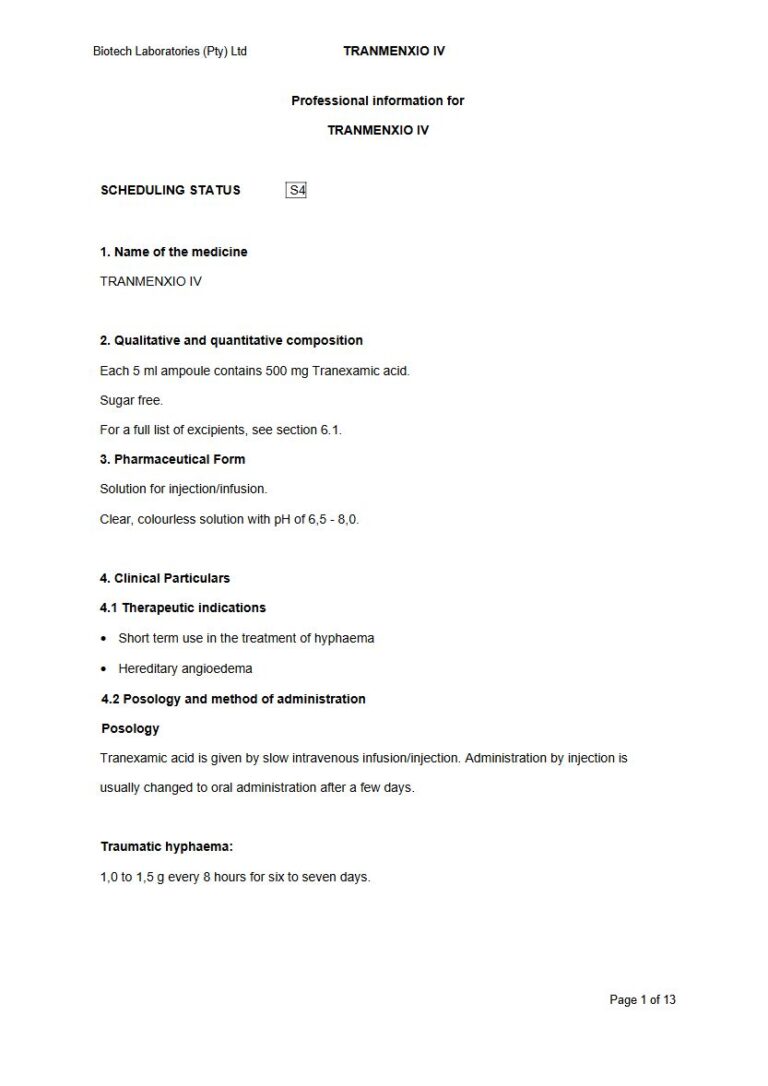
Clinical Particulars
Section 4 of the official insert — extracted exactly as issued, no alterations
4.1 Therapeutic indications
u2022 Short term use in the treatment of hyphaema
u2022 Hereditary angioedema
4.2 Posology and method of administration
Posology
Tranexamic acid is given by slow intravenous infusion/injection. Administration by injection is usually changed to oral administration after a few days.
Traumatic hyphaema: 1,0 to 1,5 g every 8 hours for six to seven days.
Hereditary angioedema: Some patients are aware of the onset of illness; a suitable treatment for these patients is 1,0 - 1,5 g two to three times daily for some days. Other patients are treated continually at this dosage.
Special populations: Renal impairment
For patients in renal failure, tranexamic acid should be given with caution because of the risk of accumulation. Dosages should be reduced in patients with renal impairment. For patients with moderate to severe impaired renal function, the following dosages are recommended.
Serum creatinine (u03bcmol/L) Intravenous Dose
- 120 u2013 250 10 mg/kg body weight twice daily
- 250 u2013 500 10 mg/kg body weight daily
- > 500 5 mg/kg body weight daily
Method of administration
Tranexamic acid solution for injection is administered intravenously by slow injection over a period of at least five minutes.
4.3 Contraindications
u2022 Hypersensitivity to tranexamic acid or to any of the excipients.
u2022 Acute venous or arterial thrombosis (see section 4.4).
u2022 Fibrinolytic conditions following consumption coagulopathy except in those with predominant activation of the fibrinolytic system with acute severe bleeding (see section 4.4).
u2022 History of convulsions.
u2022 In cases of massive upper urinary tract haemorrhage, antifibrinolytics should be avoided to reduce the risk of ureteric obstruction.
u2022 Patients with pronounced thrombotic tendency or colour vision disorder should not be given TRANMENXIO IV.
u2022 Thrombophlebitis, impaired liver function and subarachnoid bleeding.
4.4 Special warnings and precautions for use
The indications and method of administration indicated above should be followed strictly:
u2022 Intravenous injections or infusions should be given very slowly (maximum 1 ml per minute).
u2022 TRANMENXIO IV should not be administered by the intramuscular route.
u2022 TRANMENXIO IV must not be administered by intrathecal or intraventricular injection, or intracerebral application (due to a risk of cerebral oedema and convulsions.)
Convulsions
Cases of convulsions have been reported in association with tranexamic acid treatment. In coronary artery bypass graft (CABG) surgery, most of these cases were reported following intravenous (IV.) injection of tranexamic acid in high doses. With the use of the recommended lower doses of tranexamic acid, the incidence of post-operative seizures was the same as that in untreated patients.
Visual disturbances
Attention should be paid to possible visual disturbances including visual impairment, vision blurred, impaired colour vision and if necessary the treatment should be discontinued. With continuous long-term use of tranexamic acid, regular ophthalmologic examinations (eye examinations including visual acuity, colour vision, fundus, visual field etc.) are indicated. With pathological ophthalmic changes, particularly with diseases of the retina, the medical practitioner must decide after consulting a specialist on the necessity for the long-term use of TRANMENXIO IV in each individual case.
Haemauria
In case of haematuria from the upper urinary tract, there is a risk for urethral obstruction.
Thromboembolic events
Before use of TRANMENXIO IV, risk factors of thromboembolic disease should be considered. In patients with a history of thromboembolic diseases or in those with increased incidence of thromboembolic events in their family history (patients with a high risk of thrombophilia), tranexamic acid should only be administered if there is a strong medical indication after consulting a medical practitioner experienced in haemostaseology and under strict medical supervision (see section 4.3).
TRANMENXIO IV should be administered with care in patients receiving oral contraceptives because of the increased risk of thrombosis (see section 4.5).
Disseminated intravascular coagulation
Patients with disseminated intravascular coagulation (DIC) should in most cases not be treated with TRANMENXIO IV (see section 4.3). If TRANMENXIO IV is given it must be restricted to those in whom there is predominant activation of the fibrinolytic system with acute severe bleeding. Characteristically, the haematological profile approximates to the following: reduced euglobulin clot lysis time; prolonged prothrombin time; reduced plasma levels of fibrinogen, factors V and VIII, plasminogen fibrinolysin and alpha-2 macroglobulin; normal plasma levels of P and P complex; i.e. factors II (prothrombin), VIII and X; increased plasma levels of fibrinogen degradation products; a normal platelet count. The foregoing presumes that the underlying disease state does not of itself modify the various elements in this profile. In such acute cases a single dose of 1 g tranexamic acid is frequently sufficient to control bleeding. Administration of TRANMENXIO IV in DIC should be considered only when appropriate haematological laboratory facilities and expertise are available.
TRANMENXIO IV should not be administered concomitantly with Factor IX Complex Concentrates or Anti-inhibitor Coagulant Concentrates, as the risk of thrombosis may be increased.
The safety of tranexamic acid has not been established in pregnancy. Tranexamic acid passes into breast milk at a concentration of a hundredth of the corresponding serum levels. Caution should be exercised when TRANMENXIO IV is given to nursing women.
For patients in renal failure, tranexamic acid as in TRANMENXIO IV should be given with caution because of the risk of accumulation. Patients with a previous history of thromboembolic disease should not be given TRANMENXIO IV unless simultaneous treatment with anticoagulants can be given. For patients who are to receive continuous treatment with TRANMENXIO IV for longer than several days, an ophthalmological examination is advisable (including visual acuity, colour vision, eye-grounds, field of vision), before commencing treatment, and at regular intervals during treatment.
Medicines with actions on haemostasis should be given with caution to patients on antifibrinolytic therapy. The potential for thrombus formation may be increased by oestrogens, for example, or the action of the antifibrinolytic antagonised by compounds such as the thrombolytics.
4.5 Interaction with other medicines and other forms of interaction
No interaction studies have been performed. Simultaneous treatment with anticoagulants must take place under the strict supervision of a medical practitioner experienced in this field. Medicinal products that act on haemostasis should be given with caution to patients treated with TRANMENXIO IV. There is a theoretical risk of increased thrombus-formation potential, such as with oestrogens. Alternatively, the antifibrinolytic action of the medicine may be antagonised with thrombolytic medicines.
4.6 Fertility, pregnancy and lactation
Women of childbearing potential
Women of childbearing potential have to use effective contraception during treatment.
Pregnancy
The safety of tranexamic acid has not been established in pregnancy.
Breast Feeding
Tranexamic acid is excreted in human milk. Therefore, breast-feeding is not recommended. Tranexamic acid passes into breast milk at a concentration of a hundredth of the corresponding serum levels. Caution should be exercised when tranexamic acid is given to nursing women.
Fertility
There are no clinical data on the effects of tranexamic acid on fertility.
4.7 Effects on ability to drive and use machines
No studies have been performed on the ability to drive and use machines. TRANMENXIO IV can cause side effects, such as dizziness and vision problems, and can affect the ability to drive a vehicle and use machines. Caution is advised when driving a vehicle or operating machinery until the effects of TRANMENXIO IV are known.
4.8 Undesirable effects
Tabulated list of adverse reactions
Adverse reactions reported are presented in table below. Adverse reactions are listed according to MedDRA primary system organ class. Within each system organ class, adverse reactions are ranked by frequency. Within each frequency grouping, adverse reactions are presented in the order of decreasing seriousness.
System organ class Frequent Less Frequent Frequency not known (cannot be estimated from the available data)
Immune system disorders - Hypersensitivity reactions including anaphylaxis
Nervous system disorders Convulsions particularly in case of misuse (see sections 4.3 and 4.4) Dizziness
Eye disorders Visual disturbances including impaired colour vision Retinal/artery occlusion
Vascular disorders Malaise with hypotension, with or without loss of consciousness (generally following a too fast intravenous injection, exceptionally after oral administration) Arterial or venous thrombosis at any sites
Gastrointestinal Diarrhoea
disorders Vomiting Nausea
Skin and subcutaneous tissue disorders Dermatitis allergic
Cases of giddiness have been reported. Transient disturbance of colour vision may occur. Patients who experience disturbances of colour vision should be withdrawn from treatment. Rapid intravenous injection may cause dizziness and/or hypotension.
Reporting of suspected adverse reactions
Reporting suspected adverse reactions after authorisation of the medicine is important. It allows continued monitoring of the benefit/risk balance of the medicine. Health care providers are asked to report any suspected adverse reactions to SAHPRA via the u201c6.04 Adverse Drug Reactions Reporting Formu201d, found online under SAHPRAu2019s publications: https://www.sahpra.org.za/Publications/Index/8
4.9 Overdose
Treatment: Symptoms of overdosage: Dizziness, headache, nausea and vomiting, diarrhoea. Faintness and hypotension may occur. Treatment is symptomatic. Maintain adequate diuresis (with fluids plus diuretics).
