
Uralyt -U 2,5 g Granules
PDF Leaflet Revision Date: 28 March 2024
Clinical Summary
Quick overview from the medicine insert
Indication
Dissolves uric acid calculi and prevents further stone formation.
Dosage (summary)
Average daily dose: 10 g (4 spoonfuls) spread throughout the day.
Special Populations
- Renal impairment
- Hepatic impairment
Pregnancy & Breastfeeding
Use with caution during pregnancy and lactation.
Key Drug Interactions
- Quinolones
- Salicylates
- Urinary antiseptics
- Antacids
Contraindications
- Cardiac failure
- Renal impairment
- Hypernatremia
- Hyperkalemia
- Metabolic alkalosis
Common side effects
- Gastrointestinal complaints
- Mild gastric pain
- Mild diarrhea
- Nausea
Counselling Points
- Take after meals
- Monitor urine pH
- Adjust dose based on pH readings
Serious warnings
- Risk of hyperkalemia
- Monitor renal function
- Avoid urine pH > 7.0
Important Disclaimer
The Uralyt -U 2,5 g Granules professional information leaflet below is the property of Viatris South Africa and is provided on Medinsert exactly as issued, with no.. alterations or editorial changes. We make every effort to keep content current by updating documents as soon as new versions become available. Medinsert serves as a trusted access point for healthcare professionals, but does not replace official sources or clinical judgement. For more details, please read our full disclaimer. read more>>
 Healthcare Professionals Only
This content is for registered healthcare professionals
Sign in or create a free account to read the full package insert.
Free for HPCSA-registered professionals. Powered by Medinsert.
Clinical Particulars
Section 4 of the official insert — extracted exactly as issued, no alterations
4.1 Therapeutic indications
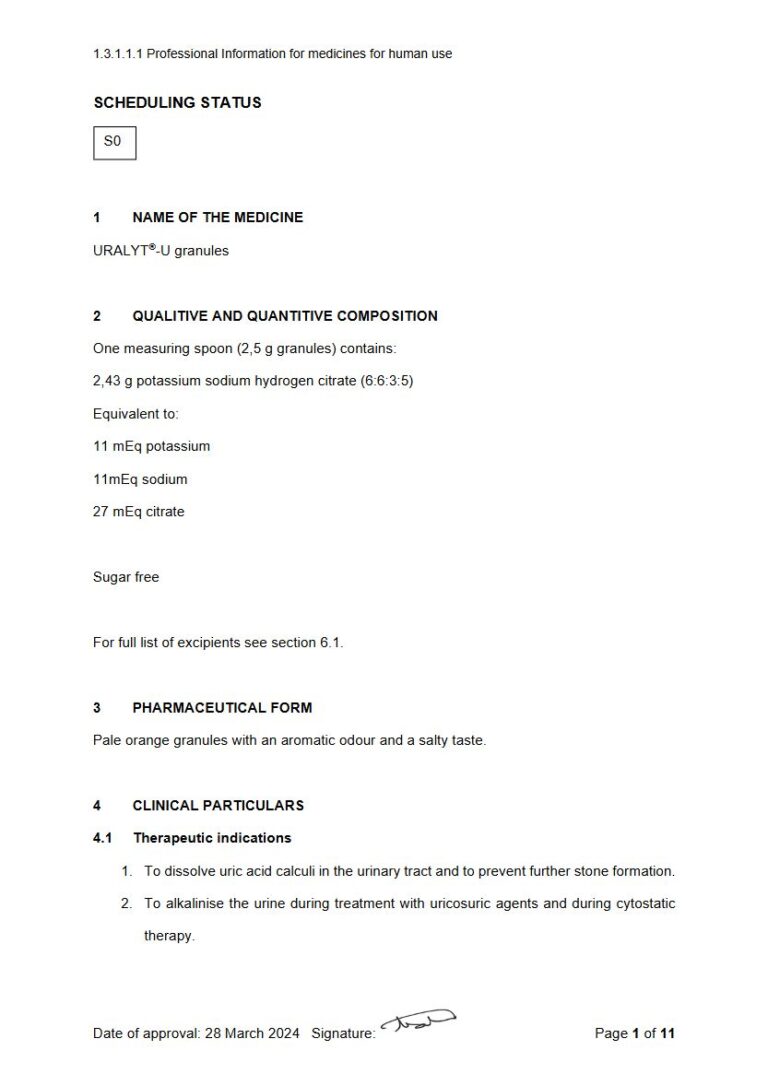
1. To dissolve uric acid calculi in the urinary tract and to prevent further stone formation.
2. To alkalinise the urine during treatment with uricosuric agents and during cytostatic therapy.
4.2 Posology and method of administration
To ensure success it is essential to follow the instructions carefully. Best results can only be obtained by close co-operation on the part of the patient. The treatment is divided into two stages:
1. Initial adjustment of the dose of Uralyt u00ae -U to a level which brings the pH of the urine into the desired range.
2. Long term administration of Uralyt u00ae -U, with regular checks by the patient.
The granules should be dissolved by stirring in half a glass of water or fruit juice and taken, preferably, after meals. Unused solution must be discarded.
The dosage of Uralyt u00ae -U is adjusted in accordance with the pH value of the urine. This is done as follows:
1. Measure the pH of the urine with the indicator paper.
2. Enter the pH value (colour number) on the enclosed test chart.
3. Take the corresponding dose (number of measuring spoonfuls of Uralyt u00ae -U) and enter it on the chart. Check the pH value of the urine before each dose of Uralyt u00ae -U. This pH value (5,6; 5,9; 6,2;6,5; 6,8; 7,0; 7,2; 7,4; 7,7; 8,0) shows the response from the previous dose of Uralyt u00ae -U. The morning test shows the response from the previous evening dose, the midday test shows the response from the morning dose, etc.
Posology:
How to take Uralyt u00ae -U: The enclosed measuring spoon holds approximately 2,5 g of the granules. For most patients it has proved satisfactory to take an average daily dose of 4 measures of the granules (10 g Uralyt u00ae -U) spread uniformly throughout the day in accordance with the following schedule:
- MORNING as early as possible (7-8 a.m.) 1
- MIDDAY 2-3 p.m. 1
- EVENING as late as possible (about 10 p.m.) 2
This is the standard dosage to stabilise the urine pH within the desired range (6,2 to 6,8) and is the range required for treatment of Uric Acid Calculi. During treatment with uricosuric agents the pH and is stabilised between 6,2 and 6,8. During cytostatic therapy the urine pH should be at least 7,0. The dose should be individually adjusted in accordance with the pH recorded. It should, however, be noted that any necessary correction of the dose is done on the following day. Examples: If at midday the pH value is found to be too high (7,0 or more) there is no point in immediately cutting down the next dose. A test result of u201c7,0 or moreu201d at midday means that the morning dose was too high. The right course is to reduce the next morning dose so that the pH response at next midday will then fall within the correct range. The same applies to other recordings.
If the morning pH is found to be too low (e.g. 5,9), this means that too small a dose of the granules was taken on the previous evening. Therefore, the next evening dose should be increased. When changing the dose, it is advisable to increase or decrease it in steps of half a spoonful only.
How to use the indicator paper and test chart: The pH of fluid is a measure of its acidity or alkalinity. For example, pH 7,0 means that the fluid is neither acid nor alkaline u2013 in other words, neutral. pH readings above 7,0 mean that the reaction is increasingly alkaline, while pH values below 7,0 mean increasing acidity. pH values are measured directly by colour changes on the prepared paper strips (indicatory papers). The special indicator paper (enclosed) consists of 52 perforated yellow paper strips and a colour scale with pH number. Every morning, at midday and in the evening, before taking Uralyt u00ae -U, tear off one paper strip and dip it into the fresh urine for a few seconds. Alternatively, it may be held in the urine stream. Match the change in colour of the strip at once with the colour scale and mark the corresponding colour number by placing a cross in the appropriate space on the test chart (morning, midday, evening). Then enter the dose of the granules by writing the number of measuring spoonsful in the space directly after the time.
When the dose has been correctly adjusted, the test which is carried out three times a day before each dose, will give colour numbers of 6,2; 6,5 or 6,8. If the colour number is over 7,0 reduce the dose, except during cytostatic therapy, when the urine pH should be at least 7,0. Conversely, underdosage is indicated by colour numbers less than 6,2 (5,6 or 5,9). In this case the dosage must be increased. If the colour number is 6,2 it may be assumed that the dose is correct. The aim should always be to keep within the 6,5 to 6,8 range; 7,0 is to be considered the upper limit.
Method of administration: For oral use.
4.3 Contraindications
Contraindicated in:
- cardiac failure,
- impairment of liver and renal function (in cases of acute or chronic renal failure),
- hypernatremia,
- hyperkalemia,
- metabolic alkalosis (see section 4.4),
- adynamia episodica hereditarian,
- chronic urinary tract infections with urea-splitting bacteria (danger of generation of struvit (magnesium ammonium phosphate) stones),
- low sodium diet,
- case of increased sensitivity to the ingredients of Uralyt u00ae -U,
- concomitant use with potassium-sparing diuretics.
4.4 Special warnings and precautions for use
- Simultaneous administration of citrate and aluminium containing antacids in patients with compromised renal function can result in absorption of dangerously high amounts of aluminium.
- Before taking the first dose the serum electrolytes should be determined and renal function should be monitored.
- Furthermore, the acid base status should be checked when renal tubular acidosis (RTA) is suspected.
- Patients with congestive cardiac failure should not use this product.
- Administer with care in cases of adrenal insufficiency.
- The average daily dose of Uralyt u00ae -U (10 g granules) contains approximately 1,7 g of potassium.
- Before starting therapy all circumstances/malconditions that may be in favour of urinary stones should be excluded. The same is true if there exists a specific therapy (adenoma of parathyroid glands, malignoma with generation of uric acid stones etc.).
- When dissolving uric acid stones, urine pH values of 7,0 and over must be avoided to prevent the formation of a phosphate layer over the existing stone.
- Patients with urinary tract infections should continue antibacterial therapy during treatment with Uralyt u00ae -U (also see section 4.5).
- This medicine contains the colouring agent yellow orange S (E110) which may induce allergic reactions including asthma in a sensitive person. Allergy is more often seen in people reacting to 2-acetoxybenzoic acid (acetylsalicylic acid).
4.5 Interaction with other medicines and other forms of Interaction
- Quinolones: Uralyt u00ae -U may reduce the solubility of ciprofloxacin, norfloxacin and ofloxacin in the urine. Patients should be monitored for signs of crystalluria and nephrotoxicity.
- Salicylates: The efficacy of salicylates, when given concurrently with Uralyt u00ae -U, may be decreased due to the alkalisation of the urine and increased urinary excretion.
- Urinary antiseptics: The efficacy of urinary antiseptics which require an acid urine, such as methenamine mandelate and methenamine Hippurate, may be lowered when used concurrently with Uralyt u00ae -U.
- Antacids: Systemic alkalosis may occur when antacids are used concurrently with Uralyt u00ae -U (see section 4.4).
- Any increase in extracellular potassium concentration will weaken the effect of cardiac glycosides, while any decrease will potentiate the arrhythmogenic effect of cardiac glycosides.
- Aldosterone antagonists, potassium-saving diuretics, ACE inhibitors, angiotensin receptor antagonists, nonsteroidal anti-inflammatory medicines and peripheral analgesics diminish renal potassium excretion.
- Medicines containing citrate given at the same time as medicines containing aluminium can cause an increase in aluminium absorption. If such medicines must be taken, an interval of at least 2 hours must be allowed between taking each kind of medicine.
4.6 Fertility, pregnancy and lactation
To be used with caution.
4.7 Effects on ability to drive and use machines
Uralyt u00ae -U has no or negligible influence on the ability to drive and use machines.
4.8 Undesirable effects
a. Summary of the safety profile
- Gastro-intestinal complaints may occur.
- Yellow orange S (E110) which may cause allergic reactions.
b. Tabulated list of adverse reactions
Body System Undesirable effect Frequent Less frequent Frequency not known Gastrointestinal disorders: Mild gastric or abdominal pain Mild diarrhoea and nausea
Reporting of suspected adverse reactions
Reporting suspected adverse reactions after authorisation of the medicine is important. It allows continued monitoring of the benefit/risk balance of the medicine. Healthcare providers are asked to report any suspected adverse reactions to SAHPRA via the u201c6.04 Adverse Drug Reactions Reporting Formu201d, found online under SAHPRAu2019s publications: https://www.sahpra.org.za/Publications/Index/8
4.9 Overdose
Symptoms:
- Overdose can lead to Hyperkalemia (potassium-plasma level >5 mmol/l), especially in patients with simultaneous acidosis or renal failure.
- Provided that renal function is adequate, there is no likelihood of any unwanted effects on normal metabolic parameters, even after taking doses higher than those recommended, since the excretion of any base excess by the kidney provides a natural regulatory mechanism which ensures maintenance of acid-base balance.
- Any rise above the recommended urine pH-range should in no circumstances be allowed to persist for more than a few days, since at considerably high pH levels there is an increased risk of phosphate crystallisation and the long-term establishment of a definite alkalotic metabolic state is in any case undesirable. Inadvertent overdosage can be corrected at any time by reducing the dose. If necessary, appropriate measures for the treatment of metabolic alkalosis may be considered.
Management:
Treatment is symptomatic and supportive.
