
Uticide 3 g Granules for oral solution
PDF Leaflet Revision Date: January 2024
Clinical Summary
Quick overview from the medicine insert
Indication
Treatment of acute uncomplicated lower urinary tract infections in women and prophylaxis in men.
Dosage (summary)
Single 3 g dose for women; two 3 g doses for men before and after surgery.
Special Populations
- Elderly
- Renal impairment
Pregnancy & Breastfeeding
Safety in pregnancy not established; contraindicated in breastfeeding.
Key Drug Interactions
- Metoclopramide
- Antivitamin-K antagonists
- Food
Contraindications
- Hypersensitivity to fosfomycin
- Severe renal insufficiency
- Haemodialysis
Common side effects
- Diarrhoea
- Nausea
- Dizziness
- Headache
Counselling Points
- Take on an empty stomach
- Report severe diarrhoea
- Avoid in lactation
Serious warnings
- Hypersensitivity reactions
- Antibiotic-associated diarrhoea
- Clostridium difficile-associated disease
Important Disclaimer
The Uticide 3 g Granules for oral solution professional information leaflet below is the property of Unicorn Pharmaceuticals and is provided on Medinsert exactly as issued, with no.. alterations or editorial changes. We make every effort to keep content current by updating documents as soon as new versions become available. Medinsert serves as a trusted access point for healthcare professionals, but does not replace official sources or clinical judgement. For more details, please read our full disclaimer. read more>>
 Healthcare Professionals Only
This content is for registered healthcare professionals
Sign in or create a free account to read the full package insert.
Free for HPCSA-registered professionals. Powered by Medinsert.
Clinical Particulars
Section 4 of the official insert — extracted exactly as issued, no alterations
4.1 Therapeutic indications
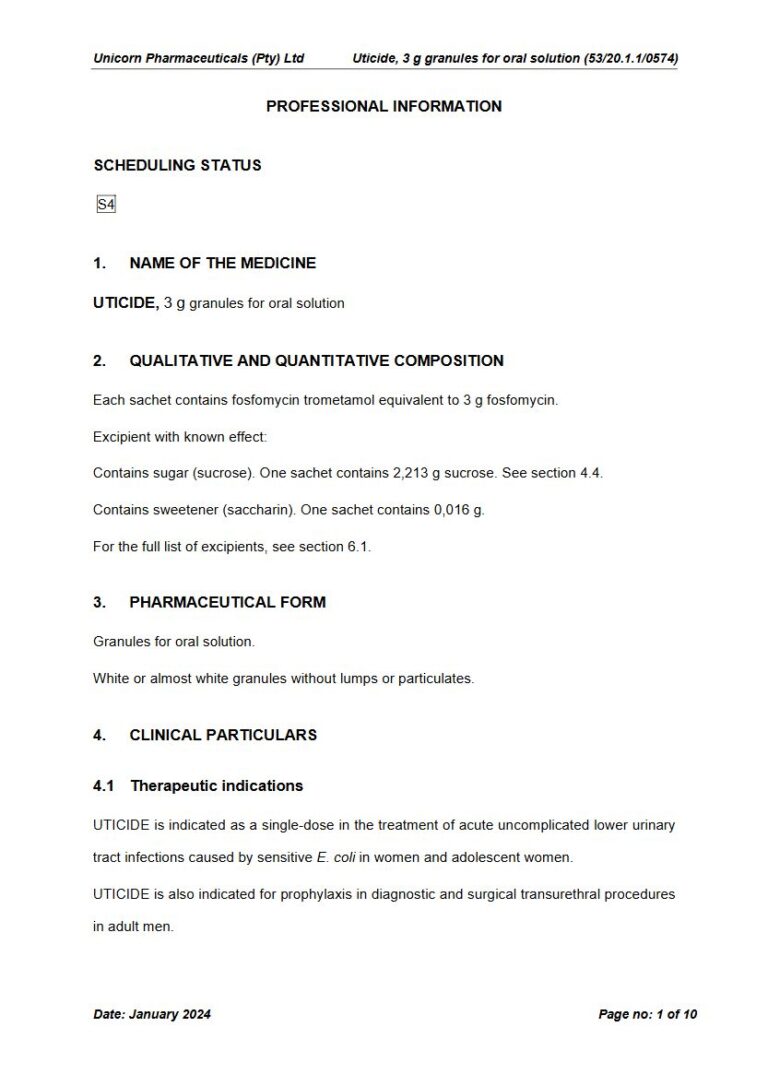
UTICIDE is indicated as a single-dose in the treatment of acute uncomplicated lower urinary tract infections caused by sensitive E. coli in women and adolescent women. UTICIDE is also indicated for prophylaxis in diagnostic and surgical transurethral procedures in adult men.
4.2 Posology and method of administration
Posology
Women and adolescent women (> 12 years of age): The recommended dose for uncomplicated urinary tract infections in women, including the elderly up to 75 years, is a single 3 g dose.
Adult men: The recommended dose for prophylaxis prior to transurethral surgical and diagnostic procedures in adult men, including the elderly, is two doses of 3 g. The first dose should be taken 3 hours before surgery. The second dose should be taken 24 hours after surgery.
Children: UTICIDE 3 g is not suitable for children between the ages of 5 and 12 years, as the recommended dose for this age group is a single 2 g dose and the sachet contents cannot be divided.
Method of administration
UTICIDE is taken orally, immediately after reconstitution in a glass of water. It should be taken at least 2 hours before the next meal, on an empty stomach.
4.3 Contraindications
Hypersensitivity to fosfomycin or to any of the excipients of UTICIDE (see section 6.1); Patients with severe renal insufficiency (creatinine clearance < 10 ml/min); Patients undergoing haemodialysis.
4.4 Special warnings and precautions for use
Hypersensitivity reactions
Hypersensitivity reactions, including anaphylaxis and anaphylactic shock, may occur during treatment with UTICIDE and may be life-threatening (see section 4.8). If such reaction occurs, UTICIDE should never be re-administrated and adequate medical treatment is required.
Antibiotic-associated diarrhoea and Clostridium difficile-associated disease (CDAD)
Antibiotic-associated diarrhoea has been reported and may range in severity from mild diarrhoea to fatal colitis. Diarrhoea, particularly if severe, persistent and/or bloody, during or after treatment with UTICIDE (including several weeks after treatment), may be symptomatic of Clostridium difficile-associated disease (CDAD). It is therefore important to consider this diagnosis in patients who develop severe diarrhoea during or after treatment with UTICIDE. If CDAD is suspected or confirmed, appropriate treatment should be initiated without delay (see section 4.8). Anti-peristaltic medicines are contraindicated in this clinical situation.
Renal insufficiency
Urinary concentrations of fosfomycin remain effective for 48 hours after a usual dose if creatinine clearance is above 10 ml/min.
Use in children
UTICIDE 3 g is not recommended for children under the age of 12 years (see section 4.2).
Information on the excipients
UTICIDE contains sucrose and saccharin (see section 2). Patients with rare hereditary problems of fructose intolerance, glucose-galactose malabsorption or sucrase-isomaltase insufficiency should not take UTICIDE.
4.5 Interactions with other medicines and other forms of interaction
Metoclopramide
Concomitant administration of metoclopramide has been shown to lower serum and urinary concentrations of fosfomycin and should be avoided. Other medicines that increase gastrointestinal motility may produce similar effects.
Alteration in international normalised ratio (INR)
Many cases of increased antivitamin-K antagonist activity have been reported in patients receiving antibiotics, including UTICIDE. Risk factors include severe infection or inflammation, age and poor general health.
Food
Food may delay the absorption of the active ingredient of UTICIDE, with consequent slight decrease in peak plasma levels and urinary concentrations. It is therefore preferable to take UTICIDE on an empty stomach, at least 2 hours before the next meal, or about 2 to 3 hours after meals.
4.6 Fertility, pregnancy and lactation
Pregnancy
No evidence has been found in animals or humans to indicate adverse effects of UTICIDE in pregnancy. However, the safety and/or efficacy of single-dose therapy has not been established for UTICIDE in pregnancy.
Breastfeeding
Fosfomycin is excreted into human milk. UTICIDE should not be given to lactating women.
4.7 Effects on ability to drive and use machines
Patients should be informed that dizziness has been reported. This may influence some patients' ability to drive and use machines.
4.8 Undesirable effects
Summary of the safety profile
Frequent adverse reactions following the single-dose administration of fosfomycin trometamol involve the gastrointestinal tract, mainly diarrhoea. These events are usually self-limited in duration and resolve spontaneously.
List of adverse events
Infections and infestations
Frequent: Vulvovaginitis
Frequency unknown: Antibiotic-associated colitis, pseudomembranous colitis
Blood and the lymphatic system disorders
Frequency unknown: Agranulocytosis, aplastic anaemia, eosinophilia, granulocytopenia, leucopenia, pancytopenia, and thrombocytopenia
Immune system disorders
Frequency unknown: Angioedema, anaphylactic reactions including anaphylactic shock, hypersensitivity
Nervous system disorders
Frequent: Headache, dizziness
Frequency unknown: Optic neuritis
Respiratory, thoracic and mediastinal disorders
Frequent: Pharyngitis, rhinitis
Frequency unknown: Exacerbation of asthma
Gastrointestinal disorders
Frequent: Diarrhoea, nausea, dyspepsia, abdominal pain
Less frequent: Vomiting
Frequency unknown: Antibiotic-associated colitis (see section 4.4), toxic megacolon
Hepatobiliary disorders
Frequency unknown: Cholestatic jaundice, hepatic necrosis
Skin and subcutaneous tissue disorders
Less frequent: Rash, urticaria, pruritus
Musculoskeletal, connective tissue and bone disorders
Frequent: Back pain
Reproductive system and breast disorders
Frequent: Dysmenorrhoea, vaginitis
General disorders and administration site conditions
Frequent: Pain (non-localised), asthenia
Investigations
Frequency unknown: Increases in serum concentration of aminotransferases, alkaline phosphatase and bilirubin
Reporting of suspected adverse reactions
Reporting suspected adverse reactions after authorisation of the medicine is important. It allows continued monitoring of the benefit/risk balance of the medicine. Health care providers are asked to report any suspected adverse reactions to SAHPRA via the u201c6.04 Adverse Drug Reactions Reporting Formu201d, found online under SAHPRAu2019s publications: https://www.sahpra.org.za/health-products-vigilance/. Reporting can also be done directly to Unicorn Pharmaceuticals at: [email protected].
4.9 Overdose
No information is available on the overdose of oral fosfomycin. In the event of overdose, side effects can be precipitated and/or be of increased severity (refer section 4.8). In the event of overdose, treatment should be symptomatic and supportive. Rehydration is recommended to promote urinary elimination of the medicine.
