
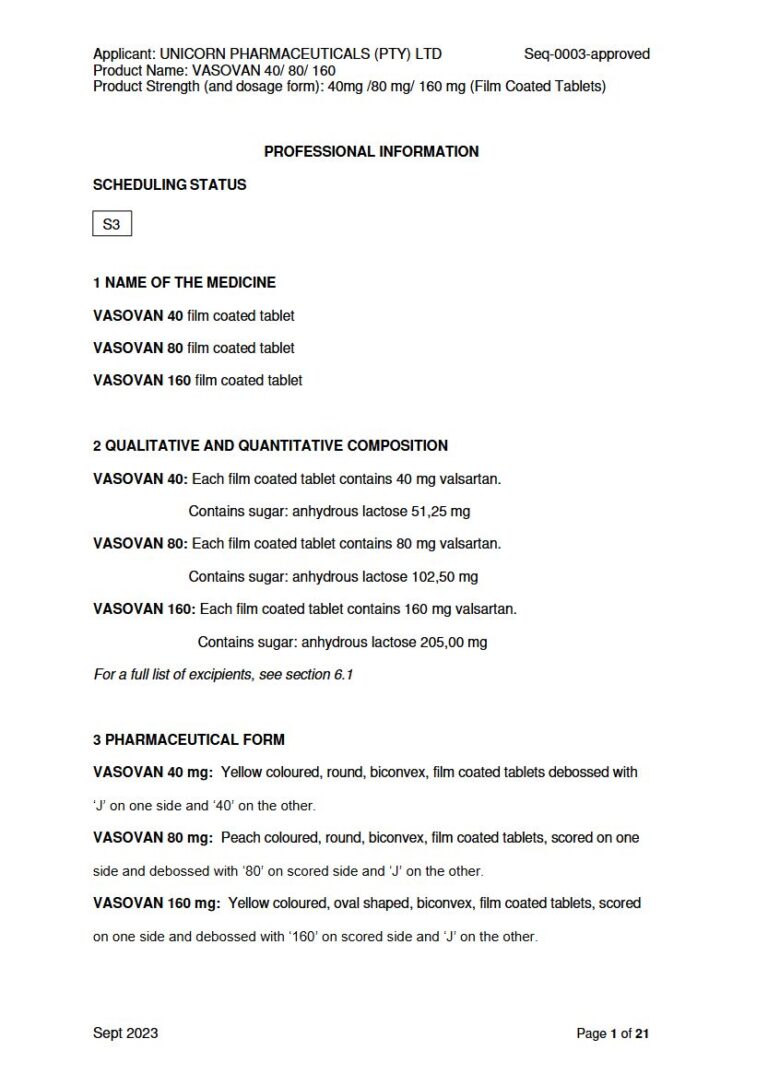
Vasovan 40/ 80/ 160 40mg /80 mg/ 160 mg FC tablets
PDF Leaflet Revision Date: 04 March 2024
Clinical Summary
Quick overview from the medicine insert
Indication
Treatment of hypertension, post-myocardial infarction, and heart failure.
Dosage (summary)
Hypertension: 80-160 mg once daily; Heart failure: 40 mg twice daily, titrate to 160 mg twice daily.
Onset of Action / Duration
Onset: 2 weeks, Duration: 24 hours
Special Populations
- Renal impairment
- Hepatic impairment
Pregnancy & Breastfeeding
Contraindicated in pregnancy and lactation; can cause fetal harm.
Key Drug Interactions
- Fluoroquinolones
- ACE inhibitors
- Aliskiren
- Lithium
- NSAIDs
Contraindications
- Hypersensitivity to valsartan
- Severe renal impairment
- Pregnancy
- Angioedema history
Common side effects
- Hypotension
- Dizziness
- Hyperkalaemia
- Fatigue
Counselling Points
- Monitor blood pressure regularly
- Avoid potassium supplements
- Report any signs of angioedema
Serious warnings
- Risk of acute kidney injury
- Angioedema
- Dual blockade of RAAS contraindicated
Important Disclaimer
The Vasovan 40/ 80/ 160 40mg /80 mg/ 160 mg FC tablets professional information leaflet below is the property of Unicorn Pharmaceuticals and is provided on Medinsert exactly as issued, with no.. alterations or editorial changes. We make every effort to keep content current by updating documents as soon as new versions become available. Medinsert serves as a trusted access point for healthcare professionals, but does not replace official sources or clinical judgement. For more details, please read our full disclaimer. read more>>
 Healthcare Professionals Only
This content is for registered healthcare professionals
Sign in or create a free account to read the full package insert.
Free for HPCSA-registered professionals. Powered by Medinsert.
Clinical Particulars
Section 4 of the official insert — extracted exactly as issued, no alterations
4.1 Therapeutic indications
Hypertension: Treatment of mild to moderate essential hypertension in adult patients 18 years and older.
Post-myocardial infarction: To improve survival following a recent (12 hours u2013 10 days) myocardial infarction in clinically stable patients with signs, symptoms or radiological evidence of left ventricular failure and/or with left ventricular systolic dysfunction.
Heart failure: Treatment of heart failure (NYHA class II - IV).
4.2 Posology and method of administration
Posology
Hypertension: The recommended dose of VASOVAN is 80 mg or 160 mg once daily, irrespective of race, age or gender. The antihypertensive effect is substantially present within 2 weeks and maximal effects are seen after 4 weeks. In patients whose blood pressure is not adequately controlled, the daily dose may be increased to 320 mg, or a diuretic may be added. VASOVAN may also be administered with other antihypertensive medicines.
Post-myocardial infarction: Therapy may be initiated as early as 12 hours after a myocardial infarction. After an initial dose of 20 mg twice daily, VASOVAN therapy should be titrated to 40 mg, 80 mg, and 160 mg twice daily over the next few weeks. Another formulation should be used for patients requiring a dose of 20 mg. The target dose is 160 mg twice daily. In general, it is recommended that patients achieve a dose level of 80 mg twice daily by two weeks after treatment initiation and that the target maximum dose be achieved by three months, based on the patientu2019s tolerability to valsartan during titration. If symptomatic hypotension or renal dysfunction occurs, consideration should be given to a dosage reduction. VASOVAN may be used in patients treated with other post-myocardial infarction therapies, e.g. thrombolytics, acetylsalicylic acid, beta blockers, or statins. Evaluation of post-myocardial infarction patients should always include assessment of renal function.
Heart failure: The recommended starting dose of VASOVAN is 40 mg twice daily. Up-titration to 80 mg and 160 mg twice daily should be done to the highest dose, tolerated by the patient. Consideration should be given to reducing the dose of concomitant diuretics. The maximum daily dose administered is 320 mg in divided doses. Evaluation of patients with heart failure should always include assessment of renal function.
Special populations
Renal impairment: - For patients with mild to moderate renal impairment (where the creatinine clearance is 30 to less than 90 ml/min) - No dosage adjustment is required
Hepatic impairment: - A lower dose should be considered for patients with a history of hepatic impairment (see section 4.4). - No initial dosage adjustment is required for patients with hepatic insufficiency of non-biliary origin and without cholestasis. (See section 4.4).
Paediatric population
Use in children and adolescents: The safety and efficacy of VASOVAN have not been established in children and adolescents (below the age of 18 years).
Method of administration: VASOVAN may be taken independently of a meal and should be administered with water. VASOVAN can be taken with or without food.
4.3 Contraindications
- Hypersensitivity to valsartan or any of the excipients of VASOVAN (see section 6.1).
- Pregnancy and lactation (see section 4.6).
- Concomitant use of fluoroquinolones with angiotensin-converting enzyme (ACE) inhibitors or renin-angiotensin receptor blockers is contraindicated in patients with moderate to severe renal impairment and in elderly patients (see section 4.4).
- Severe renal function impairment (creatinine clearance less than 30 ml/min).
- A history of angioedema related to previous therapy with angiotensin converting enzyme (ACE) inhibitors or angiotensin receptor blockers (ARBs): These patients must never again be given these medicines.
- Hereditary or idiopathic angioedema.
- Hypertrophic obstructive cardiomyopathy (HOCM).
- Bilateral renal artery stenosis.
- Renal artery stenosis in patients with a single kidney.
- Aortic valve stenosis.
- Mitral valve stenosis
- Concomitant therapy with potassium-sparing diuretics, such as spironolactone, triamterene, and amiloride (see section 4.5).
- Porphyria.
- Lithium therapy: Concomitant administration with VASOVAN may lead to toxic blood concentrations of lithium (see section 4.5).
- The concomitant use of VASOVAN with aliskiren-containing products is contraindicated in patients with Type 2 diabetes mellitus (see section 4.4 and section 4.5).
- Concomitant use of VASOVAN with aliskiren-containing products in patients with diabetes mellitus or renal impairment (GFR < 60 ml/min/1,73 m2) (see sections 4.5 and 5.1)
4.4 Special warnings and precautions for use
Should a woman become pregnant while receiving VASOVAN, the treatment should be stopped promptly and switched to a different class of antihypertensive medicine. Should a woman contemplate pregnancy, the doctor should consider alternative medication. (See section 4.3 and section 4.6.)
Acute kidney injury: Concomitant use of fluoroquinolones and angiotensin-converting enzyme (ACE) inhibitors or renin-angiotensin receptor blockers may precipitate acute kidney injury in patients, especially those with moderate to severe renal impairment and elderly patients (see section 4.3). Renal function should be assessed before initiating treatment and monitored during treatment, with fluoroquinolones or ACE inhibitors/renin-angiotensin receptor blockers whether used separately and/or concomitantly. Patients currently treated with concomitant use of ACE inhibitors/Angiotensin receptor blockers and fluoroquinolones should contact their doctor to re-evaluate their treatment.
Hypotension and electrolyte/fluid imbalance: Sodium- and/or volume-depletion, due to excessive perspiration, vomiting, diarrhoea, prolonged diuretic therapy, dialysis or dietary salt restriction may increase the risk of symptomatic hypotension. In sodium-depleted and/or volume-depleted patients, such as those receiving high doses of diuretics, and/or patients with moderate to severe renal impairment, symptomatic hypotension may occur after initiation of therapy with VASOVAN. Sodium- and/or volume-depletion should be corrected before starting treatment with VASOVAN, or the treatment should start under close medical supervision (for example, by reducing the diuretic dose). Patients with heart failure or post-myocardial infarction patients given VASOVAN commonly have some reduction in blood pressure, but discontinuation of therapy because of continuing symptomatic hypotension usually is not necessary when dosing instructions are followed. If hypotension occurs, the patient should be placed in the supine position and, if necessary, given an intravenous infusion of normal saline. Treatment can be continued once blood pressure has stabilised.
Renal artery stenosis: Short-term administration of VASOVAN to patients with renovascular hypertension secondary to unilateral renal artery stenosis, did not induce any significant changes in renal haemodynamics or serum creatinine. However, since other drugs that affect the renin-angiotensin-aldosterone system may increase blood urea and serum creatinine in patients with bilateral or unilateral renal artery stenosis, monitoring of both parameters is recommended as a safety measure. VASOVAN should not be used in patients with bilateral renal artery stenosis or unilateral renal artery stenosis of an artery to a single kidney, aortic valve stenosis, mitral valve stenosis or hypertrophic obstructive cardiomyopathy (see section 4.3).
Renal impairment: Patients whose renal function may depend in part on the activity of the reninangiotensin system (e.g., patients with renal artery stenosis, chronic kidney disease, severe congestive heart failure, or volume depletion) may be at particular risk of developing acute renal failure on VASOVAN. Monitor renal function periodically in these patients. Consider withholding or discontinuing therapy in patients who develop a clinically significant decrease in renal function on VASOVAN. No dosage adjustment is required for patients with mild to moderate renal impairment (creatinine clearance 30 ml/min to 90 ml/min). However, in severe cases (creatinine clearance < 30 ml/min) insufficient data are available. VASOVAN should not be used because of increased side effects (see section 4.3)
Hepatic impairment: No dosage adjustment is required for patients with hepatic insufficiency of non-biliary origin and without cholestasis. VASOVAN is mostly eliminated unchanged in the bile, and patients with biliary obstructive disorders showed lower valsartan clearance (see section 5.2).
Hyperkalaemia: Since hyperkalaemia may occur, serum potassium concentrations should be monitored, especially in the elderly and patients with renal impairment and the concomitant use of potassium-sparing diuretics should generally be avoided (see section 4.3 and section 4.5).
Post-myocardial infarction/Heart failure: Use of VASOVAN in patients with heart failure commonly results in some reduction in blood pressure, but discontinuation of VASOVAN therapy because of continuing symptomatic hypotension is not usually necessary provided dosing instructions are followed. Caution should be observed when initiating therapy in patients with heart failure or post myocardial infarction (see section 4.2). In patients with heart failure, caution should be observed with concurrent administration of ACE inhibitors, beta-blockers and VASOVAN as an increase in mortality has been reported on this triple therapy (see section 4.5).
Angioedema: Angioedema, including swelling of the larynx and glottis, causing airway obstruction and/or swelling of the face, lips, pharynx, and/or tongue has been reported in patients treated with valsartan; some of these patients previously experienced angioedema with other drugs including ACE inhibitors. VASOVAN should be immediately discontinued in patients who develop angioedema, and VASOVAN should not be re-administered.
Dual blockade of the renin-angiotensin-aldosterone system (RAAS): There is evidence that the concomitant use of ACE inhibitors, angiotensin II receptor blockers (ARBs) or aliskiren may increase the risk of hypotension, hyperkalaemia and decreases renal function (including acute renal failure). Dual blockade of RAAS through the combined use of VASOVAN and aliskiren is therefore contraindicated (see section 4.3 and section 4.5). VASOVAN should not be used concomitantly with aliskiren (see section 4.3). In patients with severe heart failure whose renal function may depend on the activity of the RAAS, treatment with ACE inhibitors or angiotensin receptor antagonists has been associated with oliguria and/or progressive uraemia and with acute renal failure and/or death. Evaluation of patients with heart failure should always include assessment of renal function.
Contains sugar (lactose): Patients with the rare hereditary conditions of lactose or galactose intolerance, e.g. galactosaemia, Lapp lactase deficiency, or glucose-galactose malabsorption should not take VASOVAN.
4.5 Interactions with other medicines and other forms of interaction
Concomitant use of fluoroquinolones and angiotensin-converting enzyme (ACE) inhibitors or renin-angiotensin receptor blockers may precipitate acute kidney injury (see section 4.3 and section 4.4). The concomitant use of these molecules may lead to renal impairment due to altered renal haemodynamics in particular clinical situations or with other medications that affect renal glomerular filtration.
Clinical trial data has shown that dual blockade of the renin-angiotensin-aldosterone- system (RAAS) through the combined use of ACE inhibitors, angiotensin II receptor blockers or aliskiren is associated with a higher frequency of adverse events such as hypotension, hyperkalaemia and decreased renal function compared to monotherapy. It is recommended to monitor blood pressure, renal function, and electrolytes in patients on VASOVAN and other medicines that affect the RAAS (see section 4.3, section 4.4).
The concomitant use of VASOVAN with aliskiren, should be avoided in patients with renal impairment (GFR < 60 ml/min). The concomitant use of VASOVAN with aliskiren is contraindicated in patients with Type 2 diabetes mellitus or renal impairment (GFR < 60 mL/min/1.73 m2). Concomitant use of potassium-sparing diuretics, potassium supplements or salt substitutes containing potassium may lead to increased serum potassium and in heart failure patients to increase serum creatinine levels. If needed, serum potassium to be monitored. (see section 4.3).
Concurrent use of VASOVAN with lithium may reduce lithium clearance and result in lithium toxicity. Lithium levels should be regularly monitored (see section 4.3).
The antihypertensive effects of VASOVAN may be potentiated by medicines that lower blood pressure. Increased mortality has been reported with valsartan in patients with heart failure also receiving both ACE inhibitors and beta blockers and it should be avoided in such patients. (see section 4.4).
Nonsteroidal anti-inflammatory drugs (NSAIDs), including cyclo-oxygenase-2 inhibitors, may reduce the effect of diuretics and the antihypertensive effect of VASOVAN. Patients taking NSAIDs concomitantly with VASOVAN should be adequately hydrated and renal function should be monitored. Furthermore, in elderly patients, volume-depleted (including those on diuretic therapy), or with compromised renal function, concomitant use of angiotensin II antagonists and NSAIDs may lead to an increased risk of worsening of renal function. Therefore, monitoring of renal function is recommended when initiating or modifying the treatment in patients on valsartan who are taking NSAIDs concomitantly. The antihypertensive effect of angiotensin II receptor antagonists, including valsartan, may be attenuated by NSAIDs, including selective COX-2 inhibitors.
Transporters: Valsartan is a substrate of the hepatic uptake transporter OATP1B1 and the hepatic efflux transporter MRP2. Co-administration of inhibitors of the uptake transporter (e.g., rifampin, ciclosporin) or efflux transporter (e.g., ritonavir) may increase the systemic exposure to valsartan. As VASOVAN is not metabolised to a significant extent, clinically relevant interactions in the form of metabolic induction or inhibition of the cytochrome P450 isoenzyme system is not expected. Although valsartan is highly bound to plasma proteins, no interactions of clinical significance have been found during clinical trials with the following compounds: cimetidine, warfarin, furosemide, digoxin, atenolol, indomethacin, hydrochlorothiazide, amlodipine and glibenclamide.
4.6 Fertility, pregnancy and lactation
Women of childbearing potential / Contraception in males and females: VASOVAN acts directly on the RAAS and therefore should not be used in women planning to become pregnant. Healthcare professionals prescribing VASOVAN should counsel women of childbearing potential about the potential risk during pregnancy. Women of childbearing age should ensure adequate contraception.
Pregnancy: Safety has not been established. VASOVAN is not to be used in pregnancy (see section 4.3). Medicines affecting the renin-angiotensin system, such as VASOVAN, can cause embryonal toxicity, foetal and neonatal morbidity and mortality when administered to pregnant women. When pregnancy is planned or confirmed, VASOVAN should be discontinued as soon as possible. In case of accidental exposure to ARB therapy, appropriate foetal monitoring should be considered. Infants whose mothers have taken VASOVAN should be closely observed for hypotension. There have been reports of spontaneous abortion, oligohydramnios and newborn renal dysfunction when pregnant women have inadvertently taken valsartan.
Lactation: Breastfeeding Safety has not been established. VASOVAN should not be used during breastfeeding (see section 4.3).
Fertility: There is no information on the effects of VASOVAN on human fertility.
4.7 Effects on ability to drive and use machines
When driving vehicles or operating machines it should be taken into account that dizziness or weariness may occur. It is advisable to exercise caution when driving, operating machinery or performing tasks requiring alertness, until the effects of VASOVAN are known.
4.8 Undesirable effects
System Organ Class Adverse Drug Reaction Frequency
- Infections and infestations: viral infections - Frequent; upper respiratory tract infection, pharyngitis, sinusitis, rhinitis - Less frequent
- Blood and the lymphatic system disorders: neutropenia - Frequent; thrombocytopenia - Less frequent; Haemoglobin decreased; haematocrit decreased - Frequency unknown
- Immune system disorders: hypersensitivity including serum sickness - Less frequent
- Metabolism and nutrition disorders: hyperkalaemia - Less frequent
- Psychiatric disorders: insomnia, decreased libido - Less frequent
- Nervous system disorders: postural dizziness - Frequent; syncope, dizziness, headache - Less frequent
- Eye disorders: blurred vision - Less frequent
- Ear and labyrinth disorders: Vertigo - Less frequent
- Vascular disorders: postural (orthostatic) hypotension - Frequent; hypotension (may occur in patients with volume depletion), vasculitis - Less frequent
- Cardiac disorders: cardiac failure - Less frequent
- Respiratory, thoracic and mediastinal disorders: cough - Less frequent
- Gastrointestinal disorders: diarrhoea, abdominal pain, nausea - Less frequent
- Hepatobiliary disorders: Hepatitis, Liver function test abnormal including serum bilirubin increase - Frequency unknown
- Skin and subcutaneous tissue disorders: angioedema, rash, pruritus, urticaria - Less frequent; dermatitis bullous - Frequency unknown
- Musculoskeletal, connective tissue and bone disorders: back pain, arthralgia, myalgia, rhabdomyolysis - Less frequent
- Renal and urinary disorders: renal impairment, acute renal failure, renal insufficiency, serum creatinine increased - Less frequent; Serum urea increased - Frequency unknown
- General disorders and administrative site conditions: fatigue, asthenia, oedema - Less frequent; alopecia - Frequency unknown
- Investigations: Elevated liver enzymes. Decreased: haemoglobin, haematocrit, white blood cells; increased: serum creatinine, potassium, total bilirubin - Less frequent
Reporting of suspected adverse reactions: Reporting suspected adverse reactions after authorisation of the medicine is important. It allows continued monitoring of the benefit/risk balance of the medicine. Health care providers are asked to report any suspected adverse reactions to SAHPRA via Med Safety APP (Medsafety X SAHPRA) and eReporting platform (who-umc.org) found on the SAHPRA website. Reporting can also be done directly to Unicorn Pharmaceuticals at: [email protected].
4.9 Overdose
Symptoms: Overdose with VASOVAN may result in marked hypotension, which could lead to depressed level of consciousness, circulatory collapse and/or shock. Bradycardia or tachycardia may also occur with VASOVAN overdose. If symptomatic hypotension should occur, institute supportive treatment.
Treatment: If the ingestion is recent, vomiting should be induced. Otherwise, the usual treatment would be intravenous infusion of normal saline solution. It is unlikely to be removed by haemodialysis.
