
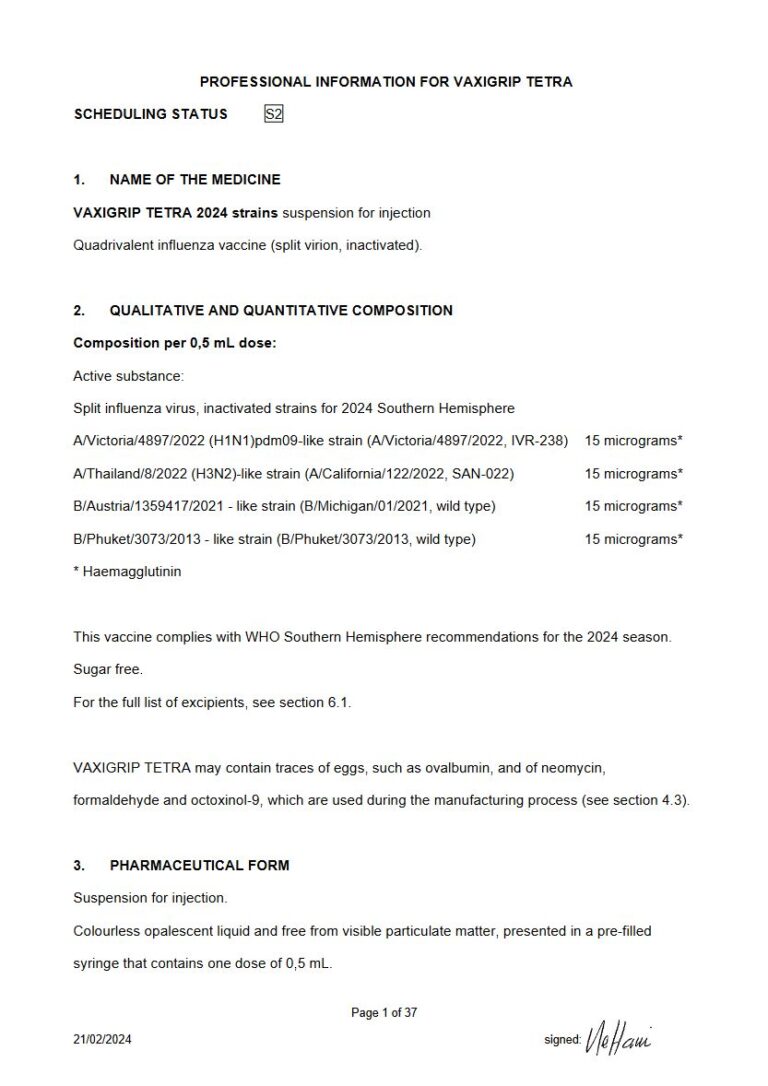
Vaxigrip Tetra 2024 Strains 0,5 mL Suspension for injection.
PDF Leaflet Revision Date: 21 February 2024
Clinical Summary
Quick overview from the medicine insert
Indication
Prevention of influenza disease in adults and children from 6 months of age.
Dosage (summary)
Adults and children u2265 6 months: 0.5 mL IM. Children < 9 years with no prior vaccination: 2 doses 0.5 mL, 4 weeks apart.
Onset of Action / Duration
Onset: 2-3 weeks, Duration: annual revaccination recommended.
Special Populations
- Pregnant women
- Elderly
- Immunocompromised
Pregnancy & Breastfeeding
Safe for use during pregnancy; may be used while breastfeeding.
Key Drug Interactions
- Concomitant administration with other vaccines may be possible
- Do not mix with other vaccines in the same syringe
Contraindications
- Severe allergic reaction to egg proteins
- Severe allergic reaction to any component of the vaccine
- Moderate or severe febrile illness
Common side effects
- Injection site pain
- Headache
- Myalgia
- Malaise
- Fever
Counselling Points
- Report any severe allergic reactions
- Expect mild side effects
- Annual vaccination recommended due to changing virus strains
Serious warnings
- May not protect all vaccinees
- Caution in individuals with hypersensitivity to neomycin
- Risk of anaphylactic reactions
Important Disclaimer
The Vaxigrip Tetra 2024 Strains 0,5 mL Suspension for injection. professional information leaflet below is the property of Sanofi-Aventis South Africa and is provided on Medinsert exactly as issued, with no.. alterations or editorial changes. We make every effort to keep content current by updating documents as soon as new versions become available. Medinsert serves as a trusted access point for healthcare professionals, but does not replace official sources or clinical judgement. For more details, please read our full disclaimer. read more>>
 Healthcare Professionals Only
This content is for registered healthcare professionals
Sign in or create a free account to read the full package insert.
Free for HPCSA-registered professionals. Powered by Medinsert.
Clinical Particulars
Section 4 of the official insert — extracted exactly as issued, no alterations
4.1 Therapeutic indications
VAXIGRIP TETRA is indicated for the prevention of influenza disease caused by the two influenza A virus subtypes and the two influenza B virus types contained in the vaccine for:
- active immunisation of adults, including pregnant women, and children from 6 months of age and older,
- passive protection of infant(s) from birth to less than 6 months of age following vaccination of pregnant women (see sections 4.4, 4.6 and 5.1).
4.2 Posology and method of administration
Posology
Due to the variation of the influenza virus and the duration of immunity provided by the vaccine, it is recommended to perform vaccination against influenza every year at the beginning of the risk period.
Adults: one dose of 0,5 mL.
Paediatric population:
- Children from 6 months to 17 years of age: one dose of 0,5 mL. For children less than 9 years of age who have not previously been vaccinated, a second dose of 0,5 mL should be given after an interval of at least 4 weeks.
- Infants less than 6 months of age: the safety and efficacy of VAXIGRIP TETRA administration (active immunisation) have not been established. No data are available.
Regarding passive protection: one 0,5 mL dose given to pregnant women may protect infants from birth to less than 6 months of age; however, not all these infants will be protected (see section 5.1).
Method of administration
The vaccine should be given by intramuscular or deep subcutaneous injection. The preferred sites for intramuscular injection are the anterolateral aspect of the thigh (or the deltoid muscle, if muscle mass is adequate) in children 6 months through 35 months of age, or the deltoid muscle in children from 36 months of age and adults.
Precautions to be taken before handling or administering VAXIGRIP TETRA: For instructions on preparation of VAXIGRIP TETRA before administration, see section 6.6.
4.3 Contraindications
VAXIGRIP TETRA should not be administered to subjects with a history of severe allergic reaction to egg proteins (eggs or egg products), to chicken proteins, to any component of the vaccine (i.e. as defined under sections 2 and 6.1 including manufacturing residuals) or a history of severe allergic reaction after previous administration of VAXIGRIP TETRA or a vaccine containing the same components.
Administration of VAXIGRIP TETRA should be postponed in subjects suffering from moderate or severe febrile disease or acute disease.
4.4 Special warnings and precautions for use
As each dose may contain undetectable traces of neomycin, which is used during vaccine production, caution should be exercised when VAXIGRIP TETRA is administered to subjects with hypersensitivity to this antibiotic (and other antibiotics of the same class).
Vaccination with VAXIGRIP TETRA may not protect all vaccinees. Regarding passive protection, not all infants less than 6 months of age born to women vaccinated during pregnancy will be protected (see section 5.1).
Influenza virus is remarkably unpredictable in that significant antigenic changes may occur from time to time. It is known that VAXIGRIP TETRA as constituted per annual seasonal composition, is not effective against all possible strains of influenza virus.
VAXIGRIP TETRA is intended to provide protection against those strains of virus from which the vaccine is prepared. If VAXIGRIP TETRA is used in immunocompromised persons whether due to genetic, immunodeficiency disease, or immunosuppressive therapy, they may have a reduced immune response to vaccination.
Interference with serological testing See section 4.5.
Do not administer VAXIGRIP TETRA by intravascular injection.
- The vaccine must be administered with caution to subjects with thrombocytopenia or a bleeding disorder, since bleeding may occur following an intramuscular administration to these subjects.
- Appropriate medical treatment and supervision should be readily available for immediate use in case of an anaphylactic reaction following the administration of the vaccine.
- As a precautionary measure, adrenaline (epinephrine) injection (1:1 000) must be immediately available in case of unexpected anaphylactic or serious allergic reactions.
- Syncope (fainting) can occur following, or even before, any vaccination as a psychogenic response to the needle injection. Procedures should be in place to prevent falling injury and manage syncopal reactions.
4.5 Interaction with other medicines and other forms of interaction
No studies regarding the simultaneous administration of VAXIGRIP TETRA and other vaccines have been conducted. Nevertheless, clinical data showing that VAXIGRIP can be administered concomitantly with other vaccines are available for the following vaccines: Pneumococcal polysaccharide vaccine in elderly subjects, Tdap-IPV (Adacel QUADRA u00ae ) in adults aged u2265 60 years and zoster vaccine (Zostavax u00ae ) in adults aged 50 years and older.
In addition, according to ACIP, there is no evidence that inactivated vaccines interfere with the immune response to other inactivated vaccines or to live vaccines. Any inactivated vaccine can be administered either simultaneously or at any time before or after a different inactivated vaccine or live vaccine.
VAXIGRIP TETRA should not be mixed with any other vaccines or medicines in the same syringe. Separate injection sites and separate syringes should be used in case of concomitant administration. Persons deficient in producing antibodies due to immunosuppressive therapy may have a reduced immune response to vaccination.
Following influenza vaccination, false positive results in serology tests using the ELISA method to detect antibodies against HIV-1, hepatitis C and especially HTLV-1 have been observed. The western blot technique disproves the false-positive ELISA test results. The transient false positive reactions could be due to the IgM response by the vaccine.
4.6 Fertility, pregnancy and lactation
Pregnancy
One developmental and reproductive toxicity study conducted in rabbits with VAXIGRIP TETRA did not show any effects on mating performance, embryo-fetal development and early postnatal development. Pregnant women are at high risk of influenza complications, including premature labour and delivery, hospitalisation, and death; therefore, pregnant women should receive an influenza vaccine, whatever their stage of pregnancy during the influenza season.
VAXIGRIP TETRA can be administered in all stages of pregnancy based on the safety data from clinical studies and post-marketing experience with VAXIGRIP TETRA and with the Sanofi Pasteur trivalent influenza vaccine, VAXIGRIP thiomersal free. Data from worldwide use of inactivated influenza vaccines, including experience with use of VAXIGRIP TETRA and VAXIGRIP in countries where inactivated influenza vaccines are recommended in all stages of pregnancy, and data from a clinical study conducted in Finland with VAXIGRIP TETRA administered in pregnant women during the second or third trimester (230 exposed pregnancies and 231 live births) did not indicate any adverse fetal or maternal outcomes attributable to the vaccine.
Data from four clinical studies conducted with VAXIGRIP thiomersal free administered to pregnant women during the second and third trimesters (more than 5 000 exposed pregnancies and more than 5 000 live births, followed up to approximately 6 months post-partum), did not indicate any adverse fetal, newborn, infant or maternal outcomes attributable to the vaccine.
In clinical studies conducted in South Africa and Nepal, there were no significant differences between the VAXIGRIP and placebo groups with regards to fetal, newborn, infant and maternal outcomes (including miscarriage, stillbirth, premature birth, low birth weight). In a study conducted in Mali, there were no significant differences between the VAXIGRIP and control vaccine (quadrivalent meningococcal conjugate vaccine) groups with regards to prematurity rate, stillbirth rate and low birth weight/small for gestational age rate. In these clinical studies, none of the serious adverse events reported in women, fetuses or infants were considered related to VAXIGRIP TETRA or VAXIGRIP.
Breastfeeding
There are no data on the effect of the vaccine in breastfed newborns/infants of women vaccinated with VAXIGRIP TETRA during the breastfeeding period. Based on inactivated influenza vaccines experience, VAXIGRIP TETRA may be used during breastfeeding.
Fertility
There are no fertility data available in humans. One animal study with VAXIGRIP TETRA did not indicate harmful effects on female fertility.
4.7 Effects on ability to drive and use machines
VAXIGRIP TETRA has no or negligible influence on the ability to drive a vehicle and use machines.
4.8 Undesirable effects
Within each system organ class, the adverse events are ranked under headings of frequency, using the following convention:
Very common: u2265 1/10 (u2265 10 %)
Common (frequent): u2265 1/100 and < 1/10 (u2265 1 % and < 10 %)
Uncommon (infrequent): u2265 1/1 000 and < 1/100 (u2265 0,1 % and < 1 %)
Rare: u2265 1/10 000 and < 1/1 000 (u2265 0,01 % and < 0,1 %)
Very rare: < 1/10 000 (< 0,01 %)
Not known: cannot be estimated from available data.
Adverse event information is derived from clinical trials with VAXIGRIP TETRA and from worldwide post-marketing experience with VAXIGRIP TETRA and VAXIGRIP (trivalent).
Data from clinical studies
The safety of VAXIGRIP TETRA was assessed in six randomised, controlled clinical trials in which 3 040 adults from 18 to 60 years of age, 1 392 elderly patients over 60 years of age and 429 children and adolescents from 9 to 17 years of age received one dose (0,5 mL) of VAXIGRIP TETRA, and 884 children from 3 to 8 years of age received one or two doses (0,5 mL) of VAXIGRIP TETRA and 1 614 children from 6 to 35 months of age received two doses (0,5 mL) of VAXIGRIP TETRA. In all of these trials, the comparator vaccine was VAXIGRIP (trivalent). In addition, a placebo was also used as comparator in the 6 to 35 months population.
The overall safety profile of VAXIGRIP TETRA was comparable to VAXIGRIP (trivalent). For all subjects, safety evaluations were performed during the first 21 days following vaccination, except for children 6 months to 8 years of age, where safety evaluations were performed during the first 28 days after any vaccination. Serious adverse reactions were collected during six months of follow-up. Most of the reactions usually occurred within the first 3 days following vaccination, and resolved spontaneously within 1 to 3 days after onset. The intensity of these reactions was mild. (Grade I: Fever: u2265 38,0 u00b0C to u2264 38,4 u00b0C except for < 24 months of age: u2265 38,0 u00b0C to u2264 38,5 u00b0C / Injection site reactions: u2265 25 to u2264 50 mm except for children under 12 years old: < 25 mm / Other reactions: no interference with activity).
The most frequently reported adverse reaction after vaccination, in all populations, including the whole group of children from 6 months to 35 months of age, was injection site pain. In the subpopulation of children less than 24 months of age, the most frequently reported adverse reaction was irritability and in the subpopulation of children from 24 to 35 months of age it was malaise. Overall, adverse reactions were generally less frequent in the elderly than in adults and in children.
Adults
In 3 randomised active-controlled studies, 3 040 adults from 18 to 60 years of age received one dose (0,5 mL) of VAXIGRIP TETRA, and 557 received one dose (0,5 mL) of VAXIGRIP. The most frequently reported reactions following VAXIGRIP TETRA administration were injection site pain, headache, myalgia and malaise.
Side effects reported within 7 days after vaccination with VAXIGRIP TETRA in adults from 18 to 60 years of age
Nervous system disorders
Very common: headache
Musculoskeletal and connective tissue disorders
Very common: myalgia
General disorders and administration site conditions
Very common: injection site pain, malaise
Common: injection site erythema, injection site swelling, injection site induration, shivering, fever
Uncommon: injection site ecchymosis.
Side effects reported within 21 days after vaccination with VAXIGRIP TETRA in adults from 18 to 60 years of age
Blood and lymphatic system disorders
Uncommon: lymphadenopathy
Immune system disorders
Rare: hypersensitivity
Nervous system disorders
Rare: dizziness, paraesthesia, somnolence
Respiratory, thoracic and mediastinal disorders
Rare: dyspnoea
Gastrointestinal disorders
Uncommon: diarrhoea, nausea
Skin and subcutaneous tissue disorders
Rare: urticaria, angioedema, allergic dermatitis, erythema, hyperhidrosis, pruritus, generalised pruritus
Musculoskeletal and connective tissue disorders
Rare: arthralgia
General disorders and administration site conditions
Uncommon: injection site pruritus, injection site warmth, fatigue
Rare: injection site discomfort, influenza-like illness, asthenia.
Elderly patients
In 2 randomised, active-controlled studies, 1 392 elderly patients over 60 years of age received one dose (0,5 mL) of VAXIGRIP TETRA, and 502 received one dose (0,5 mL) of VAXIGRIP (trivalent). The most frequently reported reactions following VAXIGRIP TETRA administration were injection site pain, headache and myalgia.
Side effects reported within 7 days after vaccination with VAXIGRIP TETRA in elderly patients over 60 years of age
Nervous system disorders
Very common: headache
Musculoskeletal and connective tissue disorders
Very common: myalgia
General disorders and administration site conditions
Very common: injection site pain
Common: injection site erythema, injection site swelling, injection site induration, shivering, malaise
Uncommon: injection site ecchymosis, fever.
Side effects reported within 21 days after vaccination with VAXIGRIP TETRA in elderly patients over 60 years of age
Nervous system disorders
Uncommon: dizziness
Rare: paraesthesia, somnolence
Vascular disorders
Uncommon: hot flushes
Gastrointestinal disorders
Uncommon: diarrhoea
Rare: nausea
Skin and subcutaneous tissue disorders
Uncommon: pruritus
Rare: erythema, hyperhidrosis
General disorders and administration site conditions
Uncommon: injection site pruritus, injection site warmth, fatigue
Rare: asthenia, influenza-like illness.
Children and adolescents 9 to 17 years of age
In a randomised, active-controlled study and an uncontrolled study, 429 children and adolescents from 9 to 17 years of age received one dose (0,5 mL) of VAXIGRIP TETRA and 55 received one dose (0,5 mL) of VAXIGRIP (trivalent). The most frequently reported reactions following VAXIGRIP TETRA administration were injection site pain (54,5 %), myalgia (29,1 %), headache (24,7 %) malaise (20,3 %) and injection site swelling (10,7 %).
Side effects reported within 7 days after vaccination with VAXIGRIP TETRA in children and adolescents from 9 to 17 years of age
Nervous system disorders
Very common: headache
Musculoskeletal and connective tissue disorders
Very common: myalgia
General disorders and administration site conditions
Very common: injection site pain, injection site swelling, malaise
Common: injection site erythema, injection site induration, injection site ecchymosis, shivering, fever.
Side effects reported within 21 days after vaccination with VAXIGRIP TETRA in children and adolescents 9 to 17 years of age
Gastrointestinal disorders
Uncommon: diarrhoea
General disorders and administration site conditions
Uncommon: injection site pruritus.
Children from 3 to 8 years of age
In a randomised, active-controlled study, 884 children from 3 to 8 years of age received one or two doses (0,5 mL) of VAXIGRIP TETRA and 354 received one or two doses (0,5 mL) of VAXIGRIP (trivalent). The safety profile of VAXIGRIP TETRA was similar after the first and the second injections. The most frequently reported reactions following VAXIGRIP TETRA administration were injection site pain (56,5 %), malaise (30,7 %), myalgia (28,5 %), headache (25,7 %), injection site swelling (20,5 %), injection site erythema (20,4 %), injection site induration (16,4 %), shivering (11,2 %).
Side effects reported within 7 days after any vaccination with VAXIGRIP TETRA in children from 3 to 8 years of age
Nervous system disorders
Very common: headache
Musculoskeletal and connective tissue disorders
Very common: myalgia
General disorders and administration site conditions
Very common: injection site pain, injection site swelling, injection site erythema, injection site induration, malaise, shivering
Common: injection site ecchymosis, fever.
Side effects reported within 28 days after any vaccination with VAXIGRIP TETRA in children from 3 to 8 years of age
Blood and lymphatic system disorders
Uncommon: thrombocytopenia
Psychiatric disorders
Uncommon: restlessness, moaning
Nervous system disorders
Uncommon: dizziness
Gastrointestinal disorders
Uncommon: diarrhoea, vomiting, upper abdominal pain
Musculoskeletal and connective tissue disorders
Uncommon: arthralgia
General disorders and administration site conditions
Uncommon: fatigue, injection site warmth.
Children from 6 to 35 months of age
In one study, 1 614 children from 6 to 35 months of age received 2 doses (0,5 mL) of VAXIGRIP TETRA, 1 612 received 2 doses (0,5 mL) of placebo and 367 received 2 doses (0,5 mL) of VAXIGRIP. The safety profile of VAXIGRIP TETRA was similar after the first and the second injections, with a trend of lower incidence of adverse reactions after the second injection compared to the first one. The most frequently reported reactions following VAXIGRIP TETRA administration were:
- For all children from 6 to 35 months of age: injection site pain/tenderness (26,8 %), fever (20,4 %) and injection site erythema (17,2 %).
- In subpopulation of children less than 24 months of age: irritability (32,3 %), appetite loss (28,9 %), abnormal crying (27,1 %), vomiting (16,1 %) and drowsiness (13,9 %).
- In a subpopulation of children from 24 to 35 months of age: malaise (26,8 %), headache (11,9 %) and myalgia (11,6 %).
Side effects reported within 7 days after any vaccination with VAXIGRIP TETRA compared to VAXIGRIP in children from 6 months to 35 months of age
Nervous system disorders
Very common: headache*
Gastrointestinal disorders
Very common: vomitingu2020
Musculoskeletal and connective tissue disorders
Very common: myalgia*
General disorders and administration site conditions
Very common: injection site pain/tenderness, injection site erythema, fever, malaise*, abnormal cryingu2020, drowsinessu2020, irritabilityu2020, appetite lossu2020
Common: injection site swelling, injection site induration, ecchymosis, shivering*.
* Solicited, recorded for subjects u2265 24 months.
u2020 Solicited, recorded for subjects < 24 months.
Side effects within 28 days after any vaccination with VAXIGRIP TETRA compared to VAXIGRIP in children from 6 months to 35 months of age
Immune system disorders
Uncommon: hypersensitivity
Metabolism and nutrition disorders
Rare: decreased appetite
(a) Gastrointestinal disorders
Uncommon: diarrhoea, vomiting
(a) Skin and subcutaneous tissue disorders
Rare: generalised pruritus, papular rash
Musculoskeletal and connective tissue disorders
Rare: myalgia
(b) General disorders and administration site conditions
Rare: influenza-like illness, injection site pruritus, injection site rash, irritability (a), malaise (b).
(a) In children u2265 24 months of age.
(b) In children < 24 months of age.
Other special populations
The safety profile of VAXIGRIP TETRA observed in a limited number of subjects with co-morbidities enrolled in the clinical studies does not differ from the one observed in the overall population. In addition, studies conducted with VAXIGRIP in renal transplant patients and asthmatic patients showed no major differences in terms of safety profile of VAXIGRIP in these populations.
Pregnant women: In clinical studies conducted in pregnant women in South Africa and Mali with VAXIGRIP (see sections 4.6 and 5.1), frequencies of local and systemic solicited reactions reported within 7 days following administration of VAXIGRIP were consistent with those reported for the adult population during clinical studies conducted with VAXIGRIP. In the South Africa study, local reactions were more frequent in the VAXIGRIP group than in the placebo group in both HIV-negative and HIV-positive cohorts. There were no other significant differences in solicited reactions between VAXIGRIP and placebo groups in both cohorts.
In one clinical study conducted in pregnant women in Finland with VAXIGRIP TETRA (see sections 4.6 and 5.1), frequencies of local and systemic solicited reactions reported within 7 days following administration of VAXIGRIP TETRA were consistent with those reported for the nonpregnant adult population during clinical studies conducted with VAXIGRIP TETRA, even though higher for some adverse reactions (injection site pain, malaise, shivering, headache, myalgia). When higher frequencies were observed, this increase was also seen with VAXIGRIP, used as comparator, suggesting a clinical study effect in this pregnant women population.
Data from post-marketing experience
Immune system disorders
Not known: allergic reactions, including anaphylactic reactions.
Adverse events
The following adverse events were reported following commercial use of VAXIGRIP (trivalent). A causal relationship with VAXIGRIP TETRA has not been established.
Blood and lymphatic system disorders
Transient thrombocytopenia*, lymphadenopathy*
Immune system disorders
Severe allergic reactions: shock
Allergic reactions: rash, generalised erythema
Nervous system disorders
Paraesthesia*, Guillain-Barru00e9 syndrome (GBS), neuritis, neuralgia, convulsions, encephalomyelitis
Vascular disorders
Vasculitis, such as Henoch-Schu00f6nlein purpura, with transient renal involvement in certain cases.
* These adverse events were reported during clinical trials with VAXIGRIP TETRA only in some age groups (see u201cData from clinical studiesu201d above).
4.9 Overdose
Cases of administration of more than the recommended dose (overdose) have been reported with VAXIGRIP TETRA. When adverse reactions were reported, the information was consistent with the known safety profile of VAXIGRIP TETRA described in section 4.8.
