
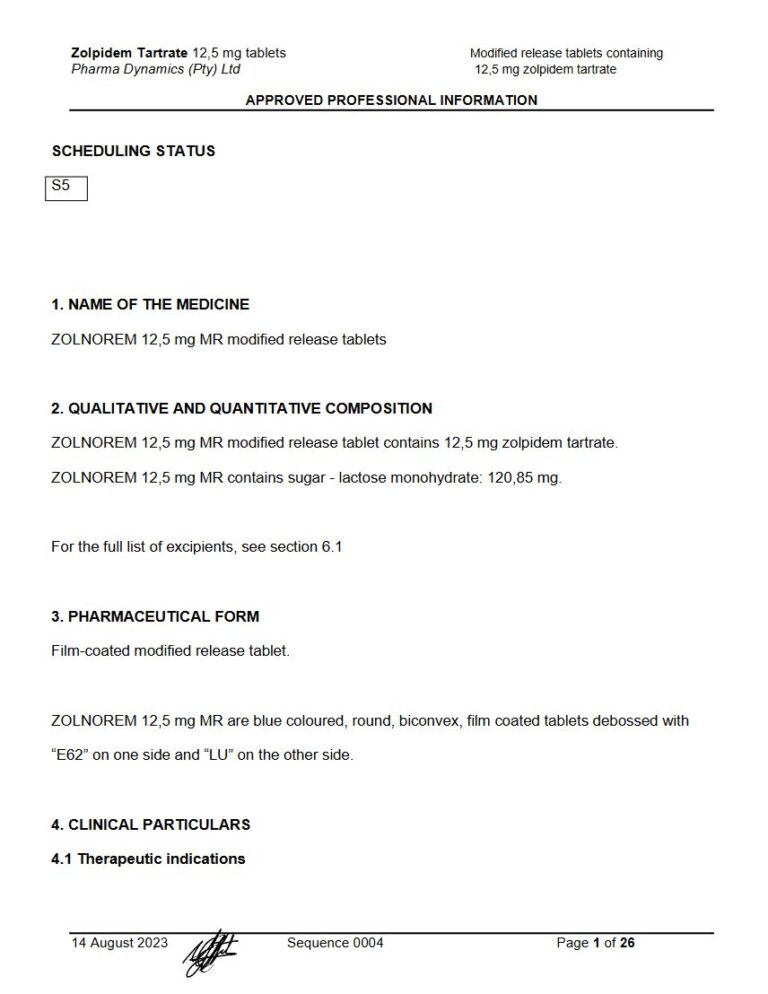
Zolnorem 12,5 mg Tablet
PDF Leaflet Revision Date: 14 August 2023
Clinical Summary
Quick overview from the medicine insert
Indication
Short term treatment of severe insomnia in adults under 65.
Dosage (summary)
12.5 mg orally before bedtime; max 12.5 mg, not to exceed 4 weeks.
Onset of Action / Duration
Onset: Rapid, Duration: 6-8 hours
Special Populations
- Hepatic impairment
- Elderly (> 65 years)
- Paediatric patients (< 18 years)
Pregnancy & Breastfeeding
Not recommended during pregnancy or breastfeeding.
Key Drug Interactions
- CNS depressants
- Alcohol
- Opioids
- CYP3A4 inhibitors
Contraindications
- Hypersensitivity to zolpidem
- Severe hepatic impairment
- Sleep apnoea syndrome
- Myasthenia gravis
- Pregnancy and lactation
Common side effects
- Somnolence
- Dizziness
- Headache
- Anxiety
Counselling Points
- Take immediately before bedtime.
- Avoid alcohol and CNS depressants.
- Do not drive or operate machinery after use.
- Report any unusual behaviors or side effects.
Serious warnings
- Risk of dependence
- Amnesia
- Psychomotor impairment
- Rebound insomnia
Important Disclaimer
The Zolnorem 12,5 mg Tablet professional information leaflet below is the property of Pharma Dynamics and is provided on Medinsert exactly as issued, with no.. alterations or editorial changes. We make every effort to keep content current by updating documents as soon as new versions become available. Medinsert serves as a trusted access point for healthcare professionals, but does not replace official sources or clinical judgement. For more details, please read our full disclaimer. read more>>
 Healthcare Professionals Only
This content is for registered healthcare professionals
Sign in or create a free account to read the full package insert.
Free for HPCSA-registered professionals. Powered by Medinsert.
Clinical Particulars
Section 4 of the official insert — extracted exactly as issued, no alterations
4.1 Therapeutic indications
Short term treatment of insomnia. ZOLNOREM 12,5 mg MR is indicated in adults below the age of 65 years, and only when the disorder is severe, disabling or subjecting the individual to extreme distress.
4.2 Posology and method of administration
Posology: ZOLNOREM 12,5 mg MR acts rapidly and therefore should be taken orally immediately before bedtime, or in bed. For faster sleep onset, ZOLNOREM 12,5 mg MR should not be administered with or immediately after a meal (see section 5.2). Tablets should not be halved, crushed or chewed. ZOLNOREM 12,5 mg MR should be taken in a single intake and not be readministered during the same night. Treatment should be as short as possible. Generally, the duration of treatment varies from four days to two weeks with a maximum, including the tapering process, of four weeks. In certain cases, extension beyond the maximum treatment period may be necessary; if so, it should not take place without re-evaluation of the patientu2019s status. Treatment should be started with the lowest recommended dose. The maximum dose should not be exceeded.
Adults (< 65 years): The recommended daily dose is 12,5 mg. The lowest effective daily dose of ZOLNOREM 12,5 mg MR is 12,5 mg, and must not exceed 12,5 mg.
Special populations
Hepatic impairment: ZOLNOREM 12,5 mg MR should not be used in patients with severe hepatic impairment (see section 4.3). Renal impairment: No dosage adjustment is required. Elderly: As ZOLNOREM 12,5 mg MR has not been evaluated in elderly patients (> 65 years). ZOLNOREM 12,5 mg MR is not recommended in this population. Paediatric population: As safety and efficacy in paediatric patients below the age of 18 years have not been established ZOLNOREM 12,5 mg MR should not be prescribed in this population (see sections 4.3 and 4.4).
Method of administration: Oral administration.
4.3 Contraindications
- hypersensitivity to zolpidem tartrate or to any other ingredient of ZOLNOREM 12,5 mg MR (see section 6.1)
- children under the age of 18 years
- sleep apnoea syndrome
- myasthenia gravis
- severe hepatic impairment
- Acute and/or severe respiratory impairment
- pregnancy and lactation (see section 4.6).
4.4 Special warnings and precautions for use
General information related to effects seen following administration of hypnotics, which should be taken into account by the prescribing medical practitioner are described below: The cause of insomnia should be identified wherever possible, and the underlying factors treated before a hypnotic is prescribed. The failure of insomnia to remit after a 7 - 14 day course of treatment may indicate the presence of a primary psychiatric or physical disorder, and the patient should be carefully re-evaluated at regular intervals.
Amnesia: ZOLNOREM 12,5 mg MR may introduce anterograde amnesia. The condition occurs most often several hours after ingesting the products and therefore to reduce the risk, patients should ensure that they get a full nightu2019s sleep (7-8 hours) before being active.
Other psychiatric and paradoxical reactions: Other psychiatric and paradoxical reactions like restlessness, exacerbated insomnia, agitation, irritability, aggression, delusion, anger, nightmares, hallucinations, abnormal behaviour and other behavioural effects are known to occur when using ZOLNOREM 12,5 mg MR. Should this occur, use of the product should be discontinued. These reactions are most likely to occur in the elderly.
Somnambulism and associated behaviours: Sleep walking and other associated behaviours such as u201csleep drivingu201d, preparing and eating food, making phone calls or having sex, with amnesia for the event have been reported in patients who have taken ZOLNOREM 12,5 mg MR and were not fully awake. The use of alcohol and other CNS-depressants with ZOLNOREM 12,5 mg MR appears to increase the risk of such behaviours, as does the use of ZOLNOREM 12,5 mg MR at doses exceeding the maximum recommended dose. Discontinuation of ZOLNOREM 12,5 mg MR should be strongly considered for patients who report such behaviours.
Psycho motor impairment: The risk of psychomotor impairment, including impaired driving ability, is increased if: ZOLNOREM 12,5 mg MR is taken within less than 7u20138 hours before performing activities that require mental alertness, a dose higher than the recommended dose is taken, or ZOLNOREM 12,5 mg MR is co-administered with other CNS depressants, alcohol, or with other medicines that increase the blood levels of ZOLNOREM 12,5 mg MR.
Medicine tolerance: Some loss of efficacy to the hypnotic effects of ZOLNOREM 12,5 mg MR may develop after repeated use for a few weeks.
Dependence: Use of ZOLNOREM 12,5 mg MR may lead to the development of physical and psychological dependence. The risk of dependence increases with dose and duration of treatment; it is also greater in patients with a history of psychiatric disorders and/or alcohol or drug abuse. These patients should be under careful surveillance when receiving hypnotics. Once physical dependence has developed, abrupt termination of treatment will be accompanied by withdrawal symptoms. These may consist of headaches or muscle pain, extreme anxiety and tension, restlessness, confusion and irritability. In severe cases the following symptoms may occur: derealisation, depersonalisation, hyperacusis, numbness and tingling of the extremities, hypersensitivity to light, noise and physical contact, hallucinations or epileptic seizures. Dependence has been reported with ZOLNOREM 12,5 mg MR (see section 4.8).
Rebound insomnia: A transient syndrome, whereby the symptoms that led to treatment with ZOLNOREM 12,5 mg MR recur in an enhanced form, may occur on withdrawal of ZOLNOREM 12,5 mg MR treatment. It may be accompanied by other reactions including mood changes, anxiety and restlessness. There are indications that, in the case of ZOLNOREM 12,5 mg MR with a short duration of action, withdrawal phenomenon can become manifest within the dosage interval, especially when the dosage is high. The rebound phenomenon, if it occurs with ZOLNOREM 12,5 mg MR, was limited to the first night after the medicine discontinuation in clinical studies (see section 5.2).
It is important that the patients should be aware of the possibility of rebound phenomenon, thereby minimising anxiety over such symptoms should they occur when the medicine is discontinued.
Respiratory impairment: As hypnotics have the capacity to depress respiratory drive, precautions should be observed if ZOLNOREM 12,5 mg MR is prescribed to patients with mild to moderate compromised respiratory function.
Risks from concomitant use with opioids: Concomitant use of ZOLNOREM 12,5 mg MR and other sedative-hypnotic medicines with opioids may result in sedation, respiratory depression, coma and death. Because of these risks, reserve concomitant prescribing of opioids and benzodiazepines for use in patients for whom alternative treatment options are inadequate. If a decision is made to prescribe ZOLNOREM 12,5 mg MR concomitantly with opioids, prescribe the lowest effective dosages and minimum duration of concomitant use, and follow patients closely for signs and symptoms of respiratory depression and sedation (see section 4.5).
Patients with a history of alcohol or drug abuse: ZOLNOREM 12,5 mg MR should be used with extreme caution in these patients (see section 4.5 and 4.7).
Psychotic illness: ZOLNOREM 12,5 mg MR is not recommended for the primary treatment of psychotic illness.
Suicidality and depression: ZOLNOREM 12,5 mg MR should not be used alone to treat depression or anxiety associated with depression (suicide may be precipitated in such patients). As suicidal tendencies may be present, the least amount of ZOLNOREM 12,5 mg MR that is feasible, should be supplied to these patients because of the possibility of intentional overdosage by the patient. A pre-existing depression may be unmasked during the use of ZOLNOREM 12,5 mg MR. Since insomnia may be a symptom of depression, the patient should be re-evaluated if insomnia persists.
Severe injuries: Due to its pharmacological properties, ZOLNOREM 12,5 mg MR can cause drowsiness and a decreased level of consciousness, which may lead to falls and consequently to severe injuries.
Patients with Long QT syndrome: An in vitro cardiac electrophysiological study showed that under experimental conditions using very high concentration and pluripotent stem cells ZOLNOREM 12,5 mg MR may reduce the hERG (human Ether-u00e0-go-go-Related Gene) related potassium currents. The potential consequence in patients with congenital long QT syndrome is unknown. As a precaution, the benefit/risk ratio of ZOLNOREM 12,5 mg MR treatment in patients with known congenital long QT syndrome should be carefully considered.
Special populations: Hepatic impairment: ZOLNOREM 12,5 mg MR should be used with caution in patients with mild to moderate hepatic impairment. ZOLNOREM 12,5 mg MR should not be used in patients with severe hepatic impairment as it may contribute to encephalopathy (see section 4.3 and 5.2). Paediatric population: As safety and efficacy in subjects below the age of 18 have not been established ZOLNOREM 12,5 mg MR should not be used in this population (see section 4.3). Information on excipients of ZOLNOREM 12,5 mg MR: ZOLNOREM 12,5 mg MR contains lactose monohydrate. Patients with the rare hereditary problems of galactose intolerance, total lactase deficiency or glucose-galactose malabsorption should not take ZOLNOREM 12,5 mg MR.
4.5 Interaction with other medicines and other forms of interaction
Combination not recommended: Concomitant use with alcohol: The sedative effect may be enhanced when the product is used in combination with alcohol. This affects the ability to drive or use machines.
Combinations to be taken into account: CNS depressants: Enhancement of the central depressive effect may occur in cases of concomitant use with antipsychotics (neuroleptics), hypnotics, anxiolytics/sedatives, antidepressant medicines, narcotic analgesics, antiepileptic medicines, anaesthetics and sedative antihistamines. Concomitant use of ZOLNOREM 12,5 mg MR with these medicines may increase drowsiness and psychomotor impairment, including impaired driving ability. Concomitant use with hypnotics may enhance the euphoric effect of narcotic analgesics, which may lead to an increase in psychological dependence.
Opioids: The concomitant use of benzodiazepines and other sedative-hypnotic medicines, including ZOLNOREM 12,5 mg MR, and opioids increases the risk of sedation, respiratory depression, coma, and death because of additive CNS depressant effect. The dosage and duration of concomitant use should be limited (see section 4.4).
Cytochrome P450 inhibitors: Compounds, which inhibit cytochrome P450, may enhance the activity of ZOLNOREM 12,5 mg MR. Coadministration of ZOLNOREM 12,5 mg MR with ketoconazole (200 mg twice daily), a potent CYP3A4 inhibitor, produced a 64 % increase in ZOLNOREM 12,5 mg MR plasma levels. A routine dosage adjustment of ZOLNOREM 12,5 mg MR is not necessary, but patients should be advised that the sedative effects might be enhanced. However, co-administration of ZOLNOREM 12,5 mg MR with itraconazole or fluconazole did not produce any significant changes in ZOLNOREM 12,5 mg MR pharmacokinetics and pharmacodynamics. Fluvoxamine is a strong inhibitor of CYP1A2 and a moderate to weak inhibitor of CYP2C9 and CYP3A4. Coadministration of fluvoxamine may increase blood levels of ZOLNOREM 12,5 mg MR; concurrent use is not recommended. Ciprofloxacin has been shown to be a moderate inhibitor of CYP1A2 and CYP3A4. Co-administration of ciprofloxacin may increase blood levels of ZOLNOREM 12,5 mg MR; concurrent use is not recommended. Rifampicin (CYP 3A4 inducer): The pharmacodynamic effect of ZOLNOREM 12,5 mg MR is decreased due to an increase in liver metabolism. St. Johnu2019s Wort (CYP 3A4 inducer): Use of St. Johnu2019s Wort, a CYP3A4 inducer, in combination with ZOLNOREM 12,5 mg MR may decrease blood levels of zolpidem and is not recommended.
Antiretrovirals: HIV-protease inhibitors such as ritonavir may increase plasma concentrations of zolpidem with a risk of extreme sedation and respiratory depression; use together is possible provided the patient is carefully monitored for excessive sedative effects.
Other: No significant pharmacokinetic interactions were observed, when ZOLNOREM 12,5 mg MR was administered with warfarin, digoxin, ranitidine or cimetidine.
4.6 Fertility, pregnancy and lactation
Women of childbearing potential: If ZOLNOREM 12,5 mg MR is prescribed to a woman of childbearing potential, she should be warned to contact her medical practitioner about stopping ZOLNOREM 12,5 mg MR if she intends to become, or suspects that she is pregnant.
Pregnancy: Safety in pregnancy have not been established. The use of ZOLNOREM 12,5 mg MR during pregnancy should be avoided. If for compelling medical reasons ZOLNOREM 12,5 mg MR is administered during the late phase of pregnancy or during labour, effects on the neonate, such as hypothermia, hypotonia and moderate respiratory depression, can be expected due to the pharmacological action of zolpidem. Infants born to mothers who took hypnotics including ZOLNOREM 12,5 mg MR, chronically during the latter stages of pregnancy may have developed physical dependence and may be at risk of developing withdrawal symptoms in the postnatal period.
Breastfeeding: As zolpidem is excreted in breast milk, the use of ZOLNOREM 12,5 mg MR in breastfeeding mothers is not recommended.
Fertility: There is no data on fertility with ZOLNOREM 12,5 mg MR.
4.7 Effects on ability to drive and use machines
Vehicle drivers and machine operators should be warned that, there might be a possible risk of adverse reactions including drowsiness, prolonged reaction time, dizziness, feeling drugged, sleepiness, blurred/double vision, reduced alertness and impaired driving the morning after the therapy. In order to minimise this risk a full night of sleep (7-8 hours) is recommended. The risk is increased by concomitant intake of alcohol and other CNS depressants. Patients should be warned not to use alcohol or other psychoactive substances when taking ZOLNOREM 12,5 mg MR (see section 4.4, 4.5 and 4.8).
4.8 Undesirable effects
Summary of the safety profile: The reaction most commonly associated with discontinuation in a 3-week study was somnolence, whilst in a 6-month study, anxiety, restlessness or agitation, (depression, major depression or depressed mood) were the most common adverse effects that resulted after discontinuation of treatment. Short-term studies indicate the most common adverse effects to be headache, next-day somnolence and dizziness. A six month study revealed the most common adverse effects to be the same as those indicated in short-term use, with the addition of higher incidence of anxiety. There is evidence of a dose-relationship for adverse effects associated with ZOLNOREM 12,5 mg MR use, particularly for certain CNS events. The occurrence is most frequently in elderly patients.
Tabulated list of adverse effects:
System Organ Class Frequency Side effects
Infections and Infestations Frequent: Influenza; Less frequent: Gastroenteritis, labyrinthitis, lower respiratory tract infection, otitis externa, upper respiratory tract infection
Blood and lymphatic system disorders Less frequent: Anaemia, hyperhaemoglobinaemia, leukopenia, lymphadenopathy, macrocytic anaemia, thrombosis
Immune system disorders Less frequent: Frequency unknown: Infection, abscess, herpes simplex zoster, otitis externa, otitis media, allergic reaction, allergy aggravated, anaphylactic shock, Angioedema
Metabolism and nutrition disorders Less frequent: Appetite disorder, hyperglycaemia, thirst, gout, hypercholesterolaemia, hyperlipidaemia, increased alkaline phosphatase, increased BUN, periorbital oedema, appetite increased, weight decreased
Psychiatric disorders Frequent: Anxiety, psychomotor retardation, disorientation; Less frequent: Frequency unknown: Depression, hallucination, apathy, binge eating, confusional state, depersonalisation, depressed mood, disinhibition, euphoric mood, hallucination visual, hypnagogic hallucination, mood swings, nightmares, stress symptoms
Nervous system disorders Frequent: Headache, somnolence, dizziness, memory disorders (memory impairment, amnesia, anterograde amnesia), disturbance in attention, drugged feeling, euphoria, insomnia, lethargy, light-headedness, dry mouth; Less frequent: Balance disorder, hypoaesthesia, paraesthesia, ataxia, burning sensation, dizziness postural, dysgeusia, involuntary muscle contractions, tremor, agitation, decreased cognition, detached, difficulty concentrating, dysarthria, emotional lability, illusion, leg cramps, migraine, nervousness, sleeping (after daytime dosing), speech disorder, stupor, abnormal gait, abnormal thinking, aggressive reaction, apathy, decreased libido, delusion, dementia, depersonalisation, neuralgia, neuritis, neuropathy, neurosis, panic attacks, paresis, personality disorder, somnambulism, suicide attempts, tetany, yawning, increased sweating, pallor, syncope, altered saliva, flushing, impotence, increased saliva, tenesmus
Eye disorders Frequent: Visual disturbance, diplopia; Less frequent: Eye redness, vision blurred, altered visual depth perception, asthenopia, eye irritation, eye pain, scleritis, conjunctivitis, corneal ulceration, abnormal lacrimation, photopsia, abnormal accommodation, glaucoma
Ear and labyrinth disorders Less frequent: Vertigo, tinnitus
Cardiac disorders Less frequent: Palpitations, tachycardia, angina pectoris, dysrhythmia, circulatory failure, extrasystoles, myocardial infarction, pulmonary embolism, pulmonary oedema, ventricular tachycardia
Vascular disorders Less frequent: Postural hypotension, hypotension, cerebrovascular disorder, hypertension, arteritis, hypertension aggravated, phlebitis, varicose veins
Respiratory, thoracic and mediastinal disorders Frequent: Sinusitis; Less frequent: Cough, dry throat, throat irritation, bronchitis, dyspnoea, bronchospasm, respiratory depression, epistaxis, hypoxia, laryngitis, pneumonia
Gastrointestinal disorders Frequent: Nausea, constipation, diarrhoea, dyspepsia, hiccup; Less frequent: Vomiting, abdominal discomfort, flatulence, frequent bowel movements, gastro-oesophageal reflux disease, enteritis, eructation, gastritis, haemorrhoids, intestinal obstruction, rectal haemorrhage, tooth caries
Blood and lymphatic disorder Less frequent: Anaemia, hyperhaemoglobinaemia, leukopenia, lymphadenopathy, macrocytic anaemia, purpura, porphyria
Hepato-biliary disorders Frequency unknown: Hepatocellular, cholestatic or mixed liver injury
Skin and subcutaneous tissue disorders Less frequent: Rash, urticaria, contact dermatitis, skin wrinkling, pruritus, acne, bullous eruption, furunculosis
Musculoskeletal, connective tissue and bone disorders Frequent: Myalgia, muscle cramp, neck pain, back pain; Less frequent: Frequency unknown: Arthralgia, arthritis, arthrosis, sciatica, tendonitis, Muscle weakness
Renal and urinary disorders Frequent: Urinary tract infection; Less frequent: Dysuria, cystitis, urinary incontinence, acute renal failure, micturition frequency, nocturia, polyuria, pyelonephritis, renal pain, urinary retention
Reproductive system and breast disorders Less frequent: Dysmenorrhoea, menorrhagia, vulvovaginal dryness, menstrual disorder, vaginitis, breast fibroadenosis, breast neoplasm, breast pain
General disorders and administrative site conditions Frequent: Fatigue; Less frequent: Asthenia, chest discomfort, feeling drunk, influenza-like illness, lethargy, pain, oedema, falling, pyrexia, malaise, trauma, face oedema, hot flashes, restless legs, rigors, tolerance increased, medicine tolerance
Investigations Less frequent: Increased body temperature, heart rate increased, increased ESR
Reporting of suspected adverse reactions: Reporting suspected adverse reactions after authorisation of the medicine is important. It allows continued monitoring of the benefit/risk balance of the medicine. Healthcare professionals are asked to report any suspected adverse reactions to SAHPRA via online service for adverse drug reaction reporting by following the link: https://www.sahpra.org.za/Publications/Index/8. An email can be sent directly to the company, [email protected] to ensure safety of the product.
4.9 Overdose
Signs and symptoms: In cases of overdose involving ZOLNOREM 12,5 mg MR alone or with other CNS-depressant agents (including alcohol), impairment of consciousness up to coma, and more severe symptomatology, including fatal outcomes have been reported.
Management of overdose: General symptomatic and supportive measures should be used. Activated charcoal should be given to reduce absorption. Sedating medicines should be withheld even if excitation occurs. Use of flumazenil may be considered where serious symptoms are observed. However, flumazenil administration may contribute to the appearance of neurological symptoms (convulsions).
