
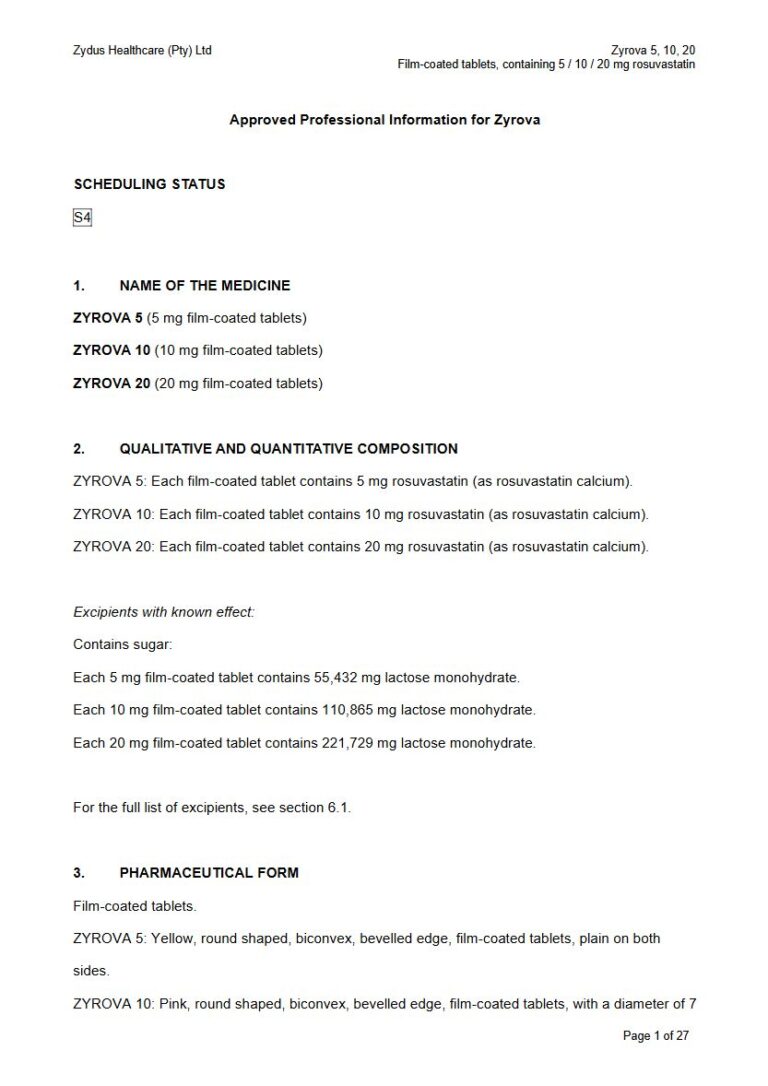
Zyrova FC tablets
PDF Leaflet Revision Date: 21 July 2023
Clinical Summary
Quick overview from the medicine insert
Indication
To reduce cardiovascular risk and treat hypercholesterolaemia.
Dosage (summary)
Start at 5 mg once daily; adjust based on response, max 40 mg.
Onset of Action / Duration
Onset: 1 week, Duration: 24 hours
Special Populations
- Elderly
- Renal impairment
- Hepatic impairment
- Asian ancestry
Pregnancy & Breastfeeding
Contraindicated in pregnancy and lactation.
Key Drug Interactions
- Ciclosporin
- Gemfibrozil
- Fusidic acid
- Protease inhibitors
Contraindications
- Hypersensitivity to rosuvastatin
- Active liver disease
- Severe renal impairment
- Pregnancy and lactation
- Myopathy
Common side effects
- Myalgia
- Headache
- Constipation
- Nausea
- Dizziness
Counselling Points
- Report muscle pain or weakness immediately.
- Avoid alcohol.
- Use effective contraception.
Serious warnings
- Risk of myopathy and rhabdomyolysis
- Monitor renal function
- Increased hepatic transaminases
Important Disclaimer
The Zyrova FC tablets professional information leaflet below is the property of Zydus Healthcare and is provided on Medinsert exactly as issued, with no.. alterations or editorial changes. We make every effort to keep content current by updating documents as soon as new versions become available. Medinsert serves as a trusted access point for healthcare professionals, but does not replace official sources or clinical judgement. For more details, please read our full disclaimer. read more>>
 Healthcare Professionals Only
This content is for registered healthcare professionals
Sign in or create a free account to read the full package insert.
Free for HPCSA-registered professionals. Powered by Medinsert.
Clinical Particulars
Section 4 of the official insert — extracted exactly as issued, no alterations
4.1 Therapeutic indications
To reduce the risk of cardiovascular events: In adult patients with an increased risk of atherosclerotic cardiovascular disease based on the presence of cardiovascular disease risk markers, such as an elevated high-sensitivity C-reaction protein (hsCRP) level, age, hypertension, low high-density lipoprotein cholesterol (HDL-C), smoking or a family history of premature coronary heart disease. ZYROVA is indicated to reduce the risk of non-fatal stroke, non-fatal myocardial infarction (MI), and the need for arterial revascularisation.
In adult patients with hypercholesterolaemia: ZYROVA is indicated for patients with primary hypercholesterolaemia, mixed dyslipidaemia and isolated hypertriglyceridaemia (including Fredrickson Type IIa, IIb and IV; and heterozygous familial and non-familial hypercholesterolaemia) as an adjunct to diet when response to diet and exercise is inadequate. ZYROVA is indicated to treat patients with primary dysbetalipoproteinaemia (Fredrickson Type III hyperlipoproteinaemia). ZYROVA is also indicated to reduce Total Cholesterol and LDL-C in patients with homozygous familial hypercholesterolaemia, either alone or as an adjunct to diet and other lipid lowering treatments (e.g. LDL apheresis). 40 mg of ZYROVA should only be considered in patients with severe hypercholesterolaemia and high cardiovascular risk who do not achieve their treatment goal on 20 mg of ZYROVA or alternative therapy. Specialist supervision is recommended when a 40 mg dose is initiated (see section 4.4).
Children and adolescents 10 to 17 years of age: ZYROVA is indicated to reduce the total cholesterol, LDL-C and Apo B, in patients with heterozygous familial hypercholesterolaemia (HeFH).
4.2 Posology and method of administration
Before treatment initiation the patient should be placed on a standard cholesterol-lowering diet that should continue during treatment.
Posology: The dose range for ZYROVA is 5 u2013 40 mg orally once a day. The recommended start dose is 5 mg once a day. The dose should be individualised according to the goal of therapy and patient response. The majority of patients are controlled at the 10 mg dose. However, if necessary, dose adjustment can be made at 2 to 4-week intervals.
Adults: Primary hypercholesterolaemia (including heterozygous familial hypercholesterolaemia), mixed dyslipidaemia, dysbetalipoproteinaemia (Frederickson Type II hyperlipoproteinaemia) and isolated hypertriglyceridaemia: The recommended starting dose is 5 mg orally once a day. A 5 mg starting dose is recommended for patients of Asian ancestry and for patients requiring a smaller reduction in LDL-C to achieve treatment target. For patients with severe hypercholesterolaemia (including heterozygous familial hypercholesterolaemia), a starting dose of 20 mg may be considered.
Homozygous familial hypercholesterolaemia: For patients with homozygous familial hypercholesterolaemia a starting dose of 20 mg once a day is recommended.
Special populations: Use in the elderly: The usual dose range applies. Dosage in patients with renal insufficiency: The starting dose applies in patients with mild to moderate renal impairment. For patients with severe renal impairment the dose of ZYROVA should not exceed 10 mg once daily. Dosage in patients with hepatic insufficiency: The usual starting dose applies in patients with mild to moderate hepatic impairment. Patients with severe hepatic impairment should start therapy with ZYROVA 5 mg. Increased systemic exposure to rosuvastatin has been observed in these patients, therefore the use of doses above ZYROVA 10 mg should be carefully considered (see section 5.2). Race: A 5 mg starting dose of ZYROVA should be considered for Asian patients. Increased plasma concentration of rosuvastatin is seen in Asian subjects (see sections 4.4 and 5.2). The increased systemic exposure should be taken into consideration when treating Asian patients whose hypercholesterolaemia is not adequately controlled at doses up to 20 mg daily.
Concomitant therapy: ZYROVA has shown to have additive efficacy in lowering triglycerides when used in combination with fenofibrate and in increasing HDL-C levels when used in combination with niacin. ZYROVA can also be used in combination with ezetimibe or bile acid sequestrants (see section 4.4).
Interactions requiring dose adjustments: Ciclosporin: Increased systemic exposure to rosuvastatin has been observed in patients taking concomitant ZYROVA and ciclosporin. For the ZYROVA dose range (10 mg u2013 40 mg) this combination is not recommended (see section 4.3). Gemfibrozil: Increased systemic exposure to rosuvastatin has been observed in patients taking concomitant ZYROVA and gemfibrozil. Patients taking this combination should start therapy with ZYROVA 5 once daily and should not exceed a dose of ZYROVA 20 once daily (see section 4.5).
Paediatric population: Children and adolescents 10 u2013 17 years of age: In children and adolescents with heterozygous familial hypercholesterolaemia, the usual dose range is 5 u2013 20 mg orally once daily. The dose should be appropriately titrated to achieve the treatment goal. Safety and efficacy of doses greater than 20 mg have not been studied in this population. In children and adolescents with homozygous familial hypercholesterolaemia, experience is limited to a small number of patients (aged 8 years and above).
Method of administration: ZYROVA may be given at any time of day, with or without food.
4.3 Contraindications
ZYROVA is contraindicated:
- In patients with hypersensitivity to rosuvastatin or to any of the excipients of ZYROVA.
- In patients with active liver disease including unexplained, persistent elevations of serum transaminases and any serum transaminase elevation exceeding 3 times the upper limit of normal (ULN).
- In patients with severe renal impairment (creatinine clearance < 30 mL/min).
- In patients receiving concomitant ciclosporin (see section 4.5).
- During pregnancy and lactation and in women of childbearing potential not using appropriate contraceptive measures (see section 4.6).
- In patients with myopathy.
- The 40 mg dose is contraindicated in patients with predisposing factors for myopathy/rhabdomyolysis. Such factors include:
- moderate renal impairment (creatinine clearance < 60 mL/min)
- hypothyroidism
- personal or family history of hereditary muscular disorders
- previous history of muscular toxicity with another HMG-CoA reductase inhibitor or fibrate
- alcohol abuse
- situations where an increase in rosuvastatin-plasma levels may occur
- Asian patients
- concomitant use of fibrates (see sections 4.4, 4.5 and 5.2).
4.4 Special warnings and precautions for use
Statin use as in ZYROVA has been associated with a risk of myasthenia gravis and ocular myasthenia (see section 4.8).
Renal effects: Proteinuria, detected by dipstick testing and mostly tubular in origin, has been observed in patients treated with higher doses of ZYROVA, in particular 40 mg; it was transient or intermittent in most cases. Proteinuria has not been shown to be a precursor to acute or progressive renal disease (see section 4.8).
The reporting rate for serious renal events in post-marketing use is higher at the 40 mg dose. An assessment of renal function must be considered during routine follow-up of patients treated with a dose of 40 mg.
Skeletal muscle effects: Effects on skeletal muscle e.g. myalgia, myopathy and, rarely, rhabdomyolysis have been reported in patients at all doses, particularly at doses higher than 20 mg. As with other HMG-CoA reductase inhibitors, the reporting rate for rhabdomyolysis in post-marketing use is higher at the highest marketed dose. Patients who develop any signs or symptoms suggestive of myopathy should have their creatine kinase (CK) levels measured. ZYROVA therapy should be discontinued if myopathy is diagnosed or suspected.
An increase in the incidence of myositis and myopathy has been seen in patients receiving other HMG-CoA reductase inhibitors together with ciclosporin, fibric acid derivatives, including gemfibrozil, nicotinic acid, azole antifungals and macrolide antibiotics. ZYROVA should be prescribed with caution in patients with predisposing factors for myopathy, such as renal impairment, advanced age and hypothyroidism, or situations where an increase in plasma levels may occur (see section 5.2).
Creatine kinase measurement: Creatine kinase (CK) should not be measured following strenuous exercise or in the presence of alternative causes of CK increase which may influence the interpretation of the result. If CK levels are significantly elevated at baseline (> 5 x ULN) a confirmatory test should be carried out within 5 u2013 7 days. If the repeat test confirms a baseline CK > 5 x ULN, treatment must not be started.
Before treatment: HMG-CoA reductase inhibitors, such as ZYROVA, should be prescribed with caution in patients with predisposing factors for myopathy/rhabdomyolysis. Such factors include:
- renal impairment
- hypothyroidism
- personal or family history of hereditary muscular disorders
- previous history of muscular toxicity with another HMG-CoA reductase inhibitor or fibrate
- alcohol abuse
- above 70 years of age
- situations where an increase in plasma levels may occur (see sections 4.2, 4.5 and 5.2)
- concomitant use of fibrates.
In this patient-group, the risk of treatment should be considered in relation to possible benefit. Clinical monitoring is recommended. If CK levels are significantly elevated at baseline (> 5 x ULN) treatment must not be initiated.
During treatment: Patients must be advised to report inexplicable muscle pain, weakness or cramps immediately, particularly if associated with malaise or fever. CK levels should be measured in these patients. Therapy must be discontinued if CK levels are markedly elevated (> 5 x ULN) or if muscular symptoms are severe and cause daily discomfort (even if CK levels are u2264 5 x ULN). If symptoms resolve and CK levels return to normal, then consideration should be given to re-introducing ZYROVA or an alternative HMG-CoA reductase inhibitor at the lowest dose with close monitoring. Routine monitoring of CK levels in asymptomatic patients is not warranted.
There have been reports of an immune-mediated necrotising myopathy (IMNM) during or after treatment with statins, including rosuvastatin. IMNM is clinically characterised by proximal muscle weakness and elevated serum creatine kinase, which persist despite discontinuation of statin treatment. An increase in the incidence of myositis and myopathy has been seen in patients receiving other HMG-CoA reductase inhibitors together with fibric acid derivatives including gemfibrozil, ciclosporin, nicotinic acid, azole antifungals, protease inhibitors and macrolide antibiotics.
4.5 Interactions with other medicines
Effect of co-administered medicines on ZYROVA: Transporter protein inhibitors: Rosuvastatin, as contained in ZYROVA, is a substrate for certain transporter proteins including the hepatic uptake transporter organic-anion-transporting polypeptide 1B1 (OATP1B1) and efflux transporter breast-cancer-resistance protein (BCRP). Concomitant administration of ZYROVA with medicines that are inhibitors of these transporter proteins may result in increased rosuvastatin plasma concentrations and an increased risk of myopathy (see sections 4.2, 4.4 and 4.5 Table 1).
Ciclosporin: During concomitant treatment with ZYROVA and ciclosporin, rosuvastatin AUC values were on average 7 times higher than those observed in healthy volunteers (see Table 1). ZYROVA is contraindicated in patients receiving concomitant ciclosporin (see section 4.3). Concomitant administration did not affect plasma concentrations of ciclosporin.
Protease inhibitors: Increased systemic exposure to rosuvastatin has been observed in subjects in pharmacokinetic studies receiving ZYROVA with various protease inhibitors in combination with ritonavir (see Table 1 below). This increase in systemic exposure to ZYROVA may lead to an increased incidence of adverse events. The concomitant use of ZYROVA and some protease inhibitor combinations may be considered after careful consideration of ZYROVA dose adjustments based on the expected increase in rosuvastatin exposure (see sections 4.2, 4.4, 4.5 and Table 1 below).
Gemfibrozil and other lipid-lowering products: Concomitant use of ZYROVA and gemfibrozil resulted in a 2-fold increase in rosuvastatin C max and AUC (see section 4.4). No pharmacokinetic relevant interaction with fenofibrate has been reported, however, a pharmacodynamic interaction may occur. Gemfibrozil, fenofibrate, other fibrates and lipid lowering doses (> or equal to 1 g/day) of niacin (nicotinic acid) increase the risk of myopathy when given concomitantly with HMG-CoA reductase inhibitors such as rosuvastatin contained in ZYROVA, probably because they can produce myopathy when given alone. The 40 mg dose is contraindicated with concomitant use of a fibrate (see sections 4.3 and 4.4).
Ezetimibe: Concomitant use of 10 mg ZYROVA and 10 mg ezetimibe resulted in a 1.2-fold increase in AUC of rosuvastatin in hypercholesterolaemic subjects (Table 1). A pharmacodynamic interaction, in terms of adverse effects, between ZYROVA and ezetimibe cannot be ruled out (see section 4.4).
Antacid: The simultaneous dosing of ZYROVA with an antacid suspension containing aluminium and magnesium hydroxide resulted in a decrease in rosuvastatin plasma concentration of approximately 50%. This effect was mitigated when the antacid was dosed 2 hours after ZYROVA. The clinical relevance of this interaction has not been studied.
Erythromycin: Concomitant use of ZYROVA and erythromycin resulted in a 20% decrease in AUC and a 30% decrease in C max of rosuvastatin. This interaction may be caused by the increase in gut motility caused by erythromycin.
Cytochrome P450 enzymes: In vitro and in vivo data indicate that rosuvastatin has no clinically significant cytochrome P450 interactions (as a substrate, inhibitor or inducer). Therefore, medicine interactions resulting from cytochrome P450-mediated metabolism are not expected. No clinically relevant interactions have been observed between rosuvastatin and either fluconazole (an inhibitor of CYP2C9 and CYP3A4) or ketoconazole (an inhibitor of CYP2A6 and CYP3A4).
Interactions requiring rosuvastatin dose adjustments (see also Table 1): When it is necessary to co-administer ZYROVA with other medicines known to increase exposure to rosuvastatin, doses of ZYROVA should be adjusted. Start with a 5 mg once daily dose of ZYROVA if the expected increase in exposure (AUC) is approximately 2-fold or higher. The maximum daily dose of ZYROVA should be adjusted so that the expected rosuvastatin exposure would not likely exceed that of a 40 mg daily dose of ZYROVA taken without interacting medicines, for example a 20 mg dose of ZYROVA with gemfibrozil (1.9-fold increase), and a 10 mg dose of ZYROVA with combination ritonavir/atazanavir (3.1-fold increase).
4.6 Fertility, pregnancy and lactation
Women of childbearing potential / contraception in males and females: Women of child-bearing potential should use appropriate contraceptive measures.
Pregnancy: ZYROVA is contraindicated in pregnancy (see section 4.3).
Lactation: ZYROVA is contraindicated in lactation. Rosuvastatin is excreted in the milk of rats. There is no data available with respect to excretion of rosuvastatin in milk in humans (see section 4.3).
4.7 Effects on ability to drive and use machines
ZYROVA may cause dizziness, therefore patients taking ZYROVA should not drive or use machines until their individual susceptibility to dizziness is known.
4.8 Undesirable effects
The adverse reactions seen with ZYROVA are generally mild and transient.
Table 2: Tabulated list of adverse reactions
System organ class Frequency Blood and lymphatic system disorders Less frequent Thrombocytopenia Immune system disorders Less frequent Hypersensitivity reactions including angioedema Endocrine disorders Frequent Diabetes mellitus 1 Psychiatric disorders Frequency unknown Depression Nervous system disorders Frequent Headache Dizziness Less frequent Polyneuropathy Memory loss Frequency unknown Peripheral neuropathy Eye disorders Frequency unknown Ocular myasthenia Respiratory, thoracic and mediastinal disorders Frequency unknown Cough Dyspnoea Gastrointestinal disorders Frequent Constipation Nausea Abdominal pain Less frequent Pancreatitis Frequency unknown Diarrhoea Hepatobiliary disorders Less frequent Increased hepatic transaminases Jaundice Hepatitis Skin and subcutaneous tissue disorders Less frequent Pruritus Rash Urticaria Frequency unknown Stevens-Johnson syndrome Musculoskeletal and connective tissue disorders Frequent Myalgia Less frequent Myopathy (including myositis) Rhabdomyolysis Lupus-like syndrome Muscle rupture Arthralgia Frequency unknown Tendon disorders, sometimes complicated by rupture Immune-mediated necrotising myopathy, myasthenia gravis Renal and urinary disorders Less frequent Haematuria Frequency unknown Proteinuria Reproductive system and breast disorders Less frequent Gynaecomastia General disorders and administration site conditions Frequent Asthenia Less frequent Oedema 1 Frequency will depend on the presence or absence of risk factors (fasting blood glucose u2265 5.6 mmol/L, BMI > 30 kg/m2, raised triglycerides, history of hypertension). As with other HMG-CoA reductase inhibitors, such as ZYROVA, the incidence of adverse reactions tends to be dose dependent.
Renal effects: Proteinuria, detected by dipstick testing and mostly tubular in origin, has been observed in patients treated with ZYROVA. Shifts in urine protein from none or trace to 100 mg/dL or more were seen in < 1% of patients at some time during treatment with 10 and 20 mg, and in approximately 3% of patients treated with 40 mg. A minor increase in shift from none or trace to 30 mg/dL was observed with the 20 mg dose. In most cases, proteinuria decreases or disappears spontaneously on continued therapy. Review of data from clinical trials and post-marketing experience to date has not identified a causal association between proteinuria and acute or progressive renal disease. Haematuria has been observed in patients treated with ZYROVA and clinical trial data show that the occurrence is low.
Skeletal muscle effects: Effects on skeletal muscle, e.g. myalgia, myopathy (including myositis) and, rarely, rhabdomyolysis with and without acute renal failure have been reported in ZYROVA-treated patients with all doses and in particular with doses > 20 mg. A dose-related increase in CK levels has been observed in patients taking rosuvastatin; the majority of cases were mild, asymptomatic and transient. If CK levels are elevated (> 5 x ULN), treatment should be discontinued (see section 4.4).
Liver effects: A dose-related increase in transaminases has been observed in a small number of patients taking rosuvastatin as in ZYROVA; the majority of cases were mild, asymptomatic and transient. The following adverse events have been reported with some statins:
- Sexual dysfunction.
- Exceptional cases of interstitial lung disease, especially with long term therapy (see section 4.4).
- The reporting rates for rhabdomyolysis, serious renal events and serious hepatic events (consisting mainly of increased hepatic transaminases) is higher at the 40 mg dose.
Children and adolescents 10 u2013 17 years of age: Creatine kinase elevations > 10 x ULN and muscle symptoms following exercise or increased physical activity were observed more frequently in a 52-week clinical trial of children and adolescents compared to adults (see section 4.4). In other respects, the safety profile of rosuvastatin was similar in children and adolescents compared to adults.
Reporting of suspected adverse reactions: Reporting suspected adverse reactions after authorisation of ZYROVA is important. It allows continued monitoring of the benefit/risk balance of ZYROVA. Healthcare providers are asked to report any suspected adverse reactions to SAHPRA via the u201c6.04 Adverse Drug Reactions Reporting Formu201d, found online under SAHPRAu2019s publications: https://www.sahpra.org.za/Publications/Index/8
4.9 Overdose
There is no specific treatment in the event of overdose. In the event of overdose, the patient should be treated symptomatically, and supportive measures instituted as required. Liver function and CK levels should be monitored. Haemodialysis is unlikely to be of benefit.
