
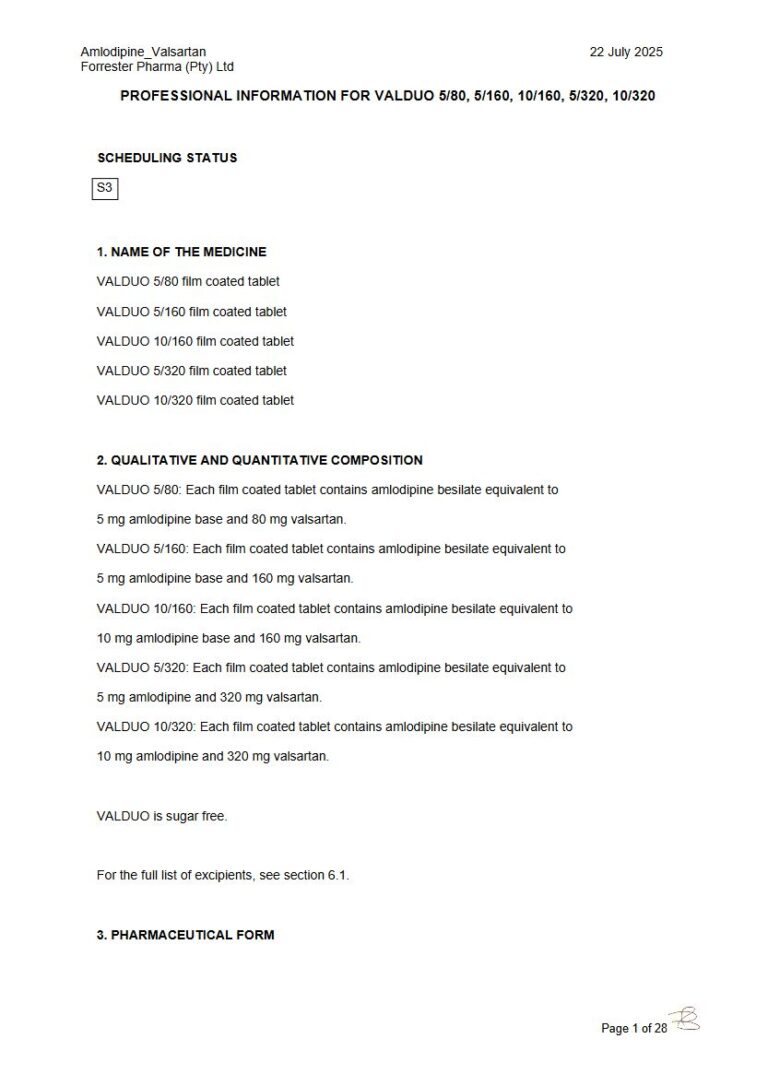
Valduo Film-coated tablets
PDF Leaflet Revision Date: 22 July 2025
Clinical Summary
Quick overview from the medicine insert
Indication
Treatment of mild to moderate essential hypertension.
Dosage (summary)
One tablet daily; no adjustment for elderly or mild to moderate renal impairment.
Onset of Action / Duration
Onset: 2 hours, Duration: 24 hours
Special Populations
- Renal impairment
- Hepatic impairment
- Elderly
Pregnancy & Breastfeeding
Contraindicated in pregnancy and breastfeeding.
Key Drug Interactions
- Lithium
- Potassium-sparing diuretics
- CYP3A4 inhibitors
Contraindications
- Hypersensitivity
- Severe renal impairment
- Severe hepatic impairment
- Bilateral renal artery stenosis
Common side effects
- Dizziness
- Headache
- Fatigue
- Oedema
Counselling Points
- Take with water
- Monitor blood pressure
- Avoid grapefruit juice
Serious warnings
- Risk of hypotension
- Angioedema
- Dual blockade of RAAS contraindicated
Important Disclaimer
The Valduo Film-coated tablets professional information leaflet below is the property of Forrester Pharma and is provided on Medinsert exactly as issued, with no.. alterations or editorial changes. We make every effort to keep content current by updating documents as soon as new versions become available. Medinsert serves as a trusted access point for healthcare professionals, but does not replace official sources or clinical judgement. For more details, please read our full disclaimer. read more>>
 Healthcare Professionals Only
This content is for registered healthcare professionals
Sign in or create a free account to read the full package insert.
Free for HPCSA-registered professionals. Powered by Medinsert.
Clinical Particulars
Section 4 of the official insert — extracted exactly as issued, no alterations
4.1 Therapeutic indications
Treatment of mild to moderate essential hypertension in patients u2265 18 years old whose blood pressure is normalised with the individual components in the same doses as the proposed fixed dose combination of VALDUO.
4.2 Posology and method of administration
Patients receiving amlodipine and valsartan from separate tablets may be switched to VALDUO containing the same component doses.
Posology: The recommended dose is one tablet daily. The dose will be determined on an individual patient basis.
Special populations
- Renal impairment: No dosage adjustment is required for patients with mild to moderate renal impairment. VALDUO is contraindicated for use in patients with severe renal impairment (see section 4.3).
- Hepatic impairment: Caution should be exercised when administering VALDUO to patients with mild to moderate hepatic impairment or biliary obstructive disorders (see sections 4.4 and 4.8). VALDUO is contraindicated in patients with severe hepatic impairment (Child - Pugh C), biliary cirrhosis or cholestasis (see section 4.3).
- Elderly: No dosage adjustment is required for elderly patients. The elimination half - life of amlodipine 5 mg oral dose is significantly prolonged, suggesting a decreased oral clearance or increased bioavailability. Therefore, VALDUO should be used with caution in elderly subjects.
- Children and adolescents: VALDUO is not recommended for use in children 18 years and younger (see section 4.4).
Method of administration: Oral use. It is recommended to take VALDUO with some water. VALDUO can be taken with or without food.
4.3 Contraindications
- Hypersensitivity to amlodipine, valsartan or to any of the excipients of VALDUO listed in section 6.1.
- A history of angioedema related to previous therapy with angiotensin - converting enzyme (ACE) inhibitors or angiotensin receptor blockers (ARBs): These patients must never again be given these medicines.
- Hereditary or idiopathic angioedema.
- Hypertrophic obstructive cardiomyopathy (HOCM).
- Severe renal function impairment (creatinine clearance less than 30 mL/min).
- Severe hepatic impairment (Child - Pugh C), biliary cirrhosis or cholestasis.
- Bilateral renal artery stenosis.
- Renal artery stenosis in patients with a single kidney.
- Aortic valve stenosis.
- Mitral valve stenosis.
- Concomitant therapy with potassium - sparing diuretics such as spironolactone, triamterene, amiloride (see sections 4.4 and 4.5).
- Porphyria.
- Lithium therapy: Concomitant administration with VALDUO may lead to toxic blood concentrations of lithium (see section 4.5).
- Pregnancy and lactation (see section 4.6).
- Concomitant use of VALDUO with aliskiren - containing products in patients with diabetes mellitus or renal impairment (GFR < 60 mL/min/1.73 m2) (see section 4.4).
- Severe hypotension.
- Shock (including cardiogenic shock).
- Haemodynamically unstable heart failure after acute myocardial infarction.
- Concomitant use of fluoroquinolones with ACE inhibitors/angiotensin receptor blockers is contraindicated in patients with moderate to severe renal impairment (creatinine clearance u2264 30 mL/min) and in elderly patients.
4.4 Special warnings and precautions for use
Pregnancy Angiotensin II Receptor Antagonists (AIIRAs) should not be initiated during pregnancy. When pregnancy is diagnosed, treatment with VALDUO should be stopped immediately, and, if appropriate, alternative therapy should be started (see sections 4.3 and 4.6).
Dual blockade of the renin - angiotensin - aldosterone system (RAAS) There is evidence that the concomitant use of angiotensin - converting enzyme (ACE) inhibitors, angiotensin II receptor blockers (ARBs) or renin inhibitors, such as aliskiren, may increase the risk of hypotension and hyperkalaemia, and decreases renal function (including acute renal failure). Dual blockade of RAAS through the combined use of VALDUO and renin inhibitors, such as aliskiren, is therefore contraindicated (see section 4.3). VALDUO should not be used concomitantly with renin inhibitors, such as aliskiren (see section 4.3).
Renal impairment Amlodipine is extensively metabolised to inactive metabolites with 10 % excreted unchanged in the urine. Changes in amlodipine plasma concentrations are not correlated with mild renal impairment. VALDUO may be used in such patients at normal doses. In patients with moderate renal impairment, VALDUO containing reduced amlodipine dosages (5 mg) may need to be administered in these patients. Amlodipine is not dialysable. No dosage adjustment of VALDUO is required for patients with mild to moderate renal impairment.
Concomitant use with fluoroquinolones Concomitant use of fluoroquinolones and ACE inhibitors/angiotensin receptor blockers may precipitate acute kidney injury in patients, especially those with moderate to severe renal impairment and elderly patients (see section 4.3). Renal function should be assessed before initiating treatment and monitored during treatment with fluoroquinolones or ACE inhibitors/angiotensin receptor blockers whether used separately and/or concomitantly.
Hepatic impairment Valsartan is mostly eliminated unchanged via the bile whereas amlodipine is extensively metabolised by the liver. Amlodipine half - life is prolonged in patients impaired hepatic function. Caution is advised when administering VALDUO to patients with mild to moderate hepatic impairment or biliary obstructive disorders. In patients with mild to moderate hepatic impairment without cholestasis, the maximum recommended dose is 80 mg valsartan. VALDUO containing lower amlodipine dosages (5 mg) should be administered in patients with impaired hepatic function. VALDUO is contraindicated in severe hepatic impairment, biliary cirrhosis or cholestasis (see section 4.3).
Sodium - and/or volume - depleted patients In patients with an activated renin - angiotensin system (such as volume - and/or salt - depleted patients receiving high doses of diuretics) who are receiving angiotensin receptor blockers (ARBs), symptomatic hypotension may occur. Correction of this condition prior to administration of VALDUO or close medical supervision at the start of treatment is recommended. If hypotension occurs with VALDUO, the patient should be placed in the supine position and, if necessary, given an intravenous infusion of normal saline. Treatment with VALDUO can be continued once the blood pressure has been stabilised.
Hyperkalaemia Concomitant use of VALDUO with potassium supplements, potassium - sparing diuretics, salt substitutes containing potassium or other medicines that may increase potassium levels, such as heparin, should be used with caution and with frequent monitoring of potassium levels (see section 4.3).
Renal artery stenosis See section 4.3.
Kidney transplantation To date there is no experience of the safe use of VALDUO in patients who have had a recent kidney transplantation.
Primary hyperaldosteronism Patients with primary hyperaldosteronism should not be treated with the angiotensin II antagonist valsartan as their renin - angiotensin system is affected by the primary disease.
Angioedema Angioedema, including swelling of the larynx and glottis, causing airway obstruction and/or swelling of the face, lips, pharynx and/or tongue, has been reported in patients treated with valsartan. Some of these patients previously experienced angioedema with other medicinal products, including ACE inhibitors. VALDUO should be discontinued immediately in patients who develop angioedema and should not be re - administered.
Heart failure/post - myocardial infarction As a consequence of the inhibition of the renin - angiotensin - aldosterone system, changes in renal function may be anticipated in susceptible individuals. In patients with severe heart failure whose renal function may depend on the activity of the renin - angiotensin - aldosterone system, treatment with ACE inhibitors and angiotensin receptor antagonists has been associated with oliguria and/or progressive uraemia and with acute renal failure and/or death. Similar outcomes have been reported with valsartan. Evaluation of patients with heart failure or post - myocardial infarction should always include assessment of renal function. In a long - term, placebo - controlled study (PRAISE - 2) of amlodipine in patients with NYHA (New York Heart Association Classification) III and IV heart failure of nonischaemic aetiology, amlodipine was associated with increased reports of pulmonary oedema despite no significant difference in the incidence of worsening heart failure as compared to placebo. Calcium channel blockers, including amlodipine, should be used with caution in patients with congestive heart failure, as they may increase the risk of future cardiovascular events and mortality.
Acute myocardial infarction Worsening angina pectoris and acute myocardial infarction can develop after starting or increasing the dose of amlodipine, particularly in patients with severe obstructive coronary artery disease.
Aortic and mitral valve stenosis See section 4.3.
Children Safety and effectiveness of VALDUO in children 18 years and younger has not been established (see section 4.2).
4.5 Interaction with other medicines and other forms of interaction
Interactions common to the combination No drug - drug interaction studies have been performed with VALDUO and other medicines.
To be taken into account with concomitant use Other antihypertensive medicines commonly used antihypertensive medicines (e.g. alpha blockers, diuretics) and other medicines which may cause hypotensive adverse effects (e.g. tricyclic antidepressants, alpha blockers for treatment of benign prostate hyperplasia) may increase the antihypertensive effect of the combination.
Interactions linked to amlodipine:
- Grapefruit or grapefruit juice: Administration of amlodipine (as contained in VALDUO) with grapefruit or grapefruit juice is not recommended as the bioavailability may be increased in some patients, increasing the antihypertensive effect.
- CYP3A4 inhibitors: Concomitant use of amlodipine (as contained in VALDUO) with strong or moderate CYP3A4 inhibitors (protease inhibitors, azole antifungals, macrolides like erythromycin or clarithromycin, verapamil or diltiazem) may give rise to a significant increase in amlodipine exposure. The clinical translation of these pharmacokinetic variations may be more pronounced in the elderly. Clinical monitoring and dose adjustment may thus be required. There is an increased risk of hypotension in patients receiving clarithromycin with amlodipine. Close observation of patients is recommended when amlodipine is co - administered with clarithromycin.
- CYP3A4 inducers: (anticonvulsant medicines [e.g. carbamazepine, phenobarbitone, phenytoin, fosphenytoin, primidone], rifampicin, Hypericum perforatum): Upon co - administration of known inducers of the CYP3A4, the plasma concentration of amlodipine may vary. Therefore, blood pressure should be monitored and dose regulation considered both during and after concomitant medication particularly with strong CYP3A4 inducers (e.g. rifampicin, Hypericum perforatum).
- Simvastatin: Co - administration of multiple doses of 10 mg amlodipine with 80 mg simvastatin resulted in a 77 % increase in exposure to simvastatin compared to simvastatin alone. It is recommended to limit the dose of simvastatin to 20 mg daily in patients on amlodipine, as contained in VALDUO.
- Dantrolene (infusion): Lethal ventricular fibrillation and cardiovascular collapse are observed in association with hyperkalaemia after administration of verapamil and intravenous dantrolene. Due to risk of hyperkalaemia, it is recommended that the co - administration of calcium channel blockers such as amlodipine (as contained in VALDUO) be avoided in patients susceptible to malignant hypertherima and in the management of malignant hyperthermia.
- Tacrolimus: There is a risk of increased tacrolimus blood levels when co administered with amlodipine. In order to avoid toxicity of tacrolimus, administration of amlodipine in a patient treated with tacrolimus requires monitoring of tacrolimus blood levels and dose adjustment of tacrolimus when appropriate.
Others: In monotherapy, amlodipine has been safely administered with hydrochorothiazides beta - blockers, angiotensin - converting enzyme inhibitors, long - acting nitrates, sublingual nitro - glycerine, digoxin, warfarin, atorvastatin, sildenafil, aluminium hydroxide gel, magnesium hydroxide, simethicone, cimetidine, nonsteroidal anti - inflammatory medicine, antibiotics and oral hypoglycaemic medicines. Co - administration of monotherapy amlodipine with digoxin did not change serum digoxin levels or digoxin renal clearance in normal volunteers and co - administration of cimetidine did not alter the pharmacokinetics of amlodipine. In vitro data from studies with human plasma indicate that monotherapy amlodipine has no effect on protein binding of the medicines tested (digoxin, phenytoin, warfarin or indomethacin). Monotherapy amlodipine does not significantly alter the effect of warfarin on prothrombin response time or the pharmacokinetics of ciclosporin.
Interactions linked to valsartan:
- Lithium therapy: Concomitant administration of valsartan (as contained in VALDUO) with lithium may lead to toxic blood concentrations of lithium (see section 4.3). Careful monitoring of serum lithium levels is advised during concomitant use. If a diurectic is also used, the risk of lithium toxicity may presumably be increased further with VALDUO.
- Dual blockade of the renin - angiotensin - aldosterone system (RAAS) with angiotensin receptor blockers (ARBs), angiotensin - converting enzyme (ACE) inhibitors or renin inhibitors: Clinical trial data have shown that dual blockade of the renin - angiotensin - aldosterone system (RAAS) through the combined use of angiotensin - converting enzyme (ACE) inhibitors, angiotensin II receptor blockers (ARBs) or renin inhibitors is associated with a higher frequency of adverse events such as hypotension, hyperkalaemia and decreased renal function (see sections 4.3 and 4.4).
- Nonsteroidal anti - inflammatory drugs (NSAIDs), including selective COX - 2 inhibitors, acetylsalicylic acid (> 3 g/day), and non - selective NSAIDs: When angiotensin II antagonists are administered simultaneously with NSAIDs attenuation of the antihypertensive effect may occur. Furthermore, concomitant use of angiotensin II antagonists and NSAIDs may lead to an increased risk of worsening of renal function and an increase in serum potassium. Therefore, monitoring of renal function at the beginning of the treatment is recommended, as well as adequate hydration of the patient.
- Inhibitors of the uptake transporter or efflux transporter: The results from an in vitro study with human liver tissue indicate that valsartan is a substrate of the hepatic uptake transporter OATP1B1 and the hepatic efflux transporter MRP2. Co - administration of inhibitors of the uptake transporter (e.g., rifampicin, ciclosporin) or efflux transporter (e.g., ritonavir) may increase the systemic exposure to valsartan.
Others: In monotherapy with valsartan, no interactions of clinical significance have been found with the following medicines: cimetidine, warfarin, furosemide, digoxin, atenolol, indomethacin, hydrochlorothiazide, amlodipine, glibenclamide.
Potassium Concomitant use with potassium supplements, potassium - sparing diuretics (see section 4.3), salt substitutes containing potassium or other medicines that may increase potassium levels, such as heparin, are contraindicated (see section 4.3).
Concomitant use of fluoroquinolones and ACE inhibitors/Angiotensin receptor Concomitant use of fluoroquinolones and ACE inhibitors/angiotensin receptor blockers may precipitate acute kidney injury. The mechanism of the possible interaction between the different classes of medicines, over and above different mechanisms of kidney damage, is unknown (see section 4.3).
4.6 Fertility, pregnancy and lactation
Should a woman become pregnant while receiving VALDUO, the treatment should be stopped promptly and switched to a different class of antihypertensive medicine (see section 4.3).
Women of childbearing potential/Contraception in males and females VALDUO must not be used in women planning to become pregnant. Healthcare professionals prescribing any products acting on the RAAS should counsel women of childbearing potential about the potential risk of these agents during pregnancy. Women of childbearing age should ensure effective contraception.
Pregnancy ACE - inhibitors, as in VALDUO, pass through the placenta and can be presumed to cause disturbance in foetal blood pressure regulatory mechanisms. Oligohydramnios as well as hypotension, oliguria and anuria in newborns, have been reported after administration of ACE - inhibitors in the second and third trimester. VALDUO acts directly on the renin - angiotensin - aldosterone system therefore it is a risk to the foetus. When pregnancy is detected during therapy, VALDUO must be discontinued as soon as possible. VALDUO must not be used during pregnancy as teratogenicity has been shown with valsartan in experimental animals (see section 4.3).
There have been reports of spontaneous abortion, oligohydramnios and newborn renal dysfunction when pregnant women have inadvertently taken valsartan.
Breastfeeding VALDUO is contraindicated in women who are breastfeeding (see section 4.3). It is not known whether valsartan is excreted in human milk. It is reported that amlodipine is excreted in human milk. The proportion of the maternal dose received by the infant has been estimated with an interquartile range of 3 u2013 7 %, with a maximum of 15 %. The effect of amlodipine on infants is unknown. Valsartan was excreted in the milk of lactating rats.
Fertility There are no clinical studies on fertility with amlodipine/valsartan (e.g., VALDUO).
4.7 Effects on ability to drive and use machines
VALDUO may cause side effects, such as dizziness, drowsiness and visual disturbances and can affect the ability to drive a vehicle and use machines (see section 4.8). Caution is advised before driving a vehicle or operating machinery until the effects of VALDUO are known.
4.8 Undesirable effects
System Organ Class Adverse reaction Frequency Amlodipine/valsartan - VALDUO Amlodipine Valsartan Infections and infestations Nasopharyngitis Frequent -- -- Influenza Frequent -- -- Blood and lymphatic system disorders Decrease in haemoglobin and in haematocrit -- -- Unknown Leukopenia -- Less frequent -- Neutropenia -- -- Unknown Thrombocytopenia sometimes with purpura -- Less frequent Unknown Immune system disorders Hypersensitivity Less frequent Less frequent Unknown Metabolism and nutrition disorders Anorexia Less frequent -- -- Hypercalcaemia Less frequent -- -- Hyperglycaemia -- Less frequent -- Hyperlipidaemia Less frequent -- -- Hyperuricaemia Less frequent -- -- Hypokalaemia Frequent -- -- Hyponatraemia Less frequent -- -- Psychiatric disorders Depression -- Less frequent -- Anxiety Less frequent -- -- Insomnia/sleep disturbances -- Less frequent -- Mood swings -- Less frequent -- Confusion -- Less frequent -- Nervous system disorders Coordination abnormal Less frequent -- -- Dizziness Less frequent Frequent -- Dizziness postural Less frequent -- -- Dysgeusia -- Less frequent -- Extrapyramidal syndrome -- Unknown -- Headache Frequent Frequent -- Hypertonia -- Less frequent -- Paraesthesia Less frequent Less frequent -- Peripheral neuropathy, neuropathy -- Less frequent -- Somnolence Less frequent Frequent -- Tremor -- Less frequent -- Hypoesthesia -- Less frequent -- Eye disorders Visual disturbance Less frequent Less frequent -- Visual impairment Less frequent Less frequent -- Ear and labyrinth disorders Tinnitus Less frequent Less frequent -- Vertigo Less frequent -- Less frequent Cardiac disorders Palpitations Less frequent Frequent -- Syncope Less frequent Less frequent -- Tachycardia Less frequent -- -- Dysrhythmias (including bradycardia, ventricular tachycardia, and atrial fibrillation) -- Less frequent -- Myocardial infarction -- Less frequent -- Vascular disorders Flushing -- Frequent -- Hypotension Less frequent Less frequent -- Orthostatic hypotension Less frequent -- -- Vasculitis -- Less frequent Unknown Respiratory, thoracic and mediastinal disorders Cough Less frequent Less frequent Less frequent Dyspnoea -- Less frequent -- Pharyngolaryngeal pain Less frequent -- -- Rhinitis -- Less frequent -- Abdominal discomfort, abdominal pain upper Less frequent Frequent Less frequent Gastrointestinal disorders Change of bowel habit -- Less frequent -- Constipation Less frequent Less frequent -- Diarrhoea Less frequent Less frequent -- Dry mouth Less frequent Less frequent -- Dyspepsia -- Less frequent -- Gastritis -- Less frequent -- Gingival hyperplasia -- Less frequent -- Nausea Less frequent Frequent -- Pancreatitis -- Less frequent -- Vomiting -- Less frequent -- Hepato - biliary disorders Liver function test abnormal, including blood bilirubin increase -- Less frequent* Unknown Hepatitis -- Less frequent -- Intrahepatic cholestasis, jaundice -- Less frequent -- Skin and Subcutaneous tissue disorders Angioedema -- Less frequent Unknown Alopecia -- Less frequent -- Dermatitis bullous -- -- Unknown Erythema Less frequent -- -- Erythema multiforme -- Less frequent -- Exanthema Less frequent Less frequent -- Hyperhidrosis Less frequent Less frequent -- Photosensitivity reaction -- Less frequent -- Pruritus Less frequent Less frequent Unknown Purpura -- Less frequent -- Rash Less frequent Less frequent Unknown Skin discolouration -- Less frequent -- Urticaria and other forms of rash -- Less frequent -- Exfoliative dermatitis -- Less frequent -- Stevens - Johnson syndrome -- Less frequent -- Quincke oedema -- Less frequent -- Toxic Epidermal Necrolysis -- Unknown -- Musculo - skeletal and connective tissue disorders Arthralgia Less frequent Less frequent -- Back pain Less frequent Less frequent -- Joint swelling Less frequent -- -- Muscle spasm Less frequent Less frequent -- Myalgia -- Less frequent Unknown Ankle swelling -- Frequent -- Sensation of heaviness Less frequent -- -- Renal and urinary disorders Increased blood creatinine -- -- Unknown Micturition disorder -- Less frequent -- Nocturia -- Less frequent -- Pollakiuria Less frequent Less frequent -- Polyuria Less frequent -- -- Renal failure and impairment -- -- Unknown Reproductive system and breast disorders Impotence -- Less frequent -- Erectile dysfunction Less frequent -- -- Gynaecomastia -- Less frequent -- General disorders and Administration site conditions Discomfort, malaise -- Less frequent -- Administration site conditions Asthenia Frequent Less frequent -- Fatigue Frequent Frequent Less frequent Facial oedema Frequent -- -- Flushing, hot flush Frequent -- -- Non cardiac chest pain -- Less frequent -- Oedema Frequent Frequent -- Oedema peripheral Frequent -- -- Pain -- Less frequent -- Pitting oedema Frequent -- -- Increased serum potassium -- -- Unknown Investigations Increased weight -- Less frequent -- Decreased weight -- Less frequent -- * mostly consistent with cholestasis
4.9 Overdose
Symptoms: There is no experience of overdose with amlodipine/valsartan.
Amlodipine: Overdose with amlodipine may result in:
- Excessive peripheral vasodilatation.
- Possibly reflex tachycardia.
- Bradycardia.
- Marked and potentially prolonged systemic hypotension up to and including shock with fatal outcome.
- Non - cardiogenic pulmonary oedema has been reported as a consequence of amlodipine overdose that may manifest with a delayed onset (24 - 48 hours post - ingestion) and require ventilatory support. Early resuscitative measures (including fluid overload) to maintain perfusion and cardiac output may be precipitating factors.
Valsartan: Overdose with valsartan may result in:
- Pronounced hypotension.
- Dizziness.
Treatment: If ingestion is recent, induction of vomiting may be considered. Administration of activated charcoal immediately or up to two hours after ingestion of amlodipine, has been shown to significantly decrease amlodipine absorption. Active cardiovascular support, in clinical significant hypotension, including frequent monitoring of cardiac and respiratory function, elevation of extremities, attention to circulating fluid volume and urine output. A vasoconstrictor may be helpful in restoring vascular tone and blood pressure, provided that there is no contraindication to its use. Intravenous calcium gluconate may be beneficial in reversing the effects of a calcium channel blocker. Both valsartan and amlodipine are unlikely to be removed by haemodialysis.
