
Preovidlen 70 mg Tablet
PDF Leaflet Revision Date: 25 March 2025
Clinical Summary
Quick overview from the medicine insert
Indication
Treatment of post-menopausal osteoporosis to reduce fracture risk.
Dosage (summary)
One tablet (70 mg/5600 IU) once weekly.
Special Populations
- Elderly
- Renal impairment
Pregnancy & Breastfeeding
Not for use in pregnancy or breastfeeding due to potential risks.
Key Drug Interactions
- Food and beverages reduce absorption
- NSAIDs may increase gastrointestinal irritation
Contraindications
- Hypersensitivity to components
- Oesophageal abnormalities
- Inability to sit upright
- Hypocalcaemia
- Severe renal insufficiency
- Pregnancy
- Breastfeeding
Common side effects
- Abdominal pain
- Dyspepsia
- Oesophageal ulcer
- Dysphagia
Counselling Points
- Take with plain water, 30 mins before food
- Do not lie down for 30 mins after taking
- Report any signs of oesophageal irritation
Serious warnings
- Risk of oesophageal irritation
- Osteonecrosis of the jaw
- Atypical femur fractures
Important Disclaimer
The Preovidlen 70 mg Tablet professional information leaflet below is the property of Pharmacare Limited and is provided on Medinsert exactly as issued, with no.. alterations or editorial changes. We make every effort to keep content current by updating documents as soon as new versions become available. Medinsert serves as a trusted access point for healthcare professionals, but does not replace official sources or clinical judgement. For more details, please read our full disclaimer. read more>>
 Healthcare Professionals Only
This content is for registered healthcare professionals
Sign in or create a free account to read the full package insert.
Free for HPCSA-registered professionals. Powered by Medinsert.
Clinical Particulars
Section 4 of the official insert — extracted exactly as issued, no alterations
4.1. Therapeutic indications
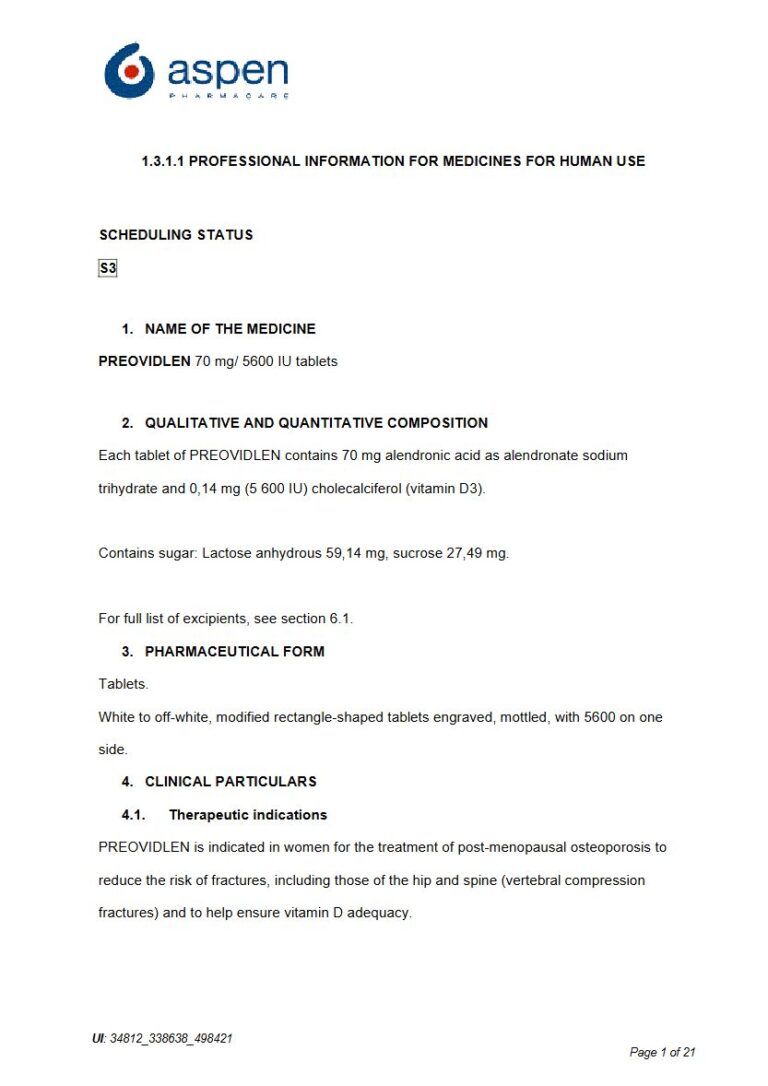
PREOVIDLEN is indicated in women for the treatment of post-menopausal osteoporosis to reduce the risk of fractures, including those of the hip and spine (vertebral compression fractures) and to help ensure vitamin D adequacy.
4.2. Posology and method of administration
Posology
Adults
The recommended dosage is one 70 mg/5 600 IU tablet once weekly. For most osteoporotic patients the appropriate dose is 70 mg/5 600 IU once weekly. The optimal duration of bisphosphonate treatment for osteoporosis has not been established. The need for continued treatment should be re-evaluated. Patients should receive supplemental calcium and/or vitamin D if intake is inadequate (see section 4.4). Additional supplementation with vitamin D should be considered on an individual basis taking into account any vitamin D intake from vitamins and dietary supplements. PREOVIDLEN is intended to provide a weeku2019s supply of vitamin D.
Special populations
Elderly population
In clinical studies there was no age-related difference in the efficacy or safety profiles of alendronate as contained in PREOVIDLEN. Therefore, no dose adjustment is necessary for the elderly.
Renal impairment
PREOVIDLEN is not recommended for patients with renal impairment where creatinine clearance is less than 35 mL /min, due to lack of experience. No dose adjustment is necessary for patients with mild to moderate renal insufficiency (creatinine clearance 35 to 60 mL/min).
Method of administration
For oral administration. PREOVIDLEN must be taken at least 30 minutes before the first food, beverage, or medication of the day with plain water only. Other beverages (including mineral water), food, and some medications are likely to reduce the absorption of alendronate, as contained in PREOVIDLEN (see section 4.5). The following instructions should be followed exactly in order to minimise the risk of oesophageal irritation and related adverse reactions (see section 4.4):
- PREOVIDLEN should only be swallowed after getting up for the day with a full glass of water (not less than 200 ml).
- Patients should only swallow PREOVIDLEN whole. Patients should not crush or chew the tablet or allow the tablet to dissolve in their mouths because of a potential for oropharyngeal ulceration.
- Patients should not lie down for at least 30 minutes after taking PREOVIDLEN and until after the first food of the day.
- PREOVIDLEN should not be taken at bedtime or before arising for the day.
Failure to follow these instructions may increase the risk of oesophageal adverse experiences (see section 4.8).
4.3. Contraindications
PREOVIDLEN is contraindicated in:
- Patients with hypersensitivity to alendronate and cholecalciferol or to any of the excipients in PREOVIDLEN (see section 6.1).
- Abnormalities of the oesophagus and other factors which delay oesophageal emptying such as stricture or achalasia.
- Inability to stand or sit upright for at least 30 minutes.
- Hypocalcaemia.
- Severe renal insufficiency (creatinine clearance less than 35 mL/min) (see section 4.2).
- Pregnancy and lactation (see section 4.6).
- Paediatric age group.
4.4. Special warnings and precautions for use
Alendronate
Upper gastrointestinal adverse reactions
Alendronate, as contained in PREOVIDLEN, can cause local irritation of the upper gastrointestinal mucosa. Because there is a potential for worsening of the underlying disease, caution should be used when alendronate, as contained in PREOVIDLEN, is given to patients with active upper gastrointestinal problems, such as dysphagia, oesophageal disease, gastritis, duodenitis, ulcers, or with a recent history (within the previous year) of major gastrointestinal disease such as peptic ulcer, or active gastrointestinal bleeding, or surgery of the upper gastrointestinal tract other than pyloroplasty (see section 4.3). In patients with known Barrett's oesophagus, prescribers should consider the benefits and potential risks of alendronate, as contained in PREOVIDLEN, on an individual patient basis.
Oesophageal reactions (sometimes severe and requiring hospitalisation), such as oesophagitis, oesophageal ulcers and oesophageal erosions, rarely followed by oesophageal stricture, have been reported in patients receiving alendronate, as contained in PREOVIDLEN. Medical practitioners should therefore be alert to any signs or symptoms signalling a possible oesophageal reaction and patients should be instructed to discontinue alendronate, as contained in PREOVIDLEN and seek medical attention if they develop symptoms of oesophageal irritation such as dysphagia, pain on swallowing or retrosternal pain or new or worsening heartburn (see section 4.8).
The risk of severe oesophageal adverse reactions appears to be greater in patients who fail to take alendronate, as contained in PREOVIDLEN, properly and/or who continue to take alendronate, as contained in PREOVIDLEN, after developing symptoms suggestive of oesophageal irritation. It is very important that the full dosing instructions are provided to and are understood by the patient (see section 4.2). Patients should be informed that failure to follow these instructions may increase their risk of oesophageal problems.
While no increased risk was observed in extensive clinical trials with alendronate, as contained in PREOVIDLEN, there have been (post-marketing) reports of gastric and duodenal ulcers, some of which were severe and with complications (see section 4.8).
Osteonecrosis of the jaw
Osteonecrosis of the jaw, generally associated with tooth extraction and/or local infection (including osteomyelitis), has been reported in patients with cancer who are receiving treatment regimens including primarily intravenously administered bisphosphonates. Many of these patients were also receiving chemotherapy and corticosteroids. Osteonecrosis of the jaw has also been reported in patients with osteoporosis receiving oral bisphosphonates, such as alendronate as in PREOVIDLEN.
The following risk factors should be considered when evaluating an individual's risk of developing osteonecrosis of the jaw:
- potency of the bisphosphonate (highest for zoledronic acid), route of administration (see above) and cumulative dose;
- cancer, chemotherapy, radiotherapy, corticosteroids, angiogenesis inhibitors, smoking;
- a history of dental disease, poor oral hygiene, periodontal disease, invasive dental procedures and poorly fitting dentures.
A dental examination with appropriate preventive dentistry should be considered prior to treatment with oral bisphosphonates, such as alendronate as in PREOVIDLEN in patients with poor dental status. While on treatment, these patients should avoid invasive dental procedures if possible. For patients who develop osteonecrosis of the jaw while on bisphosphonate therapy such as alendronate as in PREOVIDLEN, dental surgery may exacerbate the condition. For patients requiring dental procedures, there are no data available to suggest whether discontinuation of bisphosphonate treatment reduces the risk of osteonecrosis of the jaw. Clinical judgement of the treating medical practitioner should guide the management plan of each patient based on individual benefit/risk assessment. During bisphosphonate treatment, all patients should be encouraged to maintain good oral hygiene, receive routine dental check-ups, and report any oral symptoms such as dental mobility, pain, or swelling.
Osteonecrosis of the external auditory canal
Osteonecrosis of the external auditory canal has been reported with bisphosphonates, mainly in association with long-term therapy. Possible risk factors for osteonecrosis of the external auditory canal include steroid use and chemotherapy and/or local risk factors such as infection or trauma. The possibility of osteonecrosis of the external auditory canal should be considered in patients receiving bisphosphonates who present with ear symptoms such as pain or discharge, or chronic ear infections.
Atypical fractures of the femur
Atypical, low energy fractures of the subtrochanteric and proximal femoral shaft have been reported with long-term use (usually longer than 3 years) in bisphosphonate-treated patients. Some were stress fractures (also reported as insufficiency fractures) occurring in the absence of apparent trauma. Some patients experienced prodromal pain in the affected area, often associated with imaging features of stress fracture, weeks to months before a fracture occurred. Approximately one third of these fractures were bilateral; therefore the contralateral femur should be examined in patients who have sustained a femoral shaft stress fracture and receive appropriate orthopaedic care. Bisphosphonate treatment should be stopped in patients with stress fractures and they should receive appropriate orthopaedic care.
Musculoskeletal pain
Bone, joint, and/or muscle pain has been reported in patients taking bisphosphonates. In post-marketing experience, these symptoms have been severe and/or incapacitating (see section 4.8). The time to onset of symptoms varied from one day to several months after starting treatment. Most patients had relief of symptoms after stopping treatment. A subset had recurrence of symptoms when rechallenged with the same medicinal product or another bisphosphonate.
4.5. Interaction with other medicines and other forms of interaction
Alendronate
If taken at the same time, it is likely that food and beverages (including mineral water), calcium supplements, antacids, and some oral medicinal products will interfere with absorption of alendronate as contained in PREOVIDLEN. Therefore, patients must wait at least 30 minutes after taking alendronate as contained in PREOVIDLEN, before taking any other oral medicinal product (see sections 4.2 and 5.2).
Non-steroidal anti-inflammatory drugs (NSAID)
Since non-steroidal anti-inflammatory drug (NSAID) use is associated with gastrointestinal irritation, caution should be used during concomitant use with alendronate as contained in PREOVIDLEN.
Cholecalciferol
Olestra, mineral oils, orlistat, and bile acid sequestrants (e.g. colestyramine, colestipol) may impair the absorption of vitamin D as contained in PREOVIDLEN.
Anticonvulsants, cimetidine and thiazides may increase the catabolism of vitamin D as contained in PREOVIDLEN. Additional vitamin D supplements may be considered on an individual basis.
4.6. Fertility, pregnancy and lactation
PREOVIDLEN is only intended for use in postmenopausal women and therefore it should not be used during pregnancy or in breast-feeding women.
Pregnancy
There are no or limited amount of data from the use of alendronate in pregnant women. Studies in animals have shown reproductive toxicity. Alendronate as contained in PREOVIDLEN given during pregnancy in rats caused dystocia related to hypocalcaemia (see section 5.3). Studies in animals have shown hypercalcaemia and reproductive toxicity with high doses of vitamin D as contained in PREOVIDLEN (see section 5.3). PREOVIDLEN should not be used during pregnancy (see section 4.3).
Breastfeeding
It is unknown whether alendronate/metabolites are excreted in human milk. A risk to the newborns/infants cannot be excluded. Cholecalciferol as contained in PREOVIDLEN and some of its active metabolites pass into breast milk. PREOVIDLEN should not be used during breast-feeding as safety and efficacy have not been established (see section 4.3).
Fertility
Bisphosphonates are incorporated into the bone matrix, from which they are gradually released over a period of years. The amount of bisphosphonate incorporated into adult bone, and hence, the amount available for release back into the systemic circulation, is directly related to the dose and duration of bisphosphonate use (see section 5.2). There are no data on foetal risk in humans. However, there is a theoretical risk of foetal harm, predominantly skeletal, if a woman becomes pregnant after completing a course of bisphosphonate therapy. The impact of variables such as time between cessation of bisphosphonate therapy to conception, the particular bisphosphonate used, and the route of administration (intravenous versus oral) on the risk has not been studied.
4.7. Effects on ability to drive and use machines
PREOVIDLEN has no or negligible direct influence on the ability to drive and use machines. Patients may experience certain adverse reactions (for example, blurred vision, dizziness and severe bone muscle or joint pain (see section 4.8)) that may influence the ability to drive and use machines.
4.8. Undesirable effects
a) Summary of the safety profile
The frequently reported adverse reactions are upper gastrointestinal adverse reactions including abdominal pain, dyspepsia, oesophageal ulcer, dysphagia, abdominal distension and acid regurgitation (> 1 %).
b) Tabulated list of adverse reactions
System organ class Frequent Less frequent Frequency unknown (cannot be estimated from the available data)
Immune system disorders Hypersensitivity reactions including urticaria and angioedema.
Metabolism and nutrition disorders Symptomatic hypocalcaemia, often in association with predisposing condition*.
Nervous system disorders Headache, dizziness**. Dysgeusia**.
Eye disorders Eye inflammation (uveitis, scleritis, or episcleritis).
Ear and labyrinth disorders Vertigo** Osteonecrosis of the external auditory canal (bisphosphonate class adverse reaction).
Gastrointestinal disorders Abdominal pain, dyspepsia, constipation, diarrhoea, flatulence, oesophageal ulcer***, dysphagia***, abdominal distension, acid regurgitation. Nausea, vomiting, gastritis, oesophagitis***, oesophageal erosions***, melena** oesophageal stricture***, oropharyngeal ulceration***, upper gastrointestinal PUBs (perforation, ulcers, bleeding)*. Oesophageal perforations.
Skin and subcutaneous tissue disorders Alopecia ** , pruritus**. Rash, erythema rash with photosensitivity, severe skin reactions including Stevens-Johnson syndrome and toxic epidermal necrolysis****.
Musculoskeletal and connective tissue disorders Musculoskeletal (bone, muscle or joint) pain which is sometimes severe(**)(*), joint swelling**. Osteonecrosis of the jaw(****)(*); atypical subtrochanteric and diaphyseal femoral fractures (bisphosphonate class adverse reaction).
General disorders and administrative site conditions Asthenia ** , peripheral oedema**. Transient symptoms as in an acute-phase response (myalgia, malaise and fever), typically in association with initiation of treatment**. A decrease in serum calcium and phosphate may occur.
* See section 4.4 ** Frequency in clinical trials was similar in the medicinal product and placebo group *** See sections 4.2 and 4.4 **** This adverse reaction was identified through post-marketing surveillance.
Reporting of suspected adverse reactions
Reporting suspected adverse reactions after authorisation of the medicine is important. It allows continued monitoring of the benefit/risk balance of the medicine. Health care providers are requested to report any suspected adverse drug reactions to SAHPRA via the Med Safety APP (Medsafety X SAHPRA) and eReporting platform (who-umc.org) found on SAHPRA website. Aspen Pharmacare: E-mail: [email protected] Tel: 0800 118 088
4.9. Overdose
Symptoms
Alendronate
Hypocalcaemia, hypophosphataemia and upper gastrointestinal adverse reactions, such as upset stomach, heartburn, oesophagitis, gastritis, or ulcer, may result from oral overdose.
Cholecalciferol
Vitamin D toxicity has not been documented during chronic therapy in generally healthy adults at a dose less than 10,000 IU/day. In a clinical study of healthy adults, a 4,000 IU daily dose of vitamin D3 for up to five months was not associated with hypercalciuria or hypercalcaemia.
Treatment
Alendronate
No specific information is available on the treatment of overdose with alendronate as contained in PREOVIDLEN. In case of overdose with PREOVIDLEN, milk or antacids should be given to bind alendronate. Owing to the risk of oesophageal irritation, vomiting should not be induced and the patient should remain fully upright.
