
Aloribex 100 or 300 mg Tablets
PDF Leaflet Revision Date: 19 April 2023
Clinical Summary
Quick overview from the medicine insert
Indication
Prophylactic treatment of gout and hyperuricaemia.
Dosage (summary)
Adults: Start with 50 mg twice daily, increase to 200-400 mg daily as needed.
Onset of Action / Duration
Onset: 30-60 mins, Duration: 24 hours
Special Populations
- Renal impairment
- Hepatic impairment
Pregnancy & Breastfeeding
Contraindicated in pregnancy and lactation.
Key Drug Interactions
- 6-mercaptopurine
- Azathioprine
- Warfarin
- Captopril
- Theophylline
Contraindications
- Hypersensitivity to allopurinol
- Severe hepatic or renal disorder
- Acute gout attack
Common side effects
- Rash
- Nausea
- Vomiting
- Drowsiness
- Headache
Counselling Points
- Maintain hydration
- Monitor for skin reactions
- Avoid during acute gout attacks
Serious warnings
- Hypersensitivity syndrome
- Stevens-Johnson syndrome
- Toxic epidermal necrolysis
Important Disclaimer
The Aloribex 100 or 300 mg Tablets professional information leaflet below is the property of Ipharma and is provided on Medinsert exactly as issued, with no.. alterations or editorial changes. We make every effort to keep content current by updating documents as soon as new versions become available. Medinsert serves as a trusted access point for healthcare professionals, but does not replace official sources or clinical judgement. For more details, please read our full disclaimer. read more>>
 Healthcare Professionals Only
This content is for registered healthcare professionals
Sign in or create a free account to read the full package insert.
Free for HPCSA-registered professionals. Powered by Medinsert.
Clinical Particulars
Section 4 of the official insert — extracted exactly as issued, no alterations
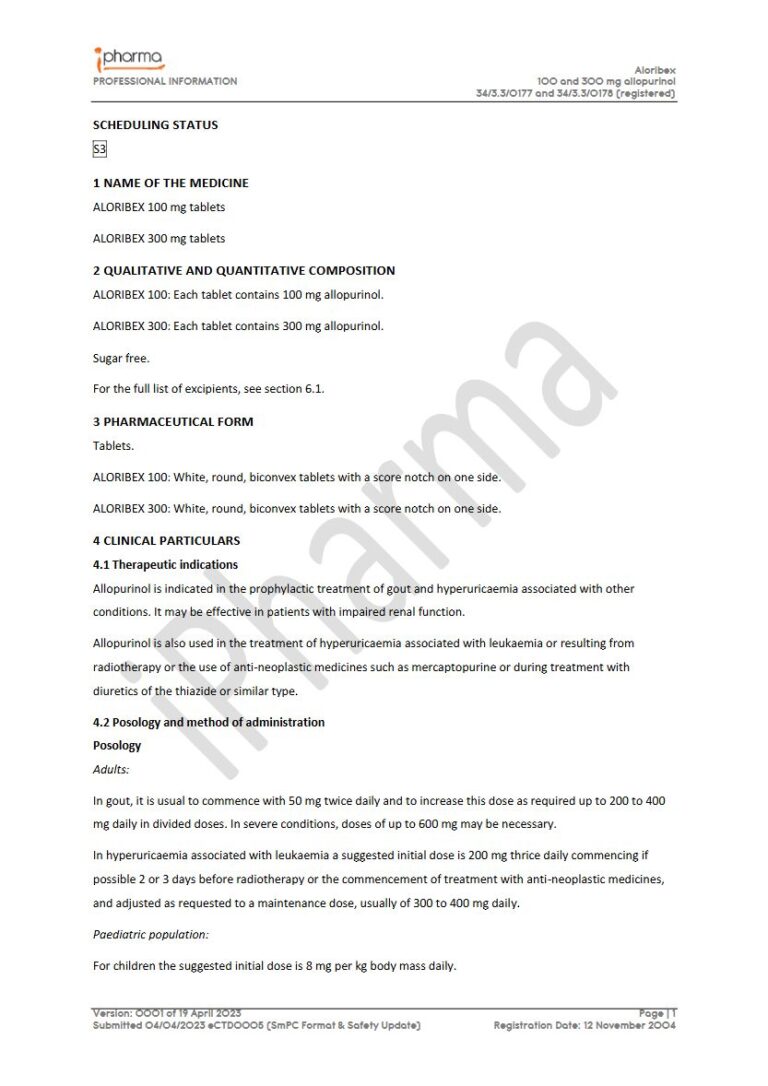
4.1 Therapeutic indications
Allopurinol is indicated in the prophylactic treatment of gout and hyperuricaemia associated with other conditions. It may be effective in patients with impaired renal function.
Allopurinol is also used in the treatment of hyperuricaemia associated with leukaemia or resulting from radiotherapy or the use of anti-neoplastic medicines such as mercaptopurine or during treatment with diuretics of the thiazide or similar type.
4.2 Posology and method of administration
Posology
Adults: In gout, it is usual to commence with 50 mg twice daily and to increase this dose as required up to 200 to 400 mg daily in divided doses. In severe conditions, doses of up to 600 mg may be necessary.
In hyperuricaemia associated with leukaemia a suggested initial dose is 200 mg thrice daily commencing if possible 2 or 3 days before radiotherapy or the commencement of treatment with anti-neoplastic medicines, and adjusted as requested to a maintenance dose, usually of 300 to 400 mg daily.
Paediatric population: For children the suggested initial dose is 8 mg per kg body mass daily.
Fluid intake should be sufficient to maintain daily urinary volume above 2 litres. Dosage must be reduced in patients with renal impairment in proportion to the reduction in glomerular filtration.
Method of administration
For oral administration.
4.3 Contraindications
- Hypersensitivity to allopurinol or to any of the excipients listed in section 6.1.
- Severe hepatic or renal disorder.
- An acute gout attack.
- Patients who have exhibited serious adverse effects from the medicine and in children, except those with malignancy.
- Pregnancy and lactation (see section 4.6).
4.4 Special warnings and precautions for use
Hypersensitivity syndrome, Stevens-Johnson syndrome (SJS) and toxic epidermal necrolysis (TEN)
Allopurinol hypersensitivity reactions can manifest in many different ways, including maculopapular exanthema, hypersensitivity syndrome (also known as DRESS) and SJS/TEN. These reactions are clinical diagnoses, and their clinical presentations remain the basis for decision making. If such reactions occur at any time during treatment, allopurinol should be withdrawn immediately. Rechallenge should not be undertaken in patients with hypersensitivity syndrome and SJS/TEN. Corticosteroids may be beneficial in overcoming hypersensitivity skin reactions.
HLA-B*5801 allele
The HLA-B*5801 allele has been shown to be associated with the risk of developing allopurinol related hypersensitivity syndrome and SJS/TEN. The frequency of the HLA-B*5801 allele varies widely between ethnic populations: up to 20 % in Han Chinese population, 8 u2013 15 % in the Thai, about 12 % in the Korean population and 1 u2013 2 % in individuals of Japanese or European origin. Screening for HLA-B*5801 should be considered before starting treatment with ALORIBEX in patient subgroups where the prevalence of this allele is known to be high. Chronic kidney disease may increase the risk in these patients additionally. In case that no HLA- B*5801 genotyping is available for patients with Han Chinese, Thai or Korean descent the benefits should be thoroughly assessed and considered outweigh the possible higher risks before starting therapy. The use of genotyping has not been established in other patient populations. If the patient is a known carrier of HLA- B*5801 (especially in those who are from Han Chinese, Thai or Korean descent), ALORIBEX should not be started unless there are no other reasonable therapeutic options and the benefits are thought to exceed risks. Extra vigilance for signs of hypersensitivity syndrome or SJS/TEN is required and the patient should be informed of the need to stop treatment immediately at the first appearance of symptoms.
SJS/TEN can still occur in patients who are found to be negative for HLA-B*5801 irrespective of their ethnic origin.
Treatment of neoplasia: Before instituting cytotoxic therapy it is advisable to assess existing serum urate and urinary acid levels. When hyperuricaemia and/or hyperuricosuria are present, they should be corrected prior to starting treatment. Adequate hydration to maintain maximum diuresis throughout is important.
Chronic renal impairment
Patients with chronic renal impairment and concomitant diuretic use, in particular thiazides, may be at increased risk of developing hypersensitivity reactions including SJS/TEN associated with allopurinol. Extra vigilance for the signs of hypersensitivity syndrome or SJS/TEN is required and the patient should be informed of the need to stop treatment immediately and permanently at the first appearance of symptoms (see section 4.8).
Hepatic or renal impairment
Reduced doses should be used in patients with hepatic or renal impairment (see section 4.2). Patients under treatment for hypertension or cardiac insufficiency, for example with diuretics or ACE inhibitors, may have some concomitant impairment of renal function and ALORIBEX should be used with care in this group.
Asymptomatic hyperuricaemia
Asymptomatic hyperuricaemia is generally not considered an indication for use of ALORIBEX. Fluid and dietary modification with management of the underlying cause may correct the condition.
Acute gouty attacks
ALORIBEX should not be started until an acute attack of gout has completely subsided, as further attacks may be precipitated. In the early stages of treatment with allopurinol, as with uricosuric medicines, an acute attack of gouty arthritis may be precipitated. Hence, when starting treatment with allopurinol, it is advisable to give colchicine at prophylactic doses or an anti-inflammatory medicine for at least one month. This effect can be avoided by using a small initial dose (100 mg per day) of allopurinol, gradually increasing the dose at intervals. If acute attacks develop in patients receiving ALORIBEX, treatment should continue at the same dosage while the acute attack is treated with a suitable anti-inflammatory medicine.
Xanthine deposition
In conditions where the rate of urate formation is greatly increased (e.g. malignant disease and its treatment, Lesch-Nyhan syndrome) the absolute concentration of xanthine in urine could, in rare cases, rise sufficiently to allow deposition in the urinary tract. This risk may be minimised by adequate hydration to achieve optimal urine dilution.
Impaction of uric acid renal stones
Adequate therapy with ALORIBEX will lead to dissolution of large uric acid renal pelvic stones, with the remote possibility of impaction in the ureter.
Thyroid disorders
Increased TSH values (>5,5 u03bcIU/mL) were observed in patients on long-term treatment with allopurinol (5,8 %) in a long term open label extension study. Caution is required when ALORIBEX is used in patients with alteration of thyroid function.
4.5 Interaction with other medicines and other forms of interaction
Medicines that can increase uric acid concentrations may decrease the efficacy of allopurinol, as in ALORIBEX. There have also been reports of allopurinol enhancing the activity of, and possibly increasing the toxicity of, a number of other medicines, including some antibacterials, some anticoagulants, some antineoplastics, captopril, ciclosporin, theophylline, and vidarabine.
6-mercaptopurine and azathioprine
Azathioprine is metabolised to 6-mercaptopurine which is inactivated by the action of xanthine oxidase. The metabolism of azathioprine and mercaptopurine is inhibited by allopurinol and their doses should be reduced to one quarter of the usual dose when either of them is given with ALORIBEX to avoid potentially life-threatening toxicity.
Vidarabine (adenine arabinoside)
Evidence suggests that the plasma half-life of vidarabine is increased in the presence of allopurinol. When the two products are used concomitantly extra vigilance is necessary, to recognise enhanced toxic effects.
Salicylates and uricosuric medicines
Oxipurinol, the major metabolite of allopurinol, and itself therapeutically active, is excreted by the kidney in a similar way to urate. Hence, medicines with uricosuric activity such as probenecid or large doses of salicylate may accelerate the excretion of oxipurinol. This may decrease the therapeutic activity of ALORIBEX, but the significance needs to be assessed in each case.
Chlorpropamide
If ALORIBEX is given concomitantly with chlorpropamide when renal function is poor, there may be an increased risk of prolonged hypoglycaemic activity, because allopurinol and chlorpropamide may compete for excretion in the renal tubule.
Coumarin anticoagulants
There have been reports of increased effect of warfarin and other coumarin anticoagulants when co-administered with allopurinol, as in ALORIBEX. Therefore, all patients receiving anticoagulants must be carefully monitored.
Phenytoin
Allopurinol may inhibit hepatic oxidation of phenytoin, but the clinical significance has not been demonstrated.
Theophylline
Inhibition of the metabolism of theophylline has been reported. The mechanism of the interaction may be explained by xanthine oxidase being involved in the biotransformation of theophylline in man. Allopurinol 300 mg by mouth daily for 7 days was found to have no effect on the pharmacokinetics of theophylline following a single intravenous dose of aminophylline or following theophylline given by mouth to steady state. However, allopurinol 600 mg by mouth daily for 28 days has been found to inhibit the metabolism of theophylline, increasing the mean half-life by 25 % after 14 days and 29 % after 28 days and there has been a report of allopurinol increasing peak plasma-theophylline concentrations by 38 % in one patient within 2 days of concomitant administration. Theophylline levels should be monitored in patients starting or increasing ALORIBEX therapy.
Ampicillin / amoxicillin
An increase in frequency of skin rash has been reported among patients receiving ampicillin or amoxicillin concurrently with allopurinol, compared to patients who are not receiving both medicines. The cause of the reported association has not been established. However, it is recommended that in patients receiving ALORIBEX, an alternative to ampicillin or amoxicillin is used where available.
Cytostatics
With administration of allopurinol and cytostatics (e.g. cyclophosphamide, doxorubicin, bleomycin, procarbazine, alkyl halogenides), blood dyscrasias occur more frequently than when these active substances are administered alone. Blood count monitoring should therefore be performed at regular intervals.
Ciclosporin
Reports suggest that the plasma concentration of ciclosporin may be increased during concomitant treatment with allopurinol. The possibility of enhanced ciclosporin toxicity should be considered if the medicines are co-administered.
Didanosine
In healthy volunteers and HIV patients receiving didanosine, plasma didanosine C max and AUC values were approximately doubled with concomitant allopurinol treatment (300 mg daily) without affecting terminal half-life. Co-administration of these 2 medicines is generally not recommended. If concomitant use is unavoidable, a dose reduction of didanosine may be required, and patients should be closely monitored.
Diuretics
An interaction between allopurinol and furosemide that results in increased serum urate and plasma oxypurinol concentrations has been reported. An increase in hypersensitivity reactions, and possibly also other adverse effects, have been reported in patients receiving allopurinol with thiazide diuretics, particularly in patients with impaired renal function.
ACE inhibitors
An increased risk of hypersensitivity has been reported when allopurinol is given with ACE inhibitors especially in renal impairment. An apparent interaction between allopurinol and captopril has been reported in patients with chronic renal failure (CRF). In one patient fatal Stevens- Johnson syndrome developed and it was suggested that the reaction was secondary to the introduction of allopurinol potentiated by the presence of captopril. In the second patient hypersensitivity, characterised by fever, arthralgia, and myalgia, occurred and in this case the cause was believed to be captopril, or one of its metabolites, potentiated by the addition of allopurinol. The combination of ALORIBEX and captopril should be prescribed with care, especially in patients with CRF.
Antacids
Allopurinol failed to reduce blood-uric-acid concentrations when administered at the same time as aluminium hydroxide in 3 patients on chronic haemodialysis. However, if allopurinol was given 3 hours before aluminium hydroxide the expected decrease in uric acid concentration did occur. If aluminium hydroxide is taken concomitantly, allopurinol may have an attenuated effect. There should be an interval of at least 3 hours between taking both medicines.
4.6 Fertility, pregnancy and lactation
ALORIBEX is contraindicated during pregnancy and lactation (see section 4.3).
Pregnancy
Contraindicated in pregnancy (see section 4.3).
Breastfeeding
ALORIBEX should not be given to nursing mothers since it is excreted in breast milk (see section 4.3).
Fertility
No data available.
4.7 Effects on ability to drive and use machines
ALORIBEX can cause side effects, such as somnolence, vertigo and ataxia, and can affect the ability to drive a vehicle and use machines. Patients should exercise caution before driving a vehicle, using machinery or participating in dangerous activities until they are reasonably certain that ALORIBEX does not adversely affect their performance.
4.8 Undesirable effects
The incidence of adverse effects is higher in the presence of renal and/or hepatic disorder and a dosage reduction should be considered in these cases.
Infections and infestations:
- Less frequent: furunculosis
Blood and the lymphatic system disorders:
- Less frequent: leucopenia, leucocytosis, eosinophilia, haemolytic anaemia, agranulocytosis, aplastic anaemia, thrombocytopenia
Very rare reports have been received of thrombocytopenia, agranulocytosis and aplastic anaemia, particularly in individuals with impaired renal and/or hepatic function, reinforcing the need for particular care in this group of patients.
Immune system disorders:
- Less frequent: hypersensitivity reactions (including skin reactions associated with exfoliation, fever, lymphadenopathy, arthralgia, eosinophilia, Stevens-Johnson syndrome and toxic epidermal necrolysis), vasculitis, angioimmunoblastic lymphadenopathy, anaphylactic reaction, angioimmunoblastic T-cell lymphoma
Angioimmunoblastic T-cell lymphoma has been described very rarely following biopsy of a generalised lymphadenopathy. It appears to be reversible on withdrawal of ALORIBEX.
Metabolism and nutrition disorders:
- Less frequent: diabetes mellitus, hyperlipidaemia
Psychiatric disorders:
- Less frequent: drowsiness, depression
Nervous system disorders:
- Less frequent: coma, paralysis, ataxia, peripheral neuropathy, paraesthesia, somnolence, headache, seizures, taste perversion
Frequency unknown: aseptic meningitis
Eye disorders:
- Less frequent: cataract, visual disturbances, macular changes
Ear and labyrinth disorders:
- Less frequent: vertigo
Cardiac disorders:
- Less frequent: angina, bradycardia
Vascular disorders:
- Less frequent: hypertension
Gastrointestinal disorders:
- Less frequent: vomiting, nausea, abdominal pain, diarrhoea, haematemesis, steatorrhoea, stomatitis, changed bowel habit. Nausea and vomiting can be avoided by taking ALORIBEX after meals.
Hepato-biliary disorders:
- Less frequent: abnormal liver function test, hepatitis (including hepatic necrosis and granulomatous hepatitis), hepatoxicity, hepatic damage
Skin and subcutaneous tissue disorders:
- Frequent: rash
- Less frequent: Stevens-Johnson syndrome, toxic epidermal necrolysis, skin eruptions, exfoliative rash, alopecia, angioedema, discoloured hair
Skin reactions are the most common and may occur anytime during treatment. They may be pruritic, maculopapular, sometimes scaly, sometimes purpuric and less frequently exfoliative. As severe skin reactions may occur, ALORIBEX should be withdrawn IMMEDIATELY should such reactions occur. A cautious reintroduction at a low dose may be attempted when mild skin reactions have cleared; ALORIBEX should not be reintroduced in those patients who have experienced other forms of hypersensitivity reaction.
Musculoskeletal, connective tissue and bone disorders:
- Less frequent: arthralgia
Renal and urinary disorders:
- Less frequent: renal damage, haematuria, uraemia, azotaemia
Reproductive system and breast disorders:
- Less frequent: male infertility, erectile dysfunction, gynaecomastia
Frequency unknown: nocturnal emission
General disorders and administration site conditions:
- Less frequent: oedema, malaise, asthenia, fever, chills
Investigations:
- Frequent: blood thyroid stimulating hormone increase
The occurrence of increased thyroid stimulating hormone (TSH) in the relevant studies did not report any impact on free T4 levels or had TSH levels indicative of subclinical hypothyroidism.
Reporting of suspected adverse reactions
Reporting suspected adverse reactions after authorisation of ALORIBEX is important. It allows continued monitoring of the benefit/risk balance of ALORIBEX. Health care providers are asked to report any suspected adverse reactions to SAHPRA via the u201c6.04 Adverse Drug Reaction Reporting Formu201d, found online under SAHPRAu2019s publications: https://www.sahpra.org.za/Publications/Index/8.
4.9 Overdose
Symptoms
The most likely reaction would be gastrointestinal intolerance. Ingestion of up to 22,5 g allopurinol, as contained in ALORIBEX, without adverse effect has been reported. Symptoms and signs including nausea, vomiting, diarrhoea and dizziness have been reported in a patient who ingested 20 g allopurinol.
Treatment
Treatment is symptomatic and supportive. Recovery followed general supportive measures. Massive absorption of ALORIBEX may lead to considerable inhibition of xanthine oxidase activity, which should have no untoward effects unless affecting concomitant medication, especially with 6-mercaptopurine and/or azathioprine. Adequate hydration to maintain maximum diuresis facilitates excretion of allopurinol and its metabolites. Haemodialysis may be resorted to if considered necessary.
