
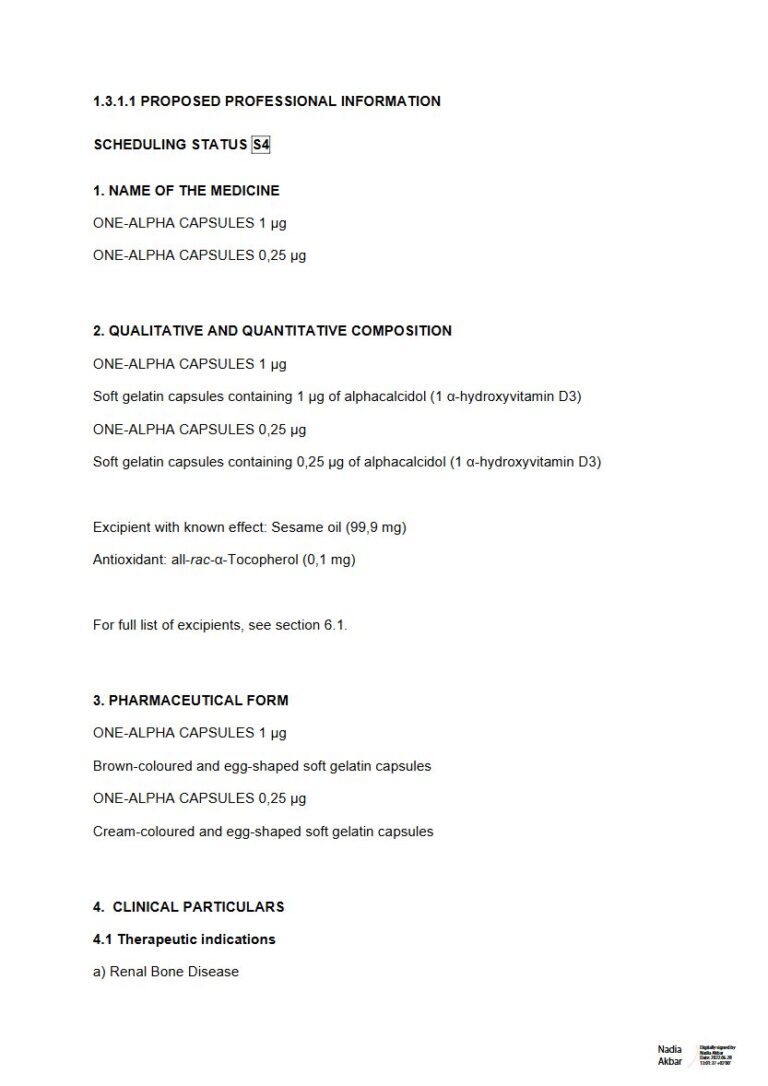
One-Alpha Capsules 1 µg, 0,25 µg CAPSULES
PDF Leaflet Revision Date: 13 June 2022
Clinical Summary
Quick overview from the medicine insert
Indication
Treatment of renal bone disease, hypoparathyroidism, and related conditions.
Dosage (summary)
Adults: 1 u03bcg daily; adjust based on response. Children: 0.05 u03bcg/kg daily.
Onset of Action / Duration
Onset: 3 days, Duration: Varies.
Special Populations
- Renal impairment
- Children
- Pregnant women
Pregnancy & Breastfeeding
Not recommended in pregnancy; excreted in breast milk.
Key Drug Interactions
- Thiazide diuretics
- Other vitamin D preparations
- Anticonvulsants
Contraindications
- Hypersensitivity
- Hypercalcaemia
- Vitamin D intoxication
- First trimester of pregnancy
Common side effects
- Hypercalcaemia
- Rash
- Gastrointestinal discomfort
- Hyperphosphataemia
Counselling Points
- Monitor for signs of hypercalcaemia
- Avoid concurrent vitamin D
- Take with caution if using thiazides
Serious warnings
- Risk of hypercalcaemia
- Monitor calcium levels
- Caution in renal impairment
Important Disclaimer
The One-Alpha Capsules 1 µg, 0,25 µg CAPSULES professional information leaflet below is the property of Adcock Ingram Critical Care and is provided on Medinsert exactly as issued, with no.. alterations or editorial changes. We make every effort to keep content current by updating documents as soon as new versions become available. Medinsert serves as a trusted access point for healthcare professionals, but does not replace official sources or clinical judgement. For more details, please read our full disclaimer. read more>>
 Healthcare Professionals Only
This content is for registered healthcare professionals
Sign in or create a free account to read the full package insert.
Free for HPCSA-registered professionals. Powered by Medinsert.
Clinical Particulars
Section 4 of the official insert — extracted exactly as issued, no alterations
4.1 Therapeutic indications
a) Renal Bone Disease
b) Hypoparathyroidism
c) Hyperparathyroidism
d) Hypophosphataemic Vitamin D resistant rickets and osteomalacia
e) Pseudo-deficiency (D-dependent) rickets
f) Nutritional and malabsorptive rickets and osteomalacia
4.2 Posology and method of administration
Posology
Initial dose for all indications: Adults and children over 20 kg bodyweight: 1 u03bcg daily
Neonates and premature infants: 0,05 to 0,1 u03bcg /kg/day
Children under 20 kg: 0,05 u03bcg/kg daily
The dose of ONE-ALPHA should be adjusted thereafter to avoid hypercalcaemia according to the biochemical response. Indices of response include plasma levels of calcium (ideally corrected for protein binding), alkaline phosphatase, parathyroid hormone, as well as radiographic and histological investigations. Plasma levels should initially be measured at weekly intervals. The daily dose of ONE-ALPHA may be increased by increments of 0,25 u2013 0,5 u03bcg. When the dose is stabilised, measurements may be taken every 2 to 4 weeks. Most adult patients respond to doses between 1 and 3 u03bcg per day. When there is biochemical or radiographic evidence of bone healing, (and in hypoparathyroid patients when normal plasma calcium levels have been attained), the dose generally decreases. Maintenance doses are generally in the range of 0,25 to 1 u03bcg per day. If hypercalcaemia occurs, ONE-ALPHA should be stopped until plasma calcium returns to normal (approximately 1 week) then restarted at half the previous dose.
Hypoparathyroidism: Low plasma calcium levels are restored to normal relatively quickly with ONE-ALPHA. Severe hypocalcaemia (e.g. after extensive neck surgery) may decline with higher doses of ONE-ALPHA (e.g. 3 to 5 u03bcg) and calcium supplements. Normocalcaemia may be maintained with smaller doses within a relatively narrow dose range.
Hyperparathyroidism: In patients with primary or tertiary hyperparathyroidism about to undergo parathyroidectomy, pre-operative treatment with ONE-ALPHA for 2 to 3 weeks alleviates bone pain and myopathy without aggravating pre-operative hypercalcaemia. In order to decrease post-operative hypocalcaemia, ONE-ALPHA should be continued until plasma alkaline phosphatase levels fall to normal or hypercalcaemia occurs.
Hypophosphataemic vitamin D-resistant rickets and osteomalacia: Neither large doses of parent vitamin D nor phosphate supplements are entirely satisfactory, the latter tending to produce hypocalcaemia and hypoparathyroidism. ONE-ALPHA at normal dosage rapidly relieves myopathy when present and increases calcium and phosphorus retention and promotes bone healing. Phosphate supplements may also be required in some patients.
Pseudo-deficiency (D-dependent) rickets: This requires large doses of vitamin D probably because of an inherited defect in the production of 1,25-(OH)2 D3. ONE-ALPHA reverses this condition.
Nutritional and malabsorptive rickets and osteomalacia: Nutritional rickets and osteomalacia can be cured with physiological doses of ONE-ALPHA. Patients with malabsorptive osteomalacia (responding to large doses of IM or IV vitamin D) will respond to small doses of ONE-ALPHA.
Neonatal hypocalcaemia: For neonatal hypocalcaemia the normal starting dose of ONE-ALPHA is 0,05 to 0,1 u03bcg/kg/day. Adjustment of the dose thereafter is by careful titration (but in severe cases doses of up to 2 u03bcg/kg/day may be required). Whilst ionised serum calcium levels may provide a guide to response, measurement of plasma alkaline phosphatase activity may be more useful. Levels of plasma alkaline phosphatase may be markedly raised in the pre-term low birthweight infant. Whilst levels of 5 times the normal adult laboratory value may be usual in this group, alkaline phosphatase levels above 7,5 times the adult range indicate active disease. A dose of ONE-ALPHA of 0,1 u03bcg/kg/day has proved effective as prophylaxis against early neonatal hypocalcaemia in premature neonates.
Method of administration
Oral
4.3 Contraindications
Hypersensitivity to the active substance(s) or to any of the excipients listed in section 6.1
Hypercalcaemia.
Evidence of vitamin D intoxication.
First trimester of pregnancy
4.4 Special warnings and precautions for use
ONE-ALPHA should be given with care to patients with impaired renal function. If hypercalcaemia is induced by ONE-ALPHA it can be corrected by stopping treatment until plasma calcium levels return to normal. During treatment with ONE-ALPHA, serum calcium and serum phosphate levels should be monitored regularly especially in children, and in patients with renal impairment and patients receiving high doses. PTH, alkaline phosphatase and calcium phosphates should be monitored as clinically indicated. Facilities for monitoring plasma calcium and other appropriate biochemical parameters should be available when ONE-ALPHA is used. Hypercalcaemia might appear in patients with normal renal function treated with ONE-ALPHA. For this reason, patients should be informed about the clinical symptoms connected with hypercalcaemia. Signs of hypercalcaemia are muscle and bone pain, muscle weakness, confusion, dehydration, anorexia, fatigue, nausea and vomiting, constipation or diarrhoea, polyuria, sweating, headache, polydipsia, hypertension, somnolence and vertigo. In patients with normal renal function, hypercalcaemia can be rapidly corrected by stopping treatment until plasma calcium levels return to normal in about a week. ONE-ALPHA may then be restarted at half the previous dose with close monitoring of calcium. Prolonged hypercalcaemia may aggravate arteriosclerosis, cardiac valve sclerosis or nephrolithiasis and therefore prolonged hypercalcaemia should be avoided when ONE-ALPHA is used in these patients. Transient or even long-lasting deterioration of kidney function has been observed. ONE-ALPHA should also be used with caution in patients with calcification of pulmonary tissue as this may result in cardiac disease. The risk of hypercalcaemia depends on such factors as the degree of any mineralisation defect, renal function and the dose of ONE-ALPHA that is used. Thus, hypercalcaemia is less likely in osteomalacia and more likely in renal failure. Hypercalcaemia will occur when there is biochemical evidence of bone healing (e.g. a return towards normal in the level of plasma alkaline phosphatase) and the dose of ONE-ALPHA is not reduced appropriately. Prolonged hypercalcaemia should be avoided, particularly in chronic renal failure. Plasma calcium levels should be measured at weekly to monthly intervals depending on the progress of the patient. Frequent estimations are necessary in the early stages of treatment and later when there is evidence of bone healing. Plasma calcium levels should also be estimated regularly during the initial treatment of disorders without significant bone involvement, e.g. hypoparathyroidism. In patients with renal bone disease or severely reduced renal function, a phosphate binding agent could be used simultaneously with alphacalcidol to prevent increased serum phosphate and potential metastatic calcification. ONE-ALPHA should be used with caution in patients with granulomatous diseases such as sarcoidosis where the sensitivity to vitamin D is increased due to increased hydroxylation activity. Concurrent use of digitalis glycosides in the presence of hypercalcaemia due to vitamin D administration increases the potential for cardiac arrhythmias. ONE-ALPHA capsules contain sesame oil as an excipient. Sesame oil may rarely cause severe allergic reactions.
4.5 Interactions with other medicines and other forms of interaction
Thiazide diuretics and calcium containing preparations
Concurrent use of thiazide diuretics or calcium containing preparations may enhance the risk of hypercalcaemia. Calcium levels should be monitored.
Other vitamin D containing preparations
Concurrent use of other vitamin D containing preparations may enhance the risk of hypercalcaemia. Use of multiple vitamin D analogues should be avoided.
Anticonvulsants
Anticonvulsants (e.g. barbiturates, phenytoin, carbamazepine or primidone) have enzyme-inducing effects resulting in an increased metabolism of alphacalcidol. Patients taking anticonvulsants may require larger doses of ONE-ALPHA.
Magnesium-containing antacids
Absorption of magnesium-containing antacids may be enhanced by ONE-ALPHA, increasing the risk of hypermagnesaemia.
Aluminium containing preparations
ONE-ALPHA may increase the serum concentration of aluminium. Patients taking aluminium-containing preparations (e.g. aluminium hydroxide, sucralfate) should be monitored for signs of aluminium related toxicities.
Bile acid sequestrants
Concomitant oral administration of bile acid sequestrants such as cholestyramine may impair the intestinal absorption of oral ONE-ALPHA formulations. ONE-ALPHA should be administered at least 1 hour before, or 4 to 6 hours after the intake of the bile acid sequestrant in order to minimize the potential risk of interaction.
4.6 Fertility, pregnancy and lactation
Pregnancy
There is a limited amount of data from the use of alphacalcidol in pregnant women. Studies in animals have shown reproductive toxicity at high doses. ONE-ALPHA is not recommended during pregnancy and in women of child-bearing potential not using contraception.
Breast-feeding
Alphacalcidol is excreted in human milk. Mothers taking ONE-ALPHA should not breastfeed their infants. Consequently, breast-fed infants of alfacalcidol-using mothers should be monitored closely for hypercalcaemia.
Fertility
There are no clinical studies on the effect of ONE-ALPHA on fertility.
4.7 Effects on ability to drive and use machines
ONE-ALPHA has no or negligible direct influence on the ability to drive and use machines. However, the patient should be informed that dizziness may occur during treatment and take this into account while driving or using machines.
4.8 Undesirable effects
a. Summary of the safety profile
The estimation of the frequency of undesirable effects is based on a pooled analysis of data from clinical studies and spontaneous reporting. The most frequently reported undesirable effects are various skin reactions such as pruritus and rash, hypercalcaemia, gastrointestinal pain/discomfort and hyperphosphataemia. Renal failure has been reported post-marketing.
b. Tabulated summary of adverse reactions
Undesirable effects are listed by MedDRA system organ class (SOC) and the individual undesirable effects are listed starting with the most frequently reported. Within each frequency grouping, adverse reactions are presented in the order of decreasing seriousness.
Very common u22651/10
Common u22651/100 and < 1/10
Uncommon u22651/1,000 and <1/100
Rare u22651/10,000 and <1/1,000
Very rare <1/10,000
System organ class Frequency Adverse Event
Metabolism and nutrition disorders Common Hypercalcaemia Hyperphosphataemia
Psychiatric disorders Uncommon Confusional state
Nervous system disorders Uncommon Headache Rare Dizziness
Gastrointestinal disorders Common Abdominal pain and discomfort Uncommon Diarrhoea Vomiting Constipation Nausea
Skin and subcutaneous tissue disorders Common Rash* Pruritus
*Various types of rash such as erythematous, maculopapular and pustular have been reported
Musculoskeletal and connective tissue disorders Uncommon Myalgia
Renal and urinary disorders Common Hypercalciuria Uncommon Renal impairment (including acute renal failure) Nephrolithiasis/ Nephrocalcinosis
General disorders and administration site conditions Uncommon Fatigue/ asthenia/ malaise
Paediatric population
The observed safety profile is similar in children and adults.
Reporting of suspected adverse reactions
Reporting suspected adverse reactions after authorisation of the medicine is important. It allows continued monitoring of the benefit/risk balance of the medicine. Health care providers are asked to report any suspected adverse reactions to SAHPRA via the u201c6.04 Adverse Drug Reaction Reporting Formu201d, found online under SAHPRAu2019s publications: https://www.sahpra.org.za/Publications/Index/8
For reporting of side effects directly to the HCR, contact +27 11 635 0134 or email [email protected].
4.9 Overdose
Excessive intake of ONE-ALPHA may lead to the development of hypercalcaemia; however, the effect is reversed rapidly on withdrawal. In severe cases of hypercalcaemia general supportive measures should be undertaken: Keep the patient well hydrated by IV infusion of saline (force diuresis), measure electrolytes, calcium, and renal functions indices, assess electrocardiographic abnormalities, especially on patient on digitalis. More specifically, treatment with glucocorticosteroids, loop diuretics, bisphosphonates, calcitonin and eventually haemodialysis with low calcium contents should be considered.
