
Glamin 500 mL Solution for infusion.
PDF Leaflet Revision Date: 11 November 2025
Clinical Summary
Quick overview from the medicine insert
Indication
Amino acid solution for parenteral nutrition when oral or enteral nutrition is impossible.
Dosage (summary)
1-1.4 g amino acids/kg body weight/day; 7-11 mL GLAMIN/kg/day.
Special Populations
- Hepatic impairment
- Severe renal impairment
Pregnancy & Breastfeeding
Safety in pregnancy and lactation not established.
Key Drug Interactions
- Not to be used as carrier solutions for medicines
- Compatibility with other solutions must be documented
Contraindications
- Hypersensitivity
- Inborn errors of amino acid metabolism
- Severe liver impairment
- Severe renal impairment
- Life-threatening circulatory conditions
- Metabolic acidosis
Common side effects
- Nausea
- Vomiting
- Flushing
- Sweating
Counselling Points
- Administer via central venous route
- Single use only
- Monitor for signs of intolerance
Serious warnings
- Hypertonic solution may cause thrombophlebitis
- Monitor serum electrolytes and liver function
Important Disclaimer
The Glamin 500 mL Solution for infusion. professional information leaflet below is the property of Fresenius Kabi South Africa and is provided on Medinsert exactly as issued, with no.. alterations or editorial changes. We make every effort to keep content current by updating documents as soon as new versions become available. Medinsert serves as a trusted access point for healthcare professionals, but does not replace official sources or clinical judgement. For more details, please read our full disclaimer. read more>>
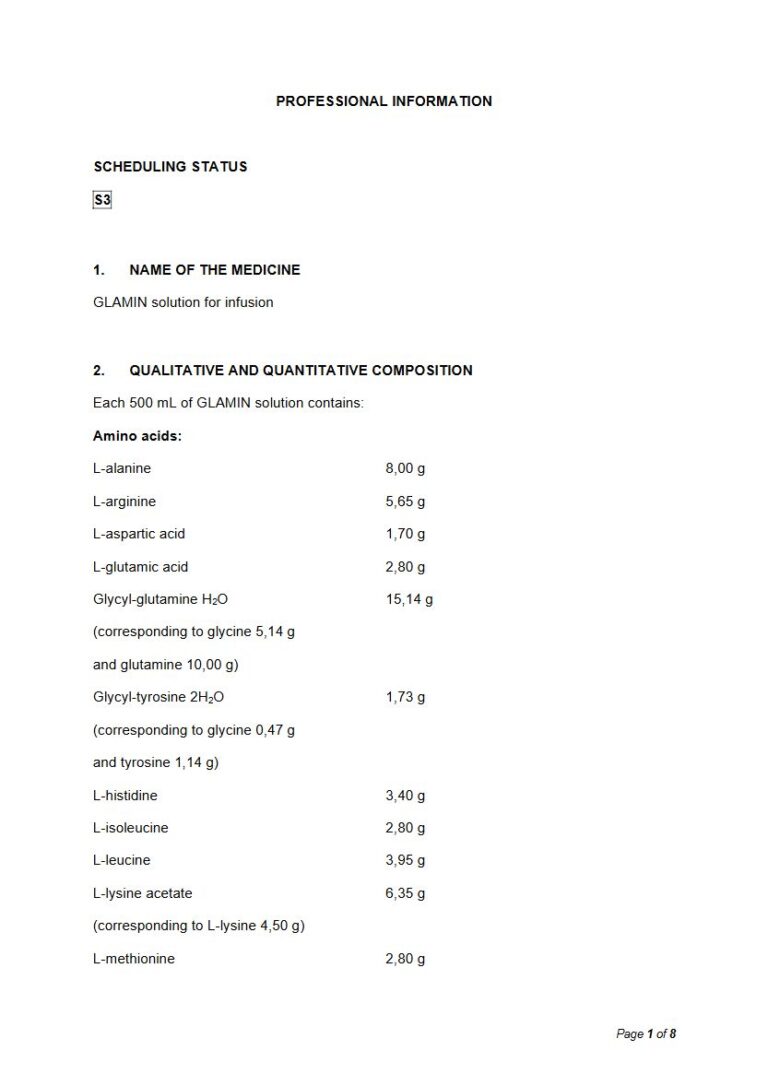 Healthcare Professionals Only
This content is for registered healthcare professionals
Sign in or create a free account to read the full package insert.
Free for HPCSA-registered professionals. Powered by Medinsert.
Clinical Particulars
Section 4 of the official insert — extracted exactly as issued, no alterations
4.1 Therapeutic indications
GLAMIN provides amino acids as part of parenteral nutrition therapy when oral or enteral nutrition is impossible, insufficient or contraindicated. In parenteral nutrition regimens, amino acid solutions should always be administered in combination with appropriate energy-supplying infusion solutions.
4.2 Posology and method of administration
Posology
In order to ensure optimal utilisation of the infused amino acids and dipeptides, the patientu2019s requirements of energy (carbohydrates, fat), electrolytes, trace elements and vitamins should be covered.
Recommended dosage for adults
The dosage depends on the amino acid requirements. Generally, 1 u2013 1,4 g amino acids/dipeptides (corresponding to 0,17 u2013 0,23 g nitrogen) per kg body weight per day is recommended. This corresponds to 7 u2013 11 mL GLAMIN/kg body weight/day or to 500 u2013 750 mL GLAMIN/day for a patient weighing 70 kg. Recommended infusion rate: 0,45 u2013 0,50 mL (corresponding to 0,06 u20130,07 g amino acids/dipeptides)/kg body weight/hour. This corresponds to 375 mL in 10 u2013 12 hours or 750 mL in 20 u2013 24 hours for patients weighing 70 kg.
Paediatric population
GLAMIN is not indicated for use in children.
Method of administration
Intravenous infusion. GLAMIN should be administered by the central venous route due to its high osmolarity (above 800 mOsm/L). For single use only. Most of the clinical experience so far is limited to 7 days of GLAMIN administration. No experience is available to date regarding administration for more than 2 weeks.
4.3 Contraindications
- Hypersensitivity to any of the active substances or to any of the excipients listed in section 6.1.
- Patients with inborn errors of amino acid metabolism, impairment of liver function and severe impairment of renal function.
- General contraindications to parenteral nutrition are:
- unstable life-threatening circulatory conditions (shock),
- metabolic acidosis,
- insufficient cellular oxygen supply,
- over-hydration,
- electrolyte disturbances,
- hyperlactataemia,
- increased serum osmolarity,
- pulmonary oedema,
- decompensated cardiac failure.
The safety in pregnancy and lactation has not been established (see section 4.6). GLAMIN is not indicated for use in children (see section 4.2).
4.4 Special warnings and precautions for use
The solution is hypertonic and thrombophlebitis may occur when the solution is infused into peripheral veins.
Monitoring advice: Serum electrolytes, serum osmolarity, water balance, acid-base status as well as liver function tests (alkaline phosphatase, ALT, AST) should be monitored.
Paediatric population
GLAMIN is not indicated for use in children (see sections 4.2 and 4.3).
4.5 Interaction with other medicines and other forms of interaction
Amino acid solutions should not be used as carrier solutions for medicines. GLAMIN may only be mixed with other solutions where compatibility is documented (see section 6.6).
4.6 Fertility, pregnancy and lactation
Pregnancy and breastfeeding
The safety in pregnancy and lactation has not been established.
Fertility
No data available.
4.7 Effects on ability to drive and use machines
Not relevant.
4.8 Undesirable effects
General disorders: The following side effects have been reported and the frequencies are unknown: When infusion rates exceed the recommended maximum rate, signs of intolerance may occur: nausea, vomiting, flushing and sweating in combination with renal excretion of amino acids and dipeptides.
Reporting of suspected adverse reactions
Reporting suspected adverse reactions after authorisation of the medicine is important. It allows continued monitoring of the benefit/risk balance of the medicine. Healthcare providers are requested to report any suspected adverse drug reactions to SAHPRA via the Med Safety APP (Medsafety X SAHPRA) and eReporting platform (who-umc.org) found on the SAHPRA website.
Healthcare providers are asked to report any suspected adverse drug reactions to the Holder of the Certificate of Registration at the following email address: [email protected] and to the relevant medicines' regulatory authority in the country where the product is marketed.
4.9 Overdose
See section 4.8 above. If symptoms of overdosage occur, reduce infusion rate, or, if necessary, stop the infusion.
