
Busulfan 6mg Fresenius Injection
PDF Leaflet Revision Date: 28 July 2020
Clinical Summary
Quick overview from the medicine insert
Indication
Conditioning treatment prior to haematopoietic progenitor cell transplantation.
Dosage (summary)
0.8 mg/kg IV infusion every 6 hours for 4 days (16 doses total).
Special Populations
- Hepatic impairment
- Obese patients
Pregnancy & Breastfeeding
Contraindicated in pregnancy; breastfeeding should be discontinued during treatment.
Key Drug Interactions
- Itraconazole
- Metronidazole
- Paracetamol
- Phenytoin
- Benzodiazepines
Contraindications
- Hypersensitivity to busulfan
- Pregnancy
- Hepatic insufficiency
Common side effects
- Neutropenia
- Thrombocytopenia
- Anaemia
- Seizures
- Nausea
Counselling Points
- Premedicate with anticonvulsants
- Monitor blood counts regularly
- Avoid pregnancy during and 6 months after treatment
Serious warnings
- Profound myelosuppression
- Risk of second malignancy
- Potential for hepatotoxicity
Important Disclaimer
The Busulfan 6mg Fresenius Injection professional information leaflet below is the property of Fresenius Kabi South Africa and is provided on Medinsert exactly as issued, with no.. alterations or editorial changes. We make every effort to keep content current by updating documents as soon as new versions become available. Medinsert serves as a trusted access point for healthcare professionals, but does not replace official sources or clinical judgement. For more details, please read our full disclaimer. read more>>
 Healthcare Professionals Only
This content is for registered healthcare professionals
Sign in or create a free account to read the full package insert.
Free for HPCSA-registered professionals. Powered by Medinsert.
Clinical Particulars
Section 4 of the official insert — extracted exactly as issued, no alterations
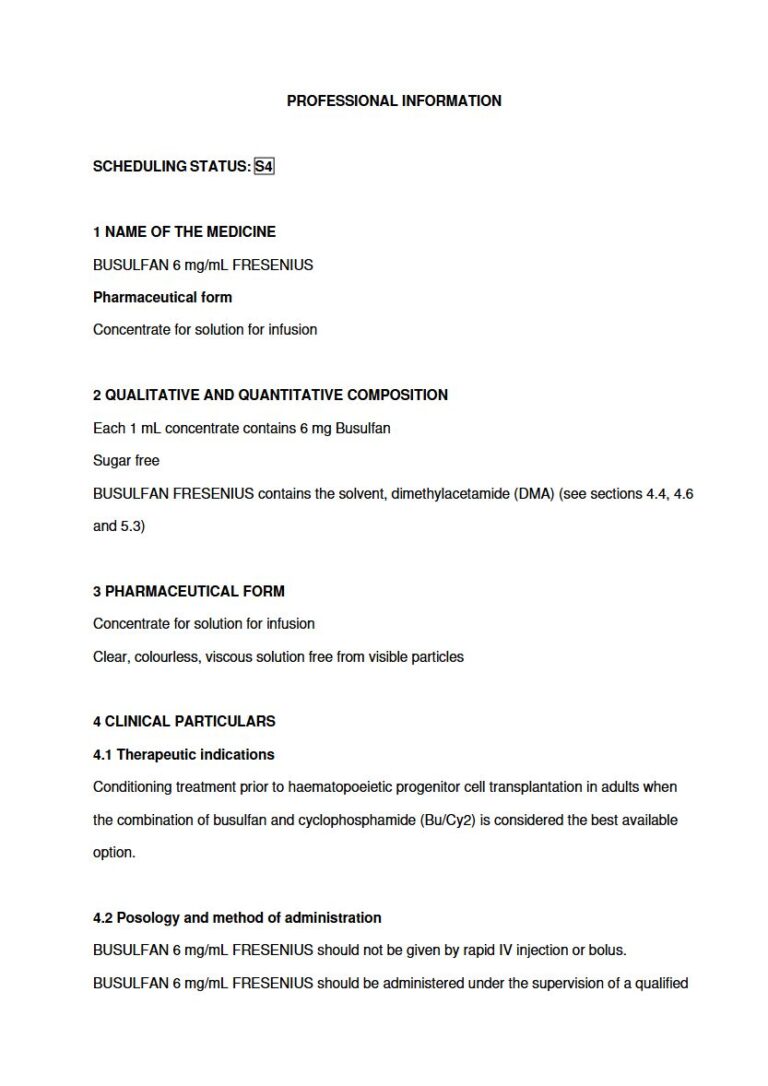
4.1 Therapeutic indications
Conditioning treatment prior to haematopoeietic progenitor cell transplantation in adults when the combination of busulfan and cyclophosphamide (Bu/Cy2) is considered the best available option.
4.2 Posology and method of administration
BUSULFAN 6 mg/mL FRESENIUS should not be given by rapid IV injection or bolus. BUSULFAN 6 mg/mL FRESENIUS should be administered under the supervision of a qualified medical practitioner who is experienced in conditioning treatment prior to haematopoeietic progenitor cell transplantation, in the use of cancer chemotherapeutic medicines and in the management of patients with severe pancytopenia. It is recommended to use actual body weight for dosing. All patients should be premedicated with anticonvulsant medicine to prevent seizures reported with the use of high dose busulfan. Antiemetics should be administered prior to the first dose and continued on a fixed schedule through its administration. The recommended dosage and regimen is 0,8 mg/kg body weight of BUSULFAN FRESENIUS 6 mg/mL as a two-hour infusion every 6 hours over 4 consecutive days, for a total of 16 doses prior to haematopoietic progenitor cell transplantation. Obese patients: For obese or severely obese patients, dosing based on adjusted ideal body weight could be considered. Ideal body weight (IBW) should be calculated as follows (height in cm and weight in kg): IBW (kg; men) = 50 + 0,91 X (height - 152); IBW (kg; women) = 45 + 0,91 X (height-152). Adjusted ideal body weight (AIBW) should be calculated as follows: AIBW = IBW + 0,25 X (actual body weight - IBW) Paediatric population The safety and efficacy of BUSULFAN 6 mg/mL FRESENIUS in children has not been established. Administration: BUSULFAN 6 mg/mL FRESENIUS must be diluted before administration. A final concentration of approximately 0,5 mg/mL busulfan should be achieved (see section 6.6). BUSULFAN 6 mg/mL FRESENIUS should be administered by IV infusion via central venous catheter. For instructions on dilution of the product before administration, (see section 6.6.)
4.3 Contraindication
Hypersensitivity to busulfan or to any of the excipients of BUSULFAN FRESENIUS. Pregnancy and lactation (see section 4.6). Hepatic insufficiency.
4.4 Special warnings and precautions for use
The consequence of treatment with BUSULFAN 6 mg/mL FRESENIUS at the recommended dose and schedule is profound myelosuppression, occurring in all patients. Severe granulocytopenia, thrombocytopenia, anaemia, or any combination thereof may develop. Frequent complete blood counts, including differential white blood cell counts, and platelet counts should be monitored during the treatment and until recovery is achieved. Prophylactic or empiric use of anti-infectives (bacterial, fungal, viral) should be considered for the prevention and management of infections during the neutropenic period. Platelet and red blood cell support, as well as the use of growth factors such as granulocyte colony stimulating medicine (G-CSF), should be employed as medically indicated. In adults, absolute neutrophil counts < 0,5 x 10⁹/l at a median of 4 days post transplant occurred in 100 % of patients and recovered at median day 10 and 13 days following autologous and allogeneic transplant respectively (median neutropenic period of 6 and 9 days respectively). Thrombocytopenia (<25 x109/l or requiring platelet transfusion) occurred at a median of 5-6 days in 98 % of patients. Anaemia (haemoglobin< 8,0 g/dl) occurred in 69 % of patients. Hepatic impairment Busulfan has not been studied in patients with hepatic impairment. Since busulfan is mainly metabolised through the liver, exposure to BUSULFAN 6 mg/mL FRESENIUS is expected to increase if liver function is impaired, and the use of BUSULFAN 6 mg/mL FRESENIUS in hepatic impaired populations is contraindicated (see section 4.3). Caution should be observed when BUSULFAN 6 mg/mL FRESENIUS is used in patients with pre-existing impairment of liver function, especially in those with severe hepatic impairment. It is recommended when treating patients with BUSULFAN 6 mg/mL FRESENIUS that serum transaminase, alkaline phosphatase, and bilirubin should be monitored regularly 28 days following transplant for early detection of hepatotoxicity. Hepatic veno-occlusive disease is a major complication that can occur during treatment with BUSULFAN 6 mg/mL FRESENIUS. Patients who have received prior radiation therapy, greater than or equal to three cycles of chemotherapy, or prior progenitor cell transplant may be at an increased risk (see section 4.8). Caution should be exercised when using paracetamol prior to (less than 72 hours) or concurrently with BUSULFAN 6 mg/mL FRESENIUS due to a possible decrease in the metabolism of busulfan (See section 4.5). As documented in clinical studies, no treated patients experienced cardiac tamponade or other specific cardiac toxicities related to BUSULFAN 6 mg/mL FRESENIUS. However cardiac function should be monitored regularly in patients receiving BUSULFAN 6 mg/mL FRESENIUS (see section 4.8). Occurrence of acute respiratory distress syndrome with subsequent respiratory failure associated with interstitial pulmonary fibrosis was reported in BUSULFAN 6 mg/mL FRESENIUS studies in one patient who died, although, no clear aetiology was identified. In addition, busulfan might induce pulmonary toxicity that may be additive to the effects produced by other cytotoxic medicines. Therefore, attention should be paid to this pulmonary issue in patients with prior history of mediastinal or pulmonary radiation (see section 4.8). Periodic monitoring of renal function should be considered during therapy with BUSULFAN 6 mg/mL FRESENIUS (see section 4.8). Seizures have been reported with high dose busulfan treatment. Special caution should be exercised when administering the recommended dose of BUSULFAN 6 mg/mL FRESENIUS to patients with a history of seizures. Patients should receive adequate anticonvulsant prophylaxis. In adults and children studies, data with busulfan were obtained when using concomitant administration of either phenytoin or benzodiazepines for seizure prophylaxis. The effect of those anticonvulsant medicines on busulfan pharmacokinetics was investigated in a phase II study (see section 4.5). The increased risk of a second malignancy should be explained to the patient. On the basis of human data, busulfan has been classified by the International Agency for Research on Cancer (IARC) as a human carcinogen. The World Health Organisation has concluded that there is a causal relationship between busulfan exposure and cancer. Leukaemia patients treated with busulfan developed many different cytological abnormalities, and some developed carcinomas. Busulfan is thought to be leukaemogenic.
4.6 Fertility, pregnancy and lactation
Busulfan can impair fertility. Therefore, men treated with BUSULFAN 6 mg/mL FRESENIUS are advised not to father a child during and up to 6 months after treatment and to seek advice on cryo-conservation of sperm prior to treatment because of the possibility of irreversible infertility due to therapy with BUSULFAN 6 mg/mL FRESENIUS. Ovarian suppression and amenorrhoea with menopausal symptoms commonly occur in pre-menopausal patients. Busulfan treatment in a pre-adolescent girl prevented the onset of puberty due to ovarian failure. Impotence, sterility, azoospermia, and testicular atrophy have been reported in male patients. The solvent dimethylacetamide (DMA) may also impair fertility. DMA decreases fertility in male and female rodents (see sections 4.6 and 5.3). Cases of thrombotic microangiopathy after hematopoietic cell transplantation (HCT), including fatal cases, have been reported in high-dose conditioning regimens in which busulfan was administered in combination with another conditioning treatment.
4.5 Interaction with other medicines and other forms of interaction
Administration of itraconazole to patients receiving high-dose busulfan may result in reduced busulfan clearance. Also, there are published case reports of increased plasma levels of busulfan after administration of metronidazole. Patients who are concurrently treated with BUSULFAN 6 mg/mL FRESENIUS and busulfan and itraconazole or metronidazole should be closely monitored for signs of busulfan toxicity. No interaction was observed when busulfan was combined with fluconazole (antifungal medicine). Ketobemidone (analgesic) may be associated with high levels of plasma busulfan. Therefore, special care is recommended when combining these two compounds. In adults, for the BuCy2 regimen it has been reported that the time interval between the last oral busulfan administration and the first cyclophosphamide administration may influence the development of toxicities. A reduced incidence of Hepatic Veno Occlusive Disease (HVOD) and other regimen-related toxicity has been observed in patients when the lag time between the last dose of oral busulfan and the first dose of cyclophosphamide is > 24 hours. Paracetamol is described to decrease glutathione levels in blood and tissues, and may therefore decrease busulfan clearance when used in combination (see section 4.4). Either phenytoin or benzodiazepines were administered for seizure prophylaxis in patients participating to the clinical trials conducted with intravenous busulfan (see section 4.2 and 4.4). The concomitant systemic administration of phenytoin to patients receiving high-dose of oral busulfan has been reported to increase busulfan clearance, due to induction of glutathion-S-transferase whereas no interaction has been reported when benzodiazepines such as diazepam, clonazepam or lorazepam have been used to prevent seizures with high-dose busulfan. No evidence of an induction effect of phenytoin has been seen on busulfan data. A phase II clinical trial was performed to evaluate the influence of seizure prophylaxis treatment on intravenous busulfan pharmacokinetics. In this study, 24 adult patients received clonazepam (0,025-0,03 mg/kg/day as IV continuous infusions) as anticonvulsant therapy and the PK data of these patients were compared to historical data collected in patients treated with phenytoin. The analysis of data through a population pharmacokinetic method indicated no difference on intravenous busulfan clearance between phenytoin and clonazepam based therapy and therefore similar busulfan plasma exposures were achieved whatever the type of seizure prophylaxis. No interaction was observed when busulfan was combined with 5 HT3 antiemetics such as ondansetron or granisetron.
4.7 Effects on ability to drive and use machines
Since adverse reactions such as dizziness, seizures and lens disorders have been reported in patients receiving BUSULFAN 6 mg/mL FRESENIUS, patients should not drive, use machinery or perform any tasks that require concentration, until they are certain that BUSULFAN 6 mg/mL FRESENIUS does not adversely affect their ability to do so (see section 4.8).
4.8 Undesirable effects
Summary of the safety profile Busulfan in combination with cyclophosphamide In adults Adverse events information is derived from two clinical trials (n=103) of Busulfan. Serious toxicities involving the haematologic, hepatic and respiratory systems were considered as expected consequences of the conditioning regimen and transplant process. These include infection and Graft-versus host disease (GVHD) which although not directly related, were the major causes of morbidity and mortality, especially in allogeneic HPCT. Blood and lymphatic system disorders: Myelo-suppression and immuno-suppression were the desired therapeutic effects of the conditioning regimen. Therefore, all patients experienced profound cytopenia: leukopenia 96 %, thrombocytopenia 94 %, and anaemia 88 %. The median time to neutropenia was 4 days for both autologous and allogeneic patients. The median duration of neutropenia was 6 days and 9 days for autologous and allogeneic patients. Immune system disorders: The incidence of acute graft versus host disease (a-GVHD) data was collected in OMC-BUS-4 study (allogeneic)(n=61). A total of 11 patients (18 %) experienced a-GVHD. The incidence of a-GVHD grades I-II was 13 % (8/61), while the incidence of grade III-IV was 5% (3/61). Acute GVHD was rated as serious in 3 patients. Chronic GVHD (c-GVHD) was reported if serious or the cause of death and was reported as the cause of death in 3 patients. Infections and infestations: 39 % of patients (40/103) experienced one or more episodes of infection, of which 83 % (33/40) were rated as mild or moderate. Pneumonia was fatal in 1% (1/103) and life-threatening in 3 % of patients. Other infections were considered severe in 3 % of patients. Fever was reported in 87 % of patients and graded as mild/moderate in 84 % and severe in 3 %. 47 % of patients experienced chills which were mild/moderate in 46 % and severe in 1 %. Hepato-biliary disorders: 15 % of SAEs involved liver toxicity. HVOD is a recognized potential complication of conditioning therapy post-transplant. Six of 103 patients (6 %) experienced HVOD. HVOD occurred in: 8,2 % (5/61) allogeneic patients (fatal in 2 patients) and 2,5 % (1/42) of autologous patients. Elevated bilirubin (n=3) and elevated AST (n=1) were also observed. Two of the above four patients with serious serum hepatotoxicity were among patients with diagnosed HVOD. Respiratory, thoracic and mediastinal disorders: One patient experienced a fatal case of acute respiratory distress syndrome with subsequent respiratory failure associated with interstitial pulmonary fibrosis in the Busulfan studies. Paediatric population Adverse reactions information is derived from the clinical study in paediatrics. Serious toxicities involving the hepatic and respiratory systems were considered as expected consequences of the conditioning regimen and transplant process. Immune system disorders: The incidence of acute graft versus host disease (a-GVHD) data was collected in allogeneic patients (n=28). A total of 14 patients (50 %) experienced a-GVHD. The incidence of a-GVHD grades I-II was 46,4 % (13/28), while the incidence of grade III-IV was 3,6 % (1/28). Chronic GVHD was reported only if it is the cause of death: one patient died 13 months post-transplant. Infections and infestations: Infections (documented and non-documented febrile neutropenia) were experienced in 89 % of patients (49/55). Mild/moderate fever was reported in 76 % of patients. Hepato-biliary disorders: Grade 3 elevated transaminases were reported in 24 % of patients. Veno occlusive disease (VOD) was reported in 15 % (4/27) and 7 % (2/28) of the autologous and allogenic transplant respectively. VOD observed were neither fatal nor severe and resolved in all cases. Combination of BUSULFAN 6 mg/mL FRESENIUS and fludarabine is not indicated. Tabulated list of adverse reactions Frequencies are defined as: frequent, less frequent, not known. Undesirable effects coming from post-marketing survey have been implemented in the tables with the incidence u201cnot knownu201d. Busulfan in combination with cyclophosphamide Adverse reactions reported both in adults and paediatric patients as more than an isolated case are listed below, by system organ class and by frequency. Within each frequency grouping, adverse events are presented in order of decreasing seriousness.
4.9 Overdose
The principal toxic effect is profound myeloablation and pancytopenia but the central nervous system, liver, lungs, and gastrointestinal tract may also be affected. There is no known antidote to other than haematopoietic progenitor cell transplantation. In the absence of haematopoietic progenitor cell transplantation, the recommended dose of BUSULFAN 6 mg/mL FRESENIUS would constitute an overdose of busulfan. The haematologic status should be closely monitored and vigorous supportive measures instituted as medically indicated. Dialysis should be considered in the case of an overdose. Since, busulfan is metabolised through conjugation with glutathione, administration of glutathione might be considered. It must be considered that overdose of busulfan will also increase exposure to DMA. In humans, the principal toxic effects were hepatotoxicity and central nervous system (CNS) effects. CNS changes precede any of the more severe side effects. No specific antidote for DMA overdose is known. In case of overdose, management would include general supportive care.
