
Noriline 10mg. 25mg Tablet
Clinical Summary
Quick overview from the medicine insert
Indication
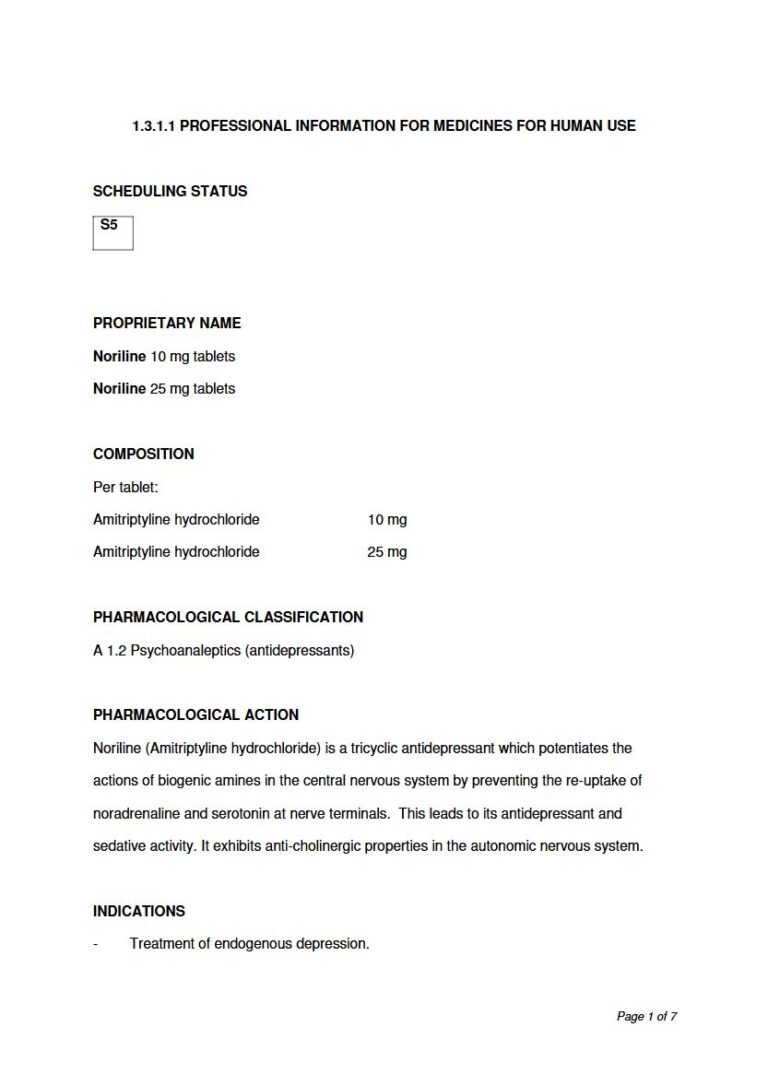
Treatment of endogenous depression and nocturnal enuresis in children over 6 years.
Dosage (summary)
Depression: Initial 25 mg TID, max 150 mg daily. Nocturnal enuresis: 10-50 mg at bedtime for children.
Onset of Action / Duration
Onset: 3-4 days, Duration: up to 30 days for full effect.
Special Populations
- Elderly
- Children
- Cardiovascular disease
- Liver impairment
- Epilepsy
Pregnancy & Breastfeeding
Safety in pregnancy and lactation not established.
Key Drug Interactions
- Monoamine oxidase inhibitors
- CNS depressants
- Barbiturates
- Thyroid preparations
Contraindications
- Sensitivity to amitriptyline
- Post-myocardial infarction
- Heart block
- Children under 6
- MAOIs
Common side effects
- Dry mouth
- Constipation
- Drowsiness
- Tachycardia
- Blurred vision
Counselling Points
- Avoid driving if drowsy
- Monitor for suicidal tendencies
- Gradual dosage reduction recommended
Serious warnings
- Impaired decision making
- Risk of psychosis in schizophrenia
- Manic phase in manic-depressive patients
Important Disclaimer
The Noriline 10mg. 25mg Tablet professional information leaflet below is the property of Aspen Pharmacare and is provided on Medinsert exactly as issued, with no.. alterations or editorial changes. We make every effort to keep content current by updating documents as soon as new versions become available. Medinsert serves as a trusted access point for healthcare professionals, but does not replace official sources or clinical judgement. For more details, please read our full disclaimer. read more>>
 Healthcare Professionals Only
This content is for registered healthcare professionals
Sign in or create a free account to read the full package insert.
Free for HPCSA-registered professionals. Powered by Medinsert.
Clinical Particulars
Section 4 of the official insert — extracted exactly as issued, no alterations
4.1 Therapeutic indications
- Treatment of endogenous depression.
- Adjunctive therapy for nocturnal enuresis in children over 6 years of age where organic pathology has been excluded.
4.2 Posology and method of administration
Depression:
Initial: One tablet (25 mg) three times per day increasing gradually to 150 mg daily if necessary. Additional doses should be taken in the late afternoon or evening. Therapy may also be initiated with a single dose of 50 to 100 mg at night increased by 25 or 50 mg as necessary to a total of 150 mg daily. The antidepressant activity may be evident within three or four days or may take up to 30 days to develop adequately.
Maintenance:
50 to 100 mg daily. Treatment should be continued for at least three months before being gradually withdrawn. Hospitalized patients may be given doses of up to 200 mg daily and, occasionally, up to 300 mg daily.
Nocturnal enuresis:
Children 6 to 10 years: 10 to 20 mg at bedtime
Children, 11 to 16 years: 25 to 50 mg at bedtime
Do not exceed the recommended dose. Treatment should not be continued for longer than 3 months.
4.3 Contraindications
Amitriptyline hydrochloride should be avoided in:
- patients who have known sensitivity to amitriptyline
- the immediate recovery phase after myocardial infarction and in patients with heart block
- not recommended for treatment of depression in children
- patients receiving monoamine oxidase inhibitors or for at least 14 days after their discontinuation
- safety in pregnancy and lactation has not been established.
4.4 Special warnings and precautions for use
At the time of initiation of therapy, patients should be advised not to drive a motor vehicle, climb dangerous heights or operate dangerous machinery. In these situations, impaired decision making could lead to accidents. Psychosis may be activated in schizophrenic patients and manic-depressive patients may switch to a manic phase; use is not recommended in mania.
Special precautions:
- Noriline should be used with caution in patients with cardiovascular disease, hyperthyroidism or with impaired liver function, and in those with a history of epilepsy, untreated narrow-angle glaucoma, urinary retention, prostatic hypertrophy, or constipation. Patients with suicidal tendencies should be carefully supervised during treatment.
- Blood sugar concentrations can be altered in diabetic patients.
- Elderly patients adolescents and children can be especially sensitive to the side- effects of tricyclic antidepressants; reduced dosage should be used.
- Drowsiness is often experienced at the start of tricyclic antidepressant therapy and patients, if affected, should not drive or operate machinery.
4.5 Interactions with other medicines
- Noriline should not be given to patients receiving monoamine oxidase inhibitors for at least 14 days after their discontinuation; severe hypertensive reactions have been reported. Several days should elapse between withdrawing a tricyclic antidepressant and starting a monoamine oxidase inhibitor.
- Local anaesthetics containing direct-acting sympathomimetic agents, adrenaline and noradrenaline, must be used with great caution because of enhanced adrenergic effects when used together with Noriline.
- The metabolism of Noriline is increased by barbiturates and other enzyme inducers such as anti-epileptics while neuroleptics, cimetidine, methylphenidate, and possibly oestrogens and oral contraceptives reduce it.
- Noriline increases the effects of the central nervous system depressants including alcohol and anti-muscarinic agents.
- Hyperthyroid patients or those taking thyroid preparations can show an enhanced response to tricyclic antidepressants.
- The effects of bethanidine, debrisoquine, guanethidine and possibly of clonidine are reduced by tricyclic antidepressants.
4.8 Undesirable effects
Side effects:
Anti-cholinergic:
- The antimuscarinic action of Noriline causes a dry mouth, sour or metallic taste, constipation which may lead to paralytic ileus, urinary retention, blurred vision and disturbances in accommodation, palpitations, tachycardia, and impotence.
Central nervous system and neuromuscular:
- Drowsiness (but sometimes nervousness and insomnia may occur), headache, peripheral neuropathy, tremor, orthostatic hypotension, less frequently hypertension, dizziness, sweating, weakness and fatigue, ataxia, epileptiform seizures, extrapyramidal symptoms including speech difficulties, tinnitus, stomatitis and gastric irritation with nausea and vomiting. Confusion and delirium may occur, particularly in the elderly.
Allergic:
- Allergic skin rash, urticaria, photosensitisation, oedema of face and tongue.
Haematologic:
- Cholestatic jaundice and blood disorders, including eosinophilic, bone marrow depression, thrombocytopenia, leucopenia, and agranulocytosis.
Cardiovascular:
- Tricyclic antidepressants have an adverse effect on the myocardium and can cause conduction defects and cardiac arrhythmia; an increased risk of sudden death has been suspected in cardiac patients receiving tricyclic antidepressants. Hypotension, tachycardia, palpitations, myocardial infarction, arrhythmias, heart block and strokes can occur.
Endocrine:
- Changes in libido, interference with sexual function, gynaecomastia and breast enlargement, and galactorrhoea.
Other:
- Changes in blood sugar concentrations can also occur, and less frequently inappropriate secretion of antidiuretic hormone.
- Anorexia with mass loss, or mass gain, sometimes with abnormal appetite (carbohydrate craving) may occur.
Withdrawal symptoms:
- Abrupt cessation of treatment after prolonged administration may produce nausea, headache, and malaise. Gradual dosage reduction has been reported to produce, within two weeks, symptoms including irritability, restlessness and dream and sleep disturbances. These are not indicative of addiction. Instances of mania or hypomania occurring within two to seven days following cessation of prolonged therapy with tricyclic antidepressants have been reported. Sweating and itching have been reported.
4.9 Overdose
Symptoms of overdosage are excitement and restlessness with marked antimuscarinic effects, including dryness of the mouth, dilated pupils, tachycardia, urinary retention and intestinal stasis. Severe symptoms include unconsciousness, convulsions and myoclonus, hyperreflexia, hypotension and respiratory and cardiac depression, with life-threatening cardiac arrhythmias that may recur some days after apparent recovery. Treatment is symptomatic and supportive.
