
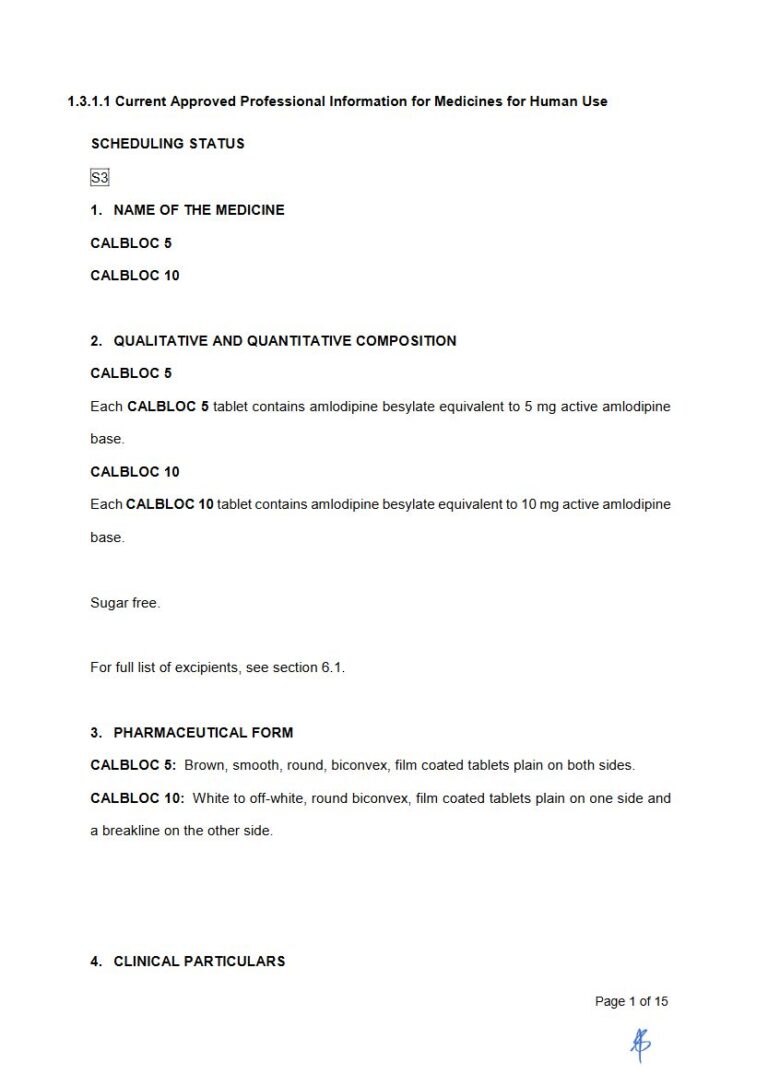
Calbloc 5mg & 10mg Tablets
PDF Leaflet Revision Date: 03 August 2023
Clinical Summary
Quick overview from the medicine insert
Indication
Treatment of mild to moderate hypertension and angina pectoris.
Dosage (summary)
Initial dose 5 mg once daily, may increase to 10 mg after 10-14 days.
Special Populations
- Elderly
- Hepatic impairment
- Renal failure
Pregnancy & Breastfeeding
Safety in pregnancy/lactation not established; caution due to benzyl alcohol.
Key Drug Interactions
- CYP3A4 inhibitors (e.g., ketoconazole, clarithromycin)
- Grapefruit juice
- Simvastatin
Contraindications
- Hypersensitivity to amlodipine or excipients
- Concomitant use with grapefruit juice
Common side effects
- Dizziness
- Headache
- Palpitations
- Nausea
Counselling Points
- Monitor for dizziness when driving or operating machinery.
- Report any allergic reactions or severe side effects.
Serious warnings
- Risk of hypotension with CYP3A4 inhibitors
- Potential for pulmonary edema in heart failure patients
Important Disclaimer
The Calbloc 5mg & 10mg Tablets professional information leaflet below is the property of Ranbaxy Pharmaceuticals and is provided on Medinsert exactly as issued, with no.. alterations or editorial changes. We make every effort to keep content current by updating documents as soon as new versions become available. Medinsert serves as a trusted access point for healthcare professionals, but does not replace official sources or clinical judgement. For more details, please read our full disclaimer. read more>>
 Healthcare Professionals Only
This content is for registered healthcare professionals
Sign in or create a free account to read the full package insert.
Free for HPCSA-registered professionals. Powered by Medinsert.
Clinical Particulars
Section 4 of the official insert — extracted exactly as issued, no alterations
4.1 Therapeutic indications
CALBLOC is indicated for the treatment of mild to moderate hypertension. CALBLOC may be combined with other antihypertensives.
Coronary artery disease (CAD)
Angina pectoris
CALBLOC is indicated for the treatment of angina pectoris.
Chronic stable angina
CALBLOC is indicated for the first line treatment of myocardial ischaemia, whether due to fixed obstruction (stable angina) and/or vasospasm/vasoconstriction (Prinzmetalu2019s or variant angina) of coronary vasculature.
CALBLOC may be used alone, as monotherapy, or in combination with other antianginal medicines.
Coronary artery disease
CALBLOC is indicated to reduce the risk of coronary revascularisation and the need for hospitalisation due to angina in patients with coronary artery disease.
CALBLOC is also indicated to reduce the risk of fatal coronary heart disease and non-fatal myocardial infarction, and to reduce the risk of stroke.
4.2 Posology and method of administration
Posology
Hypertension and Angina Pectoris
An initial dose of 5 mg CALBLOC once daily is recommended which may be increased to 10 mg once a day after 10 u2013 14 days of therapy if there is no improvement. No dose reduction is required when adding CALBLOC to thiazide diuretics, beta-blockers, or angiotensin- converting enzyme inhibitors.
Coronary artery disease
The recommended dosage range is 5 u2013 10 mg once daily. In clinical s tudies the majority of patients required is 10 mg.
Special populations
Use in the elderly
CALBLOC , used at similar doses in elderly or younger patients, is equally well tolerated. Therefore normal dosage regimens are recommended in the elderly, but increase of the dosage should take place with care. Elderly patients should start CALBLOC therapy at a lower dose. See Section 4.4 .
Use in patients with impaired hepatic function
CALBLOC should be administered with caution in patients with impaired liver function. Treatment should be initiated at the lowest dose and titrated slowly in these patients. See Section 4.4 .
Use in renal failure
CALBLOC may be used in such patients at normal doses. Changes in plasma concentrations are not correlated with degree of renal impairment. In patients with severe renal impairment, CALBLOC doses may need to be reduced. See Section 4.4 .
Paediatric population
The recommended antihypertensive oral dose in paediatric patients ages 6 u2013 17 years is 2,5 mg to 5 mg once daily. Doses in excess of 5 mg daily have not been studied in paediatric patients. The effect of CALBLOC on blood pressure in patients less than 6 years of age is not known.
Method of administration
For oral use.
4.3 Contraindications
- Hypersensitivity to dihydropyridines, amlodipine, or to any of the excipients of CALBLOC listed in Section 6.1.
- Concomitant use with grapefruit juice (see Section 4.5).
4.4 Special warnings and precautions for use
Concomitant use with potent cytochrome CYP3A4 medicines
The blood pressure lowering effect may be enhanced when potent CYP3A4 inhibitors such as ketoconazole, itraconazole or ritonavir are co-administered (see Section 4.5 ).
Use in the elderly
The time to reach peak plasma concentrations of CALBLOC is variable and not significantly different between elderly and younger subjects. CALBLOC clearance is decreased with resulting increases in AUC (40 u2013 60 %) and elimination half-life in elderly patients. AUC and elimination half-life in patients with congestive heart failure (CHF) were increased with age. Elderly patients should start CALBLOC therapy at a lower dose.
Use in patients with renal failure
CALBLOC may be used at normal doses in patients with renal impairment. Changes in amlodipine plasma concentrations are not correlated with the degree of renal impairment. In patients with severe renal impairment, CALBLOC doses may need to be reduced. CALBLOC is not dialysable.
Use in patients with impaired hepatic function
The half-life of CALBLOC is prolonged in patients with impaired liver function. CALBLOC should therefore be administered at lower (5 mg) initial dose in these CALBLOC patients.
Use in patients with heart failure
In a long-term, placebo-controlled study (PRAISE-2) of amlodipine in patients with New York Heart Association (NYHA) class III and IV heart failure of non-ischaemic etiology, amlodipine was associated with increased reports of pulmonary oedema despite no significant difference in the incidence of worsening heart failure as compared to placebo.
Benzyl alcohol content in CALBLOC 10:
This medicine contains 0,214 mg of benzyl alcohol in each 10 mg tablet. Benzyl alcohol may cause allergic reactions. Benzyl alcohol has been linked with the risk of severe side effects including breathing problems (called u2018gasping syndromeu2019) in young children. Benzyl alcohol should not be given to a new born baby (up to 4 weeks old), unless recommended by the doctor. Benzyl alcohol should not be given for more than a week to young children (less than 3 years old) as there is an increased risk of accumulation. Large amounts of benzyl alcohol can build-up in the body and may cause metabolic acidosis in pregnancy and breastfeeding. Large amounts of benzyl alcohol can build-up in the body and may cause metabolic acidosis in patients with hepatic or renal impairment. Benzyl alcohol may cause mild local irritation.
4.5 Interaction with other medicines and other forms of interaction
Amlodipine has been administered with thiazide diuretics, alpha blockers, beta blockers, angiotensin-converting enzyme inhibitors, long-acting nitrates, sublingual nitroglycerine, non- steroidal anti-inflammatory drugs (NSAIDs), antibiotics, and oral hypoglycaemic medicines.
In vitro data from studies with human plasma indicate that amlodipine has no effect on protein binding of the medicines tested (digoxin, phenytoin, warfarin, or indomethacin).
Simvastatin
Co-administration of multiple doses of 10 mg amlodipine with simvastatin resulted in a 77 % increase in exposure to simvastatin compared to simvastatin alone.
Grapefruit juice
Co-administration of 240 ml of grapefruit juice with a single oral dose of amlodipine 10 mg in 20 health volunteers had no significant effect on the pharmacokinetics of amlodipine. The study did not allow examination of the effect of genetic polymorphism in CYP3A4, the primary enzyme responsible for metabolism of amlodipine; therefore, administration of amlodipine with grapefruit or grapefruit juice is not recommended as bioavailability may be increased in some patients, resulting in increased blood pressure lowering effects (see Section 4.3 ).
CYP3A4 inhibitors
Co-administration of a 180 mg daily dose of diltiazem with 5 mg amlodipine in elderly hypertensive patients (69 to 87 years of age) resulted in a 57 % increase in amlodipine systemic exposure and a significant further decrease in systolic blood pressure than with amlodipine alone. Strong inhibitors of CYP3A4 (e.g. ketoconazole, itraconazole, ritonavir) may increase the plasma concentrations of amlodipine. Amlodipine should be used with caution when administered with CYP3A4 inhibitors (see Section 4.4 ).
Clarithromycin
Clarithromycin is an inhibitor of CYP3A4. There is an increased risk of hypotension in patients receiving clarithromycin with amlodipine. Close observation of patients is recommended when amlodipine is co-administered with clarithromycin. There is no information on the effect of the combination on the QT interval.
CYP3A4 inducers
There is no data available regarding the effect of CYP3A4 inducers on amlodipine. Concomitant use of CYP3A4 inducers (e.g. rifampicin, hypericum perforatum ) may decrease the plasma concentrations of amlodipine. Amlodipine should be used with caution when administered with CYP3A4 inducers.
Effects of medicines taken with CALBLOC
Cimetidine
Co-administration with cimetidine did not alter the pharmacokinetics of amlodipine.
Aluminium/magnesium (antacid)
Co-administration of an aluminium/magnesium antacid with a single dose of amlodipine had no significant effect on the pharmacokinetics of amlodipine.
Sildenafil
A single 100 mg dose of sildenafil in subjects with essential hypertension had no effect on the pharmacokinetic parameters of amlodipine. When amlodipine and sildenafil were used in combination, each medicine independently exerted its own blood pressure lowering effect.
Diogoxin
Co-administration of amlodipine with digoxin did not change serum digoxin levels or digoxin renal clearance in healthy volunteers.
Ethanol (alcohol)
Single and multiple 10 mg doses of amlodipine had no significant effect on the pharmacokinetics of ethanol.
Warfarin
Co-administration of amlodipine with warfarin did not change the warfarin prothrombin response time.
Ciclosporin
No medicine studies have been conducted with ciclosprin and amlodipine in healthy volunteers or other populations, with the exception of renal transplant patient. Various studies in renal transplant patients report that co-administration of amlodipine with ciclosporin increased the trough concentrations of ciclosporin and increased ciclosporin toxicity, from no change up to an average increase of 40 %. Consideration should be given for monitoring ciclosporin levels in renal transplant patients on amlodipine.
Tacrolimus
There is a risk of increased tacrolimus blood levels and toxicity when co - administered with amlodipine. In order to avoid toxicity of tacrolimus, administration of amlodipine in a patient treated with tracrolimus requires monitoring of tacrolimus blood levels and dose adjustment of tacrolimus when appropriate.
Medicine/laboratory test interactions
None known.
4.6 Fertility, pregnancy and lactation
Safety of CALBLOC in pregnancy or lactation has not been established. Large amounts of benzyl alcohol can build-up in the body and may cause metabolic acidosis in pregnancy or breastfeeding.
4.7 Effects on ability to drive and use machines
When driving vehicles or operating machines, it should be taken into account that dizziness may occur during treatment with CALBLOC.
4.8 Undesirable effects
System Organ Class Frequent Less frequent
Blood and lymphatic system disorders leuokopenia, thrombocytopenia
Immune system disorders allergic reactions with pruritus, rash, angioedema and erythema multiforme
Metabolism and nutrition disorders hyperglycaemia
Psychiatric disorders insomnia, mood changes
System Organ Class Frequent Less frequent
Nervous system disorders somnolence, dizziness, headache
tremor, dysgeusia, syncope, hypoaesthesia, paraesthesia, hypertonia, peripheral neuropathy, extrapyramidal disorder
Eye disorders visual disturbances
Ear and labyrinth disorders tinnitus
Cardiac disorders palpitations m yocardial infarction, arrhythmia (including bradycardia, ventricular tachycardia and atrial fibrillation), chest pain
Vascular disorders flushing hypotension, vasculitis
Respiratory, thoracic and mediastinal disorders dyspnoea, rhinitis, cough
Gastrointestinal disorders abdominal pain, nausea vomiting, dyspepsia (including gastritis), altered bowel habits, dry mouth, pancreatitis, gingival hyperplasia
Hepatobiliary disorders hepatitis, jaundice and hepatic enzyme elevations (mostly consistent with cholestatis)
Skin and subcutaneous tissue disorders alopecia, purpura, skin discolouration, hyperhidrosis, pruritus, rash, angioedema, erythema multiforme, urticaria
Reporting of suspected adverse reactions
Reporting suspected adverse reactions after authorisation of the medicine is important. It allows continuing monitoring of the benefit/risk balance of the medicine. Health care providers are asked to report any suspected adverse reactions to SAHPRA via the u201c6.04 Adverse Drug Reaction Reporting Formu201d, found online under SAHPRAu2019s publications. https://www.sahpra.org.za/Publications/Index/8
4.9 Overdose
Symptoms
Available data for amlodipine suggest that gross overdosage could result in excessive peripheral vasodilatation and possibly reflex tachycardia. Marked and probably prolonged systemic hypotension up to and including shock with fatal outcome have been reported.
Non-cardiogenic pulmonary oedema has rarely been reported as a consequence of amlodipine overdose that may manifest with a delayed onset (24-48 hours post-ingestion) and require ventilator support. Early resuscitative measures (including fluid overload) to maintain perfusion and cardiac output may be precipitating factors.
Treatment
Administration of activated charcoal to healthy volunteers immediately after or up to 2 hours after CALBLOC 10 mg ingestion has been shown to significantly decrease CALBLOC absorption. Activated charcoal given 6 hours after CALBLOC had no effect. Clinically significant hypotension due to CALBLOC overdosage may need active cardiovascular support, including frequent monitoring of cardiac and respiratory function, elevation of extremities, and attention to circulating fluid volume and urine output. Intravenous calcium gluconate may be beneficial in reversing the effects of calcium channel blockade. Since amlodipine is highly protein-bound, dialysis is not likely to be of benefit. Treatment is symptomatic and supportive.
