
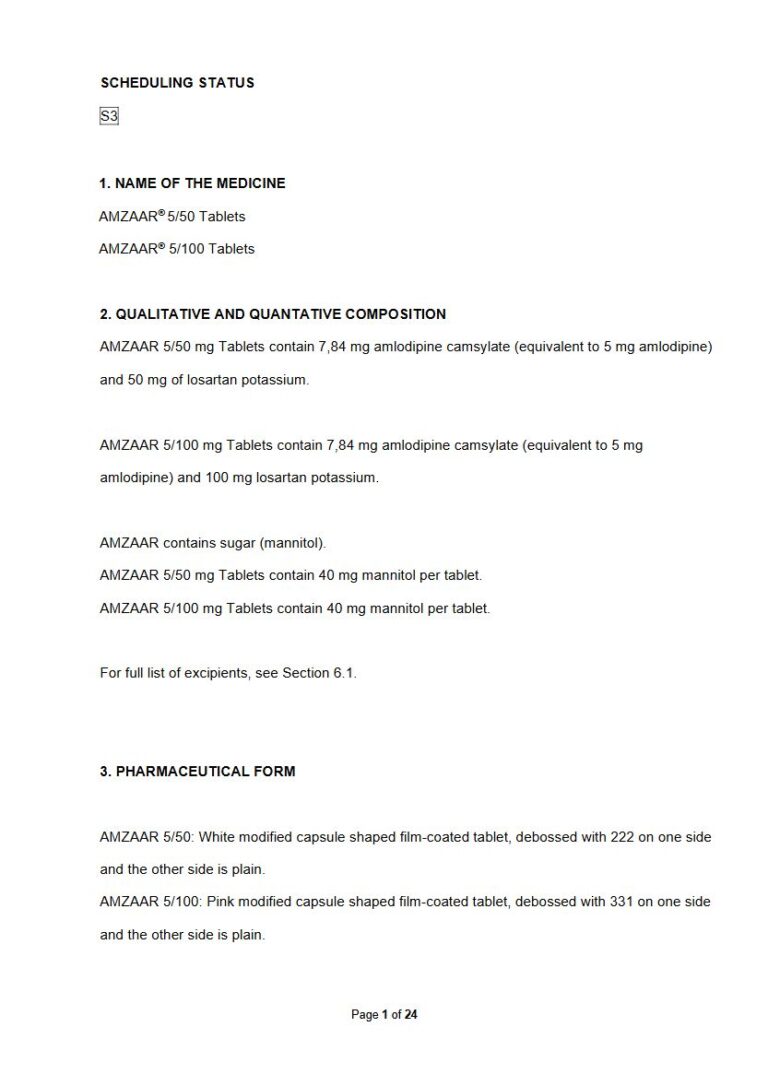
Amzaar Tablets
PDF Leaflet Revision Date: 30 November 2025
Clinical Summary
Quick overview from the medicine insert
Indication
Treatment of essential hypertension.
Dosage (summary)
1 tablet daily, usual dose 5/50 mg, max 5/100 mg.
Special Populations
- Renal impairment
- Hepatic impairment
Pregnancy & Breastfeeding
Contraindicated in pregnancy and lactation.
Key Drug Interactions
- Potassium-sparing diuretics
- Lithium
- NSAIDs
Contraindications
- Hypersensitivity
- Severe renal impairment
- Pregnancy
- Hepatic impairment
Common side effects
- Dizziness
- Headache
- Palpitation
Counselling Points
- Take with water
- Monitor for dizziness
- Avoid grapefruit juice
Serious warnings
- Risk of hypotension in volume-depleted patients
- Dual blockade of RAAS contraindicated
Important Disclaimer
The Amzaar Tablets professional information leaflet below is the property of Organon South Africa and is provided on Medinsert exactly as issued, with no.. alterations or editorial changes. We make every effort to keep content current by updating documents as soon as new versions become available. Medinsert serves as a trusted access point for healthcare professionals, but does not replace official sources or clinical judgement. For more details, please read our full disclaimer. read more>>
 Healthcare Professionals Only
This content is for registered healthcare professionals
Sign in or create a free account to read the full package insert.
Free for HPCSA-registered professionals. Powered by Medinsert.
Clinical Particulars
Section 4 of the official insert — extracted exactly as issued, no alterations
4.1 Therapeutic indications
AMZAAR (losartan potassium/amlodipine camsylate) is indicated for the treatment of essential hypertension in patients whose blood pressure is controlled on both the components, taken at the same dose as the separate medicines.
4.2 Posology and method of administration
Posology
The recommended dose of AMZAAR is one tablet per day. The usual dose of AMZAAR is 5/50 mg daily. The maximum recommended dose of AMZAAR is 5/100 mg daily.
Special populations
Use in patients with renal impairment
No dosage adjustment is necessary in patients with moderate renal impairment (i.e., creatinine clearance 30 to 50 mL/min). For patients with severe renal impairment (i.e., creatinine clearance < 30 mL/min) or patients on dialysis, administration of AMZAAR is contraindicated.
Paediatric population
Use in adolescents and children
Since safety and efficacy of AMZAAR in children equal to or less than 18 years of age has not been established, administration of AMZAAR is not recommended.
Method of administration
AMZAAR may be administered with or without food. It is recommended to take AMZAAR with water. AMZAAR may be administered with other classes of antihypertensive medicines.
4.3 Contraindications
- Hypersensitivity to any of the ingredients of AMZAAR
- A history of angioedema related to previous therapy with ACE inhibitors or angiotensin receptor blockers (ARBs). These patients must never again be given these medicines.
- Hereditary or idiopathic angioedema
- Hypertrophic obstructive cardiomyopathy (HOCM)
- Severe renal function impairment (creatinine clearance < 30 mL/min)
- Bilateral renal artery stenosis
- Renal artery stenosis in patients with a single kidney
- Aortic stenosis
- Concomitant therapy with potassium sparing diuretics such as spironolactone, triamterene, amiloride (see Section 4.5)
- Porphyria
- Lithium therapy: Concomitant administration with AMZAAR may lead to toxic blood concentrations of lithium (see Section 4.5).
- Pregnancy and lactation (see Section 4.6)
- Concomitant administration with renin antagonists such as aliskiren (see Section 4.4 and 4.5)
- Hepatic impairment (see Section 4.4)
- Concomitant use of fluoroquinolones with ACE inhibitors/Renin-Angiotensin receptor blockers is contraindicated in patients with moderate to severe renal impairment.
4.4 Special warnings and precautions for use
Should a woman become pregnant while receiving AMZAAR the treatment should be stopped promptly and switched to a different class of antihypertensive medicine (see Section 4.3 and Section 4.6).
Dual blockade of the renin-angiotensin-aldosterone system (RAAS)
There is evidence that the concomitant use of ACE-inhibitors, angiotensin II receptor blockers (ARBs) or renin antagonists such as aliskiren may increase the risk of hypotension, hyperkalaemia and decrease renal function (including acute renal failure). Dual blockade of RAAS through the combined use of AMZAAR and aliskiren is therefore contraindicated (see section 4.3).
AMZAAR
Hypotension: In patients who are intravascularly volume-depleted (e.g. those treated with diuretics), symptomatic hypotension may occur. Intravascular volume depletion should be corrected prior to administration of AMZAAR.
Based on pharmacokinetic data which demonstrate significantly increased plasma concentrations of losartan and amlodipine in cirrhotic patients, this formulation is not suitable for patients with hepatic impairment (see section 4.3).
Losartan
Hypersensitivity: Angioedema (see Section 4.8).
Intestinal angioedema
Intestinal angioedema has been reported in patients treated with angiotensin II receptor antagonists, including losartan, a component of AMZAAR (see section 4.8). These patients presented with abdominal pain, nausea, vomiting and diarrhoea. Symptoms resolved after discontinuation of angiotensin II receptor antagonists. If intestinal angioedema is diagnosed, AMZAAR should be discontinued and appropriate monitoring should be initiated until complete resolution of symptoms has occurred.
Electrolyte/Fluid Imbalance
Electrolyte imbalances are common in patients with renal impairment, with or without diabetes and should be addressed. In a clinical study conducted in type 2 diabetic patients with proteinuria, the incidence of hyperkalaemia was higher in the group treated with losartan as compared to the placebo group.
Concomitant use of other medicines that may increase serum potassium may lead to hyperkalemia (see Section 4.3 and Section 4.5).
Renal Function Impairment
As a consequence of inhibiting the renin-angiotensin system, deterioration of renal function including renal failure have been reported in susceptible individuals. AMZAAR is contraindicated in patients with severe renal function impairment (see Section 4.3).
Concomitant use of fluoroquinolones and ACE inhibitors/Renin-Angiotensin receptor blockers may precipitate acute kidney injury in patients, especially those with moderate to severe renal impairment and elderly patients (see Section 4.3). Renal function should be assessed before initiating treatment, and monitored during treatment, with fluoroquinolones or ACE inhibitors/renin-angiotensin receptor blockers.
Amlodipine
Angina or Myocardial Infarction: Worsening angina and acute myocardial infarction can develop after starting or increasing the dose of AMZAAR due to the amlodipine, particularly in patients with severe obstructive coronary artery disease.
4.5 Interaction with other medicines and other forms of interaction
In clinical pharmacokinetic trials, no medicine interactions of clinical significance have been identified with co-administration of losartan and hydrochlorothiazide, digoxin, warfarin, cimetidine, phenobarbitone, ketoconazole and erythromycin. Rifampicin and fluconazole have been reported to reduce levels of active metabolite. The clinical consequences of these interactions have not been evaluated.
Concomitant use of AMZAAR and potassium-sparing diuretics (e.g. spironolactone, triamterene, amiloride), potassium supplements, salt substitutes containing potassium, or other medicines that may increase serum potassium (e.g., trimethoprim-containing products) may lead to increases in serum potassium (see Section 4.3 and Section 4.4).
Lithium excretion may be reduced (see Section 4.3).
Non-steroidal anti-inflammatory drugs (NSAIDs) including selective cyclooxygenase-2 inhibitors (COX-2 inhibitors) may reduce the effect of diuretics and other antihypertensive medicines. Therefore, the antihypertensive effect of angiotensin II receptor antagonists such as in AMZAAR or ACE inhibitors may be attenuated by NSAIDs including selective COX-2 inhibitors.
In patients with compromised renal function (e.g. elderly patients or patients who are volume-depleted, including those on diuretic therapy) who are being treated with non-steroidal anti-inflammatory drugs (NSAIDs), including selective cyclooxygenase-2 inhibitors, the co-administration of angiotensin II receptor antagonists such as AMZAAR, may result in a further deterioration of renal function, including possible acute renal failure. Therefore, the combination should be administered with caution in patients with compromised renal function.
Concomitant use of fluoroquinolones and ACE inhibitors/Renin-Angiotensin receptor blockers may precipitate acute kidney injury (see Section 4.3).
Dual blockade of the RAAS with ARBs, ACE inhibitors, or aliskiren
Clinical trial data has shown that dual blockade of the renin-angiotensin-aldosterone-system (RAAS) through the combined use of ACE inhibitors, angiotensin II receptor blockers such as losartan, a component of AMZAAR and renin antagonists such as aliskiren are associated with a higher frequency of adverse events such as hypotension, syncope, hyperkalaemia and decreased renal function (see Section 4.3 and Section 4.4).
Grapefruit juice contains components that inhibit CYP 450 enzymes and may lower the concentration of the active metabolite of losartan which may reduce the therapeutic effect. Consumption of grapefruit juice should be avoided while taking AMZAAR.
CYP3A4 Inhibitors
Co-administration of a 180 mg daily dose of diltiazem with 5 mg amlodipine in elderly hypertensive patients resulted in a 1,6 fold increase in amlodipine systemic exposure. Erythromycin co-administration in healthy volunteers did not significantly change amlodipine systemic exposure. However, strong inhibitors of CYP3A4 (e.g. ketoconazole, itraconazole, ritonavir) may increase the plasma concentrations of amlodipine to a greater extent. Monitor for symptoms of hypotension and oedema when amlodipine is co-administered with CYP3A4 inhibitors.
CYP3A4 Inducers
No information is available on the quantitative effects of CYP3A4 inducers on amlodipine. Patients should be monitored for adequate clinical effect when amlodipine is co-administered with CYP3A4 inducers.
4.6 Pregnancy and lactation
AMZAAR is contraindicated in pregnancy and lactation (see Section 4.3).
Pregnancy
Medicines that act directly on the renin-angiotensin system can cause injury and death to the developing foetus. When pregnancy is detected, discontinue AMZAAR as soon as possible.
Foetal toxicity
Use of medicines that act on the renin-angiotensin system during the second and third trimesters of pregnancy reduces foetal renal function and increases foetal and neonatal morbidity and death. Resulting oligohydramnios can be associated with foetal lung hypoplasia and skeletal deformations. Potential neonatal adverse effects include skull hypoplasia, anuria, hypotension, renal failure and death. When pregnancy is detected, discontinue AMZAAR as soon as possible (see Section 4.3).
Neonates with a history of in utero exposure to AMZAAR:
If oliguria or hypotension occur, direct attention toward support of blood pressure and renal perfusion. Exchange transfusions or dialysis may be required as a means of reversing hypotension and/or substituting for disordered renal function.
Breastfeeding
It is not known whether losartan or amlodipine is excreted in human milk. AMZAAR should not be used by mothers who are breastfeeding their infants.
4.7 Effects on ability to drive and use machines
Side effects e.g. dizziness, that have been reported with AMZAAR may affect some patientsu2019 ability to drive or operate machinery (see Section 4.8).
4.8 Undesirable effects
Adverse reactions from clinical trials
AMZAAR
The safety of AMZAAR has been evaluated in 325 patients treated with AMZAAR for hypertension in 3 clinical trials for 8 weeks. Adverse reactions have been ranked under headings of frequency using the following convention: Very common (u2265 1/10); Common (u2265 1/100, < 1/10); Uncommon (u2265 1/1 000, < 1/100); Rare (u2265 1/10 000, < 1/1 000); Very rare (< 1/10 000).
The treatment-related adverse events:
Nervous system disorders
Common: Dizziness, headache
Uncommon: Somnolence
Cardiac disorders
Uncommon: Palpitation
Vascular disorders
Uncommon: Flushing, orthostatic hypotension
Respiratory, thoracic and mediastinal disorders
Uncommon: Dyspnoea, cough
Gastrointestinal disorders
Uncommon: Abdominal discomfort, dyspepsia, nausea, reflux oesophagitis
Skin and subcutaneous tissue disorders
Uncommon: Pruritus (generalised), urticaria (generalised)
Renal and urinary disorder
Uncommon: Pollakiuria
General disorders and administration site conditions
Uncommon: Asthenia, chest discomfort, chest pain, early satiety, peripheral oedema, pitting oedema
Sensory organ disorders
Uncommon: Vertigo
The following adverse reactions have been reported with the components of AMZAAR:
Double-blind controlled clinical trials with losartan for essential hypertension * Placebo-Controlled Studies with Amlodipine Besylate** 2,5-10 mg/day Placebo-Controlled Studies with Amlodipine Besylate*** Losartan (n=2085) Placebo (n=535) Amlodipine besylate (%) (n=1730) Placebo (%) (n=1250) Amlodipine besylate Placebo Male =% (n= 1218) Female =% (n= 512) Male =% (n=914) Female =% (n=336)
Body as a Whole
Abdominal pain 1,7 1,7 1,6 0,3
Asthenia/ fatigue 3,8 3,9 4,5 2,8
Chest pain 1,1 2,6
Oedema/ swelling 1,7 1,9 5,6 14,6 1,4 5,1
Cardiovascular
Palpitation 1,0 0,4 1,4 3,3 0,9 0,9
Tachycardia 1,0 1,7
Flushing 1,5 4,5 0,3 0,9
Digestive
Diarrhoea 1,9 1,9
Dyspepsia 1,1 1,5
Nausea 1,8 2,8 2,9 1,9
Musculoskeletal
Back pain 1,6 1,1
Muscle cramps 1,0 1,1
Nervous/ Psychiatric
Dizziness 4,1 2,4
Headache 14,1 17,2 7,3 7,8
Insomnia 1,1 0,7
Somnolence 1,4 0,6 1,3 1,6 0,8 0,3
Respiratory
Cough 3,1 2,6
Nasal congestion 1,3 1,1
Pharyngitis 1,5 2,6
Sinus disorder 1,0 1,3
Upper respiratory infection 6,5 5,6
*Adverse experiences reported with losartan occurred in u2265 1 % of patients, regardless of medicine relationship. The data are from pooled clinical studies using doses of losartan from 5 u2013 150 mg.
** Adverse experiences that were not clearly dose related but were reported with an incidence > 1,0 %.
*** Adverse experiences that appear to be medicine and dose related, there was a greater incidence in women than men. In hypertensive patients the most common medicine-related side effects were dizziness, asthenia/fatigue and vertigo. The most common medicine-related side effects in patients with diabetes mellitus were asthenia/fatigue, dizziness, hypotension and hyperkalaemia (see Section 4.4, Hypotension and Electrolyte/Fluid Imbalance).
The following events occurred in < 1 % of patients in controlled clinical trials or under conditions of open trials or where a causal relationship is uncertain; they are listed to alert the medical practitioner to a possible relationship:
Blood and the lymphatic system disorders
Leukopenia, purpura, thrombocytopenia
Immune system disorders
Angioedema
Metabolism and nutrition disorders
Hyperglycaemia, thirst, increased appetite
Psychiatric disorders
Sexual dysfunction (male and female), insomnia, nervousness, depression, abnormal dreams, anxiety, depersonalisation, amnesia
Nervous system disorders
Hypoaesthesia, neuropathy peripheral, paraesthesia, tremor, dry mouth, increased sweating, agitation
Eye disorders
Abnormal vision, conjunctivitis, diplopia, eye pain, abnormal visual accommodation, xerophthalmia
Ear and labyrinth disorders
Tinnitus, vertigo
Cardiac disorders
Dysrhythmia (including ventricular tachycardia and atrial fibrillation), bradycardia, chest pain, tachycardia, cardiac failure, pulse irregularity, extrasystoles
Vascular disorders
Hypotension, peripheral ischaemia, syncope, postural dizziness, postural hypotension, vasculitis
Respiratory, thoracic and mediastinal disorders
Dyspnoea, epistaxis, coughing, rhinitis, parosmia
Gastrointestinal disorders
Anorexia, constipation, dyspepsia, dysphagia, diarrhoea, flatulence, pancreatitis, vomiting, gingival hyperplasia, gastritis, loose stools, taste perversion
Skin and subcutaneous tissue disorder
Erythema multiforme, pruritus, rash, rash erythematous, rash maculopapular, skin discoloration, urticaria, skin dryness, alopecia, dermatitis, cold and clammy skin
Musculoskeletal, connective tissue and bone disorders
Arthralgia, arthrosis, muscle cramps, myalgia, muscle weakness, twitching, ataxia, hypertonia
Renal and urinary disorders
Micturition frequency, micturition disorder, nocturia, dysuria, polyuria
General disorders and administration site conditions
Allergic reaction, asthenia 1, back pain, hot flushes, malaise, pain, rigors, weight gain, decreased weight, migraine, apathy
1 These events occurred in < 1 % in placebo-controlled trials, but the incidence of these side effects was between 1 % and 2 % in all multiple dose studies. Other reactions occurred sporadically and cannot be distinguished from medications or concurrent disease states such as myocardial infarction and angina.
4.9 Overdose
AMZAAR
There are no available clinical data in regard to overdosage of AMZAAR in humans. The overdose on each ingredient of amlodipine and losartan are described.
Losartan
Limited data are available in regard to overdosage in humans. The most likely manifestation of overdosage would be hypotension and tachycardia; bradycardia could occur from parasympathetic (vagal) stimulation. If symptomatic hypotension should occur, supportive treatment should be instituted. Neither losartan nor the active metabolite can be removed by haemodialysis.
Amlodipine
Overdosage might be expected to cause excessive peripheral vasodilation with marked hypotension and possibly a reflex tachycardia. Marked and probably prolonged systemic hypotension up to and including shock with fatal outcome have been reported. Treatment should be symptomatic and supportive. Non-cardiogenic pulmonary oedema has been rarely reported as a consequence of amlodipine overdose, that may manifest with a delayed onset (24 u2013 48 hours post-ingestion) and require ventilatory support or may result in a fatal outcome. Early resuscitative measures (including fluid overload) to maintain perfusion and cardiac output may be precipitating factors.
