
Lotriderm Cream 10 mg Cream
PDF Leaflet Revision Date: 25 October 2023
Clinical Summary
Quick overview from the medicine insert
Indication
Topical treatment of corticosteroid-responsive dermatoses with fungal infections.
Dosage (summary)
Apply a thin film twice daily to affected areas.
Special Populations
- Children
- Infants
Pregnancy & Breastfeeding
Not recommended during pregnancy or breastfeeding.
Contraindications
- Sensitivity to components
- Herpes simplex
- Vaccinia
- Varicella
Common side effects
- Burning
- Itching
- Irritation
- Dryness
- Folliculitis
Counselling Points
- Apply regularly for effectiveness
- Avoid use in flexural areas
- Monitor for irritation or sensitization
Serious warnings
- Not for ophthalmic use
- Long-term use may cause skin atrophy
- Caution in facial dermatoses
Important Disclaimer
The Lotriderm Cream 10 mg Cream professional information leaflet below is the property of Organon South Africa and is provided on Medinsert exactly as issued, with no.. alterations or editorial changes. We make every effort to keep content current by updating documents as soon as new versions become available. Medinsert serves as a trusted access point for healthcare professionals, but does not replace official sources or clinical judgement. For more details, please read our full disclaimer. read more>>
 Healthcare Professionals Only
This content is for registered healthcare professionals
Sign in or create a free account to read the full package insert.
Free for HPCSA-registered professionals. Powered by Medinsert.
Clinical Particulars
Section 4 of the official insert — extracted exactly as issued, no alterations
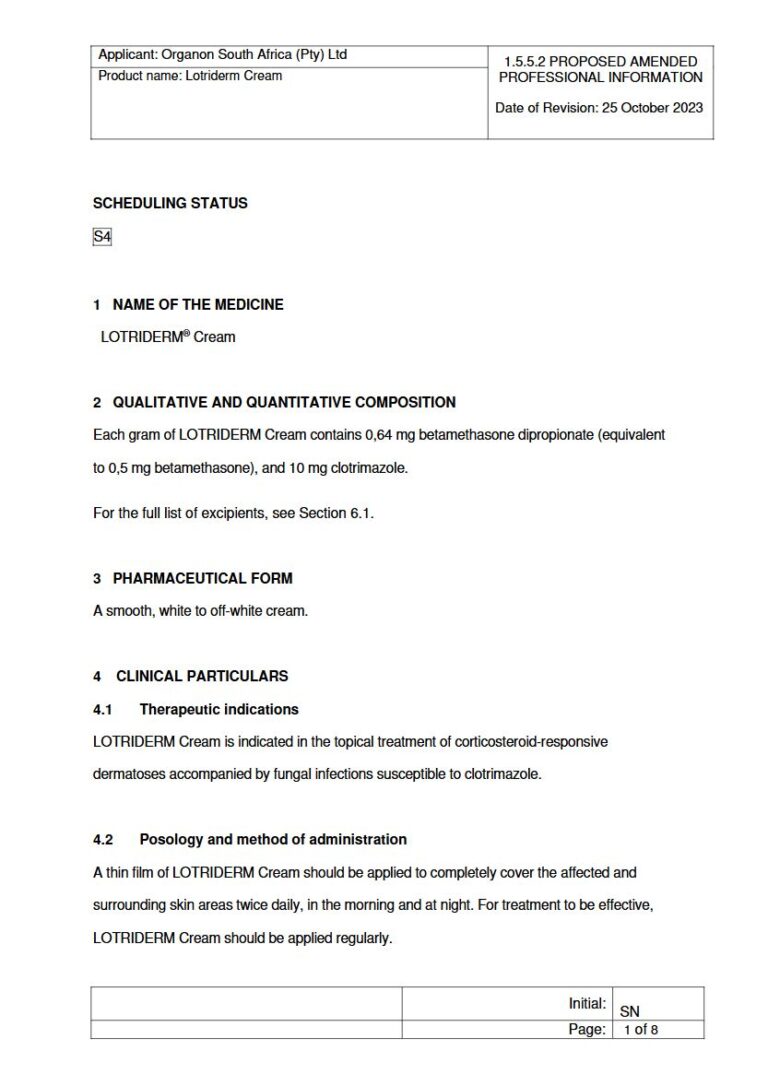
4.1 Therapeutic indications
LOTRIDERM Cream is indicated in the topical treatment of corticosteroid-responsive dermatoses accompanied by fungal infections susceptible to clotrimazole.
4.2 Posology and method of administration
A thin film of LOTRIDERM Cream should be applied to completely cover the affected and surrounding skin areas twice daily, in the morning and at night. For treatment to be effective, LOTRIDERM Cream should be applied regularly.
4.3 Contraindications
LOTRIDERM Cream is contraindicated in those patients with a history of sensitivity reactions to any of its components, or to other corticosteroids or imidazoles. LOTRIDERM Cream is contraindicated in the treatment of herpes simplex, vaccinia or varicella.
4.4 Special warnings and precautions for use
LOTRIDERM Cream is not for ophthalmic use. If irritation or sensitisation develops with the use of LOTRIDERM Cream, treatment should be discontinued and appropriate therapy instituted. Long term continuous treatment with LOTRIDERM Cream should be avoided as far as possible as this may cause atrophic changes in the skin leading to thinning, loss of elasticity, dilatation of superficial blood vessels, telangiectasiae and ecchymoses. These changes are particularly likely to occur on the face and when occlusive dressings are used. Systemic absorption of topically applied betamethasone such as contained in LOTRIDERM Cream may occur, particularly under the following conditions:
- when large quantities are used
- when application is made to wide areas of the body or to damaged skin and
- when the occlusive dressing technique is applied.
Depression of the hypothalamic-pituitary-adrenal axis with consequent suppression of the adrenal gland may occur. These effects are most likely to be severe in children. Growth may be retarded and a Cushingoid state may be produced. Benign intracranial hypertension has been reported. Visual disturbance may be reported with systemic and topical (including intranasal, inhaled and intraocular) corticosteroid use. If a patient presents with symptoms such as blurred vision or other visual disturbances, the patient should be considered for referral to an ophthalmologist for evaluation of possible causes of visual disturbances which may include cataract, glaucoma or rare diseases such as central serous chorioretinopathy (CSCR) which have been reported after use of systemic and topical corticosteroids. If a secondary microbial skin infection is present suitable concomitant antimicrobial therapy should be instituted. If a favourable response does not occur promptly, LOTRIDERM Cream therapy should be discontinued until the infection has been controlled adequately. LOTRIDERM Cream should be used with particular caution in facial dermatoses, and only for short periods. A steroid rosacea-like facies may be produced. LOTRIDERM Cream should not be applied to any skin crease areas. LOTRIDERM Cream should be used with caution near the eyes. LOTRIDERM Cream should be used for short courses only. Regular review should be made of the necessity for continuing therapy. The use of LOTRIDERM Cream for longer than 4 weeks is not recommended. LOTRIDERM Cream should not be used in flexural areas, such as in the nappy areas in infants, and ideally should not be used in infants and young children at all. The treatment of psoriasis with LOTRIDERM Cream may provoke the pustular form of the disease. LOTRIDERM Cream should not be used with occlusive dressings. If there is a lack of response to LOTRIDERM Cream, appropriate microbiological studies should be repeated to confirm the diagnosis and rule out other pathogens before instituting another course of antimycotic therapy. Long term continuous or inappropriate use of topical steroids can result in the development of rebound flares after stopping treatment (topical steroid withdrawal syndrome). A severe form of rebound flare can develop which takes the form of a dermatitis with intense redness, stinging and burning that can spread beyond the initial treatment area. It is more likely to occur when delicate skin sites such as the face and flexures are treated. Should there be a reoccurrence of the condition within days to weeks after successful treatment a withdrawal reaction should be suspected. Reapplication should be with caution and specialist advise is recommended in these cases or other treatment options should be considered.
4.5 Interaction with other medicines and other forms of interaction
None stated.
4.6 Fertility, pregnancy and lactation
Pregnancy
Corticosteroids such as betamethasone in LOTRIDERM Cream have been shown to be teratogenic in animals following dermal application. As these agents are absorbed percutaneously, teratogenicity following topical application cannot be excluded. Therefore LOTRIDERM Cream should not be used during pregnancy.
Breastfeeding
The use of LOTRIDERM Cream is not recommended for mothers who are breastfeeding.
Fertility
No clinical data available.
4.7 Effects on ability to drive and use machines
LOTRIDERM cream has no influence on the ability to drive and use machines.
4.8 Undesirable effects
Skin and subcutaneous tissue disorders: The following adverse reactions have been reported with the use of topical corticosteroids and the frequencies are unknown: burning, itching, irritation, dryness, folliculitis, hypertrichosis, acneiform eruptions, hypopigmentation, perioral dermatitis, allergic contact dermatitis, maceration of the skin, secondary infection, skin atrophy, striae and miliaria, capillary fragility (ecchymoses), sensitisation. Systemic adverse reactions, such as blurred vision, have also been reported with the use of topical corticosteroids. The following adverse reactions have been reported in clinical trials with clotrimazole and betamethasone dipropionate when used in combination: paraesthesia (common), and maculopapular rash, oedema and secondary infection each reported uncommonly. Reported adverse reactions to the clotrimazole component include erythema, burning, blistering, peeling, oedema, pruritus, urticaria and general irritation of the skin. Withdrawal reactions - redness of the skin which may extend to areas beyond the initial affected area, burning or stinging sensation, itch, skin peeling, oozing pustules (see section 4.4).
4.9 Overdose
See section 4.4 and 4.8. Symptoms: Excessive or prolonged use of topical corticosteroids can suppress pituitary-adrenal function, resulting in secondary adrenal insufficiency, and produce manifestations of hypercorticism, including Cushing syndrome. Treatment: Treatment is symptomatic and supportive. Acute hypercorticoid symptoms are usually reversible. Treat electrolyte imbalance, if necessary. In cases of chronic toxicity, slow withdrawal of corticosteroids is advised.
