
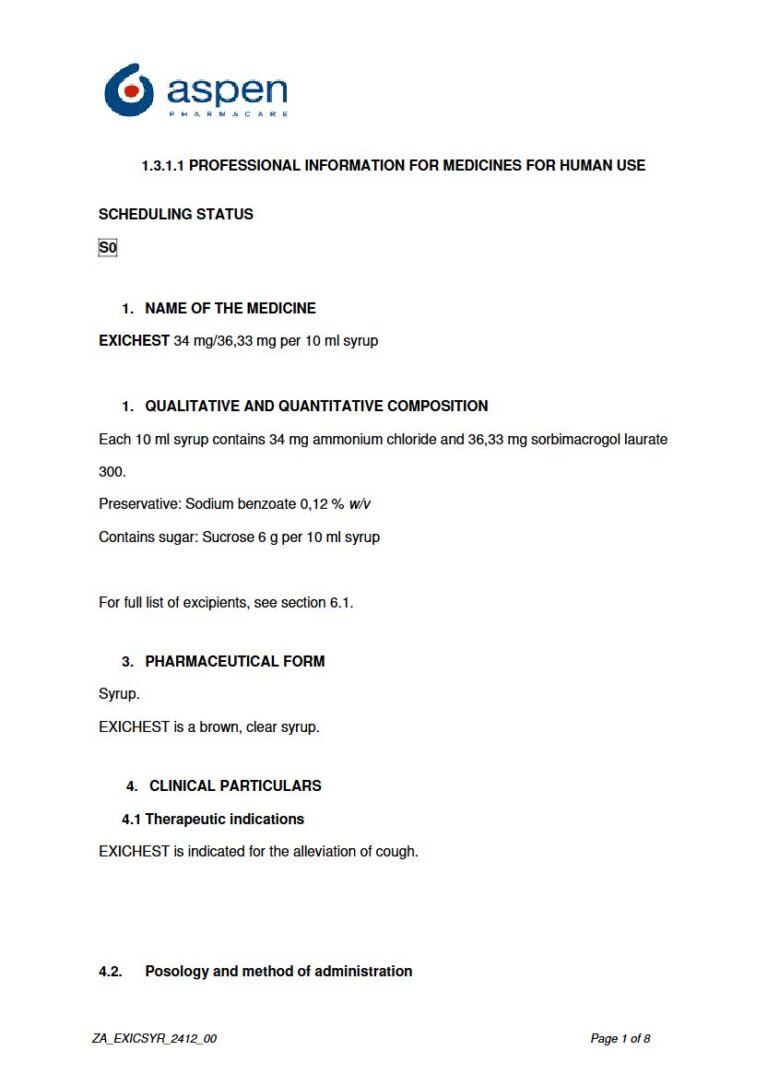
Exichest 34 mg/36,33 mg per 10 ml Syrup.
PDF Leaflet Revision Date: 19 November 2024
Clinical Summary
Quick overview from the medicine insert
Indication
Alleviation of cough.
Dosage (summary)
Adults: 5-10 ml, 3-6 times daily; Children >3 years: 5 ml, 3-6 times daily.
Special Populations
- Hepatic impairment
- Renal impairment
Pregnancy & Breastfeeding
Safety during pregnancy and lactation not established.
Contraindications
- Hypersensitivity to ingredients
- Impaired hepatic function
- Impaired renal function
Common side effects
- Acidosis
- Hypokalaemia
- Headache
- Drowsiness
- Nausea
- Vomiting
Counselling Points
- Take orally, not with food or beverages
- Contains sucrose, caution in diabetes
Serious warnings
- Consult doctor if symptoms persist
- May cause drowsiness affecting ability to drive
Important Disclaimer
The Exichest 34 mg/36,33 mg per 10 ml Syrup. professional information leaflet below is the property of Pharmacare Limited and is provided on Medinsert exactly as issued, with no.. alterations or editorial changes. We make every effort to keep content current by updating documents as soon as new versions become available. Medinsert serves as a trusted access point for healthcare professionals, but does not replace official sources or clinical judgement. For more details, please read our full disclaimer. read more>>
 Healthcare Professionals Only
This content is for registered healthcare professionals
Sign in or create a free account to read the full package insert.
Free for HPCSA-registered professionals. Powered by Medinsert.
Clinical Particulars
Section 4 of the official insert — extracted exactly as issued, no alterations
4.1 Therapeutic indications
EXICHEST is indicated for the alleviation of cough.
4.2. Posology and method of administration
Posology
Adults: One to two medicine measures (5 ml to 10 ml) three to six times a day.
Paediatric population
Children over three years old: One medicine measure (5 ml) three to six times a day.
Children under three years of age: The safety and efficacy of EXICHEST in children under 3 years of age has not yet been proven.
Method of administration
For oral administration. EXICHEST should be kept in the mouth for a few minutes and it should not be taken together with food or beverages.
4.3. Contraindications
EXICHEST is contraindicated in:
- Patients with hypersensitivity to ammonium chloride, sorbimacrogol laurate 300 or to any excipients in EXICHEST (see section 6.1).
- Impaired hepatic function.
- Impaired renal function.
4.4. Special warnings and precautions for use
If symptoms persist consult your doctor.
Paediatric population
The safety and efficacy of EXICHEST in children under 3 years of age has not yet been proven.
Excipients
EXICHEST contains 6 g of sucrose per 10 ml dose. This should be taken into account in patients with diabetes mellitus.
Patients with rare hereditary problems of fructose intolerance, glucose-galactose malabsorption or sucrase-isomaltase insufficiency should not take EXICHEST.
4.5. Interaction with other medicines and other forms of interaction
No interaction studies have been performed.
4.6. Fertility, pregnancy and lactation
Pregnancy
The safety of EXICHEST during pregnancy has not been established.
Breastfeeding
The safety of EXICHEST during lactation has not been established.
Fertility
No available data.
4.7. Effects on ability to drive and use machines
Since adverse reactions such as progressive drowsiness have been reported in patients receiving EXICHEST, patients should not drive, use machinery or perform any tasks that require concentration, until they are certain that EXICHEST does not adversely affect their ability to do so (see section 4.8).
4.8. Undesirable effects
Ammonium chloride
System organ class Frequency unknown (cannot be estimated from the available data)
- Metabolism and nutrition disorders Acidosis, hypokalaemia
- Nervous system disorders Headache, progressive drowsiness
- Respiratory, thoracic and mediastinal disorders Hyperventilation
- Gastrointestinal disorders Nausea, vomiting
- General disorders and administrative site conditions Thirst
Sorbimacrogol laurate 300
System organ class Frequency unknown (cannot be estimated from the available data)
- Gastrointestinal disorders Increased absorption of liquid paraffin and other fat- soluble substances
Reporting of suspected adverse reactions
Reporting suspected adverse reactions after authorisation of the medicine is important. It allows continued monitoring of the benefit/risk balance of the medicine. Health care providers are requested to report any suspected adverse drug reactions to SAHPRA via the Med Safety APP (Medsafety X SAHPRA) and eReporting platform (who-umc.org) found on SAHPRA website. Aspen Pharmacare: E-mail: [email protected] Tel: 0800 118 088
4.9. Overdose
Symptoms
In overdose, side effects can be precipitated and/or be of increased severity.
Treatment
Treatment should be symptomatic and supportive.
