
Arandi 100mg Injection
PDF Leaflet Revision Date: 16 August 2022
Clinical Summary
Quick overview from the medicine insert
Indication
Treatment of invasive candidiasis, including candidaemia, in adults.
Dosage (summary)
200 mg loading dose on day 1, followed by 100 mg daily.
Special Populations
- Renal impairment
- Hepatic impairment
Pregnancy & Breastfeeding
Not recommended in pregnancy; unknown if excreted in breast milk.
Key Drug Interactions
- Ciclosporin
- Voriconazole
- Tacrolimus
- Amphotericin B
- Rifampicin
Contraindications
- Hypersensitivity to anidulafungin
- Pregnancy
- Lactation
- Children under 18
Common side effects
- Rash
- Pruritus
- Dyspnoea
- Hypotension
- Flushing
Counselling Points
- Monitor for infusion-related reactions
- Do not use in children
- Report any allergic reactions
Serious warnings
- Anaphylactic reactions
- Infusion-related reactions
- Monitor hepatic function
Important Disclaimer
The Arandi 100mg Injection professional information leaflet below is the property of Sandoz Sa and is provided on Medinsert exactly as issued, with no.. alterations or editorial changes. We make every effort to keep content current by updating documents as soon as new versions become available. Medinsert serves as a trusted access point for healthcare professionals, but does not replace official sources or clinical judgement. For more details, please read our full disclaimer. read more>>
 Healthcare Professionals Only
This content is for registered healthcare professionals
Sign in or create a free account to read the full package insert.
Free for HPCSA-registered professionals. Powered by Medinsert.
Clinical Particulars
Section 4 of the official insert — extracted exactly as issued, no alterations
4.1. Therapeutic indications
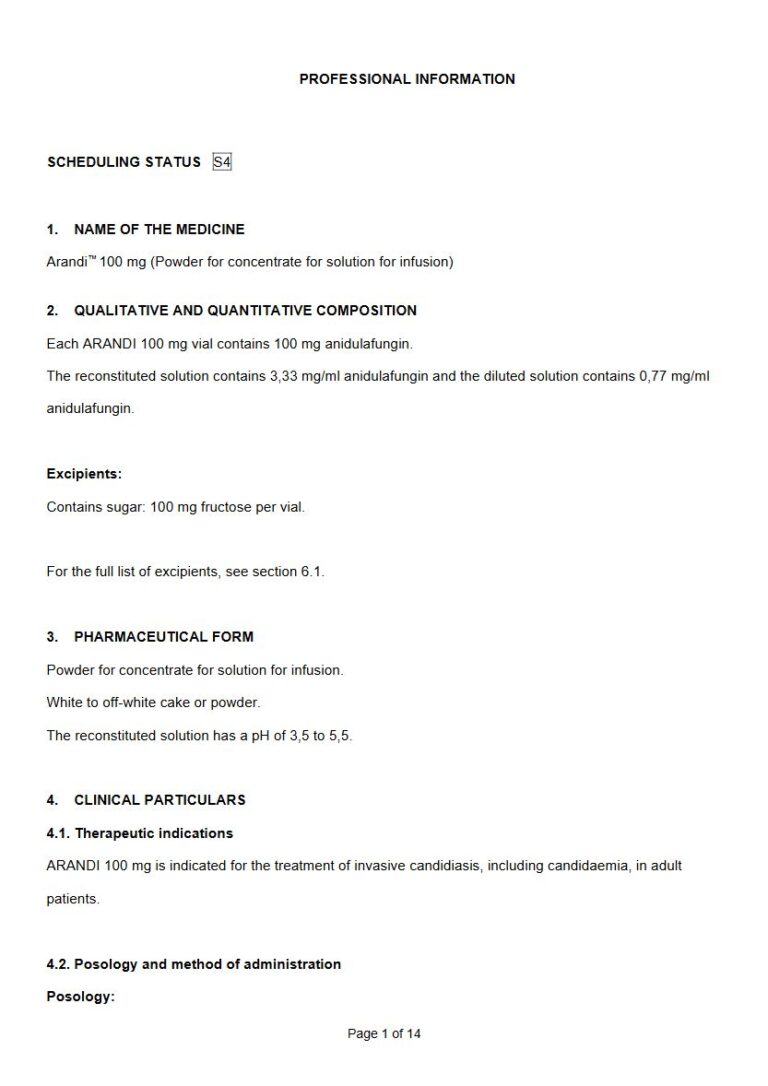
ARANDI 100 mg is indicated for the treatment of invasive candidiasis, including candidaemia, in adult patients.
4.2. Posology and method of administration
Posology:
Invasive candidiasis, including candidaemia, in adult patients: A single 200 mg loading dose should be administered on day 1, followed by 100 mg daily thereafter. Duration of treatment should be based on the patientu2019s clinical response. In general, antifungal therapy should continue for at least 14 days after the last positive culture.
Special populations:
Use in renal and hepatic impairment: No dosing adjustments are required for patients with mild, moderate, or severe hepatic impairment. Hepatic function should be monitored. No dosing adjustments are required for patients with any degree of renal insufficiency, including those on dialysis. ARANDI 100 mg can be given without regard to the timing of haemodialysis (see section 5.2).
Use in other special populations: No dosing adjustments are required for adult patients based on patient gender, weight, ethnicity, HIV positivity, or elderly status.
Use in children and adolescents: ARANDI 100 mg should not be used in children.
Method of administration:
ARANDI 100 mg should be reconstituted with water for injections to a concentration of 3,33 mg/ml and subsequently diluted to a concentration of 0,77 mg/ml before use according to the instructions given in section 6.6. It is recommended that ARANDI 100 mg is administered at a maximum rate of infusion that does not exceed 1,1 mg/minute. The rate of infusion is equivalent to 1,4 ml/min for the 100 mg and 200 mg doses. For single use only.
4.3. Contraindications
- Hypersensitivity to anidulafungin or to any of the excipients in ARANDI 100 mg listed in section 6.1.
- Hypersensitivity to other medicines of the echinocandin class (e.g. caspofungin).
- Pregnancy and lactation.
- Use in patients under 18 years of age.
4.4. Special warnings and precautions for use
ARANDI 100 mg has not been studied in patients with Candida endocarditis, osteomyelitis or meningitis. The efficacy of ARANDI 100 mg has only been evaluated in a limited number of neutropenic patients.
Hepatic effects: Increased levels of hepatic enzymes have been seen in healthy subjects and patients treated with anidulafungin. In some patients with serious underlying medical conditions who were receiving multiple concomitant medicines along with anidulafungin, clinically significant hepatic abnormalities have occurred. Cases of significant hepatic dysfunction, hepatitis, and hepatic failure were uncommon in clinical trials. Patients with increased hepatic enzymes during anidulafungin therapy should be monitored for evidence of worsening hepatic function and evaluated for risk/benefit of continuing anidulafungin therapy.
Anaphylactic reactions: Anaphylactic reactions, including shock, were reported with the use of anidulafungin. If these reactions occur, anidulafungin should be discontinued and appropriate treatment administered.
Infusion-related reactions: Infusion-related adverse events have been reported with anidulafungin, including rash, urticaria, flushing, pruritus, dyspnoea, bronchospasm and hypotension. Infusion-related adverse events are infrequent when the rate of anidulafungin infusion does not exceed 1,1 mg/min (see section 4.8). Exacerbation of infusion-related reactions by co-administration of anaesthetics has been seen in a non-clinical (rat) study (see section 5.3). The clinical relevance of this is unknown. Nevertheless, care should be taken when co-administering anidulafungin and anaesthetic medicines.
Fructose content: Patients with rare hereditary problems of fructose intolerance should not take ARANDI 100 mg. A detailed history with regard to hereditary fructose intolerance symptoms has to be taken from each patient prior to being given this medicine.
4.5. Interaction with other medicines and other forms of interaction
Anidulafungin is not a clinically relevant substrate, inducer, or inhibitor of cytochrome P450 isoenzymes (1A2, 2B6, 2C8, 2C9, 2C19, 2D6, 3A). Of note, in vitro studies do not fully exclude possible in vivo interactions. Interaction studies were performed with anidulafungin and other medicines likely to be co-administered. No dosage adjustment of either medicine is recommended when anidulafungin is co-administered with ciclosporin, voriconazole or tacrolimus, and no dosage adjustment for anidulafungin is recommended when co-administered with amphotericin B or rifampicin.
Paediatric population: Interaction studies have only been performed in adults.
4.6. Fertility, pregnancy and lactation
Pregnancy: There are no data from the use of anidulafungin in pregnant women. Studies in animals have shown reproductive toxicity.
Breastfeeding: It is unknown whether anidulafungin is excreted in human milk. Available pharmacodynamic/toxicological data in animals have shown excretion of anidulafungin in milk.
Fertility: For anidulafungin, there were no effects on fertility in studies conducted in male and female rats.
4.7. Effects on ability to drive and use machines
No studies on the ability to drive and use machines have been performed.
4.8. Undesirable effects
Summary of the safety profile: Infusion-related adverse reactions have been reported with anidulafungin in clinical studies, including rash, pruritus dyspnoea, bronchospasm, hypotension (frequent events), flushing, hot flush and urticaria (less frequent events), summarised in Table 1 (see section 4.4). The following table includes the all-causality adverse reactions (MedDRA terms) from subjects who received 100 mg anidulafungin. Within each frequency grouping, undesirable effects are presented in order of decreasing seriousness.
Table 1. Table of Adverse Reactions
System Organ Class Frequent Less frequent Frequency unknown Infections and Infestations Fungaemia, candidiasis, pseudomembranous colitis, oral candidiasis Blood and Lymphatic System Disorders Thrombocytopenia, coagulopathy Thrombocythaemia Immune System Disorders Anaphylactic shock, anaphylactic reaction* Metabolism and Nutrition Disorders Hyperkalaemia, hypokalaemia, Hypercalcaemia, hypernatraemia hyperglycaemia, hypomagnesaemia Nervous System Disorders Convulsion, headache Eye Disorders Eye pain, visual disturbance, vision blurred Cardiac Disorders Atrial fibrillation, sinus dysrhythmia, ventricular extrasystoles, bundle branch block right Vascular Disorders Flushing, hypotension, hypertension Thrombosis, hot flush Respiratory, Thoracic and Mediastinal Disorders Bronchospasm, dyspnoea Gastrointestinal Disorders Diarrhoea, nausea, vomiting Abdominal pain upper, faecal incontinence, constipation Hepatobiliary Disorders Gamma-Glutamyltransferase increased, alanine aminotransferase increased, blood alkaline phosphatase increased, aspartate aminotransferase increased, blood bilirubin increased, cholestasis Skin and Subcutaneous Tissue Disorders Rash, pruritus Urticaria, generalised pruritus Renal and Urinary Disorders Blood creatinine increased Musculoskeletal and Connective Tissue Disorders Back pain General Disorders and Administration Site Conditions Infusion site pain Investigations Prolonged electrocardiogram QT Increased blood amylase, decreased blood magnesium, decreased blood potassium, electrocardiogram abnormal, increased lipase, increased platelet count, increased blood urea *See section 4.4
Reporting of suspected adverse reactions: Reporting suspected adverse reactions after authorisation of the medicine is important. It allows continued monitoring of the benefit/risk balance of the medicine. Healthcare providers are asked to report any suspected adverse reactions to SAHPRA via the u201c6.04 Adverse Drug Reactions Reporting Formu201d, found online under SAHPRAu2019s publications: https://www.sahpra.org.za/Publications/Index/8. Suspected adverse reactions can also be reported directly to the HCR via [email protected].
4.9. Overdose
In case of overdose, adverse reactions may occur as mentioned in section 4.8 and general supportive measures should be utilised as necessary. During clinical trials, a single 400 mg dose of anidulafungin was inadvertently administered as a loading dose. No clinical adverse reactions were reported. No dose limiting toxicity was observed in a study of 10 healthy subjects administered a loading dose of 260 mg followed by 130 mg daily; 3 of the 10 subjects experienced transient, asymptomatic transaminase elevations (u22643 x Upper Limit of Normal (ULN)). ARANDI 100 mg is not dialysable.
