
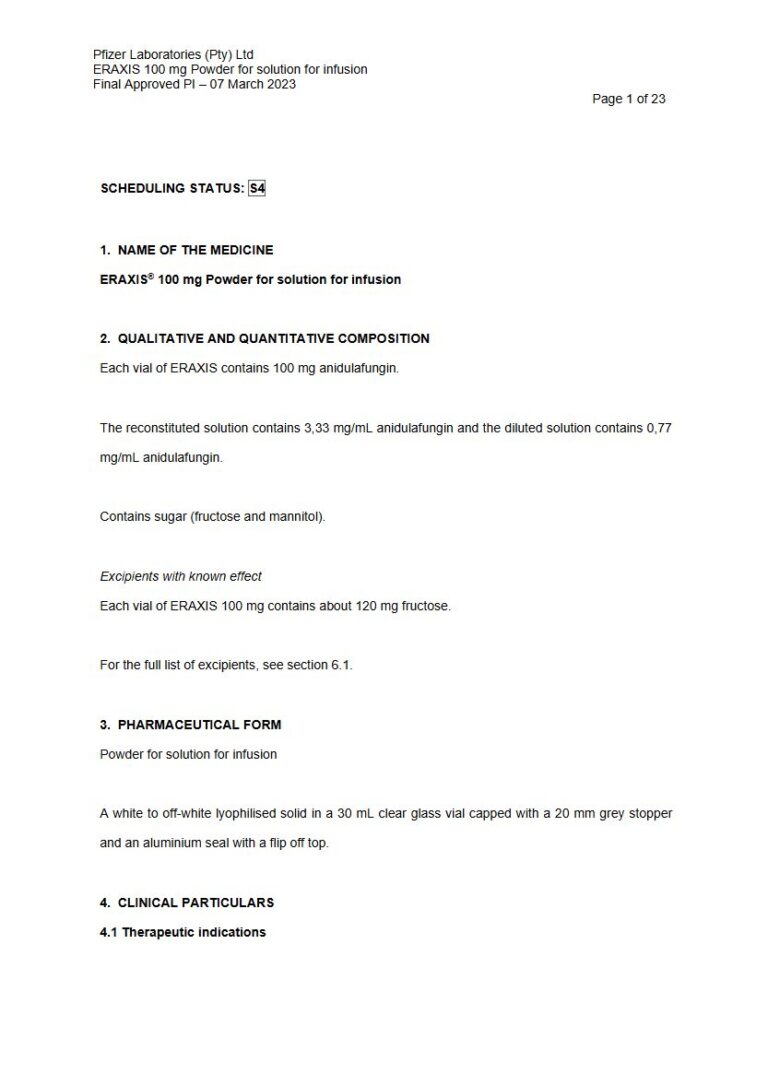
Eraxis 100 mg Powder for solution for infusion
PDF Leaflet Revision Date: 07 March 2023
Clinical Summary
Quick overview from the medicine insert
Indication
Treatment of invasive candidiasis, including candidaemia.
Dosage (summary)
200 mg loading dose on Day 1, followed by 100 mg daily.
Special Populations
- Renal impairment
- Hepatic impairment
Pregnancy & Breastfeeding
Avoid in pregnancy and breastfeeding; safety not established.
Key Drug Interactions
- Ciclosporin
- Voriconazole
- Tacrolimus
- Liposomal amphotericin B
- Rifampicin
Contraindications
- Hypersensitivity to anidulafungin
- Hypersensitivity to echinocandins
Common side effects
- Rash
- Pruritus
- Hypotension
- Diarrhoea
- Headache
Counselling Points
- Monitor for infusion reactions
- Use effective contraception during treatment
- Avoid in patients with hereditary fructose intolerance
Serious warnings
- Anaphylactic reactions
- Infusion-related reactions
- Hepatic effects
Important Disclaimer
The Eraxis 100 mg Powder for solution for infusion professional information leaflet below is the property of Pfizer Laboratories and is provided on Medinsert exactly as issued, with no.. alterations or editorial changes. We make every effort to keep content current by updating documents as soon as new versions become available. Medinsert serves as a trusted access point for healthcare professionals, but does not replace official sources or clinical judgement. For more details, please read our full disclaimer. read more>>
 Healthcare Professionals Only
This content is for registered healthcare professionals
Sign in or create a free account to read the full package insert.
Free for HPCSA-registered professionals. Powered by Medinsert.
Clinical Particulars
Section 4 of the official insert — extracted exactly as issued, no alterations
4.1 Therapeutic indications
ERAXIS is indicated for the treatment of invasive candidiasis, including candidaemia, in adults and paediatric patients 1 month of age and older (see section 4.4).
4.2 Posology and method of administration
Posology
Invasive candidiasis, including candidaemia, in adult patients
A single 200 mg loading dose should be administered on Day 1, followed by 100 mg daily thereafter. Duration of treatment should be based on the patientu2019s clinical response. In general, antifungal therapy should continue for at least 14 days after the last positive culture.
Special populations
Renal and hepatic impairment
No dosing adjustments are required for patients with renal (including those on dialysis) or hepatic impairment. Hepatic function should be monitored (see section 5.2).
Other special populations
No dosing adjustments are required for adult patients based on patient gender, weight, ethnicity, HIV positivity, or elderly.
Paediatric population
Use in children and adolescents 1 month to < 18 years (dosing and treatment duration)
A single loading dose of 3,0 mg/kg (not to exceed 200 mg) should be administered on Day 1 followed by a daily maintenance dose of 1,5 mg/kg (not to exceed 100 mg) thereafter. Duration of treatment should be based on the patientu2019s clinical response. In general, antifungal therapy should continue for at least 14 days after the last positive culture.
The safety and efficacy of ERAXIS have not been established in neonates (< 1 month old) (see section 4.4).
Method of administration
For intravenous use. For instructions on reconstitution and dilution of ERAXIS see section 6.6. ERAXIS should be reconstituted with water for injections to a concentration of 3,33 mg/mL and subsequently diluted to a concentration of 0,77 mg/mL before use according to the instructions in section 6.6. For a paediatric patient, the volume of infusion solution required to deliver the dose will vary depending on the weight of the child. It is recommended that ERAXIS is administered at a maximum rate of infusion that does not exceed 1,1 mg/minute (see section 4.4). The rate of infusion is equivalent to 1,4 mL/min for the 100 mg and 200 mg doses. For single use only.
4.3 Contraindications
- Hypersensitivity to anidulafungin or any of the excipients of ERAXIS listed in section 6.1.
- Hypersensitivity to other medicines of the echinocandin class (e.g. caspofungin).
4.4 Special warnings and precautions for use
Anaphylactic reactions
Anaphylactic reactions, including shock, have been reported with the use of ERAXIS. If these reactions occur, ERAXIS should be discontinued and appropriate treatment administered (see section 4.8).
Infusion-related reactions
Infusion-related adverse events have been reported with ERAXIS, including rash, urticaria, flushing, pruritus, dyspnoea, bronchospasm and hypotension. The infusion rate should not exceed the recommended infusion rate of 1,1 mg/minute.
Hepatic effects
Laboratory abnormalities in liver function tests have been seen in healthy subjects and patients treated with ERAXIS. In some patients with serious underlying medical conditions who were receiving multiple concomitant medicines along with ERAXIS, clinically significant hepatic abnormalities have occurred. Cases of significant hepatic dysfunction, hepatitis, or worsening hepatic failure have been reported. Patients who develop abnormal liver function tests during ERAXIS therapy should be monitored for evidence of worsening hepatic function and evaluated for continuing ERAXIS therapy. However, if deteriorating hepatic function is persistent, ERAXIS therapy should be withdrawn.
Paediatric population
Treatment with ERAXIS in neonates (< 1 month old) is not recommended. Treating neonates requires consideration for coverage of disseminated candidiasis including central nervous system (CNS); non-clinical infection models indicate that higher doses of ERAXIS are needed to achieve adequate CNS penetration, resulting in higher doses of polysorbate 80, a formulation excipient. High doses of polysorbates have been associated with potentially life-threatening toxicities in neonates as reported in the literature.
Information about the excipients of ERAXIS
ERAXIS contains fructose. Patients with hereditary fructose intolerance (HFI) must not be given this medicine unless strictly necessary. Babies and young children (below 2 years of age) may not yet be diagnosed with HFI. Medicines (containing fructose) given intravenously may be life-threatening and should not be administered in this population unless there is an overwhelming clinical need and no alternatives are available.
A detailed history with regard to HFI symptoms has to be taken of each patient prior to being given ERAXIS.
Sodium content
ERAXIS contains less than 1 mmol sodium (23 mg) per vial. Patients on low sodium diets can be informed that ERAXIS is essentially u2018sodium freeu2019. ERAXIS may be diluted with sodium-containing solutions (see section 6.6) and this should be considered in relation to the total sodium from all sources that will be administered to the patient.
4.5 Interaction with other medicines and other forms of interaction
Ciclosporin (CYP3A4 substrate)
In a study of 12 healthy adult subjects who received 100 mg/day ERAXIS following a 200 mg loading dose alone and in combination with 1,25 mg/kg oral ciclosporin twice daily, the steady state plasma peak concentration (C max) of ERAXIS was not significantly altered by ciclosporin; however, the steady state area under the concentration-time curve (AUC) was increased by 22 %. An in vitro study has shown that ERAXIS has no effect on the metabolism of ciclosporin. Adverse events observed in this study were consistent with those observed in other studies where ERAXIS only was administered. No dosage adjustment of either medicine is required when they are co-administered.
Voriconazole (CYP2C19, CYP2C9, CYP3A4 inhibitor and substrate)
In a study of 17 healthy subjects who received 100 mg/day ERAXIS alone following a 200 mg loading dose, 200 mg twice daily oral voriconazole alone following 400 mg twice on the first day as loading doses, and both in combination, the steady state C max and AUC of ERAXIS and voriconazole were not significantly altered by co-administration. No dosage adjustment of either medicine is required when co-administered.
Tacrolimus (CYP3A4 substrate)
In a study of 35 healthy subjects who received a single oral dose of 5 mg tacrolimus alone, 100 mg/day ERAXIS alone following a 200 mg loading dose and both in combination, the steady state C max and AUC of ERAXIS and tacrolimus were not significantly altered by co-administration. No dosage adjustment of either medicine is required when co-administered.
Liposomal amphotericin B
The pharmacokinetics of ERAXIS were examined in 27 patients (100 mg/day ERAXIS) who were co-administered with liposomal amphotericin B (doses up to 5 mg/kg/day). The population pharmacokinetic analysis showed that, the pharmacokinetics of ERAXIS were not significantly altered by co-administration with amphotericin B when compared to data from patients who did not receive amphotericin B. No dosage adjustment of ERAXIS is required.
Rifampicin (potent CYP450 inducer)
The pharmacokinetics of ERAXIS were examined in 27 patients (50 or 75 mg/day ERAXIS) who were co-administered with rifampicin (doses up to 600 mg/day). The population pharmacokinetic analysis showed that when compared to data from patients that did not receive rifampicin, the pharmacokinetics of ERAXIS were not significantly altered by co-administration with rifampicin. No dosage adjustment of ERAXIS is required.
No studies have been conducted to evaluate interaction of ERAXIS with other medicines used for the treatment of TB or HIV.
Paediatric population
Interaction studies have only been performed in adults.
4.6 Fertility, pregnancy and lactation
Women of childbearing potential/Contraception in males and females
Effective contraception should be used in women of childbearing age while taking ERAXIS and for two weeks after discontinuation of ERAXIS treatment.
Pregnancy
Safety in pregnancy and lactation has not been established. Use of ERAXIS should be avoided in pregnant women and women likely to become pregnant unless no safer treatment option is available.
Breastfeeding
It is not known whether ERAXIS is excreted in human breast milk. Use of ERAXIS should be avoided in women who are breastfeeding their babies. In animal studies, ERAXIS was found to cause foetal harm in rabbits and was excreted in breastmilk in rats.
4.7 Effects on ability to drive and use machines
Side effects such as visual disturbances and central nervous system effects may impair the ability to drive or to use machines.
4.8 Undesirable effects
Summary of the safety profile
Nine hundred and twenty-nine (929) patients received intravenous ERAXIS in clinical trials (672 in Phase 2/3 studies and 257 in Phase I studies). Of the 669 Phase 2/3 patients for whom safety data are available, five hundred and five (505) received ERAXIS for u2265 14 days.
Three studies (one comparative vs fluconazole, 2 non-comparative) assessed the efficacy of ERAXIS (100 mg) in patients with candidaemia and other deep tissue Candida infections. In these three studies, a total of 204 patients received ERAXIS, 119 for u2265 14 days.
The medicine-related adverse events (MedDRA) listed below were reported with frequencies corresponding to Very common (u2265 1/10); common (u2265 1/100 to < 1/10); uncommon (u2265 1/1 000 to < 1/100); rare (u2265 1/10 000 to < 1/1 000); very rare (< 1/10 000). Within each frequency grouping, undesirable effects are presented in order of decreasing seriousness.
Infusion-related adverse events have been reported with ERAXIS, including rash, urticaria, flushing, pruritus, dyspnoea, and hypotension.
Tabulated summary of adverse reactions
MedDRA system organ class Frequency Undesirable effects
Infections and infestations Uncommon Fungaemia, candidiasis, pseudomembranous colitis, oral candidiasis
Blood and lymphatic system disorders Common Thrombocytopenia, coagulopathy Uncommon Thrombocythaemia
Metabolism and nutrition disorders Common Hyperkalaemia, hypokalaemia, hypomagnesaemia Uncommon Hyperglycaemia, hypercalcaemia, hypernatraemia
Nervous system disorders Common Convulsion, headache
Eye disorders Uncommon Eye pain, visual disturbance, blurred vision
Cardiac disorders Uncommon Atrial fibrillation, sinus dysrhythmia, ventricular extrasystoles, bundle branch block right
Vascular disorders Common Flushing Uncommon Thrombosis, hypertension, hot flush
Gastrointestinal disorders Common Diarrhoea Uncommon Upper abdominal pain, vomiting, faecal incontinence, nausea, constipation
Hepato-biliary disorders Common Increased gamma-glutamyltransferase, increased blood alkaline phosphatase, increased aspartate aminotransferase, increased alanine aminotransferase Uncommon Abnormal liver function test, cholestasis, increased hepatic enzyme, increased transaminases
Skin and subcutaneous tissue disorders Common Rash, pruritus Uncommon Urticaria, generalised pruritus
Musculoskeletal and connective tissue disorders Uncommon Back pain
General disorders and administration site conditions Uncommon Infusion site pain
Investigations Common Increased blood bilirubin, decreased platelet count, increased blood creatinine, prolonged electrocardiogram QT Uncommon Increased blood amylase, decreased blood magnesium, decreased blood potassium, abnormal electrocardiogram, increased lipase, increased platelet count, increased blood urea
In the safety assessment of the full Phase 2/3 patient population (N = 669), the following additional adverse events, all uncommon (u2265 1/1 000 to < 1/100), were of note:
MedDRA system organ class Side effect
Infections and infestations Lymphangitis
Blood and lymphatic system disorders Neutropenia, leukopenia, anaemia
Metabolism and nutrition disorders Hyperuricaemia, hypocalcaemia, hyponatraemia, hypoalbuminaemia, hypophosphataemia
Psychiatric disorders Anxiety, delirium, confusional state, auditory hallucination
Nervous system disorders Dizziness, paraesthesia, central pontine myelinolysis, dysgeusia, Guillain-Barru00e9 syndrome, tremor
Eye disorders Altered visual depth perception
Ear and labyrinth disorders Unilateral deafness
Vascular disorders Phlebitis, superficial thrombophlebitis, hypotension
Gastrointestinal disorders Dyspepsia, dry mouth, oesophageal ulcer
Hepato-biliary disorders Hepatic necrosis
Skin and subcutaneous tissue disorders Angioedema, hyperhidrosis
Musculoskeletal and connective tissue disorders Myalgia, monoarthritis
Renal and urinary disorders Renal failure, haematuria
General disorders and administration site conditions Pyrexia, chills, peripheral oedema, injection site reaction
Investigations Increased blood creatine phosphokinase, increased blood lactate dehydrogenase, decreased lymphocyte count
Paediatric population
The safety of ERAXIS was investigated in 68 paediatric patients (1 month to < 18 years) with invasive candidiasis, including candidaemia (ICC) in a prospective, open-label, non-comparative paediatric study. The frequencies of certain hepatobiliary adverse events, including increased alanine aminotransferase (ALT) increased and aspartate aminotransferase (AST) appeared at a higher frequency (7 u2013 10 %) in these paediatric patients than has been observed in adults (2 %). Although chance or differences in underlying disease severity may have contributed, it cannot be excluded that hepatobiliary adverse reactions occur more frequently in paediatric patients compared to adults.
Post-marketing adverse events
Adverse drug reactions reported from post-marketing experiences are included in the table below:
MedDRA system organ class Side effect
Immune system disorders Anaphylactic shock, anaphylactic reaction
Respiratory, thoracic and mediastinal disorders Bronchospasm
Reporting of suspected adverse reactions
Reporting suspected adverse reactions after authorisation of the medicine is important. It allows continued monitoring of the benefit/risk balance of the medicine. Health care providers are asked to report any suspected adverse reactions to SAHPRA via the u201c6.04 Adverse Drug Reactions Reporting Formu201d, found online under SAHPRAu2019s publications: https://www.sahpra.org.za/Publications/Index/8
4.9 Overdose
General supportive measures should be utilised as necessary. In a study of 10 healthy subjects administered a loading dose of 260 mg followed by 130 mg daily, ERAXIS was well tolerated with no dose limiting toxicity; 3 of the 10 subjects experienced transient, asymptomatic transaminase elevations (u2264 3 x ULN). During a paediatric clinical trial, one patient received two doses of ERAXIS that were 143 % of the expected dose. No clinical adverse reactions were reported. Side effects may be exacerbated or exaggerated in overdose. ERAXIS is not dialysable. Treatment is symptomatic and supportive.
