
Aspirin 300 Unimed Tablets
PDF Leaflet Revision Date: 11 August 2023
Clinical Summary
Quick overview from the medicine insert
Indication
Relief of mild to moderate pain and fever.
Dosage (summary)
Adults: 1-2 tablets every 4 hours; max 10 days without doctor consultation.
Special Populations
- Elderly
- Renal impairment
- Hepatic impairment
Pregnancy & Breastfeeding
Contraindicated in pregnancy and lactation; may cause fetal renal dysfunction.
Key Drug Interactions
- Increased risk of gastrointestinal bleeding with NSAIDs
- Enhanced anticoagulant effects with warfarin
Contraindications
- Peptic ulcers
- Haemophilia
- Severe renal impairment
- Hypersensitivity to aspirin
- Heart failure
Common side effects
- Gastrointestinal bleeding
- Nausea
- Dizziness
- Oedema
Counselling Points
- Use the lowest effective dose
- Consult doctor if symptoms persist
- Avoid in children under 12 years
Serious warnings
- Risk of gastrointestinal perforation
- Serious skin reactions
- Reye's syndrome in children
Important Disclaimer
The Aspirin 300 Unimed Tablets professional information leaflet below is the property of Unimed Healthcare and is provided on Medinsert exactly as issued, with no.. alterations or editorial changes. We make every effort to keep content current by updating documents as soon as new versions become available. Medinsert serves as a trusted access point for healthcare professionals, but does not replace official sources or clinical judgement. For more details, please read our full disclaimer. read more>>
 Healthcare Professionals Only
This content is for registered healthcare professionals
Sign in or create a free account to read the full package insert.
Free for HPCSA-registered professionals. Powered by Medinsert.
Clinical Particulars
Section 4 of the official insert — extracted exactly as issued, no alterations
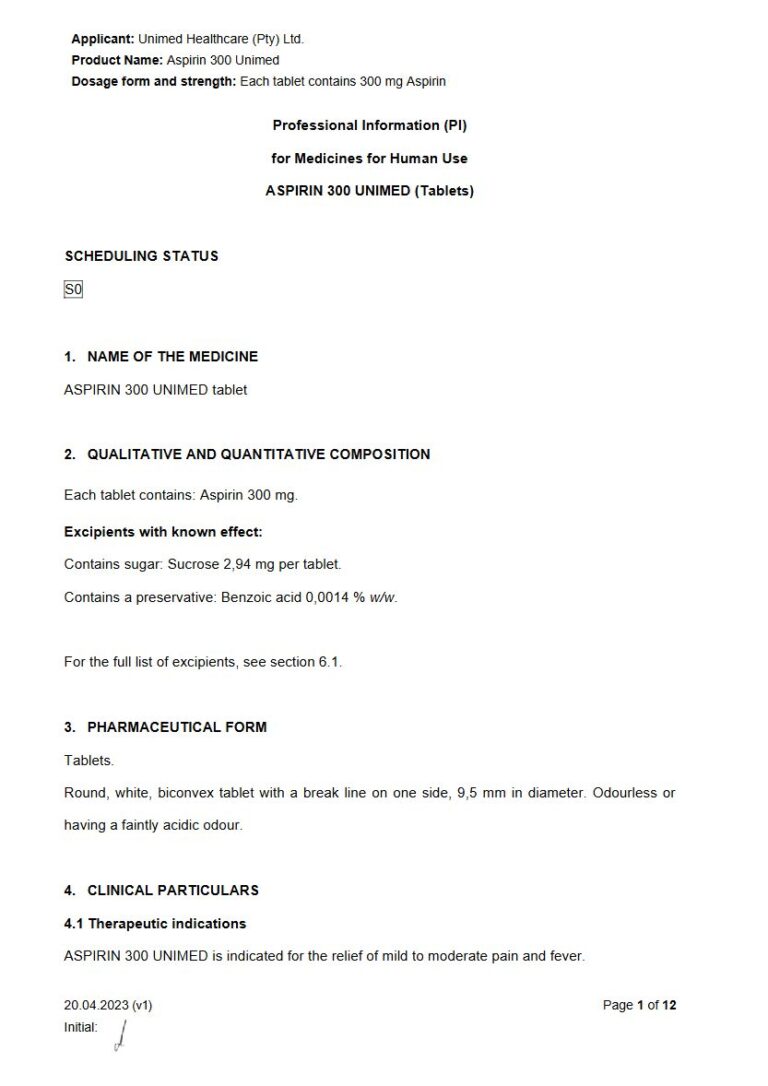
4.1 Therapeutic indications
ASPIRIN 300 UNIMED is indicated for the relief of mild to moderate pain and fever.
4.2 Posology and method of administration
Posology
Use the lowest effective dose for the shortest possible duration of treatment.
Adults: One to two tablets every four hours with water. Do not use continuously for longer than ten (10) days without consulting your doctor.
Method of administration
For oral administration.
4.3 Contraindications
- Patients with peptic ulcers, haemophilia, severe renal impairment and patients receiving oral anti-coagulant therapy.
- Patients with an intolerance (hypersensitivity) to aspirin, or hypersensitivity to any of the excipients in ASPIRIN 300 UNIMED.
- Heart failure.
- History of gastrointestinal perforation, ulceration or bleeding (PUBs) related to previous NSAIDs, including ASPIRIN 300 UNIMED.
- Active or history of recurrent ulcer, haemorrhage or perforations.
- Pregnancy and lactation (see section 4.6).
- Not to be used in children under the age of 12 years (see section 4.4).
4.4 Special warnings and precautions for use
Do not use continuously for longer than ten (10) days without consulting your doctor. Excessive and prolonged use of this medicine may be dangerous. Not for children under 12 years of age (see section 4.3).
Reye's syndrome
Aspirin as contained in Aspirin 300 Unimed has been implicated in Reye's syndrome, a rare but serious illness in children and teenagers with chickenpox and influenza. A doctor should be consulted before ASPIRIN 300 UNIMED is used in such patients.
Heart conditions
Caution is required in patients with a history of hypertension and/or heart failure as fluid retention and oedema have been reported in association with ASPIRIN 300 UNIMED therapy. In view of the ASPIRIN 300 UNIMEDu2019s inherent potential to cause fluid retention, heart failure may be precipitated in some compromised patients.
Elderly
The elderly have an increased frequency of adverse reactions to NSAIDs including ASPIRIN 300 UNIMED, especially gastrointestinal perforation, ulceration and bleeding (PUBs) which may be fatal.
Gastrointestinal perforation, ulceration or bleeding (PUBs)
The risk of gastrointestinal perforation, ulceration or bleeding (PUBs) is higher with increasing doses of ASPIRIN 300 UNIMED, in patients with a history of ulcers, and the elderly. When gastrointestinal bleeding or ulceration occurs in patients receiving ASPIRIN 300 UNIMED, treatment with ASPIRIN 300 UNIMED should be stopped. ASPIRIN 300 UNIMED should be given with caution to patients with a history of gastrointestinal disease (e.g. ulcerative colitis, Crohnu2019s disease, hiatus hernia, gastroesophageal reflux disease, angiodysplasia) as the condition may be exacerbated. ASPIRIN 300 UNIMED should be stopped several days before scheduled surgical procedures because of the possibility of increased bleeding times.
4.5 Interaction with other medicines and other forms of interaction
NSAIDs
The use of two or more NSAIDs concomitantly could result in an increase in side effects. The plasma concentrations of some other NSAIDu2019s, for example fenbufen, indomethacin and piroxicam, may be decreased when given concomitantly with ASPIRIN 300 UNIMED.
Corticosteroids
Concomitant treatment with corticosteroids may increase the risk of gastrointestinal perforation, ulceration or bleeding (PUBs). Corticosteroids may reduce plasma-salicylate concentrations. Conversely, salicylate toxicity may occur if corticosteroids are withdrawn.
Anti-platelet medicines and selective serotonin reuptake inhibitors (SSRIs)
Increased risk of gastrointestinal bleeding.
Others
ASPIRIN 300 UNIMED may enhance the activity of coumarin anticoagulants (such as warfarin), oral antidiabetic preparations, sulphonamides, zafirlukast, methotrexate, phenytoin and valproate. ASPIRIN 300 UNIMED diminishes the effects of uricosurics such as probenecid and sulphinpyrazone. Barbiturates and other sedatives may mask the respiratory symptoms of ASPIRIN 300 UNIMED overdosage and have been reported to enhance its toxicity. Antacids may increase the excretion of aspirin, as in ASPIRIN 300 UNIMED, in alkaline urine. ASPIRIN 300 UNIMED may alter the efficacy of mifepristone. Use of ASPIRIN 300 UNIMED with medicines such as dipyridamole, metoclopramide, metoprolol and carbonic anhydrase inhibitors may result in increased plasma-salicylate concentrations. Alcohol may exacerbate the gastrointestinal effects of ASPIRIN 300 UNIMED.
Interference with laboratory tests
ASPIRIN 300 UNIMED may produce falsely increased results for blood creatinine, urate (low dose aspirin) and urea. Falsely decreased results may be obtained for blood thyroxine and urate (> 4 g/day aspirin) and for urinary 5-HIAA (with nitrosonaphthol method). Urinary VMA (HMMA) levels may be falsely increased or decreased depending on the method of analysis. Urinary glucose oxidase: ASPIRIN 300 UNIMED may cause a false negative test in the presence of glycosuria.
4.6 Fertility, pregnancy and lactation
ASPIRIN 300 UNIMED is contraindicated during pregnancy and lactation. Regular use of non-steroidal anti-inflammatory drugs (NSAIDs) during the third trimester of pregnancy, may result in premature closure of the foetal ductus arteriosus in utero, and possibly, in persistent pulmonary hypertension of the new-born. The onset of labour may be delayed and its duration increased. The administration of ASPIRIN 300 UNIMED around 20 weeks or later in pregnant patients may cause foetal renal dysfunction, which may progress to renal failure with oligohydramnios, and in some cases neonatal renal impairment (see sections 4.3 & 4.4).
4.7 Effects on ability to drive and use machines
No studies on the effects on the ability to drive and use machines have been performed with ASPIRIN 300 UNIMED. Since side effects such as dizziness have been reported in patients receiving ASPIRIN 300 UNIMED, patients should not drive or use any machinery until they are certain that ASPIRIN 300 UNIMED does not affect their ability to do so.
4.8 Undesirable effects
Side effects of ASPIRIN 300 UNIMED treatment are listed below. The frequencies of these reported side effects are unknown.
Blood and lymphatic system disorders
Increased bleeding time decreased platelet adhesiveness. Prolonged use in high doses may lead to hypoprothrombinaemia and other blood disorders including thrombocytopenia.
Immune system disorders
Some persons, especially asthmatics, exhibit notable sensitivity to ASPIRIN 300 UNIMED which may include skin eruptions, paroxysmal bronchospasm, dyspnoea, urticaria, angioedema and rhinitis.
Nervous system disorders
Dizziness
Cardiac disorders
Oedema, hypertension and cardiac failure.
Gastrointestinal disorders
The most frequently observed adverse events are gastrointestinal in nature. Peptic ulcers, perforation or gastrointestinal bleeding, sometimes fatal. Nausea, vomiting, diarrhoea, flatulence, constipation, dyspepsia, abdominal pain, melaena, haematemesis, ulcerative stomatitis, exacerbation of colitis and Crohnu2019s disease, gastritis.
Hepato-biliary disorders
Hepatotoxicity, especially in patients with juvenile idiopathic arthritis or other connective tissue disorders.
Skin and subcutaneous tissue disorders
Bullous reactions, including Stevens-Johnson syndrome and toxic epidermal necrolysis.
Drug Reaction with Eosinophilia and Systemic Symptoms (DRESS) (see section 4.4).
Respiratory, thoracic and mediastinal disorders
Bronchospasm, asthma attack.
Reporting of suspected adverse reactions
Reporting suspected adverse reactions after authorisation of the medicine is important. It allows continued monitoring of the benefit/risk balance of the medicine. Health care providers are asked to report any suspected adverse reactions to SAHPRA via the u201c6.04 Adverse Drug Reactions Reporting Formu201d, found online under SAHPRAu2019s publications: https://www.sahpra.org.za/Publications/Index/8
4.9 Overdose
Symptoms include dizziness, tinnitus, deafness, sweating, nausea, headache, vomiting, and mental confusion. Symptoms of more acute or severe intoxication following overdose include hyperventilation, fever, respiratory alkalosis, metabolic acidosis, and ketosis. Depression of the central nervous system may lead to coma, cardiovascular collapse or respiratory failure. In children drowsiness and metabolic acidosis commonly occur, hypoglycaemia may be severe. In children serious signs of overdosage may develop rapidly. In cases of overdosage, consult your doctor immediately. Treatment is supportive and symptomatic. Fluid and electrolyte management is the mainstay of treatment with the immediate aim being correction of acidosis, hyperpyrexia, hypokalaemia and dehydration. Salicylate remaining in the stomach may be adsorbed by activated charcoal. Alkaline diuresis, haemodialysis or haemoperfusion are effective methods of removing salicylate from the plasma.
