
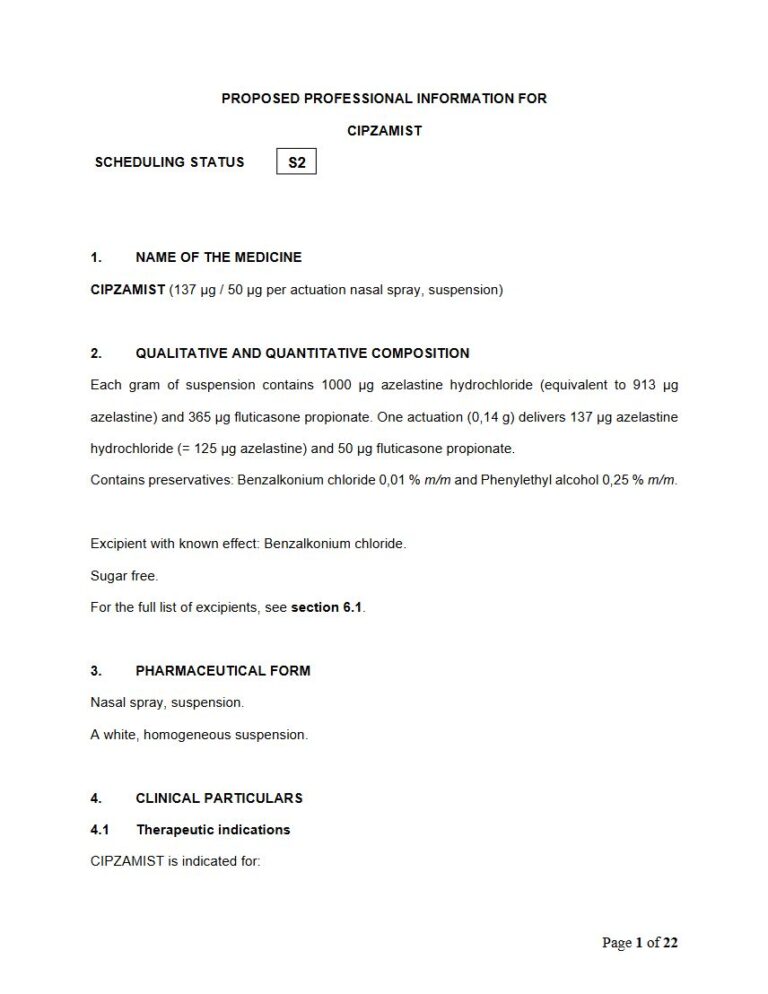
Cipzamist 137 μg & 50 μg Nasal Spray
PDF Leaflet Revision Date: Not applicable.
Clinical Summary
Quick overview from the medicine insert
Indication
Treatment of allergic rhinitis and rhino-conjunctivitis.
Dosage (summary)
One actuation in each nostril twice daily for adults and children 6 years and older.
Onset of Action / Duration
Onset: 15 mins, Duration: Long-term use recommended.
Special Populations
- Elderly patients
- Renal impairment
- Hepatic impairment
Pregnancy & Breastfeeding
Limited data; caution advised during pregnancy and breastfeeding.
Key Drug Interactions
- Ritonavir
- Ketoconazole
- Alcohol
Contraindications
- Hypersensitivity to azelastine or fluticasone
Common side effects
- Dysgeusia
- Epistaxis
- Headache
Counselling Points
- Avoid contact with eyes
- Monitor for nasal irritation
- Caution with CNS depressants
Serious warnings
- Somnolence
- Potential for glaucoma and cataracts
- Immunosuppression risk
Important Disclaimer
The Cipzamist 137 μg & 50 μg Nasal Spray professional information leaflet below is the property of Cipla Medpro and is provided on Medinsert exactly as issued, with no.. alterations or editorial changes. We make every effort to keep content current by updating documents as soon as new versions become available. Medinsert serves as a trusted access point for healthcare professionals, but does not replace official sources or clinical judgement. For more details, please read our full disclaimer. read more>>
 Healthcare Professionals Only
This content is for registered healthcare professionals
Sign in or create a free account to read the full package insert.
Free for HPCSA-registered professionals. Powered by Medinsert.
Clinical Particulars
Section 4 of the official insert — extracted exactly as issued, no alterations
4.1 Therapeutic indications
CIPZAMIST is indicated for:
- The treatment of seasonal and perennial allergic rhinitis (including hay fever) and rhino-conjunctivitis in adults if the use of either intranasal antihistamine or corticosteroid alone is not sufficient.
- Short term treatment of seasonal allergic rhinitis in children above the age of 6 years if the use of either intranasal antihistamine or corticosteroid alone is not sufficient.
4.2 Posology and method of administration
Posology
For full therapeutic benefit regular usage is essential. Contact with the eyes should be avoided.
Adults and children 6 years and older
One actuation in each nostril twice daily (morning and evening).
Children below 6 years
CIPZAMIST is not recommended for use in children below 6 years of age as safety and efficacy has not been established in this age group.
Duration of treatment
CIPZAMIST is suitable for long-term use. The duration of treatment should correspond to the period of allergenic exposure.
Special populations
Elderly patients
No dose adjustment is required in this population.
Renal and hepatic impairment
There are no data in patients with renal and hepatic impairment.
Method of administration
CIPZAMIST is for nasal use only.
Instruction for use
Preparing the spray: The bottle should be shaken gently before use for about 5 seconds by tilting it upwards and downwards and the protective cap be removed afterwards. Prior to first use CIPZAMIST must be primed by pressing down and releasing the pump 6 times. If CIPZAMIST has not been used for more than 7 days, it must be reprimed once by pressing down and releasing the pump.
Using the spray: After blowing the nose the suspension is to be sprayed once into each nostril keeping the head tilted downward (see figure). After use the spray tip is to be wiped and the protective cap to be replaced.
4.3 Contraindications
CIPZAMIST is contraindicated in:
- Patients with known hypersensitivity to azelastine hydrochloride and fluticasone propionate or to any of the excipients used in the formulation of CIPZAMIST (see section 6.1).
4.4 Special warnings and precautions for use
Somnolence
Somnolence has been reported in some patients using CIPZAMIST in trials (see section 4.8). Patients should be cautioned against engaging in hazardous occupations requiring complete mental alertness and motor coordination such as operating machinery or driving a motor vehicle after administration of CIPZAMIST. Concurrent use of CIPZAMIST with alcohol or other central nervous system depressants should be avoided because additional reductions in alertness and additional impairment of central nervous system performance may occur (see section 4.5 and 4.7).
Local Nasal Effects
In reported clinical trials, epistaxis was observed more frequently in patients treated with azelastine hydrochloride and fluticasone propionate than those who received placebo (see section 4.8). Instances of nasal ulceration and nasal septal perforation have been reported in patients following the intranasal application of corticosteroids. There were no instances of nasal ulceration or nasal septal perforation observed in reported clinical trials with azelastine hydrochloride and fluticasone propionate. Because of the inhibitory effect of corticosteroids on wound healing, patients who have experienced recent nasal ulcers, nasal surgery, or nasal trauma should avoid use of CIPZAMIST until healing has occurred. In reported clinical trials with fluticasone propionate administered intranasally, the development of localized infections of the nose and pharynx with Candida albicans has occurred. When such an infection develops, it may require treatment with appropriate local therapy and discontinuation of treatment with CIPZAMIST. Patients using CIPZAMIST over several months or longer should be examined periodically for evidence of Candida infection or other signs of adverse effects on the nasal mucosa.
Glaucoma and Cataracts
Nasal and inhaled corticosteroids may result in the development of glaucoma and/or cataracts. Therefore, close monitoring is warranted in patients with a change in vision or with a history of increased intraocular pressure, glaucoma, and/or cataracts. Glaucoma and cataract formation were evaluated with intraocular pressure measurements and slit lamp examinations in a reported clinical study in adolescent and adult patients aged 12 years and older with perennial allergic or vasomotor rhinitis (VMR). In the azelastine hydrochloride and fluticasone propionate group, one patient had increased intraocular pressure at month 6. In addition, three patients had evidence of posterior subcapsular cataract at month 6 and one at month 12 (end of treatment). In the fluticasone propionate group, three patients had evidence of posterior subcapsular cataract at month 12 (end of treatment).
Immunosuppression
Persons who are using medicines, such as corticosteroids, that suppress the immune system are more susceptible to infections than healthy individuals. Chickenpox and measles can have a more serious or even fatal course in susceptible children or adults using corticosteroids. In children or adults who have not had these diseases or been properly immunized, particular care should be taken to avoid exposure. How the dose, route, and duration of corticosteroid administration affect the risk of developing a disseminated infection is not known. The contribution of the underlying disease and/or prior corticosteroid treatment to the risk is also not known. If exposed to chickenpox, prophylaxis with varicella zoster immune globulin (VZIG) may be indicated. If exposed to measles, prophylaxis with pooled intramuscular immunoglobulin (IG) may be indicated. If chickenpox develops, treatment with antiviral medicines may be considered.
Corticosteroids should be used with caution, if at all, in patients with active or quiescent tuberculous infections of the respiratory tract; untreated local or systemic fungal or bacterial infections; systemic viral or parasitic infections; or ocular herpes simplex because of the potential for worsening of these infections.
Hypothalamic-Pituitary-Adrenal (HPA) Axis Effects
When intranasal steroids are used at higher than recommended dosages or in susceptible individuals at recommended dosages, systemic corticosteroid effects such as hypercorticism and adrenal suppression may appear. If such changes occur, the dosage of CIPZAMIST should be discontinued slowly, consistent with accepted procedures for discontinuing oral corticosteroid therapy. The concomitant use of intranasal corticosteroids with other inhaled corticosteroids could increase the risk of signs or symptoms of hypercorticism and/or suppression of the HPA axis. The replacement of a systemic corticosteroid with a topical corticosteroid can be accompanied by signs of adrenal insufficiency, and in addition some patients may experience symptoms of withdrawal, e.g., joint and/or muscular pain, lassitude, and depression. Patients previously treated for prolonged periods with systemic corticosteroids and transferred to topical corticosteroids should be carefully monitored for acute adrenal insufficiency in response to stress. In those patients who have asthma or other clinical conditions requiring long-term systemic corticosteroid treatment, too rapid a decrease in systemic corticosteroids may cause a severe exacerbation of their symptoms.
Use of Cytochrome P450 3A4 Inhibitors
Ritonavir and other strong cytochrome P450 3A4 (CYP3A4) inhibitors can significantly increase plasma fluticasone propionate exposure, resulting in significantly reduced serum cortisol concentrations (see sections 4.5 and 5.2). During post-marketing use, there have been reports of clinically significant medicine interactions in patients receiving fluticasone propionate and ritonavir, resulting in systemic corticosteroid effects including Cushing syndrome and adrenal suppression. Therefore, co-administration of CIPZAMIST and ritonavir is not recommended. Use caution with the co-administration of CIPZAMIST and other potent CYP3A4 inhibitors, such as ketoconazole (see sections 4.5 and 5.2).
Effect on Growth
Growth retardation has been reported in paediatric patients receiving corticosteroids. It is recommended that the growth of paediatric patients receiving CIPZAMIST is regularly monitored (see section 4.8).
Benzalkonium chloride
CIPZAMIST contains benzalkonium chloride. Prolonged use of benzalkonium chloride may result in irritation or inflammation of the nasal mucosa and induce bronchospasm.
4.5 Interaction with other medicines and other forms of interaction
Fluticasone propionate
Under normal circumstances, low plasma concentrations of fluticasone propionate are achieved after intranasal dosing, due to extensive first pass metabolism and high systemic clearance mediated by cytochrome P450 3A4 in the gut and liver. Hence, clinically significant medicine interactions mediated by fluticasone propionate are unlikely.
A study of the interaction with ritonavir conducted in healthy subjects has shown that ritonavir (a highly potent cytochrome P450 3A4 inhibitor) can significantly increase fluticasone propionate plasma concentrations, resulting in markedly reduced serum cortisol concentrations. During post-marketing use, there have been reports of clinically significant medicine interactions in patients receiving intranasal or inhaled fluticasone propionate and ritonavir, resulting in systemic corticosteroid effects. Co-treatment with other CYP 3A4 inhibitors, including cobicistat-containing products is also expected to increase the risk of systemic side effects. The combination should be avoided unless the benefit outweighs the increased risk of systemic corticosteroid side-effects, in which case patients should be monitored for systemic corticosteroid side effects.
Reported studies have shown that other inhibitors of cytochrome P450 3A4 produce negligible (erythromycin) and minor (ketoconazole) increases in systemic exposure to fluticasone propionate without notable reductions in serum cortisol concentrations. Nevertheless, care is advised when co-administering potent cytochrome P450 3A4 inhibitors (e.g. ketoconazole), as there is potential for increased systemic exposure to fluticasone propionate.
Azelastine hydrochloride
No specific interaction studies with azelastine hydrochloride nasal spray have been performed. Interaction studies at high oral doses have been performed. However, they bear no relevance to azelastine nasal spray as given recommended nasal doses result in much lower systemic exposure. Nevertheless, care should be taken when administering azelastine hydrochloride in patients taking concurrent sedative or central nervous medications because sedative effect may be enhanced. Alcohol may also enhance this effect (see section 4.7).
4.6 Fertility, pregnancy and lactation
Pregnancy
There are no or limited amount of data from the use of azelastine hydrochloride and fluticasone propionate in pregnant women. There are no adequate and well-controlled clinical trials of azelastine hydrochloride only, or fluticasone propionate only in pregnant women. Animal reproductive studies of azelastine hydrochloride and fluticasone propionate in mice, rats, and/or rabbits revealed evidence of teratogenicity as well as other developmental toxic effects.
Azelastine hydrochloride:
Azelastine hydrochloride has shown teratogenic effects in experimental animals, such as mice, rats and rabbits. Effects such as embryo-foetal death, malformations (cleft palate; short or absent tail; fused, absent or branched ribs), delayed ossification, and decreased foetal weight and maternal toxicity occurred in mice. In rats, azelastine hydrochloride caused malformations (oligo- and brachydactylia), delayed ossification and skeletal variations, in the absence of maternal toxicity. Azelastine hydrochloride also caused embryo foetal death and decreased foetal weight at higher doses. This also caused severe maternal toxicity. In rabbits, azelastine hydrochloride caused abortion, delayed ossification, and decreased foetal weight and also resulted in severe maternal toxicity.
Fluticasone propionate:
Fluticasone propionate has also shown teratogenic effects. Corticosteroids have been shown to be teratogenic in laboratory animals when administered systemically at relatively low dosage levels. In the rabbit, foetal weight reduction, skeletal variations, omphalocele and cleft palate were observed.
Nonteratogenic Effects:
Fluticasone propionate crossed the placenta following oral administration of approximately 4 and 25 times the MRHDID (Maximum Recommended Human Daily Inhalation Dose) in adult rats and rabbits.
Breastfeeding
It is unknown whether CIPZAMIST is excreted in human breast milk. Caution should be exercised when CIPZAMIST is administered to breastfeeding women (see section 5.3).
Fertility
There are only limited data with regard to fertility (see section 5.3).
4.7 Effects on ability to drive and use machines
CIPZAMIST has minor influence on the ability to drive and use machines. In isolated cases fatigue, weariness, exhaustion, dizziness or weakness that may also be caused by the disease itself, may occur when using CIPZAMIST. In these cases, the ability to drive and use machines may be impaired. Alcohol may enhance this effect.
4.8 Undesirable effects
Commonly, dysgeusia, a substance-specific unpleasant taste, may be experienced after administration (often due to incorrect method of application, namely tilting the head too far backwards during administration).
Tabulated list of adverse reactions
The following adverse reactions have been classified according to the following categories, frequent, less frequent and frequency unknown.
| MedDRA system organ Class | Frequency | Side effects |
|---|---|---|
| Immune system disorders | Less frequent | Hypersensitivity including anaphylactic reactions, angioedema (oedema of the face or tongue and skin rash), bronchospasm |
| Nervous system disorder | Frequent | Headache, Dysgeusia (unpleasant taste), unpleasant smell |
| Less frequent | Dizziness, somnolence (drowsiness, sleepiness) | |
| Eye disorders* | Less frequent | Glaucoma, increased intraocular pressure, cataract |
| frequency unknown | Vision blurred (see section 4.4) | |
| Respiratory, thoracic, and mediastinal disorders | Frequent | Epistaxis |
| Less frequent | Nasal discomfort (including nasal irritation, stinging, itching), sneezing, nasal dryness, cough, dry throat, throat irritation, Nasal septal perforation**, mucosal erosion | |
| frequency unknown | Nasal ulcers | |
| Gastrointestinal disorders | Less frequent | Dry mouth, Nausea |
| Skin and subcutaneous tissue disorders | Less frequent | Rash, pruritus, urticaria |
| General disorders and administration site conditions | Less frequent | Fatigue (weariness, exhaustion), weakness (see section 4.7) |
* A very small number of spontaneous reports have been identified following prolonged treatment with intranasal fluticasone propionate.
** Nasal septal perforation has been reported following the use of intranasal corticosteroids.
Description of selected adverse reactions
Frequent adverse reactions include the following:
- Dysgeusia which is a substance-specific unpleasant taste that may be experienced after administration.
- Epistaxis which involves bleeding from the inside of the nose.
Paediatric population
Use of azelastine hydrochloride and fluticasone propionate in short term trials for seasonal allergic rhinitis have reported dysgeusia and epistaxis in children 6 to 11 years of age (see section 5.1). Growth retardation has been reported in children receiving nasal corticosteroids. Growth retardation may be possible in adolescents, too (see section 4.4).
Other special populations
CIPZAMIST was not studied in any special populations, and no gender specific pharmacokinetic data have been obtained. Systemic effects of some nasal corticosteroids may occur, particularly when administered at high doses for prolonged periods (see section 4.4). In less frequent cases osteoporosis was observed if nasal glucocorticoids were administered long-term.
Reporting of suspected adverse reactions
Reporting suspected adverse reactions after authorisation of the medicine is important. It allows continued monitoring of the benefit/risk balance of the medicine. Health care providers are asked to report any suspected adverse reactions to SAHPRA via the Med Safety APP (Medsafety X SAHPRA) and eReporting platform (who-umc.org) found on SAHPRA website and to Cipla Medpro (Pty) Ltd at [email protected] or telephone 080 222 6662 (toll free).
4.9 Overdose
With the nasal route of administration overdose reactions are not anticipated. There are no data from patients available on the effects of acute or chronic overdosage with intranasal fluticasone propionate. Intranasal administration of 2 mg fluticasone propionate (10 times the recommended daily dose) twice daily for seven days to healthy human volunteers had no effect on hypothalamic-pituitary-adrenal (HPA) axis function. Administration of doses higher than those recommended over a long period of time may lead to temporary suppression of adrenal function. In these patients, treatment with CIPZAMIST should be continued at a dose sufficient to control symptoms; the adrenal function will recover in a few days and can be verified by measuring plasma cortisol. In the event of overdose after incidental oral uptake, disturbances of the central nervous system (including drowsiness, confusion, coma, tachycardia and hypotension) caused by azelastine hydrochloride are to be expected based on the results of animal experiments. Treatment of these disorders must be symptomatic. There is no known antidote.
