
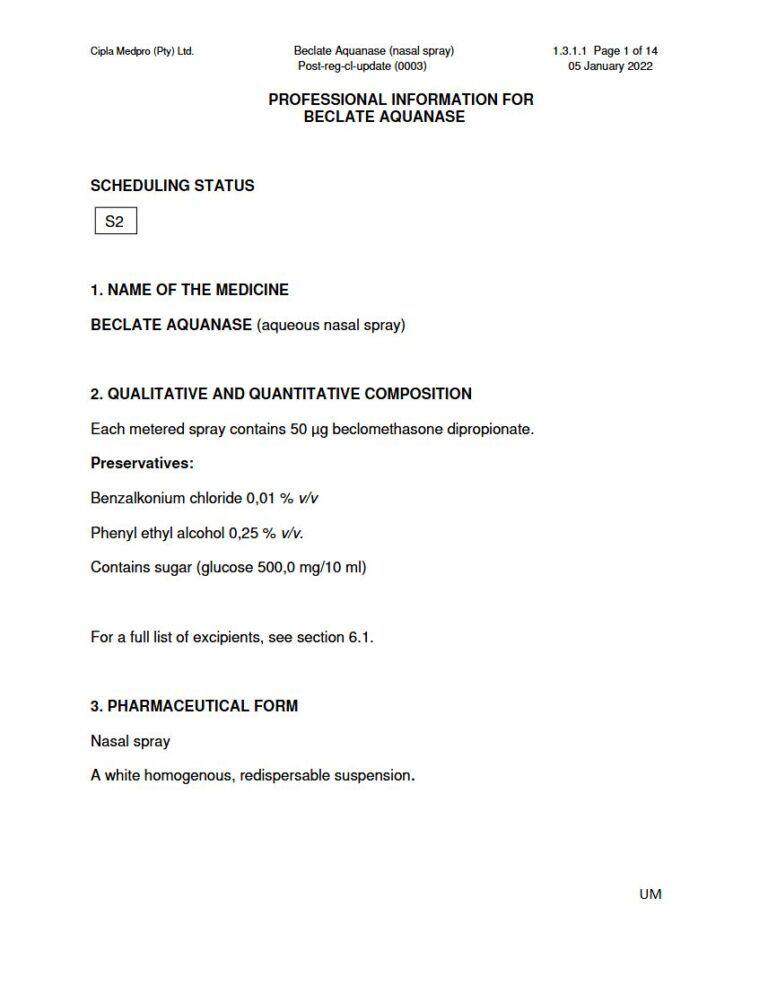
Beclate Aquanase 50 µg Nasal spray
PDF Leaflet Revision Date: 05 January 2022
Clinical Summary
Quick overview from the medicine insert
Indication
Treatment of seasonal allergic rhinitis.
Dosage (summary)
Adults and children over 12: 50 u03bcg in each nostril, 2-4 times daily.
Special Populations
- Children under 6 years
- Elderly
Pregnancy & Breastfeeding
Not established for safety in pregnancy; use caution in breastfeeding.
Contraindications
- Hypersensitivity to beclomethasone
- Severe nasal infection
- Untreated infections
- Tuberculosis
- Ocular herpes simplex
- Unhealed nasal wounds
Common side effects
- Nasal discomfort
- Candidiasis
- Nasal irritation
- Epistaxis
Counselling Points
- Monitor growth in children
- Avoid prolonged use beyond 3 months
- Gradual withdrawal recommended
Serious warnings
- Systemic effects may occur with high doses
- Growth retardation in children
- Adrenal suppression with high doses
Important Disclaimer
The Beclate Aquanase 50 µg Nasal spray professional information leaflet below is the property of Cipla Medpro and is provided on Medinsert exactly as issued, with no.. alterations or editorial changes. We make every effort to keep content current by updating documents as soon as new versions become available. Medinsert serves as a trusted access point for healthcare professionals, but does not replace official sources or clinical judgement. For more details, please read our full disclaimer. read more>>
 Healthcare Professionals Only
This content is for registered healthcare professionals
Sign in or create a free account to read the full package insert.
Free for HPCSA-registered professionals. Powered by Medinsert.
Clinical Particulars
Section 4 of the official insert — extracted exactly as issued, no alterations
4.1 Therapeutic indications
BECLATE AQUANASE is indicated for the treatment of the symptoms of seasonal allergic rhinitis, including hay fever.
4.2 Posology and method of administration
Posology
Adults and children over 12 years of age: One metered dose (50 u03bcg) in each nostril, two to four times a day. Alternatively, a dosage of two metered doses (100 u03bcg) into each nostril twice daily can be used. The total daily recommended dose is 200 u03bcg/nostril/day.
Method of administration
BECLATE AQUANASE aqueous nasal spray is for administration through the nasal route only.
4.3 Contraindications
- Patients with hypersensitivity to beclomethasone dipropionate or any of the components of BECLATE AQUANASE.
- Sever nasal infection, especially candidiasis.
- Untreated fungal, bacterial or viral infections,
- Tuberculosis, ocular herpes simplex, unhealed nasal wounds.
- Bleeding tendencies or a history of recurrent nasal bleeding.
- Children under the age of 6 years.
- Safety of beclomethasone dipropionate in pregnancy has not been established. (see section 4.6).
4.4 Special warnings precautions for use
Systemic effects of nasal corticosteroids may occur, particularly when high doses are prescribed for prolonged periods. The likelihood of these systemic effects are however less likely to occur with nasal preparations than oral corticosteroids. Possible systemic effects may include Cushing's syndrome, Cushingoid features, adrenal suppression, growth retardation in children and adolescents, cataracts and glaucoma. More rarely, a range of psychological or behavioural effects including psychomotor hyperactivity, sleep disorders, anxiety, depression or aggression especially in children may occur.
Growth retardation has been reported in children receiving nasal corticosteroids at licensed doses. It is recommended that the height of children receiving prolonged treatment with nasal corticosteroids is regularly monitored. If growth is slowed, therapy should be reviewed with the aim of reducing the dose of nasal corticosteroid, if possible to the lowest dose at which effective control of symptoms is maintained. In addition, consideration should be given to referring the patient to a paediatric specialist.
Clinically significant adrenal suppression may occur with treatment higher than the recommended dose. If there is evidence of higher than recommended doses being used, then additional systemic corticosteroid cover should be considered during periods of stress or elective surgery.
If the patient is particularly sensitive or has recently used systemic adrenocorticoids prior to using BECLATE AQUANASE, the patient may also be predisposed to hypercorticism. Patients on high doses should be assessed periodically for signs of systemic absorption.
Caution is needed when transferring patients from systemic steroids to BECLATE AQUANASE if there is any reason to suppose that their adrenal function has been impaired. Patients using BECLATE AQUANASE over several months or longer should be examined periodically due to possible changes in the nasal mucosa. If localised infection of the nose and pharynx develops, appropriate treatment must be instituted or treatment be discontinued.
BECLATE AQUANASE should not be used continuously for longer than 3 months. Infections of the nasal passages and paranasal sinuses should be appropriately treated but do not constitute a specific contra-indication. Care should be taken to avoid exposure to viral infections.
In certain cases, heavy challenge of summer allergens may necessitate appropriate additional therapy particularly to control eye symptoms. In the case of recent injury, nasal surgery or ulceration, it is advised to seek medical advice.
BECLATE AQUANASE withdrawal should always be gradual since an abrupt withdrawal or reduction of dosage of exogenous corticosteroids can produce a hypoadrenal state. Replacement of systematic steroid treatment with intranasal therapy may unmask allergies such as allergic asthma or eczema previously controlled by the systemic drug. These allergic conditions should be appropriately treated.
BECLATE AQUANASE contains 0,01 % v/v benzalkonium chloride in each spray. Benzalkonium chloride may cause irritation or swelling inside the nose, especially if used for a long time. Benzalkonium chloride may cause wheezing and breathing difficulties (bronchospasm), especially if the patient has asthma.
Visual Disturbance
Visual disturbance may be reported with systemic and topical corticosteroid use. If a patient presents with symptoms such as blurred vision or other visual disturbances, the patient should be considered for referral to an ophthalmologist for evaluation of possible causes, which may include cataract, glaucoma or rare diseases such as central serous chorioretinopathy (CSCR) which have been reported after use of systemic and topical corticosteroids.
4.5 Interaction with other medicines and other forms of interaction
No information on interactions is available. Significant medical interactions are unlikely to occur with the usual doses of BECLATE AQUANASE. If used in high doses over a long time, systemic absorption may occur and subsequently some of the interactions seen with systemic corticosteroids.
4.6 Fertility, pregnancy and lactation
Safety of BECLATE AQUANASE in pregnancy has not been established (see section 4.3). Corticosteroids have been shown to be teratogenic in animals following topical application. As these medicines may be absorbed systemically, teratogenicity following topical application of BECLATE AQUANASE cannot be excluded. Therefore, BECLATE AQUANASE should not be used during pregnancy, or lactation.
Administration of corticosteroids to pregnant animals can cause abnormalities of foetal development including cleft palate and intra-uterine growth retardation. There may therefore be a very small risk of such effects in the human foetus. It should be noted, however, that the foetal changes in animals occur after relatively high systemic exposure. BECLATE AQUANASE delivers beclomethasone dipropionate directly to the nasal mucosa and so minimises systemic exposure.
Breast-feeding
No specific studies examining the transference of beclometasone dipropionate into the milk of lactating animals have been performed. It is reasonable to assume that beclometasone dipropionate is secreted in milk but at the dosages used for direct intranasal administration there is low potential for significant levels in breast milk. The use of beclomethasone dipropionate in mothers breast feeding their babies requires that the therapeutic benefits of the drug be weighed against the potential hazards to the mother and baby.
4.8 Undesirable effects
Infections and infestations:
- Frequent: Candidiasis-pharyngeal or nasal, oesophageal candidiasis.
- Less frequent: Fever.
Immune system disorders:
- Less frequent: Hypersensitivity reactions including rashes, urticaria, pruritus and erythema, oedema of the eyes, face, lips, tongue and throat, dyspnoea or bronchospasm, watery eyes, and anaphylactoid or anaphylactic reactions.
- Frequency unknown: Intolerance to adrenocorticoids.
Endocrine disorders:
- Less frequent: Adrenal suppression, hypercorticism, hyperglycaemia.
Psychiatric disorders:
- Less frequent: Aggressive reactions, anxiety, behavioural changes, depression, psychosis, restlessness.
Nervous system disorders:
- Less frequent: Dizziness, headache, lethargy, lightheadedness, unpleasant taste, unpleasant smell, syncope.
Eye disorders:
- Less frequent: Increased intra-ocular pressure, glaucoma or cataract formation.
- Frequent unknown: Vision, Blurred (see section 4.4).
Vascular disorders:
- Less frequent: Palpitations or tachycardia, hypertension, rectal haemorrhage.
Respiratory, thoracic and mediastinal disorders:
- Frequent: Nasal discomfort, transient burning, nasal dryness, throat dryness, nasal irritation, throat irritation, sneezing, cough and epistaxis.
- Less frequent: Nasal septum perforation, inner nose crusting, sore throat, ulceration of nasal mucosa, cough, hoarseness, rhinorrhoea, nasal congestion, rhinitis, bronchospasm, pneumonia, dyspnoea.
- Frequency unknown: Pulmonary eosinophilia.
Gastrointestinal disorders:
- Less frequent: Nausea or vomiting, stomach pain, gastroenteritis.
Skin and subcutaneous tissue disorders:
- Less frequent: Rash, urticaria, numbness.
Musculoskeletal, connective tissue and bone disorders:
- Frequency unknown: Suppressed bone formation. Loss of bone marrow density from the hip. Decreased growth in children.
Renal and urinary disorders:
- Less frequent: Cystitis.
Reproductive system and breast disorders:
- Less frequent: Menstrual changes.
General disorders and administrative site conditions:
- Less frequent: Chest pain, malaise, loss of taste or smell.
Frequency unknown: Impaired wound healing.
4.9 Overdose
The use of large amounts of BECLATE AQUANASE over a short time period may lead to suppression of hypothalamic-pituitary-adrenal (HPA) function. Treatment is symptomatic and supportive. Symptoms of chronic overdosing include acneform lesions; Cushingu2019s syndrome (fullness or rounding of face) and menstrual changes. Withdraw BECLATE AQUANASE gradually to avoid precipitation of acute adrenal insufficiency. Treatment should be symptomatic and supportive.
