
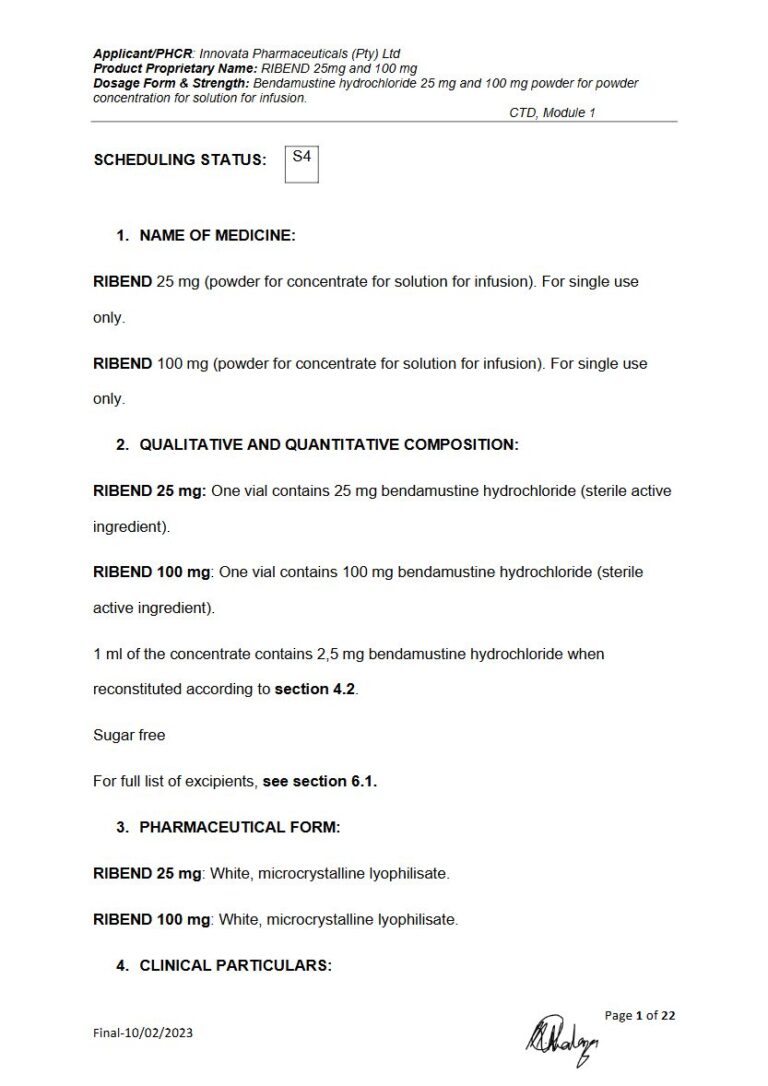
Ribend 25 mg/100 mg Solution
PDF Leaflet Revision Date: 10 February 2023
Clinical Summary
Quick overview from the medicine insert
Indication
First-line treatment for specific leukemias and lymphomas.
Dosage (summary)
IV infusion over 30-60 mins; varies by condition.
Special Populations
- Elderly
- Renal impairment
- Hepatic impairment
Pregnancy & Breastfeeding
Contraindicated in pregnancy and breastfeeding.
Key Drug Interactions
- CYP1A2 inhibitors
- Myelosuppressive agents
- Ciclosporin
- Tacrolimus
Contraindications
- Hypersensitivity
- Severe hepatic impairment
- Severe bone marrow suppression
- Infections
- Live vaccinations
Common side effects
- Leucopenia
- Thrombocytopenia
- Nausea
- Vomiting
- Fever
Counselling Points
- Avoid pregnancy during treatment
- Monitor for signs of infection
- Report severe skin reactions
- Discuss sperm conservation options
Serious warnings
- Myelosuppression
- Infection risk
- Skin reactions
- QT prolongation
- Tumor lysis syndrome
Important Disclaimer
The Ribend 25 mg/100 mg Solution professional information leaflet below is the property of Innovata Pharmaceuticals and is provided on Medinsert exactly as issued, with no.. alterations or editorial changes. We make every effort to keep content current by updating documents as soon as new versions become available. Medinsert serves as a trusted access point for healthcare professionals, but does not replace official sources or clinical judgement. For more details, please read our full disclaimer. read more>>
 Healthcare Professionals Only
This content is for registered healthcare professionals
Sign in or create a free account to read the full package insert.
Free for HPCSA-registered professionals. Powered by Medinsert.
Clinical Particulars
Section 4 of the official insert — extracted exactly as issued, no alterations
4.1 Therapeutic Indications
RIBEND is indicated for:
- First-line treatment of chronic lymphocytic leukaemia (Binet stage B or C) in patients for whom fludarabine combination chemotherapy is not appropriate.
- First-line treatment of indolent CD 20 positive non-Hodgkinu2019s lymphoma in combination with rituximab.
- Indolent non-Hodgkinu2019s lymphomas as monotherapy in patients, who have progressed during or within 6 months following treatment with rituximab or a rituximab containing regimen.
- Front line treatment of multiple myeloma (Durie-Salmon stage II with progress or stage III) in combination with prednisone for patients older than 65 years who are not eligible for autologous stem cell transplantation and who have clinical neuropathy at time of diagnosis precluding the use of thalidomide or bortezomib containing treatment.
4.2 Posology and method of administration
Posology
RIBEND is used for intravenous infusion over 30 to 60 minutes. Infusion must be administered under the supervision of a healthcare provider qualified and experienced in the use of chemotherapeutic agents. Poor bone marrow function is related to increased chemotherapy-induced haematological toxicity. Treatment should not be started if leukocyte and/or platelet values dropped to < 3 x 10⁹/L or < 75 x 109/L, respectively (see section 4.3).
Monotherapy for chronic lymphocytic leukaemia
100 mg/m2 body surface area RIBEND on days 1 and 2; every 4 weeks.
Combination treatment for first-line indolent non-Hodgkinu2019s lymphoma
90 mg/m2 body surface area RIBEND on days 1 and 2 in combination with 375 mg/m2 body surface area rituximab as a slow I.V. infusion on day 1; every 4 weeks.
Monotherapy for indolent non-Hodgkinu2019s lymphomas refractory to RIBEND
120 mg/m2 body surface area RIBEND on days 1 and 2; every 3 weeks.
Multiple Myeloma
120-150 mg/m2 body surface area RIBEND on days 1 and 2, 60 mg/m2 body surface area prednisone I.V. or orally on days 1 to 4; every 4 weeks.
Treatment should be terminated or delayed if leukocyte and/or platelet values dropped to u2264 3 x 10⁹/L or u2264 75 x 109/L, respectively. Treatment can be continued after leukocyte values have increased to > 4 x 10⁹/L and platelet values to > 100 x 109/L. The leukocyte and platelet Nadir is reached, after 14 - 20 days with regeneration after 3 - 5 weeks. During therapy free intervals strict monitoring of the blood count is recommended (see section 4.4).
In case of non-haematological toxicity dose reductions have to be based on the worst CTC grades in the preceding cycle. A 50 % dose reduction is recommended in case of CTC grade 3 toxicity. An interruption of treatment is recommended in case of CTC grade 4 toxicity.
If a patient requires a dose modification the individually calculated reduced dose must be given on day 1 and 2 of the respective treatment cycle. For preparation and administration instructions see Method of administration.
Special populations
Elderly population: There is no evidence that dose adjustments are necessary in elderly patients (see section 5.2).
Renal impairment: On the basis of pharmacokinetic data, no dose adjustment is necessary in patients with a creatinine clearance of > 10 ml/min. Experience in patients with severe renal impairment is limited.
Hepatic impairment: On the basis of pharmacokinetic data, no dose adjustment is necessary in patients with mild hepatic impairment [serum bilirubin 51,3 u03bcmol/ L (3,0 mg/dl)].
Paediatric population: There is no experience in children and adolescents with RIBEND.
4.3 Contraindications
RIBEND is contraindicated:
- In hypersensitivity to bendamustine, or to any of the excipients listed in section 6.1.
- Pregnancy and lactation (see section 4.6)
- Severe hepatic impairment [serum bilirubin > 34,2 u03bcmol/ L (2,0 mg/dl)]
- Jaundice
- Severe bone marrow suppression and severe blood count alterations (leukocyte and/or platelet values dropped to < 3 x 10⁹/L or < 75 x 109/L, respectively)
- Major surgery less than 30 days before start of treatment
- Infections, especially involving leukocytopenia
- Yellow fever vaccination or any other live (attenuated) vaccination
- Congenital QT prolongation
- Concomitant medicines causing QT prolongation
4.4 Special warnings and precautions for use
Myelosuppression
Patients treated with RIBEND experience myelosuppression. Treatment-related myelosuppression, leukocytes, platelets, haemoglobin, and neutrophils must be monitored at least weekly. Prior to the initiation of the next cycle of therapy, the following parameters are recommended: Leukocyte and/or platelet values > 4 x 10⁹/L or > 100 x 109/L, respectively.
Infections
The CD4/CD8 ratio may be reduced. A reduction of the lymphocyte count was seen. In immunosuppressed patients, the risk of infection (e.g., with herpes zoster) may be increased. Cases of tuberculosis have been less frequently reported compared to other infections. Latent or dormant tuberculosis may become active. Infection, including pneumonia and sepsis, has been reported. Infection has been associated with hospitalisation, septic shock and death. Patients with neutropenia and/or lymphopenia following treatment with RIBEND are more susceptible to infections including tuberculosis. Patients with myelosuppression following RIBEND treatment should be advised to contact a healthcare provider if they have symptoms or signs of infection, including fever or respiratory symptoms. The presence of tuberculosis should be excluded before treatment with RIBEND is commenced.
Skin reactions
A number of skin reactions have been reported. These events have included rash, toxic skin reactions and bullous exanthema. Some of these events occurred when bendamustine hydrochloride was given in combination with other anticancer agents. Where skin reactions occur, they may be progressive and increase in severity with further treatment. If skin reactions are progressive, RIBEND should be withheld or discontinued. For severe skin reactions where a relationship to RIBEND is suspected, treatment should be discontinued.
Patients with cardiac disorders
During treatment with RIBEND the concentration of potassium in the blood must be closely monitored. When serum potassium levels are < 3,5 mEq/L (3,5 mmol/L), an ECG recording must be performed and potassium supplement must be given. It was reported that QTcf was prolonged by more than 30 msecs in 4 of 9 patients studied.
Nausea, vomiting
An antiemetic should be given for the symptomatic treatment of nausea and vomiting.
Tumour lysis syndrome
Tumour lysis syndrome associated with bendamustine hydrochloride treatment has been reported in patients in clinical trials. The onset tends to be within 48 hours of the first dose of bendamustine hydrochloride and, without intervention, may lead to acute renal failure and death. Preventive measures include adequate fluid volume status and close monitoring of blood chemistry, particularly potassium and uric acid levels.
The use of allopurinol during the first one to two weeks of RIBEND therapy can be considered. However, there have been cases of Stevens-Johnson Syndrome and Toxic Epidermal Necrolysis reported when bendamustine hydrochloride and allopurinol are administered concomitantly.
Anaphylaxis
Infusion reactions to RIBEND have occurred commonly in clinical trials. Symptoms include fever, chills, pruritus and rash. Severe anaphylactic and anaphylactoid reactions have occurred. Patients must be asked about symptoms suggestive of infusion reactions after their first cycle of therapy. Measures to prevent severe reactions, including antihistamines, antipyretics and corticosteroids must be considered in subsequent cycles in patients who have previously experienced infusion reactions. In patients who experienced Grade 3 or worse allergic-type reactions, RIBEND should be discontinued.
Contraception
RIBEND is teratogenic and mutagenic. Women should not become pregnant during treatment. Male patients should not father a child during and up to 6 months after treatment. They should seek advice about sperm conservation prior to treatment with RIBEND because of possible irreversible infertility.
Extravasation
An extravasal injection should be stopped immediately. The needle should be removed after a short aspiration. Thereafter the affected area of tissue should be cooled. The arm should be elevated. Additional treatments like the use of corticosteroids are not of clear benefit. It was reported that necrosis after accidental extra-vascular administration and toxic epidermal necrosis, tumour lysis syndrome, and anaphylaxis. It was reported that secondary tumours, including myelodysplastic syndrome, myeloproliferative disorders, acute myeloid leukaemia and bronchial carcinoma.
Hepatitis B reactivation
Reactivation of hepatitis B in patients who are chronic carriers of this virus has occurred after these patients received bendamustine hydrochloride. Some cases resulted in acute hepatic failure or a fatal outcome. Patients should be tested for HBV infection before initiating treatment with RIBEND. Experts in liver disease and in the treatment of hepatitis B should be consulted before treatment is initiated in patients with positive hepatitis B tests (including those with active disease) and for patients who test positive for HBV infection during treatment. Carriers of HBV who require treatment with RIBEND should be closely monitored for signs and symptoms of active HBV infection throughout therapy and for several months following termination of therapy.
Non-melanoma skin cancer
In clinical studies, an increased risk for non-melanoma skin cancers (basal cell carcinoma and squamous cell carcinoma) has been observed in patients treated with bendamustine containing therapies. Periodic skin examination is recommended for all patients, particularly those with risk factors for skin cancer.
4.5 Interaction with other medicines and other forms of interaction
It was reported that no in-vivo interaction studies have been performed. When RIBEND is combined with myelosuppressive agents, the effect of RIBEND and/or the co-administered medicines on the bone marrow may be potentiated. Any treatment reducing the patientu2019s performance status or impairing bone marrow function can increase the toxicity of RIBEND. Combination of RIBEND with ciclosporin or tacrolimus may result in excessive immunosuppression with risk of lymphoproliferation. Cytostatics can reduce antibody formation following live-virus vaccination and increase the risk of infection which may lead to fatal outcome. This risk is increased in subjects who are already immunosuppressed by their underlying disease. RIBEND metabolism involves cytochrome P450 (CYP) 1A2 isoenzyme. Therefore, potential for interaction with CYP1A2 inhibitors such as fluvoxamine, ciprofloxacin, acyclovir, and cimetidine exists. Incompatibilities: RIBEND must not be mixed with other medicines except those mentioned in section 4.2, method of administration.
4.6 Fertility, pregnancy, and lactation
Women of childbearing potential/Contraception in males and females: Women of childbearing potential must use effective methods of contraception both before and during RIBEND therapy. Men being treated with RIBEND are advised not to father a child during and up to 6 months following cessation of treatment.
Pregnancy: There are no adequate data from the use of RIBEND in pregnant women. It was reported that in nonclinical studies bendamustine was embryo-/foetolethal, teratogenic and genotoxic. Therefore, RIBEND is contraindicated during pregnancy.
Breastfeeding: It is not known whether RIBEND passes into the breast milk. Treatment with RIBEND is therefore contraindicated during breastfeeding (see section 4.3). Mothers on RIBEND must not breastfeed their babies.
Fertility: Advice on conservation of sperm should be sought prior treatment because of the possibility of irreversible infertility due to therapy with RIBEND.
4.7 Effects on the ability to drive and use machines
It was reported no studies have been performed on the effects on the ability to drive and use machines. However, ataxia, peripheral neuropathy and somnolence have been reported during treatment with bendamustine hydrochloride (see section 4.8). Patients should be instructed that if they experience these symptoms, they should avoid potentially hazardous tasks such as driving and using machines.
4.8 Undesirable effects
Summary of the safety profile
The most frequent side effects with RIBEND are haematological adverse reactions (leucopenia, thrombocytopenia), dermatologic toxicities (allergic reactions), constitutional symptoms (fever), gastrointestinal symptoms (nausea, vomiting).
Listed summary of adverse reactions
Infections and infestations
- Frequent: Infections (not otherwise specified), including opportunistic infection (e.g., Herpes zoster, cytomegalovirus hepatitis B).
- Less frequent: Primary atypical pneumonia, septicaemia and tuberculosis, Pneumocystis jirovencii pneumonia.
Blood and lymphatic system disorders
- Frequent: Anaemia, haemorrhage, leucopenia (not otherwise specified), lymphopenia, neutropenia, thrombocytopenia.
- Less frequent: Haemolysis, pancytopenia, bone marrow failure.
Neoplasms benign, malignant and unspecified (including cysts and polyps)
- Frequent: Tumour lysis syndrome
- Less frequent: Myelodysplastic syndrome, acute myeloid, leukemia
Immune system disorders
- Frequent: Hypersensitivity (not otherwise specified)
- Less frequent: Anaphylactic reaction, anaphylactic shock and anaphylactoid reaction.
Nervous system disorders
- Frequent: Insomnia, headache, dizziness.
- Less frequent: Anticholinergic syndrome, aphonia, ataxia, dysgeusia, encephalitis, neurological disorders, paraesthesia, peripheral sensory neuropathy and somnolence.
Cardiac disorders
- Frequent: Cardiac dysfunction, such as angina pectoris, dysrhythmia, palpitations, QT prolongation and tachycardia.
- Less frequent: Cardiac failure, myocardial infarction, pericardial effusion and tachycardia.
- Frequency not known: Atrial fibrillation
Vascular disorders
- Frequent: Hypertension and hypotension.
- Less frequent: Acute circulatory failure and phlebitis.
Respiratory, thoracic and mediastinal disorders
- Frequent: Pulmonary dysfunction
- Less frequent: Pulmonary fibrosis.
Gastrointestinal disorders
- Frequent: Constipation, diarrhoea, nausea, stomatitis, and vomiting.
- Less frequent: Gastrointestinal haemorrhage and haemorrhagic oesophagitis.
Hepato-biliary disorders
- Frequency not known: hepatic failure
Skin and subcutaneous tissue disorders
- Frequent: Alopecia, skin disorders (not otherwise specified), urticaria
- Less frequent: dermatitis, erythema, hyperhidrosis, maculo-papular rash and pruritis.
- Frequency not known: Steven-Johnson syndrome, toxic epidermal necrolysis (TEN), drug reaction with eosinophilia and systemic symptoms (DRESS)
Reproductive system and breast disorders
- Frequent: Amenorrhoea
- Less frequent: Infertility
General disorders and administration site conditions
- Frequent: Anorexia, chills, dehydration, fatigue, mucosal inflammation and pyrexia, pain
- Less frequent: multi-organ failure
Investigations
- Frequent: Decreased haemoglobin, hypokalaemia, increased alkaline phosphate, increased ALT, increase AST, increased bilirubin, increased creatinine and increased urea and tumor lysis syndrome.
Reporting of suspected adverse reactions
Reporting suspected adverse reactions after authorisation of the medicine is important. It allows continued monitoring of benefit/risk balance of the medicine. Health care providers are asked to report any suspected adverse reactions to SAHPRA via the u201c6.04 Adverse Drug Reactions Reporting Formu201d, found online under SAHPRAu2019s publications: hppts://www.sahpra.or.za/Publications/Index/8.
4.9 Overdose
After application of a 30 min infusion of bendamustine hydrochloride once every 3 weeks the maximum tolerated dose (MTD) was 280 mg/mu00b2. Cardiac events of CTC grade 2 which were compatible with ischaemic ECG changes occurred which were regarded as dose limiting. It was reported in a subsequent study with a 30 min infusion of bendamustine hydrochloride at day 1 and 2 every 3 weeks the MTD was found to be 180 mg/mu00b2. The dose limiting toxicity was grade 4, thrombocytopenia. Cardiac toxicity was not dose limiting with this schedule.
Counter measures
There is no specific antidote. Bone marrow transplantation and transfusions (platelets, concentrated erythrocytes) may be made or haematological growth factors may be given as effective countermeasures to control haematological side effects. RIBEND and its metabolites are dialysable to a small extent.
