
Loxoptic 5 Mg Solution
PDF Leaflet Revision Date: 11 November 2024
Clinical Summary
Quick overview from the medicine insert
Indication
Treatment of chronic open-angle glaucoma and elevated intraocular pressure.
Dosage (summary)
One drop in affected eye(s) twice daily.
Onset of Action / Duration
Onset: 30 mins, Duration: 12-24 hours
Special Populations
- Renal impairment
- Hepatic impairment
Pregnancy & Breastfeeding
Safety in pregnancy not established; caution in breastfeeding.
Key Drug Interactions
- Calcium channel blockers
- Beta blockers
- Anti-dysrhythmics
- Hypoglycaemic agents
Contraindications
- Hypersensitivity to betaxolol
- Cardiac shock
- Sinus bradycardia
- Reactive airway disease
- Damaged cornea
Common side effects
- Eye discomfort
- Headache
- Dry eyes
- Dizziness
Counselling Points
- Avoid contact lenses during use
- Monitor for signs of cardiac failure
- Use caution when driving or operating machinery
Serious warnings
- Risk of bronchospasm
- Caution in cardiac failure
- Potential for systemic effects
Important Disclaimer
The Loxoptic 5 Mg Solution professional information leaflet below is the property of Gen-Eye and is provided on Medinsert exactly as issued, with no.. alterations or editorial changes. We make every effort to keep content current by updating documents as soon as new versions become available. Medinsert serves as a trusted access point for healthcare professionals, but does not replace official sources or clinical judgement. For more details, please read our full disclaimer. read more>>
 Healthcare Professionals Only
This content is for registered healthcare professionals
Sign in or create a free account to read the full package insert.
Free for HPCSA-registered professionals. Powered by Medinsert.
Clinical Particulars
Section 4 of the official insert — extracted exactly as issued, no alterations
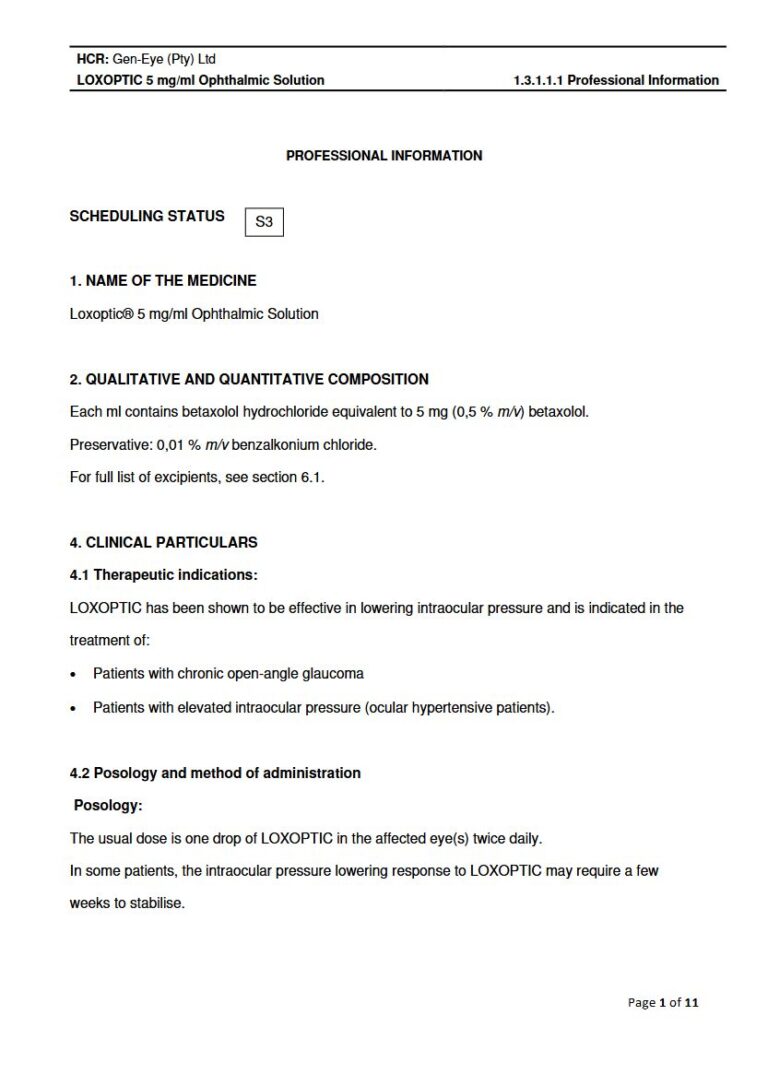
4.1 Therapeutic indications
LOXOPTIC has been shown to be effective in lowering intraocular pressure and is indicated in the treatment of:
- Patients with chronic open-angle glaucoma
- Patients with elevated intraocular pressure (ocular hypertensive patients).
4.2 Posology and method of administration
Posology: The usual dose is one drop of LOXOPTIC in the affected eye(s) twice daily. In some patients, the intraocular pressure lowering response to LOXOPTIC may require a few weeks to stabilise. A clinical follow up should include a determination of the intraocular pressure during the first month of treatment with LOXOPTIC. Thereafter, intraocular pressure readings should be determined on an individual basis at the judgement of the medical practitioner.
When substituting LOXOPTIC for another ophthalmic anti-glaucoma agent, continue the agent already used and add one drop of LOXOPTIC in the affected eye(s) twice a day. On the following day, discontinue the previous anti-glaucoma agent completely and continue with LOXOPTIC. Due to diurnal variations of intraocular pressure in individual patients, a satisfactory response to twice a day therapy is best determined by measuring intraocular pressure at different times during the day. Therapy with LOXOPTIC should be individualised. If the intraocular pressure of the patient is poorly controlled on this regimen, concurrent therapy with pilocarpine, other miotics, epinephrine (adrenaline) or systemically administered carbonic anhydrase inhibitors can be initiated. When a patient is transferred from several concomitantly administered anti-glaucoma agents individualisation is needed. The adjustment should involve one agent at a time made at intervals of not less than one week. A recommended approach is to continue the agents being used and add one drop of LOXOPTIC in the affected eye(s) twice a day. On the following day, discontinue one of the other anti-glaucoma agents. The remaining anti-glaucoma agents may be decreased or discontinued according to the patientu2019s response to treatment.
Method of Administration: For ocular use only. When using nasolacrimal occlusion or closing the eyelids for 2 minutes, the systemic absorption is reduced. If more than one eye drop is being used, the eye drops should be administered at least 10 minutes apart.
4.3 Contraindications
- Hypersensitivity to betaxolol hydrochloride or to any of the excipients. See section 6.1.
- Cardiac shock and overt cardiac failure.
- Sinus bradycardia, sick sinus syndrome, sino-atrial block, second or third degree atrioventricular (AV) block not controlled with a pacemaker.
- Reactive airway disease including bronchial asthma or a history of severe bronchial asthma, severe chronic obstructive pulmonary disease.
- Patients with damaged cornea.
4.4 Special warnings and precautions for use
- LOXOPTIC is absorbed systemically and the same adverse reactions observed with systemic beta-blocker therapy may occur (see 4.8 UNDESIRABLE SIDE EFFECTS).
- Due to its negative effect on conduction time, caution should be used in treating patients with a history of cardiac failure or first degree heart block (see 4.3 CONTRA-INDICATIONS). Treatment with LOXOPTIC should be discontinued at the first signs of cardiac failure.
- Cardiac disorders: Therapy with LOXOPTIC should be assessed in patients with cardiovascular disease (e.g. coronary heart disease, Prinz Metalu2019s angina, cardiac failures) and hypotension. Patients should be observed for signs of deterioration of the disease state and exacerbation of adverse reactions.
- Anaphylactic reactions: While using LOXOPTIC, patients with a history of atopy or a history of severe anaphylactic reactions to a variety of allergens may be more reactive to repeated challenge with such allergens and unresponsive to the usual dosage of epinephrine (adrenaline) used to treat anaphylactic reactions.
- Respiratory disorders: LOXOPTIC should be used with extreme caution in patients with bronchospasm, bronchial asthma or patients with a history of asthma or chronic obstructive pulmonary disease (COPD) when there is no alternative treatment as bronchoconstriction, shortness of breath may be precipitated (see SIDE EFFECTS).
- Death due to bronchospasm in patients with bronchospasm has been reported following the administration of an ophthalmic beta-blocker such as LOXOPTIC.
- In patients with angle-closure glaucoma, the immediate treatment objective is to re-open the angle by constriction of the pupil with a miotic agent. LOXOPTIC has no effect on the pupil; therefore, LOXOPTIC should be used with a miotic to decrease elevated intraocular pressure in angle-closure glaucoma.
- LOXOPTIC may induce dryness of eyes. Caution should be exercised in the use of LOXOPTIC in patients with corneal diseases, sicca syndrome or similar tear film abnormalities.
- LOXOPTIC should be administered with caution in patients subject to spontaneous hypoglycaemia or to patients with labile diabetes as LOXOPTIC may mask the signs and symptoms of acute hypoglycaemia. LOXOPTIC may also mask the signs of hyperthyroidism. LOXOPTIC should therefore be used with caution in patients with diabetes or in patients with thyrotoxicosis.
- LOXOPTIC used alone has little or no effect on pupil size; however concurrent therapy of LOXOPTIC and epinephrine (adrenaline) has resulted in mydriasis.
- Other beta-blocking agents: Patients on treatment with an oral beta-adrenergic blocking agent and LOXOPTIC should be monitored for a potential additive effect either on the intraocular pressure or on the known systemic effects of beta blockade.
- LOXOPTIC contains benzalkonium chloride. Diminished responsiveness to LOXOPTIC following long term therapy may occur.
- Beta blockers such as LOXOPTIC may reduce tear flow, resulting in irritation of the eye in wearers of contact lenses possibly due to the dehydration of soft lenses.
- Clinical studies to establish the safety and efficacy in children have not been performed. Excipient with known effect: Benzalkonium chloride may be absorbed by soft contact lenses and may change the colour of the contact lenses. You should remove contact lenses before using this medicine and put them back 15 minutes afterwards. Benzalkonium chloride may also cause eye irritation, especially if you have dry eyes or disorders of the cornea (the clear layer at the front of the eye). If you feel abnormal eye sensation, stinging or pain in the eye after using this medicine, talk to your doctor.
- As the possibility of adverse effects on the corneal permeability and the danger of disruption of the corneal epithelium with prolonged or repeated usage of benzalkonium chloride preserved ophthalmological preparations may occur, regular ophthalmological examination is required. Caution should be exercised in the use of benzalkonium chloride preserved topical medication such as LOXOPTIC over an extended period.
4.5 Interaction with other medicines and other forms of interaction
- LOXOPTIC used alone has little or no effect on pupil size; however concurrent therapy of LOXOPTIC and epinephrine (adrenaline) has resulted in mydriasis.
- There is a potential for additive effects resulting in hypotension and/or marked bradycardia when LOXOPTIC is administered concomitantly with oral calcium channel blockers, beta adrenergic blocking agents, anti-dysrhythmics (including amiodarone, digoxin), parasympathomimetics and catecholamine-depleting agents such as reserpines (see WARNINGS AND SPECIAL PRECAUTIONS).
- Caution should be exercised in patients using LOXOPTIC, hypoglycaemic agents and phenothiazines concurrently.
- Caution should be exercised in patients using concomitant adrenergic psychotropic medicines.
4.6 Fertility, pregnancy and lactation
Pregnancy: Safety in pregnancy has not yet been established. Infants of mothers administered beta-blockers shortly before giving birth, or during labour may be born hypotonic, collapsed and hypoglycaemic.
Lactation: LOXOPTIC is secreted in human milk therefore caution should be exercised when administering LOXOPTIC to mothers breastfeeding their babies.
4.7 Effects on ability to drive and use machines
LOXOPTIC may cause dizziness, fatigue, transient ocular irritation, blurred vision and lacrimation. Patients should be advised to exercise caution until they know how LOXOPTIC affects them.
4.8 Undesirable effects
LOXOPTIC is absorbed into the systemic circulation and may cause similar undesirable effects as seen with systemic beta-blockers.
System Organ Class LOXOPTIC Side Effects
Immune system disorders: Less frequent: Systemic allergic reactions including angioedema, urticaria, localised and generalised rash, pruritus
Eye disorders:
- Frequent: Discomfort on instillation.
- Less frequent: Tearing, instances of decreased corneal sensitivity, itching sensation, corneal punctuate staining, keratitis, anisocoria, photophobia, erythema.
- Frequency unknown: Blepharitis, decreased tear production and dry eyes, blurred vision, conjunctivitis, soreness, ocular irritation (burning, stinging, redness), diplopia, ptosis, corneal erosion.
Psychiatric disorders: Frequency unknown: Depressive neurosis, malaise, vivid dreams and nightmares, overt psychosis, hallucinations.
Nervous system disorders: Frequent: Headache Less frequent: Depression Frequency unknown: Insomnia, confusion, memory loss, syncope, cerebrovascular accident, cerebral ischaemia, increase in signs and symptoms of myasthenia gravis, dizziness, paraesthesia.
Metabolism and nutrition disorders: Frequency unknown: Hypoglycaemia
Cardiac disorders: Less frequent: Marked bradycardia Frequency unknown: Congestive cardiac failure, chest pain, palpitations, dysrhythmia, cardiac failure, atrioventricular block, cardiac arrest, a slowed AV-conduction or increase of an existing AV- block.
Vascular disorders: Frequency unknown: Exacerbation of peripheral vascular disease, Raynaudu2019s phenomenon (due to unopposed arteriolar sympathetic activation), severe peripheral vascular disease, peripheral gangrene, hypotension, cold and cyanotic hands and feet, oedema, exacerbation of intermittent claudication.
Respiratory, thoracic and mediastinal disorders: Less frequent: Dyspnoea, asthma. Frequency unknown: Bronchospasm, cough.
Gastro-intestinal disorders: Frequency unknown: Nausea, vomiting, diarrhoea, constipation, abdominal cramping, dysgeusia, dyspepsia, dry mouth.
Skin and subcutaneous tissue disorders: Less frequent: Alopecia. Frequency unknown: Erythema, psoriasiform rash or exacerbation of psoriasis.
Musculoskeletal, connective tissue and bone disorders: Frequency unknown: Skeletal muscle weakness, myalgia.
Reproductive system and breast disorders: Frequency unknown: Sexual dysfunction, impotence, decreased libido.
Side-effects are frequent in patients with renal decomposition.
Reporting of suspected adverse reactions Reporting of suspected adverse reactions after authorisation of LOXOPTIC is important. It allows continued monitoring of the benefit/risk balance of LOXOPTIC. Healthcare professionals are asked to report any suspected adverse reactions. Suspected adverse reactions can be reported to Gen- Eye (Pty) Ltd via email: [email protected] or telephonically on 011 312 3812. Suspected adverse reactions can also be reported to SAHPRA via the u201c6.04 Adverse Drug Reaction Reporting Formu201d, found online under SAHPRAu2019s publications: https://www.sahpra.org.za/Publications/Index/8
4.9 Overdose
The symptoms which might be expected in an overdosage of a systemically administered beta-1- adrenergic receptor blocking agent are hypotension, bradycardia, and acute cardiac failure. A topical overdose of LOXOPTIC may be flushed from the eye(s) with warm tap water.
