
Cipla Bleomycin 7,5 mg Powder for solution for injection.
PDF Leaflet Revision Date: 09 November 2022
Clinical Summary
Quick overview from the medicine insert
Indication
Treatment of squamous cell carcinomas and certain lymphomas.
Dosage (summary)
0.25 to 0.5 units/kg weekly or twice weekly; maintenance 1 unit daily or 5 units weekly.
Special Populations
- Renal impairment
- Elderly patients
- Pulmonary impairment
Pregnancy & Breastfeeding
Contraindicated in pregnancy and lactation; reliable contraception required.
Key Drug Interactions
- Cisplatin
- Vinca alkaloids
- Granulocyte Colony-Stimulating Factor
Contraindications
- Hypersensitivity to bleomycin
- Pregnancy
- Lactation
Common side effects
- Pulmonary toxicity
- Cutaneous reactions
- Nausea
- Fever
Counselling Points
- Avoid pregnancy during treatment
- Monitor for pulmonary symptoms
- Report any severe skin reactions
Serious warnings
- Risk of pulmonary toxicity
- Monitor lung function
- Caution in renal impairment
Important Disclaimer
The Cipla Bleomycin 7,5 mg Powder for solution for injection. professional information leaflet below is the property of Cipla Medpro and is provided on Medinsert exactly as issued, with no.. alterations or editorial changes. We make every effort to keep content current by updating documents as soon as new versions become available. Medinsert serves as a trusted access point for healthcare professionals, but does not replace official sources or clinical judgement. For more details, please read our full disclaimer. read more>>
 Healthcare Professionals Only
This content is for registered healthcare professionals
Sign in or create a free account to read the full package insert.
Free for HPCSA-registered professionals. Powered by Medinsert.
Clinical Particulars
Section 4 of the official insert — extracted exactly as issued, no alterations
4.1 Therapeutic indications
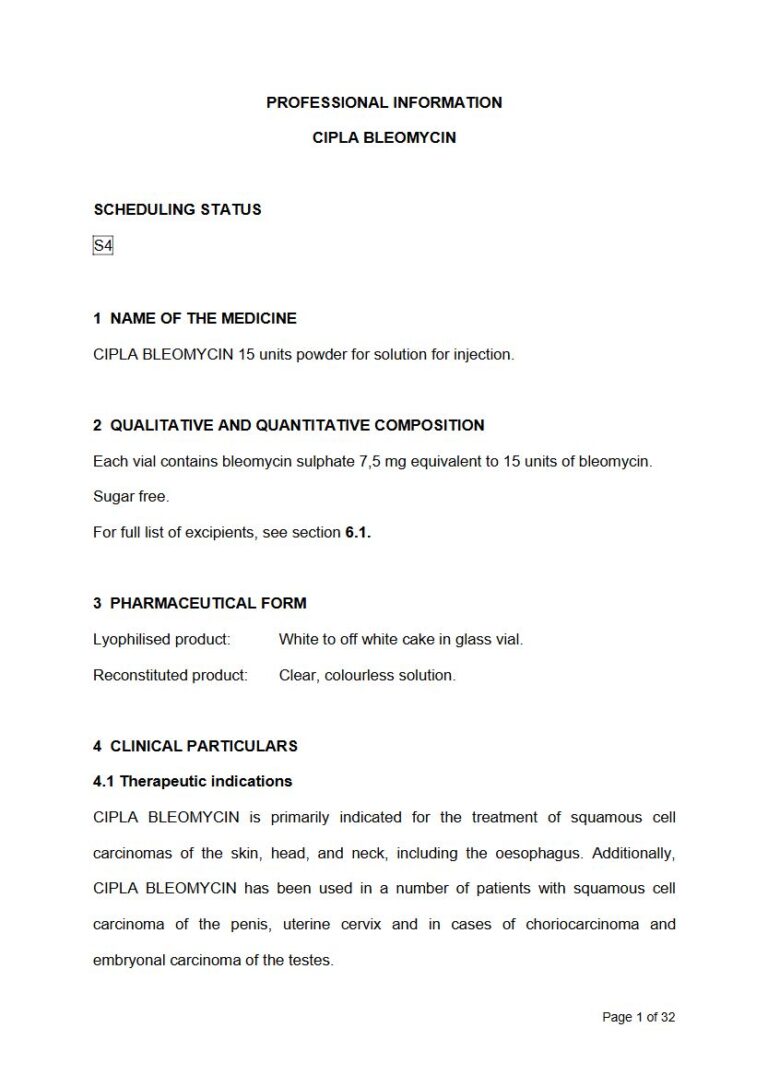
CIPLA BLEOMYCIN is primarily indicated for the treatment of squamous cell carcinomas of the skin, head, and neck, including the oesophagus. Additionally, CIPLA BLEOMYCIN has been used in a number of patients with squamous cell carcinoma of the penis, uterine cervix and in cases of choriocarcinoma and embryonal carcinoma of the testes.
CIPLA BLEOMYCIN has produced remissions in some cases of malignant lymphoma, Hodgkin's disease, and non-Hodgkin's lymphoma. CIPLA BLEOMYCIN is generally not effective against malignancies of the haematopoietic system.
Note: Treatment of patients with CIPLA BLEOMYCIN after radiation therapy is less successful than treatment prior to radiation therapy (see section 4.5).
4.2 Posology and method of administration
Posology
Because of the possibility of an anaphylactoid reaction, patients with lymphoma should be treated with 2 units or less for the first 2 doses. If no acute reaction occurs, then the regular dosage schedule may be followed.
All dosing below as well as throughout this Professional Information is given as units of dry powder which must be reconstituted before administration to the patient.
The following dose schedules are recommended:
- Squamous cell carcinoma, non-Hodgkin's lymphoma, testicular carcinoma: 0,25 to 0,5 units/kg (10 to 20 units/m2) given intramuscularly, subcutaneously, or intravenously, weekly or twice weekly.
- Hodgkin's disease: 0,25 to 0,5 units/kg (10 to 20 units/m2) given intramuscularly, subcutaneously, or intravenously weekly or twice weekly.
After a 50 percent response, a maintenance dose of 1 unit daily or 5 units weekly intravenously or intramuscularly should be given.
NOTE: PULMONARY TOXICITY FROM CIPLA BLEOMYCIN APPEARS TO BE DOSE-RELATED WITH A STRIKING INCREASE WHEN THE TOTAL DOSE IS OVER 400 UNITS. TOTAL DOSES OVER 400 UNITS SHOULD BE GIVEN WITH GREAT CAUTION. FREQUENT CHEST X-RAYS AND CLOSE MONITORING OF PULMONARY FUNCTION DURING THERAPY ARE ADVISABLE. WHEN CIPLA BLEOMYCIN IS USED IN COMBINATION WITH OTHER ANTINEOPLASTIC AGENTS, PULMONARY TOXICITIES MAY OCCUR AT LOWER DOSES (SEE SECTION 4.5).
Method of administration
CIPLA BLEOMYCIN may be given by intramuscular, subcutaneous, or intravenous routes.
Note: CIPLA BLEOMYCIN should not be reconstituted with dextrose-containing solutions. Any unused portion must be discarded as prescribed for antineoplastic medicines.
Intramuscular: CIPLA BLEOMYCIN vial should be reconstituted with 1 to 5 mL of sterile water for injection or sodium chloride injection 0,9 % m/v.
Subcutaneous: Prepare as for intramuscular injection.
Intravenous: Dissolve the contents of the vial in 5 mL sodium chloride injection 0,9 % and administer slowly over a period of 10 minutes. CIPLA BLEOMYCIN may be administered in the commonly employed intravenous solution, i.e., water for injection or sodium chloride 0,9 % and is stable in solution at room temperature.
4.3 Contraindications
CIPLA BLEOMYCIN is contraindicated in:
- Patients who have demonstrated a hypersensitive or idiosyncratic reaction to bleomycin or any of the ingredients of CIPLA BLEOMYCIN.
- Pregnancy and lactation (see section 4.6).
4.4 Special warnings and precautions for use
CIPLA BLEOMYCIN should be administered under supervision of an experienced oncologist. Patients receiving CIPLA BLEOMYCIN must be observed carefully and frequently during and after therapy. Adequate diagnostic and treatment facilities should be available to allow appropriate management of therapy and possible complications.
A highly rigorous risk/benefit assessment should be performed following lung or mediastinal radiotherapy. CIPLA BLEOMYCIN should only be used with caution at a reduced dose in the event of impaired renal function. Because of the possible mutagenic effects of CIPLA BLEOMYCIN on male and female germ cells, reliable contraception must be ensured during therapy and for up to 6 months after the end thereof.
CIPLA BLEOMYCIN should be used with extreme caution in patients with significant impairment of renal function or compromised pulmonary function. A repeat course of therapy is contraindicated in any patient who has shown signs of pneumonitis or decreased pulmonary function.
Pulmonary reactions: Patients should be carefully monitored for any signs of pulmonary dysfunction during treatment with CIPLA BLEOMYCIN. The most serious delayed effect is pulmonary toxicities. In some treated patientu2019s interstitial pneumonitis induced by CIPLA BLEOMYCIN progressed to irreversible pulmonary fibrosis and death. Interstitial pneumonitis and fibrosis occur in roughly 10 % of patients. Approximately 1 % of patients treated with bleomycin, as contained in CIPLA BLEOMYCIN, have died from the consequences of pulmonary fibrosis.
Pulmonary toxicity is more frequent in patients over 70 years of age and in those receiving total doses greater than 400 units. It is significantly increased by thoracic irradiation and by hyperoxia during surgical anaesthesia. Although pulmonary toxicity is age and dose-related, the toxicity is unpredictable. Renal impairment is a risk factor for the development of pulmonary toxicity. Frequent monitoring is essential to identify and treat interstitial pneumonitis immediately.
Pulmonary toxicity has also been observed on occasion in young patients receiving low doses of bleomycin, as contained in CIPLA BLEOMYCIN. Pulmonary toxicity is potentially the most serious side effect of CIPLA BLEOMYCIN. Interstitial pneumonitis, which can rapidly progress to pulmonary fibrosis and even death in some patients, occasionally develops as a result of therapy with CIPLA BLEOMYCIN. It is difficult to predict which patients will develop fibrosis. However, frequent chest X-rays and measurements of pulmonary function should be obtained during treatment with CIPLA BLEOMYCIN. These should continue to be taken for up to 4 weeks after completion of the course and patients should be kept under clinical review for approximately 2 months. With concomitant radiation therapy of the thorax, a study or an X-ray of the thorax should possibly be done more frequently. Should a patient develop signs of pneumonitis, or if the X-rays show signs of infiltrates, CIPLA BLEOMYCIN should be discontinued immediately and the patient treated with corticosteroids and antibiotics, where appropriate.
Lung function tests with 100 % oxygen should not be used in patients who have been treated with CIPLA BLEOMYCIN. Lung function tests using less than 21 % oxygen are recommended as an alternative. Monthly analysis of pulmonary diffusion capacity for carbon monoxide could be planned. A study of lung function, in particular the measuring of carbon monoxide diffusion and vital capacity, often makes an early diagnosis of lung toxicity possible.
Vascular changes occur in the lungs, leading to partial destruction of the elasticity of the vessel wall. The earliest symptom of pulmonary damage caused by bleomycin, as contained in CIPLA BLEOMYCIN, is dyspnoea. Fine rales are the earliest sign. If pulmonary changes are noticed, CIPLA BLEOMYCIN treatment should be discontinued until it is determined whether they are caused by the medication. The patients should be treated with broad spectrum antibiotics and corticosteroids.
In the event of dyspnoea, cough, basal crepitations or lung infiltrates not clearly attributable to the neoplasm or a concomitant pulmonary disease, administration of CIPLA BLEOMYCIN must be discontinued immediately and the patient should be treated with a corticosteroid and broad-spectrum antibiotics. High oxygen concentrations should be used with caution. In case of lung damage as a result of CIPLA BLEOMYCIN, BELOCIP should not be administered any more (see section 4.3).
Although the pulmonary toxicity of bleomycin, as contained in CIPLA BLEOMYCIN, appears to be dose-related upon exceeding a total dose of 400 units, it can also be observed at lower doses, in particular in elderly patients, patients with impaired renal function, patients with pre-existing lung disease, patients with a history of or receiving concomitant thoracic radiotherapy, and patients requiring oxygen administration. These patients should be carefully monitored and the CIPLA BLEOMYCIN dosage reduced or the dose interval prolonged based on clinical observation of the patient. CIPLA BLEOMYCIN should be used with extreme caution in patients with lung cancer as these patients show an increased incidence of pulmonary toxicity.
As 2/3 (two thirds) of the administered dose of CIPLA BLEOMYCIN is excreted unchanged in the urine, renal function has a major effect on the rate of excretion. Plasma concentrations are significantly elevated when the usual doses are administered to patients with renal function disorders.
Other clinical conditions requiring caution include patients with severe heart disease or hepatic dysfunction as toxicity may be increased and patients with varicella as fatal systematic dysfunctions may occur.
Radiographically, CIPLA BLEOMYCIN-induced pneumonitis produces non-specific patchy opacities. The most common changes in pulmonary function tests are a decrease in total lung volume and a decrease in vital capacity. These changes are not predictive of the development of pulmonary fibrosis.
The microscopic tissue changes due to CIPLA BLEOMYCIN toxicity include bronchiolar squamous metaplasia, reactive macrophages, atypical alveolar epithelial cells, fibrinous oedema, and interstitial fibrosis. The acute stage may involve capillary changes and subsequent fibrinous exudation into alveoli producing a change similar to hyaline membrane formation and progressing to a diffuse interstitial fibrosis resembling idiopathic interstitial fibrosis (the Hamman-Rich syndrome). These microscopic findings are non-specific. Similar changes are seen in e.g., radiation pneumonitis and Pneumocystis jirovecii pneumonitis.
To monitor the onset of pulmonary toxicity, X-rays of the chest should be taken every 1 to 2 weeks. If pulmonary changes are noted, CIPLA BLEOMYCIN treatment should be discontinued until bleomycin toxicity can be ruled out as a cause. Studies have suggested that sequential measurement of the pulmonary diffusion capacity for carbon monoxide (DLco) during treatment with CIPLA BLEOMYCIN may be an indicator of subclinical pulmonary toxicity. It is recommended that the DLco be monitored monthly if it is to be employed to detect pulmonary toxicities, and thus CIPLA BLEOMYCIN should be discontinued when the DLco falls below 30 to 35 percent of the pre-treatment value.
Patients who have received CIPLA BLEOMYCIN are at greater risk of developing pulmonary toxicity when oxygen is administered during surgery (see section 4.5). While long exposure to very high oxygen concentrations is a known cause of lung damage after CIPLA BLEOMYCIN administration, lung damage can occur at lower concentrations than usually would be considered safe. Suggested preventive measures are:
- Maintain inspired O2 at concentrations approximately that of room air (25 percent) during surgery and the postoperative period.
- Carefully monitor fluid replacement, focusing more on colloid administration than crystalloid administration.
Cutaneous side effects are the most frequent side effects, occurring in most treated patients (see section 4.8). Cutaneous toxicity is a relatively late manifestation. It usually develops in the second and third week of treatment after 150 to 200 units of CIPLA BLEOMYCIN have been administered. Cutaneous toxicity appears to be related to cumulative dose. Cutaneous reactions include rash, erythema, pruritus, reddening and painful ulceration, particularly at pressure points, such as fingertips and elbows, striae, vesiculation, thickening, hyperpigmentation and tenderness of the skin. Change in the nails and nail beds, alopecia, and stomatitis are also frequently encountered. It was necessary to discontinue bleomycin, as contained in CIPLA BLEOMYCIN, therapy in some patients because of these toxicities. Local reactions and thrombophlebitis may occur at the site of parenteral administration. Contact dermatitis has also been observed following the application of CIPLA BLEOMYCIN to the skin of sensitive patients.
CIPLA BLEOMYCIN should be stopped in people with AIDS if cutaneous adverse effects are seen and rechallenge should be avoided.
Cisplatin induced renal impairment may result in delayed clearance of CIPLA BLEOMYCIN, leading to increased bleomycin toxicity. The dosage of CIPLA BLEOMYCIN should be reduced and caution is advised (see section 4.5).
Idiosyncratic reactions/ hypersensitivity: Idiosyncratic reactions, clinically similar to anaphylaxis, have been reported in approximately 1 % of lymphoma patients treated with bleomycin, as contained in CIPLA BLEOMYCIN. The reaction may be immediate or after a few hours delay, and usually occurs after the first or second dose. It consists of hypotension, confusion, fever, chills, wheezing and stridor. Treatment is usually symptomatic and comprises volume expansion, vasopressors, antihistamines, and corticosteroids.
Because of the possibility of anaphylactoid reaction, patients should initially receive a test dose of 1 to 2 units. If there is no acute reaction, the full dose can be administered.
Miscellaneous: There have been reports of vascular toxicity following use of bleomycin, as contained in CIPLA BLEOMYCIN, in particular in combination with other antineoplastic agents. The events are clinically heterogeneous and include myocardial infarction, cerebrovascular insults, thrombotic microangiopathies, e.g., haemolytic uraemic syndrome and cerebral arteritis.
In adults or adolescents capable of reproduction, effects on the sexual glands should be considered. Like other cytotoxic active substances, CIPLA BLEOMYCIN can trigger tumour lysis syndrome in patients with rapidly growing tumours. Appropriate supportive treatment and pharmacological measures might prevent or alleviate such complications.
Patients with creatinine clearance values of less than 50 mL/min should be treated with caution and their renal function should be carefully monitored during the administration of CIPLA BLEOMYCIN. Lower doses of CIPLA BLEOMYCIN may be required in these patients than those with normal renal function.
Intravenous administration: Vascular pain may occur; therefore, it is important to pay due attention to concentration of the injection and administration rate. Administer intravenously as slowly as possible.
Intramuscular administration: Avoid repeated injections at the same site and innervated sites, particularly if administering to paediatrics. If insertion of the injection needle evokes intense pain or if blood flows back into the syringe, withdraw the needle immediately and inject at a different site.
4.5 Interaction with other medicines and other forms of interaction
Combination therapy
If CIPLA BLEOMYCIN is used as part of combination chemotherapy, its toxicity should be taken into account for the selection and dosage of other agents with similar toxicity spectrum.
An increased risk of pulmonary toxicity has been reported with concomitant administration of other agents with pulmonary toxicity, e.g., BCNU, mitomycin, cyclophosphamide, methotrexate and gemcitabine. The pulmonary toxicity of CIPLA BLEOMYCIN is potentiated by combined treatment with cisplatin in particular. Special care should therefore be taken with this combination. Data from literature indicates that cisplatin should only be administered after bleomycin, as contained in CIPLA BLEOMYCIN.
Cisplatin-induced renal impairment may result in delayed clearance of CIPLA BLEOMYCIN, leading to increased bleomycin toxicity. It seems reasonable to assume that similar interactions might occur if CIPLA BLEOMYCIN were given with other nephrotoxic agents. It has been suggested that apart from a decrease in CIPLA BLEOMYCIN dosage if nephrotoxicity occur with such a combination, giving CIPLA BLEOMYCIN by constant infusion rather than intermittent bolus might be less toxic.
In patients with testicular tumours treated with a combination of bleomycin, as contained in CIPLA BLEOMYCIN, and vinca alkaloids, Raynaud-like phenomena have been reported with acral ischemia, leading to necrosis of peripheral parts of the body (fingers, toes, tip of the nose).
In patients who received a combination of cisplatin, vinblastine and bleomycin, a positive correlation was observed between glomerular filtration rate and lung function. CIPLA BLEOMYCIN should therefore be used with caution in severely renally impaired patients. Data from other studies performed revealed that increasing cisplatin doses were associated with a decrease in creatinine clearance and therefore in the elimination of bleomycin, as contained in CIPLA BLEOMYCIN.
An increased incidence of pulmonary toxicity has been reported in patients receiving CIPLA BLEOMYCIN as part of the ABVD regimen (with doxorubicin, vinblastine, and dacarbazine) who were given granulocyte colony-stimulating factor to alleviate neutropenia. A case of rapidly developing and fatal pneumonitis in a patient given BEP (bleomycin, etoposide, and cisplatin) with granulocyte colony-stimulating factor has been reported.
Vascular toxicities coincident with the use of CIPLA BLEOMYCIN in combination with other antineoplastic agents have been reported. These events are clinically heterogeneous and may include myocardial infarction, cerebrovascular accident, thrombotic microangiopathy, haemolytic-uraemic syndrome or cerebrovascular arteritis.
Radiotherapy: Previous or concurrent thoracic radiotherapy contributes significantly to increased frequency and severity of pulmonary toxicity. Previous or concurrent radiotherapy to the head or neck is a factor increasing stomatitis and angular stomatitis may deteriorate. It may cause inflammation of pharyngeal mucosa infrequently resulting in hoarseness.
Concurrent radiation therapy may result in increased CIPLA BLEOMYCIN toxicity, including bone marrow depression (which is less frequently caused by bleomycin alone) and in pulmonary toxicity. Dosage adjustment may be necessary.
Ulceration of the mucous membranes may be exacerbated if CIPLA BLEOMYCIN is combined with radiation therapy or combined with other medicines that are toxic to the mucous membranes.
Oxygen concentration: Because of the potential of bleomycin, as contained in CIPLA BLEOMYCIN, to sensitize lung tissues, pulmonary toxicity increases if CIPLA BLEOMYCIN is administered during surgical procedures involving increased oxygen supply. The inspiratory oxygen concentration should therefore be reduced intraoperatively and postoperatively.
Granulocyte Colony-Stimulating Factor (GCSF): An increase in the number of neutrophil granulocytes and stimulation of the ability to generate free oxygen radicals following administration of GCSF may potentiate lung injury. Analysis of data failed to show increased pulmonary toxicity when granulocyte colony-stimulating factor was added to bleomycin-containing regimens in patients with germ cell tumours or non-Hodgkinu2019s lymphoma. In a retrospective review of patients with Hodgkinu2019s lymphoma, however, use of bleomycin, as contained in CIPLA BLEOMYCIN, with granulocyte colony-stimulating factor was associated with a statistically significant increase in pulmonary toxicity.
Digoxin: Reduced effect of digoxin as a result of a reduced oral bioavailability when combined with bleomycin, as contained in CIPLA BLEOMYCIN, may occur.
Phenytoin and phosphophenytoin: Reduced levels of phenytoin may occur when combined with bleomycin, as contained in CIPLA BLEOMYCIN. Risk of exacerbation of convulsions resulting from the decrease of phenytoin digestive absorption by cytotoxic medicines or risk of toxicity enhancement or loss of efficacy of the cytotoxic medicine due to increased hepatic metabolism by phenytoin may occur. Concomitant use is not recommended. Cytotoxic medicines, such as CIPLA BLEOMYCIN, may reduce the absorption of phenytoin. When combined with bleomycin, the phenytoin plasma concentration may be decreased resulting in loss of seizure control.
Clozapine: Concomitant use of bleomycin, as contained in CIPLA BLEOMYCIN, with clozapine should be avoided due to an increased risk of agranulocytosis.
Antibiotics: The bacteriostatic efficacy of gentamicin, amikacin and ticarcillin may be reduced.
Cyclosporine, tacrolimus: Excessive immunosuppression with risk of lymphoproliferation exists.
Live vaccines: The administration of live vaccines may lead to serious or life-threatening infections in patients whose immune system is weakened by chemotherapeutic medicines, including CIPLA BLEOMYCIN. Vaccinations with live vaccines should be avoided in patients receiving CIPLA BLEOMYCIN. Use an inactivated vaccine where this exists (poliomyelitis). Vaccination with the yellow fever vaccine has resulted in severe and fatal infections when used in combination with immunosuppressive chemotherapeutics. This risk is increased in subjects who are already immunosuppressed by their underlying disease. This combination must not be used.
4.6 Fertility, pregnancy and lactation
Pregnancy: The use of CIPLA BLEOMYCIN is contraindicated during pregnancy (see section 4.3). The use of a contraceptive is recommended for women of childbearing potential. Both male and female patients should take adequate contraceptive measures up to six months after discontinuation of CIPLA BLEOMYCIN therapy. Genetic counselling is also recommended for patients wishing to have children after therapy. Advice on conservation of sperm should be sought prior to treatment because of the possibility of irreversible infertility due to therapy with bleomycin.
Breastfeeding: It is not known whether CIPLA BLEOMYCIN or its metabolites are excreted into breast milk; however, breastfeeding is contraindicated for the duration of CIPLA BLEOMYCIN therapy, due to possible very harmful effects on the infant.
Fertility: CIPLA BLEOMYCIN therapy may cause irreversible infertility.
4.7 Effects on ability to drive and use machines
Patients may feel tired, weak or dizzy following treatment with CIPLA BLEOMYCIN. Patients should be advised to refrain from driving or operating machinery until they know how CIPLA BLEOMYCIN affects them.
4.8 Undesirable effects
Summary of the safety profile
Like most cytotoxic agents, bleomycin, as contained in CIPLA BLEOMYCIN, can cause immediate and delayed toxic effects. Fever on the day of injection is the earliest reaction. Data from a study performed on patients receiving bleomycin, as contained in CIPLA BLEOMYCIN, revealed that the most frequent side effects are pulmonary manifestations such as interstitial pneumonia or pulmonary fibrosis, sclerosis of skin, pigmentation, fever and rigors, alopecia, anorexia and weight decrease, general malaise, nausea and vomiting, stomatitis, and nail changes. Pain at the injection site and in the tumour area have also been observed on occasion. Other sporadic side effects include hypotension and local thrombophlebitis following intravenous injection. There have also been reports of Raynaudu2019s phenomena, both when using bleomycin, as contained in CIPLA BLEOMYCIN, as monotherapy and in combination therapy.
Summary of adverse reactions
Infections and infestations
Frequency unknown: Sepsis.
Neoplasms benign, malignant and unspecified (including cysts and polyps)
Less frequent: Tumour pain.
Blood and lymphatic system disorders
Less frequent: Myelosuppression, leukopaenia, neutropaenia, thrombocytopaenia, haemorrhage.
Immune system disorders
Frequent: Anaphylaxis, hypersensitivity, idiosyncratic drug reactions. Less frequent: Acute reactions (pulmonary oedema, shock syndromes, urticaria, rash) have been observed. In approximately 1 % of patients with lymphoma who were treated with CIPLA BLEOMYCIN, an idiosyncratic reaction, similar to anaphylaxis clinically, has been reported. The reaction may be immediate or delayed for several hours and usually occurs after the first or second dose. It consists of hypotension, mental confusion, fever, chills and wheezing. Treatment is symptomatic including intravascular volume expansion, pressor agents, antihistamines and corticosteroids.
Nervous system disorders
Frequent: Headache. Less frequent: Dizziness, confusion.
Metabolism and nutrition disorders
Frequent: Anorexia and weight loss may persist long after termination of treatment with CIPLA BLEOMYCIN.
Cardiac disorders
Frequent: Cardiorespiratory collapse in patients with lymphoma. Less frequent: Myocardial infarction, pericarditis, chest pain.
Vascular disorders
Less frequent: Hypotension requiring symptomatic treatment, cerebral infarction, thrombotic microangiopathies, haemolytic uraemic syndrome, cerebral arteritis, Raynaudu2019s phenomena, arterial thrombosis, deep vein thrombosis. Frequency unknown: Myocardial infarction, cerebrovascular accident, peripheral ischaemia.
Respiratory, thoracic and mediastinal disorders
Frequent: Interstitial pneumonitis, pulmonary fibrosis, dyspnoea, acute respiratory distress syndrome, lung failure, pulmonary embolism. Less frequent: Bleomycin, as contained in CIPLA BLEOMYCIN, has been associated with local pain following intrapleural administration. Death has been reported in association with bleomycin pleurodesis. Frequency unknown: Sudden onset of an acute chest pain syndrome, suggestive of pleuropericarditis, during CIPLA BLEOMYCIN infusions. Although each patient must be individually evaluated, further courses of CIPLA BLEOMYCIN do not appear to be contraindicated. Pulmonary adverse events have been reported following the intrapleural administration of CIPLA BLEOMYCIN.
Gastrointestinal disorders
Frequent: Nausea and vomiting, inflammation of the mucous membranes, angular stomatitis, decreased appetite, weight loss. Less frequent: Angular cheilitis, diarrhoea.
Hepatobiliary disorders
Less frequent: Hepatic toxicity, beginning as deterioration in liver function tests. Such toxicities may occur, however, at any time after initiation of therapy. Hepatic impairment.
Skin and subcutaneous tissue disorders
Frequent: Cutaneous side-effects including erythema, pruritus, reddening and painful ulceration, particularly at pressure points, such as fingertips and elbows, rash, striae, vesiculation, thickening, hyperpigmentation and tenderness of the skin, change in the nails and nail beds, alopecia, contact dermatitis, oedema, flagellate dermatitis, urticaria, induration, exanthema (see section 4.4). Less frequent: Deformation and discolouration of the nails, bulla formation at pressure points, scleroderma.
Musculoskeletal and connective tissue disorders
Less frequent: Muscle and joint pain.
Renal and urinary disorders
Less frequent: Renal toxicity, beginning as deterioration in renal function tests. Such toxicities may occur at any time after initiation of therapy. Oliguria, dysuria, polyuria, urinary retention.
General disorders and administrative site conditions:
Frequent: Fever, chills and malaise. Patients may frequently develop transient fevers, 3 to 5 hours after the intravenous injection of CIPLA BLEOMYCIN; however, fever can generally be minimised by reducing the dosage.
Less frequent: Pain in the tumour area, phlebitis, hypertrophy of the vein wall and venous access constriction (with i.v. administration), induration (with i.m. or local administration), tumour lysis syndrome.
Description of selected adverse reactions
Fever and chills may develop with a lag time of 45 hours or more after the administration of CIPLA BLEOMYCIN. Because a dose response relation exists between the fever and dose at a given time, if the fever is severe, appropriate measures should be taken such as administering a reduced dose at shorter intervals, or antihistaminic and antipyretic agents before and/or after administration of CIPLA BLEOMYCIN.
If cutaneous side effects occur in AIDS patients, the treatment should be discontinued and not resumed. Skin and mucosal lesions are the most common undesirable effects and are observed in up to 50 % of the patients treated. They comprise of induration, oedema, erythema, pruritis, rashes, striae, ulceration, blistering, hyperpigmentation, tenderness, swelling of the fingertips, hyperkeratosis, nail changes, bulla formation at pressure points such as the elbows, hair loss and stomatitis.
Mucosal ulcers appear to be aggravated by the combination of bleomycin, as contained in CIPLA BLEOMYCIN, with radiotherapy or other medication toxic to mucous membranes. Skin toxicity occurs at a relatively late stage and is correlated with the total dose; it usually develops in the second and third week after administration of 150 to 200 units of bleomycin, as contained in CIPLA BLEOMYCIN.
Gastrointestinal side effects such as nausea and vomiting are possible but are observed more frequently in high-dose regimens. Antiemetics may be helpful. Loss of appetite and weight loss are common and may continue for a long time after the end of treatment.
Bone marrow: Bleomycin, as contained in CIPLA BLEOMYCIN, does not appear to have any significant bone marrow depressant properties. Thrombocytopaenia occurring in connection with bleomycin treatment has not been attributed to decreased production of platelets, but rather to increased destruction of platelets.
4.9 Overdose
There is no specific antidote. It is virtually impossible to eliminate bleomycin, as contained in CIPLA BLEOMYCIN, from the body by dialysis. The acute reaction following an overdose consists of hypotension, fever, tachycardia and generalised shock. Treatment is exclusively symptomatic. In the event of respiratory complications, the patient should be treated with a corticosteroid and a broad-spectrum antibiotic. Usually, the lung reaction to an overdose (fibrosis) is not reversible, unless diagnosed at an early stage.
