
Zoxan Eye 0.3 % Drops
PDF Leaflet Revision Date: 14-06-2023
Clinical Summary
Quick overview from the medicine insert
Indication
Treatment of corneal ulceration and conjunctivitis caused by susceptible bacteria.
Dosage (summary)
Corneal ulcers: 2 drops every 15 mins for 6 hours on day 1, then hourly on day 2, and every 4 hours for days 3-14. Conjunctivitis: 1-2 drops every 2 hours for 2 days, then every 4 hours until resolved.
Special Populations
- Elderly patients
- Patients with extensive ocular surface disease
Pregnancy & Breastfeeding
Safety in pregnancy and breastfeeding not established.
Key Drug Interactions
- Elevates theophylline levels
- Interferes with caffeine metabolism
- Enhances warfarin effects
Contraindications
- Hypersensitivity to ciprofloxacin
- Hypersensitivity to other quinolones
Common side effects
- Hypersensitivity
- Dizziness
- Headache
- Ocular discomfort
- Blurred vision
Counselling Points
- Discontinue at first sign of rash
- Avoid contact lens use during treatment
- Regular ophthalmological examination recommended
Serious warnings
- Serious hypersensitivity reactions
- Prolonged use may cause superinfection
- Risk of tendon inflammation
Important Disclaimer
The Zoxan Eye 0.3 % Drops professional information leaflet below is the property of Fdc Sa and is provided on Medinsert exactly as issued, with no.. alterations or editorial changes. We make every effort to keep content current by updating documents as soon as new versions become available. Medinsert serves as a trusted access point for healthcare professionals, but does not replace official sources or clinical judgement. For more details, please read our full disclaimer. read more>>
 Healthcare Professionals Only
This content is for registered healthcare professionals
Sign in or create a free account to read the full package insert.
Free for HPCSA-registered professionals. Powered by Medinsert.
Clinical Particulars
Section 4 of the official insert — extracted exactly as issued, no alterations
4.1. Therapeutic indications
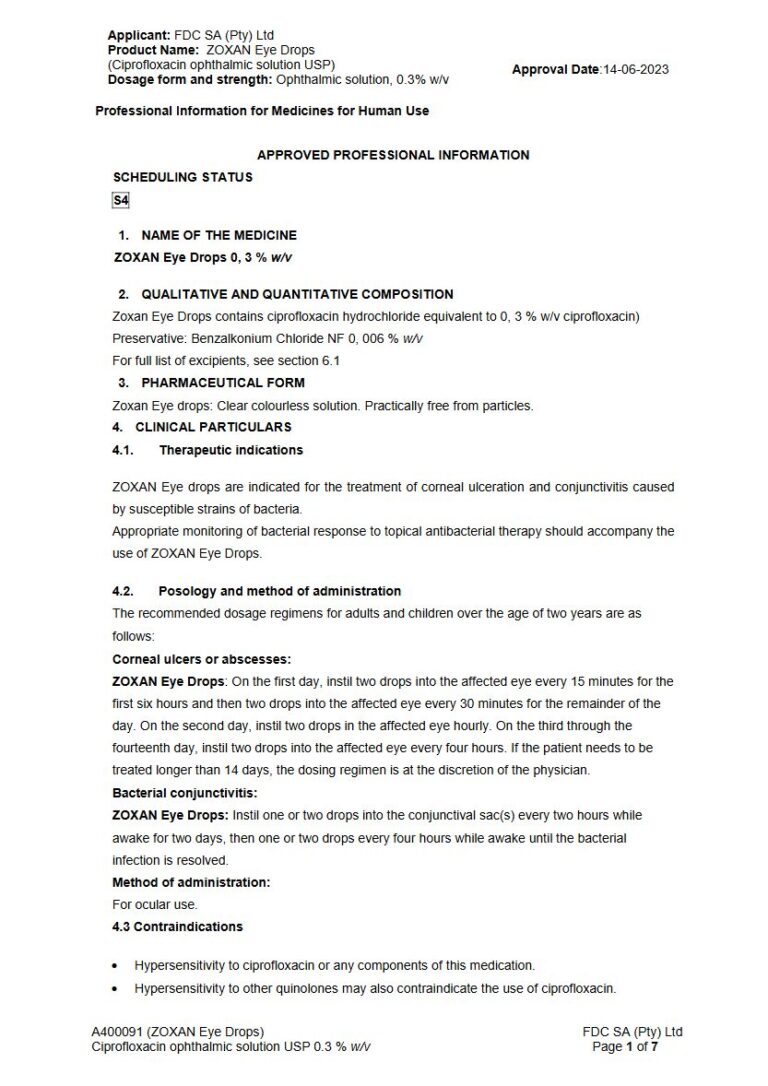
ZOXAN Eye drops are indicated for the treatment of corneal ulceration and conjunctivitis caused by susceptible strains of bacteria. Appropriate monitoring of bacterial response to topical antibacterial therapy should accompany the use of ZOXAN Eye Drops.
4.2. Posology and method of administration
The recommended dosage regimens for adults and children over the age of two years are as follows:
Corneal ulcers or abscesses: ZOXAN Eye Drops: On the first day, instil two drops into the affected eye every 15 minutes for the first six hours and then two drops into the affected eye every 30 minutes for the remainder of the day. On the second day, instil two drops in the affected eye hourly. On the third through the fourteenth day, instil two drops into the affected eye every four hours. If the patient needs to be treated longer than 14 days, the dosing regimen is at the discretion of the physician.
Bacterial conjunctivitis: ZOXAN Eye Drops: Instil one or two drops into the conjunctival sac(s) every two hours while awake for two days, then one or two drops every four hours while awake until the bacterial infection is resolved.
Method of administration: For ocular use.
4.3 Contraindications
- Hypersensitivity to ciprofloxacin or any components of this medication.
- Hypersensitivity to other quinolones may also contraindicate the use of ciprofloxacin.
4.4 Special warnings and precautions for use
- Zoxan Eye Drops should be discontinued at the first appearance of a skin rash or any other sign of a hypersensitivity reaction. Serious and occasionally fatal hypersensitivity (anaphylactic) reactions have been reported in patients receiving systemic quinolone therapy. Some reactions were accompanied by cardiovascular collapse, loss of consciousness, tingling, pharyngeal or facial oedema, dyspnoea, urticaria and itching. Only a few patients had a history of hypersensitivity reactions. Serious anaphylactic reactions require immediate emergency treatment with epinephrine and other resuscitation measures, including oxygen, intravenous fluids, intravenous antihistamines, corticosteroids, pressor amines and airway management, as clinically indicated.
- Prolonged use may result in overgrowth of nonsusceptible organisms, including fungi. If superinfection occurs, appropriate measures should be initiated. Whenever clinical judgement dictates, the patient should be examined with the aid of magnification, such as slit-lamp biomicroscopy and where appropriate, fluorescein staining.
- As the possibility of adverse effects on the corneal permeability and the danger of disruption of the corneal epithelium with prolonged or repeated usage of benzalkonium chloride preserved preparations cannot be excluded, regular ophthalmological examination is required. Caution should be exercised in the use of benzalkonium chloride preserved topical medication over an extended period in patients with extensive ocular surface disease.
- Tendon inflammation and rupture may occur with systemic fluoroquinolone therapy including ciprofloxacin, particularly in elderly patients and those treated concurrently with corticosteroids. Therefore, treatment with ZOXAN Eye drops should be discontinued at the first sign of tendon inflammation (see section 4.8).
- In patients with corneal ulcer and frequent administration of ZOXAN Eye drops, white topical ocular precipitates (medication residue) have been observed which resolved after continued application of ZOXAN Eye drops. The precipitate does not preclude the continued application of ZOXAN Eye drops nor does it adversely affect the clinical course of the recovery process. The onset of the precipitate was within 24 hours to 7 days after starting therapy. Resolution of the precipitate varied from immediately to 13 days after therapy commencing.
- Contact lens wear is not recommended during treatment of an ocular infection. Therefore, patients should be advised not to wear contact lenses during treatment with ZOXAN Eye drops.
- ZOXAN Eye drops contains benzalkonium chloride which may cause irritation and is known to discolour soft contact lenses. In case patients are allowed to wear contact lenses they should be instructed to remove them prior to application of ZOXAN Eye drops and wait at least 15 minutes before reinsertion.
4.5 Interaction with other medicines and other forms of interaction
The systemic administration of some quinolones has been shown to elevate plasma concentrations of theophylline, interfere with the metabolism of caffeine, enhance the effect of warfarin and its derivatives and transient increases in serum creatinine have been observed in patients receiving cyclosporin concomitantly.
4.6 Fertility, pregnancy, and lactation
Women of childbearing potential/ Contraception in males and females: No information available.
Pregnancy: Safety in pregnant women has not been established.
Breastfeeding: Safety in pregnant women and breastfeeding mothers has not been established.
Fertility: Studies have not been performed in humans to evaluate the effect of topical administration of ciprofloxacin on fertility.
4.7 Effects on ability to drive and use machines
ZOXAN Eye drops can cause blurred vision or other visual disturbances (see section 4.8 Undesirable effects) and may have no or negligible influence or effect on mental and/or physical abilities to perform or execute tasks or activities requiring mental alertness, judgment and/or sound coordination and vision.
4.8 Undesirable effects
In clinical trials with Ciprofloxacin Ophthalmic Solution, the following treatment-related signs and symptoms have been reported:
a. Summary of safety profile: The following adverse reactions have been reported during clinical trials with Ciprofloxacin Ophthalmic Solution, and are classified according to the subsequent convention: Frequent (u2265 1/10), (u2265 1/100 to <1/10) Less frequent (u2265 1/1,000 to <1/100), (u2265 1/10,000 to <1/1,000), (<1/10,000).
b. Tabulated list of adverse reactions:
Body System Undesirable effect Frequent Less frequent Immune system disorders hypersensitivity Nervous system disorders dizziness, headache Eye disorders white precipitate and, ocular discomfort Keratopathy, punctate keratitis, corneal infiltrates, photophobia, (stinging and burning may occur upon application), ocular hyperaemia visual acuity reduced, eyelid oedema, blurred vision, eye pain, eye swelling, pruritus (itching), increased tearing, eye discharge, eyelid margin crusting, crystals/scales, conjunctival oedema, erythema of eyelid, Ocular toxicity, keratitis, conjunctivitis, corneal epithelium defect, diplopia, hypoaesthesia eye, asthenopia, eye irritation, eye inflammation, hordeolum Ear and labyrinth disorders ear pain Respiratory, thoracic and mediastinal disorders paranasal sinus hypersecretion, rhinitis. Gastrointestinal disorders taste perversion (metallic taste) nausea, diarrhoea, abdominal pain Skin and subcutaneous tissue disorders dermatitis Additional adverse reactions identified from post-marketing surveillance include the following. Frequencies cannot be estimated from the available data. Body System Undesirable effect Musculoskeletal and connective tissue disorders tendon disorder.
Reporting of suspected adverse reactions: Reporting suspected adverse reactions after authorisation of the medicine is important. It allows continued monitoring of the benefit/risk balance of the medicine. Healthcare professionals are asked to report any suspected adverse reactions to SAHPRA via the u201c6.04 Adverse Drug Reactions Reporting Formu2019, Found under SAHPRAu2019s publications: https://www/sahpra.org.za/Publications/Index/8
4.9 Overdose
In overdose, side effects can be precipitated and/or be of increased severity (see section 4.8). A topical ocular overdose may be flushed from the eye(s) with lukewarm tap water. Treatment should be symptomatic and supportive.
