
Mavenclad 10 Mg Tablets
PDF Leaflet Revision Date: 10 November 2025
Clinical Summary
Quick overview from the medicine insert
Indication
Treatment of highly active relapsing multiple sclerosis in adults.
Dosage (summary)
Cumulative dose of 3.5 mg/kg over 2 years, with 1.75 mg/kg per year.
Special Populations
- Renal impairment
- Hepatic impairment
- Elderly
- Paediatric population
Pregnancy & Breastfeeding
Contraindicated in pregnancy and breastfeeding.
Key Drug Interactions
- Immunosuppressive medicines
- Live vaccines
- Interferon-beta
Contraindications
- Hypersensitivity to cladribine
- HIV infection
- Active chronic infections
- Immunocompromised patients
- Active malignancy
- Moderate or severe renal impairment
Common side effects
- Lymphopenia
- Herpes zoster
- Hypersensitivity
- Liver injury
- Rash
Counselling Points
- Monitor lymphocyte counts
- Use effective contraception
- Avoid live vaccines during treatment
Serious warnings
- Serious infections risk
- Malignancy risk
- Liver function monitoring required
Important Disclaimer
The Mavenclad 10 Mg Tablets professional information leaflet below is the property of Merck and is provided on Medinsert exactly as issued, with no.. alterations or editorial changes. We make every effort to keep content current by updating documents as soon as new versions become available. Medinsert serves as a trusted access point for healthcare professionals, but does not replace official sources or clinical judgement. For more details, please read our full disclaimer. read more>>
 Healthcare Professionals Only
This content is for registered healthcare professionals
Sign in or create a free account to read the full package insert.
Free for HPCSA-registered professionals. Powered by Medinsert.
Clinical Particulars
Section 4 of the official insert — extracted exactly as issued, no alterations
4.1 Therapeutic Indications
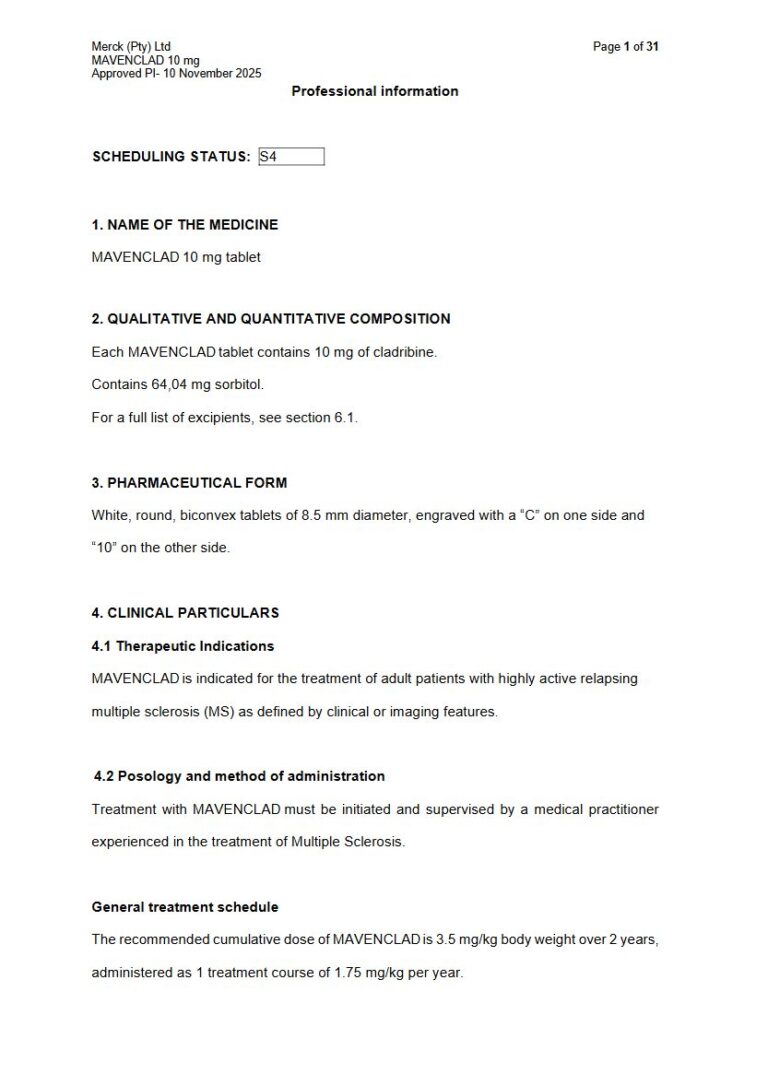
MAVENCLAD is indicated for the treatment of adult patients with highly active relapsing multiple sclerosis (MS) as defined by clinical or imaging features.
4.2 Posology and method of administration
Treatment with MAVENCLAD must be initiated and supervised by a medical practitioner experienced in the treatment of Multiple Sclerosis.
General treatment schedule
The recommended cumulative dose of MAVENCLAD is 3.5 mg/kg body weight over 2 years, administered as 1 treatment course of 1.75 mg/kg per year.
Each treatment course consists of 2 treatment weeks, one at the beginning of the first month and one at the beginning of the second month of the respective treatment year. Each treatment week consists of 4 or 5 days on which a patient receives 10 mg or 20 mg (one or two tablets) as a single daily dose, depending on body weight. For details, see Tables 1 and 2 below. Following completion of the 2 treatment courses, no further cladribine treatment is required in years 3 and 4. Re-initiation of therapy after year 4 has not been studied.
Criteria for initiating and continuing therapy
Lymphocyte counts must be normal before initiating MAVENCLAD in year 1, at least 800 cells/mm3 before initiating MAVENCLAD in year 2. If necessary, the treatment course in year 2 can be delayed for up to 6 months to allow for recovery of lymphocytes. If this recovery takes more than 6 months the patient should not receive MAVENCLAD anymore.
Distribution of dose
The distribution of the total dose over the 2 years of treatment is provided in Table 1. For some weight ranges the number of tablets may vary from one treatment week to the next. Use of oral cladribine in patients weighing less than 40 kg has not been investigated.
Table 1 Dose of MAVENCLAD per treatment week by patient weight in each treatment year
Weight range Dose in mg (number of 10 mg tablets) per treatment week
kg* Treatment week 1 Treatment week 2
- 40 to <50 40 mg (4 tablets) 40 mg (4 tablets)
- 50 to <60 50 mg (5 tablets) 50 mg (5 tablets)
- 60 to <70 60 mg (6 tablets) 60 mg (6 tablets)
- 70 to <80 70 mg (7 tablets) 70 mg (7 tablets)
- 80 to <90 80 mg (8 tablets) 70 mg (7 tablets)
- 90 to <100 90 mg (9 tablets) 80 mg (8 tablets)
- 100 to <110 100 mg (10 tablets) 90 mg (9 tablets)
- 110 and above 100 mg (10 tablets) 100 mg (10 tablets)
Table 2 shows how the total number of tablets per treatment week is distributed over the individual days. It is recommended that the daily cladribine doses in each treatment week be taken at intervals of 24 hours at approximately the same time each day. If a daily dose consists of two tablets, both tablets are taken together as a single dose.
Table 2 MAVENCLAD 10 mg tablets per week day
Total number of tablets per week Day 1 Day 2 Day 3 Day 4 Day5
- 4 1 1 1 1 0
- 5 1 1 1 1 1
- 6 2 1 1 1 1
- 7 2 2 1 1 1
- 8 2 2 2 1 1
- 9 2 2 2 2 1
- 10 2 2 2 2 2
A missed dose must be taken as soon as remembered on the same day according to the treatment schedule. A missed dose must not be taken together with the next scheduled dose on the following day. In the case of a missed dose, the patient must take the missed dose on the following day, and extend the number of days in that treatment week. If two consecutive doses are missed, the same rule applies, and the number of days in the treatment week is extended by two days.
Concomitant use of other oral medicinal products
It is recommended that administration of any other oral medicinal product be separated from that of MAVENCLAD by at least 3 hours during the limited number of days of cladribine administration (see section 4.5).
Special Populations
Renal impairment
No dedicated studies have been conducted in patients with renal impairment. In patients with mild renal impairment (creatinine clearance 60 to 89 mL/min), no dosage adjustment is considered necessary. Safety and efficacy in patients with moderate or severe renal impairment have not been established. Therefore, MAVENCLAD is contraindicated in these patients (see section 4.3).
Hepatic impairment
No studies have been conducted in patients with hepatic impairment. Although the importance of hepatic function for the elimination of cladribine is considered negligible, in the absence of data, use of MAVENCLAD is not recommended in patients with moderate or severe hepatic impairment (Child-Pugh score > 6) (see section 4.4).
Elderly
Clinical studies with oral cladribine did not include patients over 65 years of age; therefore, it is not known whether they respond differently from younger patients. Caution is recommended when MAVENCLAD is used in elderly patients, taking into account the potential greater frequency of decreased hepatic or renal function, concomitant diseases, and other medicinal therapies (see section 4.4).
Paediatric population
Safety and effectiveness of MAVENCLAD in paediatric MS patients have not been established. MAVENCLAD is not recommended in patients below the age of 18 years.
Method of Administration
MAVENCLAD is for oral use. The tablets are taken with water and swallowed without chewing. MAVENCLAD can be taken independent of food intake. As the tablets are uncoated, they must be swallowed immediately once removed from the blister and not be left exposed on surfaces or handled for any period of time greater than that required for dosing. If a tablet is left on a surface, or if a broken or fragmented tablet is released from the blister, the area must be thoroughly washed. The patientu2019s hands must be dry when handling the tablets and washed thoroughly afterwards.
4.3 Contraindications
- Hypersensitivity to cladribine or to any of the excipients of MAVENCLAD listed in section 6.1.
- Infection with human immunodeficiency virus (HIV) (see section 4.4).
- Active chronic infection (tuberculosis or hepatitis) (see section 4.4).
- Initiation of cladribine treatment in immunocompromised patients, including patients currently receiving immunosuppressive or myelosuppressive therapy (see section 4.5).
- Active malignancy.
- Moderate or severe renal impairment (creatinine clearance < 60 mL/min).
- Pregnancy and breastfeeding (see section 4.6).
4.4 Special warnings and precautions for use
MAVENCLAD should be prescribed by a medical practitioner experienced in the management of multiple sclerosis.
Haematological monitoring
MAVENCLADu2019s mode of action is closely linked to a reduction in lymphocyte count. The effect on lymphocyte count is dose dependent. Decreases in neutrophil count, red blood cell count, haematocrit, haemoglobin or platelet count compared to baseline values have also been observed in clinical studies, although these parameters usually remain within normal limits. Additive haematological adverse reactions may be expected if cladribine is administered prior to or concomitantly with other substances that affect the haematological profile. Lymphocyte counts must be determined:
- before initiating MAVENCLAD in year 1,
- before initiating MAVENCLAD in year 2,
- 2 and 6 months after start of treatment in each treatment year.
If the lymphocyte count is below 500 cells/mm3, it should be actively monitored until values increase again.
For treatment decisions based on the patientu2019s lymphocyte counts, (see section 4.2 and subsection u2018Infectionsu2019 below).
Infections
Cladribine can reduce the bodyu2019s immune defence and may increase the likelihood of infections. Serious, severe, and opportunistic infections u2013 including events with fatal outcome u2013 have been observed with MAVENCLAD treatment. HIV infection, active tuberculosis and active hepatitis must be excluded before initiation of cladribine (see section 4.3). Latent infections may be activated, including tuberculosis or hepatitis. Therefore, screening for latent infections, in particular tuberculosis and hepatitis B and C, must be performed prior to initiation of therapy in year 1 and year 2. Initiation of MAVENCLAD should be delayed until the infection has been adequately treated. A delay in initiation of cladribine should also be considered in patients with an acute infection until the infection is fully controlled. Particular attention is recommended for patients who have no history of exposure to varicella zoster virus. Vaccination of antibody-negative patients is recommended prior to initiation of cladribine therapy. Initiation of treatment with MAVENCLAD should be postponed for 4 to 6 weeks to allow for the full effect of vaccination to occur. The incidence of herpes zoster was increased in patients on cladribine. If lymphocyte counts drop below 200 cells/mm3, anti-herpes prophylaxis according to local standard practice should be considered during the time of grade 4 lymphopenia. Patients with lymphocyte counts below 500 cells/mm3 should be actively monitored for signs and symptoms suggestive of infections, in particular herpes zoster. If such signs and symptoms occur, anti-infective treatment should be initiated as clinically indicated. Interruption or delay of MAVENCLAD may be considered until proper resolution of the infection.
Cases of progressive multifocal leukoencephalopathy (PML) have been reported for parenteral cladribine in patients treated for hairy cell leukaemia with a different treatment regimen. In the clinical study data base of cladribine in MS (1,976 patients, 8,650 patient years) no case of PML has been reported. However, a baseline magnetic resonance imaging (MRI) should be performed before initiating MAVENCLAD (usually within 3 months).
Malignancies
In clinical studies, events of malignancies were observed more frequently in cladribine-treated patients compared to patients who received placebo. MAVENCLAD is contraindicated in MS patients with active malignancies. An individual benefit-risk evaluation should be performed before initiating MAVENCLAD in patients with prior malignancy. Patients treated with MAVENCLAD should be advised to follow standard cancer screening guidelines.
Liver function
Liver injury, including serious cases, has been reported uncommonly in patients treated with MAVENCLAD. Before initiating MAVENCLAD a comprehensive patient history regarding previous episodes of liver injury with other medicines or underlying disorders should be taken. Patients should have their serum aminotransferase, alkaline phosphatase and total bilirubin levels assessed prior to initiation of therapy in year 1 and year 2. During treatment, liver enzyme and bilirubin monitoring should be obtained based on clinical signs and symptoms. If a patient develops clinical signs, unexplained liver enzyme elevations or symptoms suggestive of hepatic dysfunction (e.g., unexplained nausea, vomiting, abdominal pain, fatigue, anorexia, or jaundice and/or dark urine), serum transaminases and total bilirubin should be measured promptly. Treatment with MAVENCLAD should be interrupted or discontinued, as appropriate.
Contraception
Before initiation of treatment both in year 1 and year 2, women with childbearing potential and males who could potentially father a child should be counselled regarding the potential for serious risk to the foetus and the need for effective contraception (see section 4.5 and 4.6). Women of childbearing potential must prevent pregnancy by use of effective contraception during cladribine treatment and for at least 6 months after the last dose. Male patients must take precautions to prevent pregnancy of their female partner during cladribine treatment and for at least 6 months after the last dose.
Blood transfusions
In patients who require blood transfusion, irradiation of cellular blood components is recommended prior to administration to prevent transfusion-related graft-versus host disease. Consultation with a haematologist is advised.
Switching to and from cladribine treatment
In patients who have previously been treated with immunomodulatory or immunosuppressive medicinal products, the mode of action and duration of effect of the other medicinal product should be considered prior to initiation of MAVENCLAD. A potential additive effect on the immune system should also be considered when such medicinal products are used after treatment with MAVENCLAD (see section 4.5).
When switching from another MS medicine, a baseline MRI should be performed (see subsection u2018Infectionsu2019 above).
Hepatic impairment
No studies have been conducted in patients with hepatic impairment. Although the importance of hepatic function for the elimination of cladribine is considered negligible, in the absence of data, use of MAVENCLAD is not recommended in patients with moderate or severe hepatic impairment (Child-Pugh score > 6). MAVENCLAD contains Sorbitol. Patients with hereditary fructose intolerance (HFI) should not take/be given MAVENCLAD.
4.5 Interaction with other medicinal products and other forms of interaction
MAVENCLAD contains hydroxypropylbetadex which may be available for complex formation with other medicinal products, potentially leading to an increase in bioavailability of such a product (especially medicinal products with low solubility). Therefore, it is recommended that administration of any other oral medicinal product be separated from that of MAVENCLAD by at least 3 hours during the limited number of days of cladribine administration.
Immunosuppressive medicines
Initiation of cladribine treatment is contraindicated in immunocompromised patients, including patients receiving immunosuppressive or myelosuppressive therapy with, e.g., methotrexate, cyclosphosphamide, cyclosporine or azathioprine, or chronic use of corticosteroids because of a risk of additive effects on the immune system (see section 4.3).
Acute short-term therapy with systemic corticosteroids can be administered during cladribine treatment.
Other disease-modifying medicinal products
The use of MAVENCLAD with interferon-beta results in an increased risk of lymphopenia. Safety and efficacy of MAVENCLAD in combination with other disease-modifying treatments for MS have not been assessed. Concomitant treatment is not recommended.
Haematotoxic medicines
Because of the cladribine-induced reduction in lymphocyte count, additive haematological adverse effects may be expected if MAVENCLAD is administered prior to or concomitantly with other medicines that affect the haematological profile (e.g. carbamazepine). Careful monitoring of haematological parameters is recommended in such cases.
Live or live attenuated vaccines
Treatment with MAVENCLAD should not be initiated within 4 to 6 weeks after vaccination with live or attenuated live vaccines because of a risk of active vaccine infection. Vaccination with live or attenuated live vaccines should be avoided during and after MAVENCLAD treatment as long as the patientu2019s white blood cell counts are not within normal limits.
Potent ENT1, CNT3 and BCRP transporter inhibitors
At the level of cladribine absorption, the only conceivable interaction pathway of clinical relevance appears to be the breast cancer resistance protein (BCRP). Inhibition of BCRP in the gastrointestinal tract may increase the oral bioavailability and systemic exposure of cladribine. Known BCRP inhibitors, which may alter the pharmacokinetics of BCRP substrates by 20 % in vivo, including eltrombopag.
In vitro studies indicate that cladribine is a substrate of the equilibrative nucleoside (ENT1) and concentrative nucleoside (CNT3) transport proteins. Accordingly, the bioavailability, intracellular distribution and renal elimination of cladribine may theoretically be altered by potent ENT1 and CNT3 transporter inhibitors such as dilazep, nifedipine, nimodipine, cilostazol, sulindac or reserpine. However, net effects in terms of potential cladribine exposure alterations are difficult to predict. Although the clinical relevance of such interactions is unknown, it is recommended that co-administration of potent ENT1, CNT3 or BCRP transporter inhibitors be avoided during the 4- to 5-day cladribine treatment. If this is not possible, selection of alternative concomitant medicinal products with no, or minimal ENT1, CNT3 or BCRP transporter inhibiting properties should be considered. If this is not possible, dose reduction to the minimum mandatory dose of medicinal products containing these compounds, separation in the timing of administration and careful patient monitoring is recommended.
Potent BCRP and P-gp transporter inducers
The effects of potent inducers of the efflux transporters BCRP and P-glycoprotein (P-gp) on the bioavailability and disposition of cladribine have not been formally studied. A possible decrease in cladribine exposure should be considered if potent BCRP (e.g. corticosteroids) or P-gp (e.g. rifampicin, St. Johnu2019s Wort) transporter inducers are co-administered.
Hormonal contraceptives
Co-administration of cladribine with oral hormonal contraceptives (ethinylestradiol and levonorgestrel) showed no clinically relevant pharmacokinetic interaction with cladribine. Therefore, concomitant use of cladribine is not expected to decrease the efficacy of hormonal contraceptives (see section 4.6).
4.6 Fertility, pregnancy and lactation
Contraception in males and females
Before initiation of treatment both in year 1 and year 2, women of childbearing potential and males who could potentially father a child should be counselled regarding the potential for serious risk to the foetus and the need for effective contraception. In women of childbearing potential, pregnancy must be excluded before the initiation of MAVENCLAD in year 1 and year 2 and prevented by use of effective contraception during cladribine treatment and for at least 6 months after the last dose. Women who become pregnant under therapy with MAVENCLAD should discontinue treatment. As cladribine interferes with DNA synthesis, adverse effects on human gametogenesis could be expected. Therefore, male patients must take precautions to prevent pregnancy of their partner during cladribine treatment and for at least 6 months after the last dose.
Pregnancy
Based on human experience with other substances inhibiting DNA synthesis, cladribine could cause congenital malformations when administered during pregnancy. Studies in animals have shown reproductive toxicity. MAVENCLAD is contraindicated in pregnant women (see section 4.3).
Lactation
It is not known whether cladribine is excreted in human milk. Because of the potential for serious adverse reactions in nursing infants, breastfeeding is contraindicated during treatment with MAVENCLAD and for 1 week after the last dose (see section 4.3).
Fertility
In mice, there were no effects on fertility or the reproductive function of offspring. However, testicular effects were observed in mice and monkeys.
4.7 Effects on ability to drive and use machinery
MAVENCLAD has no influence on the ability to drive and use machines.
4.8 Undesirable effects
Summary of safety profile
The most clinically relevant adverse reactions are lymphopenia (25.6%) and herpes zoster (3.0%). The incidence of herpes zoster was higher during the period of grade 3 or 4 lymphopenia (<500 to 200 cells/mm3 or <200 cells/mm3) compared to the time when the patients were not experiencing grade 3 or 4 lymphopenia (see section 4.4).
Tabulated list of adverse reactions:
Adverse reactions described in the list below are derived from pooled data from clinical studies in MS in which oral cladribine was used as monotherapy at a cumulative dose of 3.5 mg/kg. The safety database from these studies comprises 923 patients. Adverse reactions identified during post-marketing surveillance are indicated by an asterisk [*] The following definitions apply to the frequency terminology used hereafter:
Very common (u2265 1/10) Common (u22651/100 to <1/10) Uncommon (u22651/1,000 to <1/100) Rare (u22651/10,000 to < 1/1,000) Very rare (<1/10,000) Frequency not known (cannot be estimated from the available data)
Infections and infestations
- Common: Oral herpes, dermatomal herpes zoster
- Very rare: Tuberculosis (see section 4.4)
Blood and lymphatic system disorders
- Very common: Lymphopenia**
- Common: Decrease in neutrophil count***
** includes terms lymphopenia and lymphocyte count decreased
*** includes terms neutropenia and neutrophil count decreased
Immune system disorders
- Common: Hypersensitivity* including pruritis, urticaria, rash and rare cases of angio-oedema
Hepatobiliary disorders
- Uncommon: Liver injury*
Skin and subcutaneous tissue disorders
- Common: Rash, alopecia
Description of selected adverse reactions
Lymphopenia
In clinical studies, 20 % to 25 % of the patients treated with a cumulative dose of cladribine 3.5 mg/kg over 2 years as monotherapy developed transient grade 3 or 4 lymphopenia based on laboratory values. Grade 4 lymphopenia was seen in less than 1 % of the patients. The largest proportion of patients with grade 3 or 4 lymphopenia was seen 2 months after the first cladribine dose in each year (4.0 % and 11.3 % of patients with grade 3 lymphopenia in year 1 and year 2, 0 % and 0.4 % of patients with grade 4 lymphopenia in year 1 and year 2). It is expected that most patients recover to either normal lymphocyte counts or grade 1 lymphopenia within 9 months. To decrease the risk for severe lymphopenia, lymphocyte counts must be determined before, during and after cladribine treatment (see section 4.4) and strict criteria for initiating and continuing cladribine treatment must be followed (see section 4.2).
Malignancies
In clinical studies and long-term follow-up of patients treated with a cumulative dose of 3.5 mg/kg oral cladribine, events of malignancies were observed more frequently in cladribine-treated patients (10 events in 3,414 patient-years [0.29 events per 100 patient-years]) compared to patients who received placebo (3 events in 2,022 patient-years [0.15 events per 100 patient-years]).
Hypersensitivity
In clinical studies of patients treated with a cumulative dose of 3.5 mg/kg oral cladribine, hypersensitivity events were observed more frequently in cladribine-treated patients (11.8%) compared to patients who received placebo (8.4%). Serious hypersensitivity events were observed in 0.3% of cladribine-treated patients and in no patients who received placebo. Hypersensitivity events led to treatment discontinuation in 0.4% of cladribine-treated patients and in 0.3% patients who received placebo.
Liver injury
During post-marketing experience, uncommon events of liver injury, including serious cases and cases leading to discontinuation of treatment, were reported in temporal association with MAVENCLAD. Transient elevations of serum transaminases were usually greater than 5-fold the upper limit of normal (ULN). Isolated cases of transient serum transaminase elevations up to 40-fold the ULN and / or symptomatic hepatitis with transient elevation of bilirubin and jaundice have been observed. Time to onset varied, with most cases occurring within 8 weeks after the first treatment course (see section 4.4).
Reporting of suspected adverse reactions
Reporting suspected adverse reactions after authorization of the medicine is important. It allows continued monitoring of the benefit/risk balance of the medicine. Health care providers are requested to report any suspected adverse drug reaction to SAHPRA via the Med Safety APP (Medsafety X SAHPRA) & eReporting platform (who-umc.org) found on SAHRPA website.
4.9 Overdose
There is limited experience with overdose of oral cladribine. Lymphopenia is known to be dose dependent. Particularly close monitoring of haematological parameters is recommended in patients who have been exposed to an overdose of cladribine. There is no known specific antidote to an overdose of MAVENCLAD. Treatment consists of careful observation and initiation of appropriate supportive measures. Discontinuation of MAVENCLAD may need to be considered. Because of the rapid and extensive intracellular and tissue distribution, haemodialysis is unlikely to eliminate cladribine to a significant extent.
