
Xeraspor T Cream 1 g CREAM
PDF Leaflet Revision Date: 21 August 2023
Clinical Summary
Quick overview from the medicine insert
Indication
Treatment of dermatomycoses and skin infections.
Dosage (summary)
Apply thinly 2-3 times daily; treatment duration varies from 1-4 weeks.
Pregnancy & Breastfeeding
Use in pregnancy under supervision; risk in lactation not excluded.
Key Drug Interactions
- May reduce effectiveness of latex contraceptives.
Contraindications
- Hypersensitivity to clotrimazole or excipients.
Common side effects
- Allergic reactions, skin irritation, blisters, pruritus.
Counselling Points
- Continue treatment for 2 weeks after symptoms resolve; keep out of reach of children.
Serious warnings
- For external use only; avoid contact with eyes.
Important Disclaimer
The Xeraspor T Cream 1 g CREAM professional information leaflet below is the property of Fdc and is provided on Medinsert exactly as issued, with no.. alterations or editorial changes. We make every effort to keep content current by updating documents as soon as new versions become available. Medinsert serves as a trusted access point for healthcare professionals, but does not replace official sources or clinical judgement. For more details, please read our full disclaimer. read more>>
 Healthcare Professionals Only
This content is for registered healthcare professionals
Sign in or create a free account to read the full package insert.
Free for HPCSA-registered professionals. Powered by Medinsert.
Clinical Particulars
Section 4 of the official insert — extracted exactly as issued, no alterations
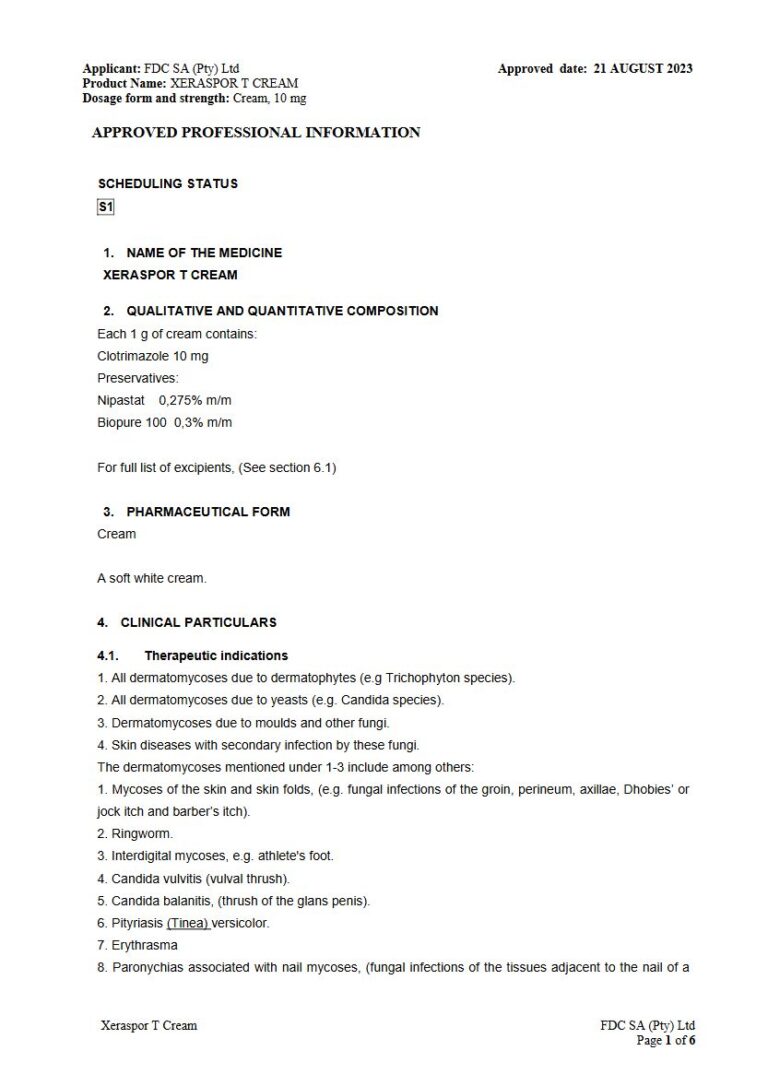
4.1. Therapeutic indications
1. All dermatomycoses due to dermatophytes (e.g Trichophyton species).
2. All dermatomycoses due to yeasts (e.g. Candida species).
3. Dermatomycoses due to moulds and other fungi.
4. Skin diseases with secondary infection by these fungi.
The dermatomycoses mentioned under 1-3 include among others:
- 1. Mycoses of the skin and skin folds, (e.g. fungal infections of the groin, perineum, axillae, Dhobiesu2019 or jock itch and barberu2019s itch).
- 2. Ringworm.
- 3. Interdigital mycoses, e.g. athlete's foot.
- 4. Candida vulvitis (vulval thrush).
- 5. Candida balanitis, (thrush of the glans penis).
- 6. Pityriasis (Tinea) versicolor.
- 7. Erythrasma
- 8. Paronychias associated with nail mycoses, (fungal infections of the tissues adjacent to the nail of a finger or toe).
4.2. Posology and method of administration
Apply thinly to the affected areas 2-3 times daily and rub in. A small amount of cream is sufficient for an area about the size of the palm. Successful treatment demands that XERASPOR T CREAM be applied correctly and over a sufficiently long period of time. The duration of treatment varies. In general, it is 3-4 weeks in the case of dermatomycoses due to dermatophytes and yeasts; in Candida vulvitis and Candida balanitis, 1 - 2 weeks; and approximately 2 - 4 weeks in Erythrasma and 1 - 3 weeks in Pityriasis versicolor. TREATMENT OF FUNGAL INFECTION SHOULD BE CONTINUED FOR APPROXIMATELY 2 WEEKS AFTER THE DISAPPEARANCE OF ALL SYMPTOMS DESPITE A RAPID, SUBJECTIVE IMPROVEMENT, IN ORDER TO PREVENT RELAPSE. Athlete's foot: Always dry the feet carefully, especially between the toes.
4.3 Contraindications
Hypersensitivity to clotrimazole or to any of the excipients listed in section 6.1.
4.4 Special warnings and precautions for use
For external use only.
- Direct contact with XERASPOR T CREAM may reduce the effectiveness and safety of latex products such as condoms and diaphragms. The effect is temporary and occurs only during treatment.
- Cetostearyl alcohol may cause local skin reactions (e.g. contact dermatitis)
- XERASPOR T CREAM is not indicated for ophthalmic use and should be used with caution around the eyes.
4.5 Interaction with other medicines and other forms of interaction
Laboratory tests have suggested that, when used together, this product may cause damage to latex contraceptives. Consequently the effectiveness of such contraceptives may be reduced. Patients should be advised to use alternative precautions for at least five days after using this product.
4.6 Fertility, pregnancy and lactation
Fertility
No human studies of the effects of clotrimazole on fertility have been performed; however, animal studies have not demonstrated any effects of the drug on fertility.
Pregnancy:
There is a limited amount of data from the use of clotrimazole in pregnant women. Animal studies with clotrimazole have shown reproductive toxicity at high oral doses (see section 5.3). At the low systemic exposures of clotrimazole following topical treatment, harmful effects with respect to reproductive toxicity are not predicted. Clotrimazole can be used during pregnancy, but only under the supervision of a physician or midwife.
Lactation:
Available pharmacodynamic/toxicological data in animals have shown excretion of clotrimazole/metabolites in milk after intravenous administration (see section 5.3). A risk to the suckling child cannot be excluded. A decision must be made whether to discontinue breast-feeding or to discontinue/abstain from clotrimazole therapy taking into account the benefit of breast-feeding for the child and the benefit of therapy for the woman.
4.7 Effects on ability to drive and use machines
XERASPOR T CREAM has no or negligible influence on the ability to drive or use machinery.
4.8 Undesirable effects
System Class Frequent Less Frequent Frequency Unknown
Immune system disorders Allergic reaction (syncope, hypotension, dyspnoea, urticaria)
Skin and subcutaneous tissue disorders Blisters, discomfort/pain, oedema, erythema, irritation, peeling/exfoliation, pruritus, rash, stinging/burning, allergic dermatitis Treatment should be discontinued.
Reporting of suspected adverse reactions
Reporting suspected adverse reactions after authorisation of the medicine is important. It allows continued monitoring of the benefit/risk balance of the medicine. Healthcare providers are asked to report any suspected adverse reactions to SAHPRA via the u201c6.04 Adverse Drug Reaction Reporting Formu201d, found online under SAHPRAu2019s publications: https://www.sahpra.org.za/Publications/Index/8
4.9 Overdose
In case of accidental ingestion, gastro-intestinal disturbances and central nervous system depression may occur. Treatment is symptomatic and supportive.
