
Xalkori 200 mg and 250 mg Capsules.
PDF Leaflet Revision Date: 15 January 2024
Clinical Summary
Quick overview from the medicine insert
Indication
Treatment of ALK-positive or ROS1-positive advanced NSCLC in adults.
Dosage (summary)
250 mg orally twice daily; dose adjustments for tolerability.
Special Populations
- Hepatic impairment
- Renal impairment
- Elderly
Pregnancy & Breastfeeding
Contraindicated in pregnancy and breastfeeding; use contraception during treatment.
Key Drug Interactions
- Avoid strong CYP3A inhibitors (e.g., ketoconazole, grapefruit juice)
- Avoid strong CYP3A inducers (e.g., rifampicin, St. John's wort)
Contraindications
- Hypersensitivity to crizotinib or excipients
Common side effects
- Vision disorder
- Nausea
- Diarrhoea
- Vomiting
- Fatigue
- Bradycardia
Counselling Points
- Monitor for liver function and cardiac symptoms.
- Avoid grapefruit and St. John's wort.
- Report any vision changes immediately.
Serious warnings
- Hepatotoxicity
- Interstitial lung disease
- QT interval prolongation
- Cardiac failure
Important Disclaimer
The Xalkori 200 mg and 250 mg Capsules. professional information leaflet below is the property of Pfizer Laboratories and is provided on Medinsert exactly as issued, with no.. alterations or editorial changes. We make every effort to keep content current by updating documents as soon as new versions become available. Medinsert serves as a trusted access point for healthcare professionals, but does not replace official sources or clinical judgement. For more details, please read our full disclaimer. read more>>
 Healthcare Professionals Only
This content is for registered healthcare professionals
Sign in or create a free account to read the full package insert.
Free for HPCSA-registered professionals. Powered by Medinsert.
Clinical Particulars
Section 4 of the official insert — extracted exactly as issued, no alterations
4.1 Therapeutic indications
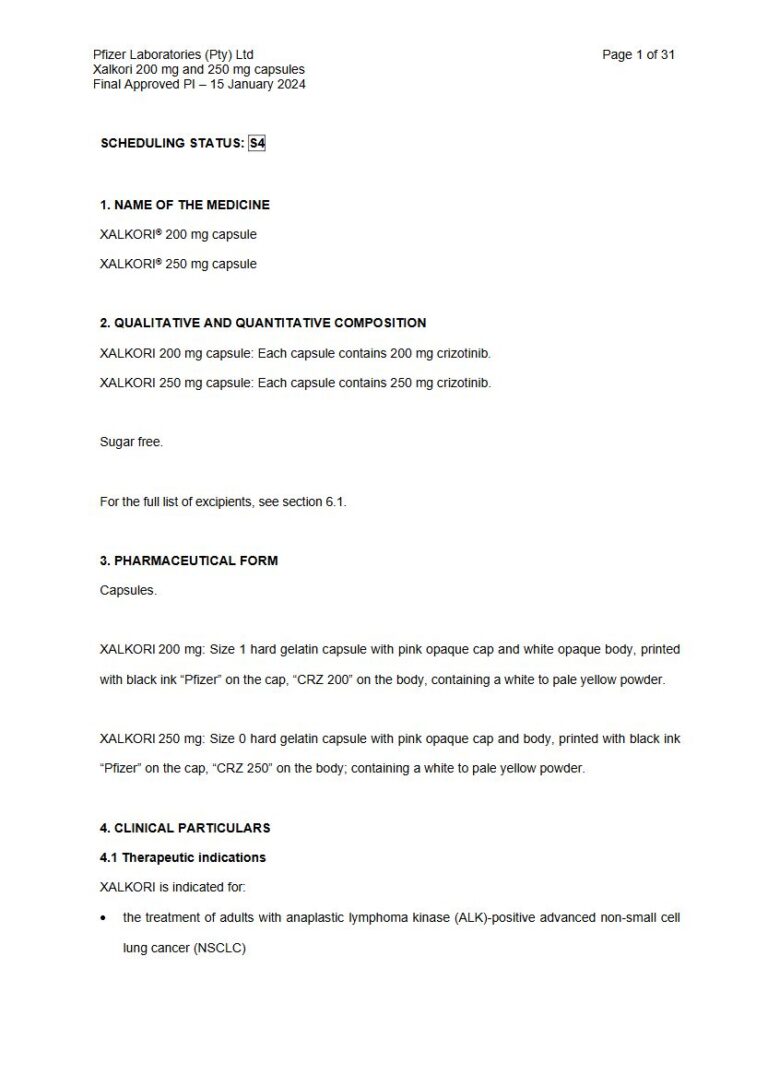
XALKORI is indicated for:
- the treatment of adults with anaplastic lymphoma kinase (ALK)-positive advanced non-small cell lung cancer (NSCLC)
- the treatment of adults with c-ros oncogene 1 (ROS1)-positive advanced non-small cell lung cancer (NSCLC)
4.2 Posology and method of administration
Posology
ALK and ROS1 testing
Detection of either ALK-positive or ROS1-positive NSCLC is necessary for selection of patients for treatment with XALKORI because these are the only patients for whom benefit has been shown. Assessment for either ALK-positive or ROS1-positive NSCLC should be performed by laboratories with demonstrated proficiency in the specific technology being utilised. Improper assay performance can lead to unreliable test results.
Recommended dosing
The recommended dose schedule of XALKORI is 250 mg taken orally twice daily. Treatment should be stopped when the patient ceases to derive clinical benefit. XALKORI may be taken with or without food (see section 5.2). Capsules should be swallowed whole. If a dose of XALKORI is missed, then it should be taken as soon as the patient remembers unless it is less than 6 hours until the next dose, in which case the patient should not take the missed dose. Patients should not take 2 doses at the same time to make up for a missed dose.
Dose modification
Dosing interruption and/or dose reduction may be required based on individual safety and tolerability. If dose reduction is necessary for patients treated with XALKORI 250 mg orally twice daily, then the dose of XALKORI should be reduced as below:
- First dose reduction: XALKORI 200 mg taken orally twice daily
- Second dose reduction: XALKORI 250 mg taken orally once daily
- Permanently discontinue if unable to tolerate XALKORI 250 mg taken orally once daily
...
Special populations
Hepatic impairment
XALKORI is extensively metabolised in the liver. Treatment with XALKORI should be used with caution in patients with hepatic impairment (see Table 2 above and sections 4.4, 4.8 and 5.2).
No starting dose adjustment of XALKORI is recommended for patients with mild hepatic impairment (either AST > Upper Limit of Normal (ULN) and total bilirubin u2264 ULN or any AST and total bilirubin > ULN but u2264 1,5 u00d7 ULN). The starting XALKORI dose for patients with moderate hepatic impairment (any AST and total bilirubin > 1,5 u00d7 ULN and u2264 3 u00d7 ULN) is recommended to be 200 mg twice daily. The starting XALKORI dose for patients with severe hepatic impairment (any AST and total bilirubin > 3 u00d7 ULN) is recommended to be 250 mg once daily.
Renal impairment
No starting dose adjustment is needed for patients with mild (60 u2264 creatinine clearance [Cl cr ] < 90 mL/min) or moderate (30 u2264 Cl cr < 60 mL/min) renal impairment since the population pharmacokinetic analysis indicated no clinically meaningful changes in steady-state XALKORI exposure in these patients. XALKORI plasma concentrations may be increased in patients with severe renal impairment (Cl cr < 30 mL/min). The starting XALKORI dose should be adjusted to 250 mg taken orally once daily in patients with severe renal impairment not requiring peritoneal dialysis or haemodialysis. The dose may be increased to 200 mg twice daily based on individual safety and tolerability after at least 4 weeks of treatment (see sections 4.4 and 5.2).
Elderly
No starting dose adjustment is required.
Paediatric population
The safety and efficacy of XALKORI in paediatric patients has not been established.
Method of administration
For oral use. The capsules should be swallowed whole preferably with water, and should not be crushed, dissolved, or opened. They may be taken with or without food. Grapefruit or grapefruit juice should be avoided since it may increase crizotinib plasma concentration; St. Johnu2019s wort should be avoided since it may decrease crizotinib plasma concentration (see section 4.5).
4.3 Contraindications
Use of XALKORI is contraindicated in patients with hypersensitivity to crizotinib or to any of the excipients of XALKORI listed in section 6.1.
4.4 Special warnings and precautions for use
Hepatotoxicity
Drug-induced hepatotoxicity with fatal outcome have been reported (see section 4.8). Concurrent elevations in ALT and/or AST u2265 3 u00d7 ULN and total bilirubin u2265 2 u00d7 ULN without significant elevations of alkaline phosphatase (u2264 2 u00d7 ULN) have been observed in less than 1 % of patients treated with XALKORI. Increases to Grade 3 or 4 ALT or AST elevations were observed in 187 (11 %) and 95 (6 %) of patients respectively. Seventeen (1 %) patients required permanent discontinuation from treatment associated with elevated transaminases, suggesting that these events were generally manageable by dosing modifications as defined in Table 2 (see section 4.2). Transaminase elevations generally occurred within the first 2 months of treatment. Liver function tests including ALT, AST and total bilirubin should be monitored every 2 weeks during the first 2 months of treatment, then once a month and as clinically indicated, with more frequent repeat testing for Grades 2, 3 or 4 elevations. For patients who develop transaminase elevations, see Dose modification section (see section 4.2).
Interstitial lung disease (ILD/pneumonitis)
XALKORI has been associated with severe, life-threatening or fatal ILD/pneumonitis in clinical trials at a frequency of 26 (2 %) of 1772 patients treated with XALKORI. These cases generally occurred within 3 months after the initiation of treatment. Patients should be monitored for pulmonary symptoms indicative of ILD/pneumonitis. Other potential causes of ILD/pneumonitis should be excluded. XALKORI should be permanently discontinued in patients diagnosed with treatment related ILD/pneumonitis (see section 4.2 and 4.8).
QT interval prolongation
QTc prolongation has been observed in clinical studies in patients treated with XALKORI (see sections 4.8 and 5.2) which may lead to an increased risk for ventricular tachyarrhythmias (e.g., Torsade de Pointes) or sudden death. XALKORI should be administered with caution to patients who have a history of or predisposition for QTc prolongation, or who are taking medications that are known to prolong the QT interval. When using XALKORI in these patients, periodic monitoring with electrocardiograms, electrolytes and renal function should be considered. For patients who develop QTc prolongation, see Dose modification section (see sections 4.2 and 4.8).
Bradycardia
Bradycardia has been reported in clinical studies in 13 % of patients, and it was usually asymptomatic. The full effect of XALKORI on pulse rate may not develop until several weeks after start of treatment. Avoid using XALKORI in combination with other bradycardic medicines (e.g. beta-blockers, non-dihydropyridine calcium channel blockers such as verapamil and diltiazem, clonidine, digoxin) to the extent possible, due to the increased risk of symptomatic bradycardia (syncope, dizziness, hypotension). Monthly monitoring of pulse rate and blood pressure is recommended. Dose modification is not required in cases of asymptomatic bradycardia. In cases of symptomatic bradycardia, XALKORI should be withheld and the use of concomitant medications should be re-evaluated. For management of patients who develop symptomatic bradycardia, see Dose modifications section (see section 4.2) and Description of selected adverse reactions, Bradycardia section (see section 4.8).
Cardiac failure
In clinical studies with XALKORI and during post marketing surveillance in adult patients, severe, life-threatening, or fatal adverse reactions of cardiac failure were reported (see section 4.8). Patients with or without pre-existing cardiac disorders, receiving XALKORI, should be monitored for signs and symptoms of heart failure (dyspnoea, oedema, rapid weight gain from fluid retention). Dosing interruption, dose reduction, or discontinuation should be considered as appropriate if such symptoms are observed.
Neutropenia and leukopenia
In clinical studies with XALKORI in adult patients with either ALK-positive or ROS1-positive NSCLC, Grade 3 or 4 neutropenia has been very commonly reported (12 %). Grade 3 or 4 leukopenia has been commonly reported (3 %) in patients with ALK-positive or ROS1-positive NSCLC. Less than 0,5 % of adult patients with either ALK-positive or ROS1-positive NSCLC experienced febrile neutropenia in clinical studies with XALKORI. Complete blood counts including differential white blood cell counts should be monitored as clinically indicated, with more frequent repeat testing if Grade 3 or 4 abnormalities are observed, or if fever or infection occurs (see section 4.2).
Gastrointestinal perforation
In clinical studies with XALKORI, events of gastrointestinal perforations were reported. There were reports of fatal cases of gastrointestinal perforation during post-marketing use of XALKORI (see section 4.8). XALKORI should be used with caution in patients at risk for gastrointestinal perforation (e.g., history of diverticulitis, metastases to the gastrointestinal tract, concomitant use of medicines with a recognised risk of gastrointestinal perforation). XALKORI should be discontinued in patients who develop gastrointestinal perforation. Patients should be informed of the first signs of gastrointestinal perforations and be advised to consult rapidly in case of occurrence.
Renal effects
Blood creatinine increase and creatinine clearance decreased were observed in patients in clinical studies with XALKORI. Renal failure and acute renal failure were reported in patients treated with XALKORI in clinical studies and during post marketing. Cases with fatal outcome, cases requiring haemodialysis and cases of Grade 4 hyperkalaemia were also observed in adult patients. Monitoring of patients for renal function at baseline and during therapy with XALKORI is recommended, with particular attention to those who have risk factors or previous history of renal impairment (see section 4.8).
Visual effects
In any patient with new onset of Grade 4 visual loss, XALKORI treatment should be discontinued and ophthalmological evaluation should be performed. Ophthalmological evaluation is recommended if vision disorder persists or worsens in severity (see section 4.2).
Photosensitivity
Photosensitivity has been reported in patients treated with XALKORI (see section 4.8). Patients should be advised to avoid prolonged sun exposure while taking XALKORI and, when outdoors, to take protective measures (e.g., use of protective clothing and/or sunscreen).
4.5 Interaction with other medicines and other forms of interaction
XALKORI is a substrate of CYP3A4/5 and also a moderate inhibitor of CYP3A. In vitro studies in human liver microsomes demonstrated that XALKORI is a time-dependent inhibitor of CYP3A.
Medicines that may increase XALKORI plasma concentrations
Co-administration of XALKORI with strong CYP3A inhibitors may increase XALKORI plasma concentrations. The concomitant use of strong CYP3A inhibitors, including but not limited to atazanavir, clarithromycin, indinavir, itraconazole, ketoconazole, nefazodone, nelfinavir, ritonavir, saquinavir, telithromycin, troleandomycin and voriconazole should be avoided. Grapefruit or grapefruit juice may also increase plasma concentrations of XALKORI and should be avoided.
Medicines that may decrease XALKORI plasma concentration
Co-administration of XALKORI with strong CYP3A inducers may decrease XALKORI plasma concentrations. The concurrent use of strong CYP3A inducers, including but not limited to carbamazepine, phenobarbital, phenytoin, rifabutin, rifampicin and St. Johnu2019s wort should be avoided.
Medicines whose plasma concentrations may be altered by XALKORI
XALKORI has been identified as an inhibitor of CYP3A both in vitro and in vivo. Caution should be exercised in administering XALKORI in combination with medicines that are predominantly metabolised by CYP3A, particularly those CYP3A substrates that have narrow therapeutic indices, including but not limited to alfentanil, ciclosporin, fentanyl, quinidine, sirolimus and tacrolimus. Co-administration of XALKORI should be avoided with CYP3A substrates that have narrow therapeutic indices and are associated with life-threatening arrhythmias, including but not limited to dihydroergotamine, ergotamine and pimozide.
4.6 Fertility, pregnancy and lactation
XALKORI is contraindicated in pregnancy and lactation. Women of childbearing potential/Contraception in males and females. There are no adequate and well-controlled studies in pregnant women using XALKORI. Women of childbearing potential should be advised to avoid becoming pregnant while receiving XALKORI. Women of childbearing potential who are receiving XALKORI, or partners of women of childbearing potential receiving XALKORI, should use adequate contraceptive methods during therapy and for at least 90 days after completing therapy.
Pregnancy
XALKORI may cause foetal harm when administered to a pregnant woman. Female patients taking XALKORI during pregnancy or who become pregnant while taking XALKORI should be apprised of the potential hazard to a foetus. Male patients taking XALKORI should also be apprised of the potential hazard to a foetus if their partner is or should become pregnant.
Breastfeeding
It is not known whether XALKORI and its metabolites are excreted in human milk. Women using XALKORI should not breastfeed their infants.
Fertility
Based on non-clinical safety findings, male and female fertility may be compromised by treatment with XALKORI.
4.7 Effects on ability to drive and use machines
No studies on the effect of XALKORI on the ability to drive and use machines have been performed. However, caution should be exercised when driving or operating machinery because XALKORI causes vision disturbances, dizziness and fatigue (see section 4.8).
4.8 Undesirable effects
Summary of the safety profile
The data described below reflect exposure to XALKORI in 1669 patients with ALK-positive advanced NSCLC who participated in randomised Phase 3 Studies 1007 or 1014 or in single-arm Studies 1001 or 1005 and in 53 patients with ROS1-positive advanced NSCLC who participated in single-arm Study 1001, for a total of 1722 patients. These patients received a starting oral dose of 250 mg twice daily continuously. In Study 1014, the median duration of study treatment was 47 weeks for patients in the XALKORI arm (n=171); the median duration of treatment was 23 weeks for patients who crossed over from the chemotherapy arm to receive XALKORI treatment (n=109). In Study 1007, the median duration of study treatment was 48 weeks for patients in the XALKORI arm (n=172). In ALK-positive NSCLC patients in study 1001 (n=154), the median duration of treatment was 57 weeks. In Study 1005 (n=1063), the median duration of treatment was 45 weeks. For ROS1-positive NSCLC patients in Study 1001 (n=53), the median duration of treatment was 101 weeks.
The most serious adverse reactions in 1722 patients with either ALK-positive or ROS1-positive advanced NSCLC were hepatotoxicity, ILD/pneumonitis and QT interval prolongation (see section 4.4). The most common adverse reactions (u2265 25 %) in patients with either ALK-positive or ROS1-positive NSCLC were vision disorder, nausea, diarrhoea, vomiting, oedema, constipation, elevated transaminases, decreased appetite, fatigue, dizziness and neuropathy. In 1722 patients with either ALK-positive or ROS1-positive NSCLC treated with XALKORI, all-causality adverse events associated with dosing interruptions or dose reductions occurred in 763 (44 %) and 259 (15 %) patients respectively. All-causality adverse events associated with permanent treatment discontinuation occurred in 302 (18 %) patients.
The adverse drug reactions listed in the Table 3 below are presented by System Organ Class (SOC) and frequency categories, defined using the following convention: very common (u2265 1/10); common (u2265 1/100 to < 1/10), uncommon (u2265 1/1 000 to < 1/100) or rare (u2265 1/10 000 to < 1/1 000). Within each frequency grouping, undesirable effects are presented in order of decreasing seriousness.
...
4.9 Overdose
Treatment of overdose with XALKORI should consist of general supportive measures. There is no antidote for XALKORI.
